
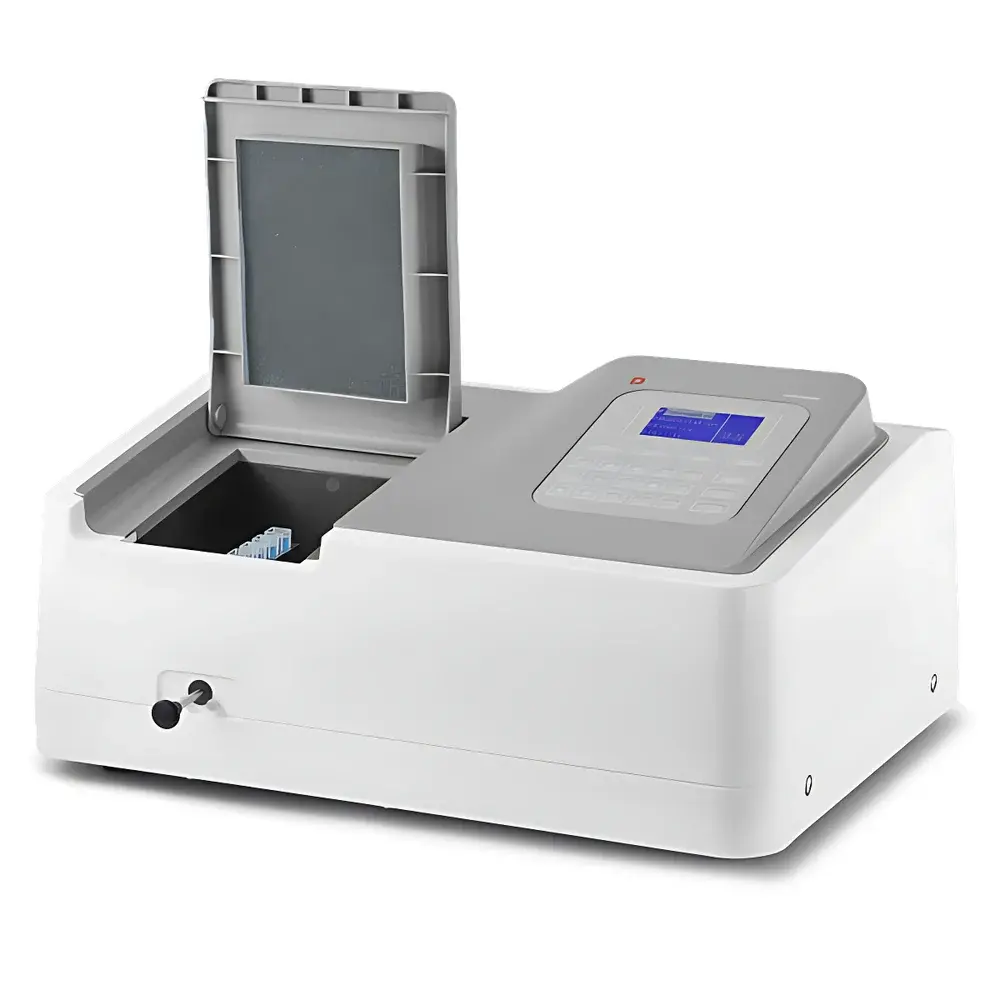
DLAB SP-UV1100 Ultraviolet-Visible Spectrophotometer
| Brand | DLAB |
|---|---|
| Origin | Beijing, China |
| Manufacturer Type | Original Equipment Manufacturer (OEM) |
| Instrument Architecture | Single-Beam |
| Wavelength Range | 190–1100 nm |
| Spectral Bandwidth | 2.0 nm |
| Wavelength Accuracy | ±0.5 nm |
| Wavelength Repeatability | ≤0.3 nm |
| Stray Light | ≤0.05% T at 220 nm and 360 nm |
Overview
The DLAB SP-UV1100 Ultraviolet-Visible Spectrophotometer is a precision single-beam optical instrument engineered for quantitative and qualitative analysis across the full UV-Vis spectral region (190–1100 nm). It operates on the fundamental principle of Beer–Lambert law-based absorbance measurement, where sample-induced attenuation of monochromatic light is quantified to determine analyte concentration or characterize electronic transitions in molecular species. Designed with a dual-source configuration—deuterium lamp for deep-UV (190–350 nm) and tungsten-halogen lamp for visible/NIR (350–1100 nm)—the system ensures seamless spectral continuity without manual lamp switching artifacts. Its 2.0 nm fixed spectral bandwidth provides optimal resolution for routine applications while maintaining high photometric stability and signal-to-noise ratio. The instrument meets essential performance benchmarks required for method validation under ISO/IEC 17025-accredited laboratories and aligns with key regulatory expectations for analytical instrumentation used in pharmaceutical development (e.g., ICH Q2(R2)), food safety screening (AOAC Official Methods), and environmental monitoring (EPA Method 410.1, 415.1).
Key Features
- Single-beam optical architecture with optimized optical path design for minimal stray light and high photometric linearity (±0.002 A over 0–3.0 A range)
- Dual-lamp illumination system enabling continuous spectral coverage from 190 nm to 1100 nm without mechanical interruption
- Automated wavelength calibration using built-in holmium oxide and didymium reference filters, traceable to NIST standards
- Real-time dark current correction during each measurement cycle, eliminating thermal drift effects on baseline stability
- High-stability Czerny–Turner monochromator with holographic grating and precision stepper-motor-driven wavelength drive
- Integrated quartz cuvette holder with 10 mm standard pathlength compatibility; optional holders for microvolume, flow cell, or temperature-controlled configurations
Sample Compatibility & Compliance
The SP-UV1100 accommodates a broad range of sample formats including liquid solutions in standard 10 mm quartz or UV-grade plastic cuvettes, suspended particulates (with appropriate filtration), and thin-film coatings on transparent substrates. It supports compliance with international testing protocols such as USP , EP 2.2.25, and ASTM E275 for spectrophotometer performance verification. All firmware and control logic are designed to support audit-ready operation: timestamped measurement logs, user-access-level permissions, and immutable data storage paths satisfy GLP and GMP documentation requirements. While not inherently 21 CFR Part 11 compliant out-of-the-box, the instrument’s software architecture permits integration with validated third-party LIMS or ELN platforms that enforce electronic signature, change control, and audit trail functionality.
Software & Data Management
The SP-UV1100 is operated via DLAB’s proprietary UVWinPro software, a Windows-based application supporting both local and networked deployment. It delivers real-time spectral acquisition, kinetic time-course monitoring, multi-wavelength quantitative analysis (up to 10 wavelengths simultaneously), and derivative spectroscopy. Data export options include CSV, TXT, and XML formats compatible with MATLAB, OriginLab, and JMP for advanced statistical modeling. All raw spectra and processed results are stored with embedded metadata—including instrument ID, operator name, date/time stamp, calibration status, and environmental conditions (if external sensor input is enabled). Software updates follow a documented release cycle with version-controlled firmware binaries and formal impact assessments per ISO 13485 Annex C guidelines.
Applications
- Pharmaceutical QC/QA: Active pharmaceutical ingredient (API) assay, excipient identification, dissolution profile monitoring, and cleaning validation swab analysis
- Food & Beverage: Nitrate/nitrite quantification in meat products, anthocyanin profiling in juices, caffeine determination in soft drinks
- Environmental Testing: COD and BOD surrogate measurements, heavy metal complexation studies (e.g., Cr(VI) with diphenylcarbazide), chlorophyll-a estimation in water samples
- Academic Research: Ligand-binding kinetics, enzyme-catalyzed reaction monitoring, nanoparticle surface plasmon resonance characterization
- Materials Science: Optical bandgap determination of semiconducting thin films, transmittance/absorbance mapping of polymer composites
FAQ
What is the recommended calibration frequency for routine use?
For daily operation in regulated environments, wavelength calibration is advised before first use each day; photometric calibration using neutral density filters should be performed weekly or after any lamp replacement.
Can the SP-UV1100 perform scanning measurements below 190 nm?
No—the lower limit is defined by the deuterium lamp output cutoff and quartz optics transmission envelope; measurements below 190 nm require vacuum UV instrumentation with MgF₂ optics and purged optical path.
Is there an option for temperature-controlled sample handling?
Yes—DLAB offers an optional Peltier-based thermostatted cuvette holder (SP-TCU-10) with ±0.1 °C stability across 5–60 °C, compatible with kinetic and thermodynamic studies.
Does the software support automated method transfer between instruments?
UVWinPro enables export of complete method files (.uvp), including scan parameters, calculation formulas, and report templates—ensuring reproducible setup across identical SP-UV1100 units within a lab network.
How is stray light performance verified during installation qualification (IQ)?
Stray light is validated using sodium nitrite solution (10 g/L in water) at 340 nm and potassium chloride solution (12 g/L) at 220 nm, following ASTM E387 and ISO 9001 Annex A.3 procedures.





