
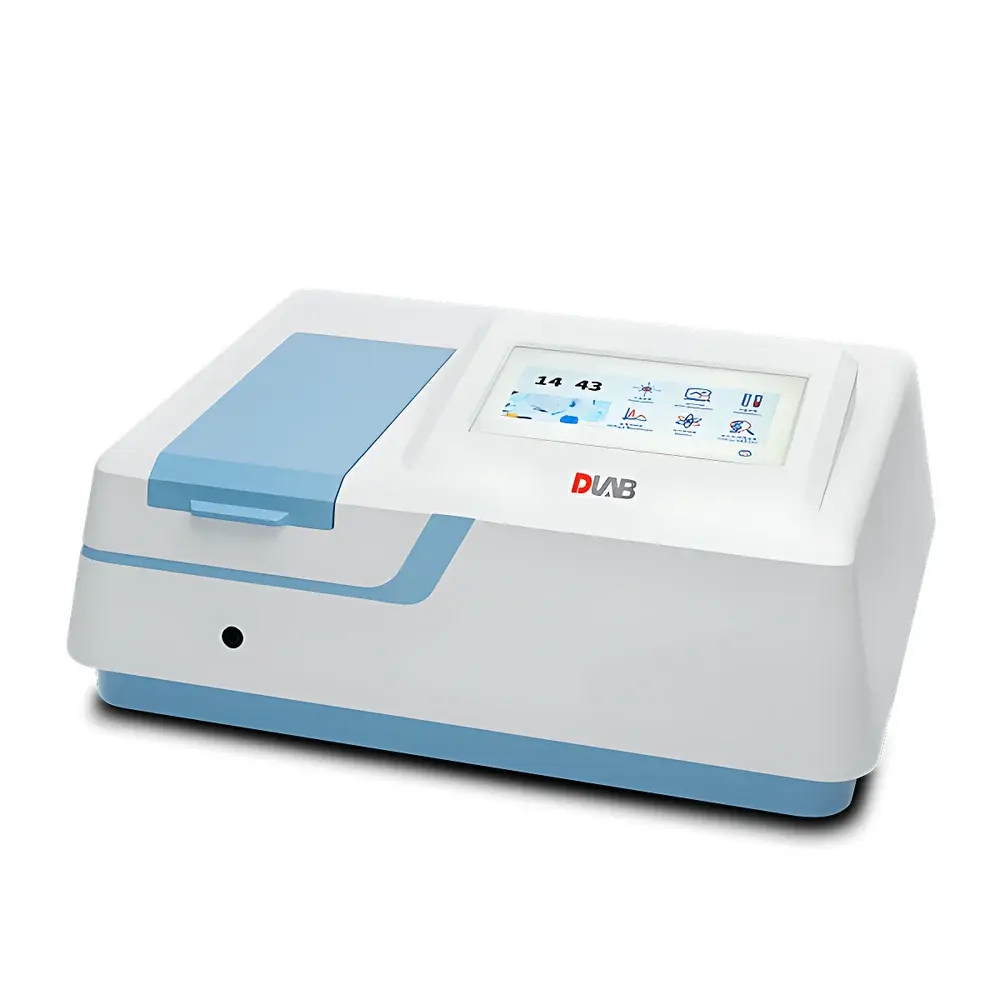
DLAB SP-XUV5101 Dual-Beam Ultraviolet-Visible Spectrophotometer
| Brand | DLAB |
|---|---|
| Origin | Beijing, China |
| Manufacturer Type | Direct Manufacturer |
| Instrument Type | Domestic |
| Model | SP-XUV5101 |
| Optical System | Dual-Beam |
| Wavelength Range | 190–1100 nm |
| Spectral Bandwidth | 1.0 nm |
| Wavelength Accuracy | ±0.1 nm @ 656.1 nm, ±0.3 nm across full range |
| Wavelength Repeatability | ≤0.1 nm |
| Stray Light | ≤0.02% T @ 220 nm and 360 nm |
| Photometric Range | –0.3 to 3 A, 0–9999 C (0–9999 F) |
| Photometric Accuracy | ±0.0015 A (0–0.5 A), ±0.002 A (0.5–1 A) |
| Photometric Repeatability | ±0.001 A (0–0.5 A), ±0.0015 A (0.5–1 A) |
| Baseline Stability | ≤0.001 A/h @ 500 nm |
| Detector | Digital Photodiode Array |
| Light Source | Hamamatsu Xenon Lamp (Long-Life) |
| Display | 10.1-inch Color Touchscreen (1024 × 600) |
| Dimensions (L × W × H) | 570 × 440 × 210 mm |
| Weight | 20 kg |
| Interface | USB port, Printer port |
| Power Supply | 110/220 V, 50/60 Hz, 120 W |
Overview
The DLAB SP-XUV5101 is a high-performance dual-beam ultraviolet-visible (UV-Vis) spectrophotometer engineered for precision absorbance, transmittance, and concentration measurements across the 190–1100 nm spectral range. Its optical architecture employs a holographic grating monochromator and a digitally calibrated photodiode array detector, ensuring low stray light (≤0.02% T at 220 nm and 360 nm), minimal photometric noise, and exceptional baseline stability (≤0.001 A/h at 500 nm). The instrument utilizes a long-life Hamamatsu xenon lamp—eliminating frequent lamp replacement—and features an optimized wavelength drive mechanism that delivers ±0.1 nm accuracy at the hydrogen alpha line (656.1 nm) and ±0.3 nm across the full range, with repeatability better than 0.1 nm. Designed for routine QC, academic research, and regulated laboratory environments, the SP-XUV5101 supports compliant workflows through built-in GLP/GMP-aligned software functionality and hardware-level traceability.
Key Features
- Dual-beam optical design with real-time reference beam compensation for enhanced photometric stability and reduced drift during extended scans or kinetic assays.
- 10.1-inch high-resolution color touchscreen (1024 × 600) with intuitive graphical user interface—enabling standalone operation for photometric, quantitative, spectral scanning, kinetics, DNA/protein analysis, and multi-wavelength measurements.
- Holographic grating monochromator with 1.0 nm spectral bandwidth ensures high resolution and reproducible peak shape fidelity in complex sample matrices.
- Integrated Hamamatsu xenon lamp provides broad-spectrum output from deep UV to near-IR, with stable intensity and >2,000-hour operational lifetime under typical usage conditions.
- Robust mechanical design includes vibration-damped optical bench, temperature-compensated wavelength encoder, and sealed optical path to minimize environmental influence on calibration integrity.
- Expandable platform supporting optional accessories: automatic 8-cell cuvette changer, thermostatted cell holder (±0.1 °C control), integrating sphere (for diffuse reflectance/transmittance), film holder, micro-volume adapters, and fiber-optic probes.
Sample Compatibility & Compliance
The SP-XUV5101 accommodates standard 10 mm pathlength quartz or glass cuvettes, as well as specialized sample formats including micro-volume cells (down to 50 µL), solid films, powders (with reflection accessories), and liquid-filled capillaries. Its optical path is compatible with ASTM E275, ISO 6226, and USP guidelines for spectrophotometric system suitability testing. The instrument meets IEC 61010-1 safety requirements and conforms to electromagnetic compatibility standards per EN 61326-1. When operated with the optional PC control software, audit-trail-enabled user management, electronic signature support, and time-stamped data logging satisfy FDA 21 CFR Part 11 and EU Annex 11 expectations for regulated laboratories.
Software & Data Management
The embedded firmware and optional PC-based DLAB SpectraSuite software provide full instrument control, method development, and data processing capabilities. SpectraSuite implements role-based access control (administrator, analyst, viewer), automated calibration verification logs, and encrypted database storage with immutable timestamped records for all measurements, parameter changes, and maintenance events. All spectra, quantitative results, kinetic traces, and reports are stored in vendor-neutral formats (CSV, XML, PDF) and can be exported via USB without proprietary codec dependencies. The software includes pre-configured methods for nucleic acid (A260/A280 ratio), protein (Bradford, Lowry, BCA), enzyme kinetics (Michaelis-Menten fitting), and colorimetric assays (e.g., nitrate, phosphate, heavy metals), each with configurable acceptance criteria and pass/fail logic.
Applications
- Pharmaceutical QC: Active pharmaceutical ingredient (API) assay, dissolution testing, excipient compatibility studies, and cleaning validation swab extract analysis.
- Environmental monitoring: Quantification of nitrate, nitrite, phosphate, cyanide, and heavy metal complexes in water and wastewater samples per EPA Methods 353.2, 365.1, and 365.4.
- Life sciences: Nucleic acid purity assessment (A260/A280, A260/A230), protein quantification, enzyme activity kinetics, and ligand-binding studies.
- Materials science: Thin-film thickness determination via interference fringe analysis, bandgap estimation of semiconductors, and optical density profiling of coatings.
- Food & beverage: Color index measurement (e.g., AOAC 993.02), antioxidant capacity (FRAP, DPPH), and adulterant screening in oils and dairy products.
FAQ
Does the SP-XUV5101 support regulatory compliance for GMP/GLP laboratories?
Yes—the instrument’s firmware and SpectraSuite software include electronic signatures, user-level permissions, full audit trails, and data immutability features aligned with FDA 21 CFR Part 11 and EU Annex 11 requirements.
What is the expected lifetime of the Hamamatsu xenon lamp?
The lamp is rated for ≥2,000 hours of continuous operation under standard scan protocols; its intensity stability is monitored automatically during warm-up and recalibrated if deviation exceeds preset thresholds.
Can the SP-XUV5101 perform kinetic measurements over extended timeframes?
Yes—it supports time-resolved acquisition up to 24 hours with programmable interval sampling, baseline correction, and export of raw time-series datasets in CSV format for external statistical analysis.
Is third-party software integration possible?
The instrument exposes a documented ASCII command protocol over USB CDC virtual COM port, enabling integration with LIMS, ELN, or custom automation frameworks via Python, LabVIEW, or .NET drivers.
How is wavelength calibration verified and maintained?
Calibration is performed using certified holmium oxide and didymium filters traceable to NIST SRM 2034 and SRM 2035; the system stores calibration history and prompts revalidation based on user-defined frequency or event triggers (e.g., lamp replacement).




