
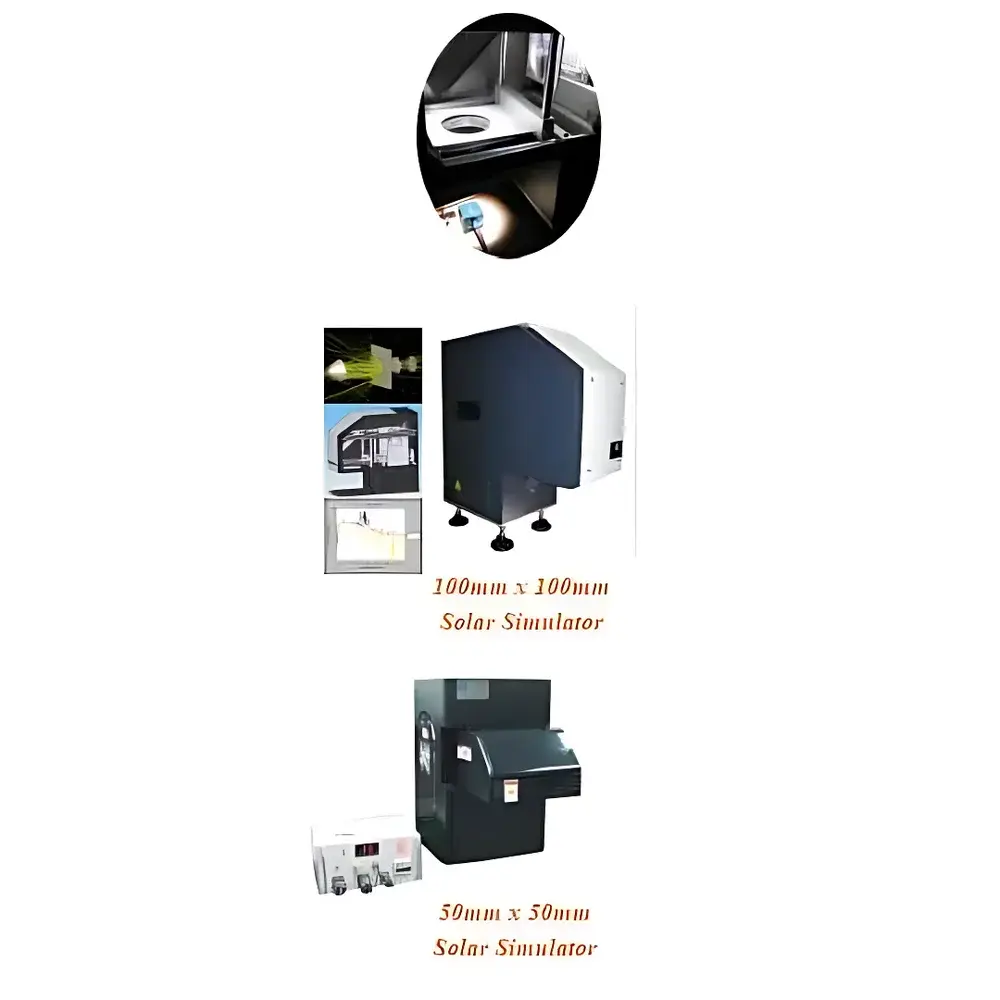
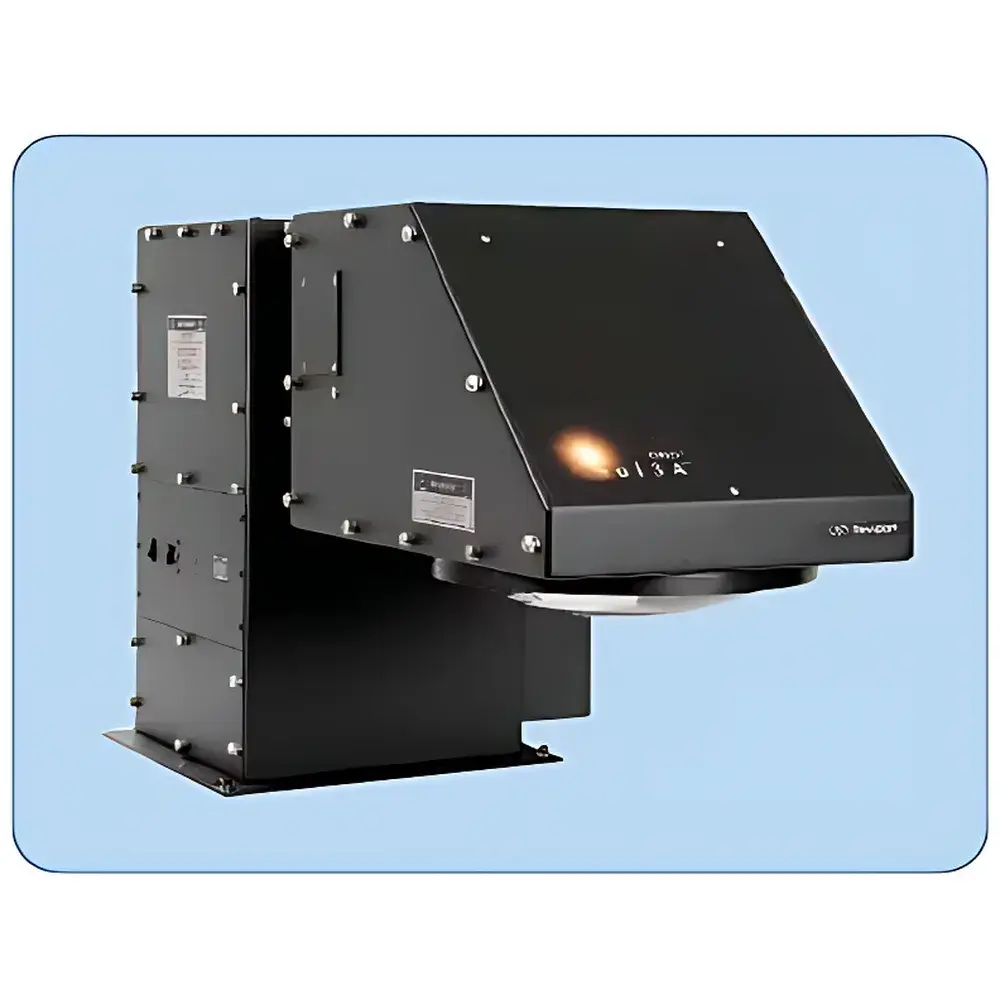
DM Series Xenon Short-Arc Solar Simulator
| Origin | Taiwan |
|---|---|
| Manufacturer Type | Distributor |
| Origin Category | Domestic (China) |
| Model | DM |
| Price | USD 12,000 (FOB) |
| Spectral Range | 400–1000 nm (standard), 400–1650 nm (optional) |
| Lamp Type | Xenon short-arc |
| Lamp Power | 1000 W |
| Rated Lamp Lifetime | 1000 h |
| Air Mass | AM 1.5G |
| Effective Irradiated Area Options | 50 × 50 mm, 100 × 100 mm, 150 × 150 mm, 200 × 200 mm |
| Nominal Irradiance | 1000 W/m² |
| Spectral Match Class | Class A (0.75–1.25), Class B (0.6–1.4) |
| Temporal Instability | ±2% / hr (Class A), ±5% / hr (Class B) |
| Irradiance Non-uniformity | ±2% (Class A), ±5% (Class B) |
| Input Power | AC 220 V |
| Operating Voltage/Current | 22 V / 45 A |
| Cooling Method | Forced-air |
| Weight | ~35 kg |
| Dimensions (H×W×D) | 620 × 380 × 610 mm (for 50 × 50 mm configuration) |
Overview
The DM Series Xenon Short-Arc Solar Simulator is a precision optical instrument engineered for laboratory-grade photovoltaic (PV) device characterization and materials testing under controlled, repeatable solar irradiation conditions. It operates on the principle of broadband spectral replication using a stabilized 1000 W xenon short-arc lamp, whose emission profile—when filtered and collimated—is calibrated to emulate the global reference solar spectrum defined by AM 1.5G (ASTM G173-03). This enables quantitative evaluation of solar cell efficiency (η), quantum efficiency (QE), maximum power point tracking (MPPT), and degradation kinetics under standardized illumination. Unlike broad-spectrum LED-based systems, the xenon arc source delivers continuous spectral output from 400 nm to 1000 nm (extendable to 1650 nm with optional IR-transmissive optics), ensuring fidelity in simulating both silicon and emerging multi-junction or perovskite absorber responses. The system is not a generic light source but a metrologically traceable irradiance platform, validated against ASTM E927, IEC 60904-9, and JIS C 8912:1989 for spectral match, temporal stability, and spatial uniformity—criteria essential for ISO/IEC 17025-accredited PV testing laboratories.
Key Features
- High-fidelity AM 1.5G spectral match compliant with Class A (0.75–1.25) and Class B (0.6–1.4) tolerances per IEC 60904-9, verified via NIST-traceable spectroradiometric calibration.
- Stable 1000 W xenon short-arc lamp with engineered thermal management and ignition control, delivering ≤ ±2% temporal irradiance drift over one hour under constant-power operation.
- Four standard irradiation field sizes (50 × 50 mm to 200 × 200 mm), each optimized for collimation and uniformity—±2% non-uniformity across the full active area at Class A level.
- Integrated forced-air cooling system maintaining lamp envelope temperature within operational limits, extending mean time between lamp replacements to 1000 hours under recommended duty cycles.
- Modular optical train including ellipsoidal reflector, precision bandpass filters, and homogenizing optics—designed to minimize angular dependence and stray light contribution.
- Robust mechanical architecture with vibration-damped baseplate and CNC-machined aluminum housing (620 × 380 × 610 mm for smallest configuration), facilitating integration into optical tables and glovebox environments.
Sample Compatibility & Compliance
The DM Solar Simulator supports a wide range of photovoltaic and photoelectrochemical samples, including single-junction Si, GaAs, and CIGS cells; tandem and perovskite–silicon devices; organic photovoltaics (OPVs); and photocatalytic thin films. Its 50–200 mm square irradiation zones accommodate standard test coupons (e.g., 2 × 2 cm², 5 × 5 cm²) as well as mini-modules up to 10 × 10 cm². All configurations meet the spatial uniformity, temporal stability, and spectral match requirements mandated for certification testing under IEC 61215 and IEC 61646. The system is compatible with external reference diodes traceable to NREL or PTB standards and integrates seamlessly with source-measure units (SMUs) such as Keysight B2900 series or Keithley 2450 for J–V curve acquisition. Full compliance documentation—including factory calibration reports, spectral irradiance maps, and uncertainty budgets—is provided with each unit to support GLP/GMP audit readiness and ISO 17025 method validation.
Software & Data Management
While the DM simulator operates as a standalone hardware platform, it includes analog voltage outputs (0–10 V) synchronized to irradiance level for real-time monitoring and closed-loop feedback integration. Optional digital interface modules (RS-232 or USB-C) enable remote control of lamp enable/disable, intensity modulation (via internal attenuator), and status reporting (lamp hours, thermal alerts). Calibration data—including spectral power distribution (SPD) files in CSV format and spatial uniformity grids—are delivered in machine-readable form for import into MATLAB, Python (NumPy/Pandas), or LabVIEW environments. All calibration certificates adhere to ISO/IEC 17025 requirements and include measurement uncertainty statements aligned with GUM (JCGM 100:2008). For regulated environments, the system supports 21 CFR Part 11-compliant electronic record archiving when paired with validated third-party data acquisition software.
Applications
- Quantitative current–voltage (J–V) characterization of research-scale solar cells under standard test conditions (STC: 1000 W/m², AM 1.5G, 25 °C).
- External quantum efficiency (EQE) mapping using monochromator-coupled setups with lock-in detection.
- Light-soaking and accelerated aging studies of perovskite and organic semiconductors under controlled irradiance stress.
- Photoelectrochemical (PEC) water-splitting electrode testing requiring stable, spectrally defined illumination in three-electrode electrochemical cells.
- Calibration and verification of reference solar cells and pyranometers in metrology labs.
- Optical coating performance assessment under broadband solar exposure, including UV–VIS–NIR transmittance/reflectance drift analysis.
FAQ
What spectral calibration standards does the DM simulator conform to?
It complies with ASTM E927-19 (specifying requirements for solar simulators), IEC 60904-9:2020 (classification of solar simulators), and JIS C 8912:1989. Spectral match is validated using a double-monochromator spectroradiometer referenced to NIST SRM 2252.
Can the simulator be used for UV-sensitive materials?
Yes—the standard 400–1000 nm range excludes significant UV-C and most UV-B emission; however, optional quartz optics and UV-enhanced lamps are available for extended 280–400 nm coverage upon request.
Is lamp replacement user-serviceable?
Lamp replacement requires alignment recalibration and is recommended to be performed by certified service personnel or under supervision using the included collimation jig and alignment laser. Full recalibration is advised post-replacement.
Does the system include a reference photodiode?
A calibrated Si reference diode (traceable to NREL) is available as an optional accessory; it is not included in the base configuration but is required for STC-compliant efficiency measurements.
How is irradiance intensity adjusted?
Intensity is controlled via a motorized neutral density filter wheel (optional) or internal electronic lamp current regulation—both enabling fine-tuned irradiance down to 10% of nominal 1000 W/m² without altering spectral distribution.






