
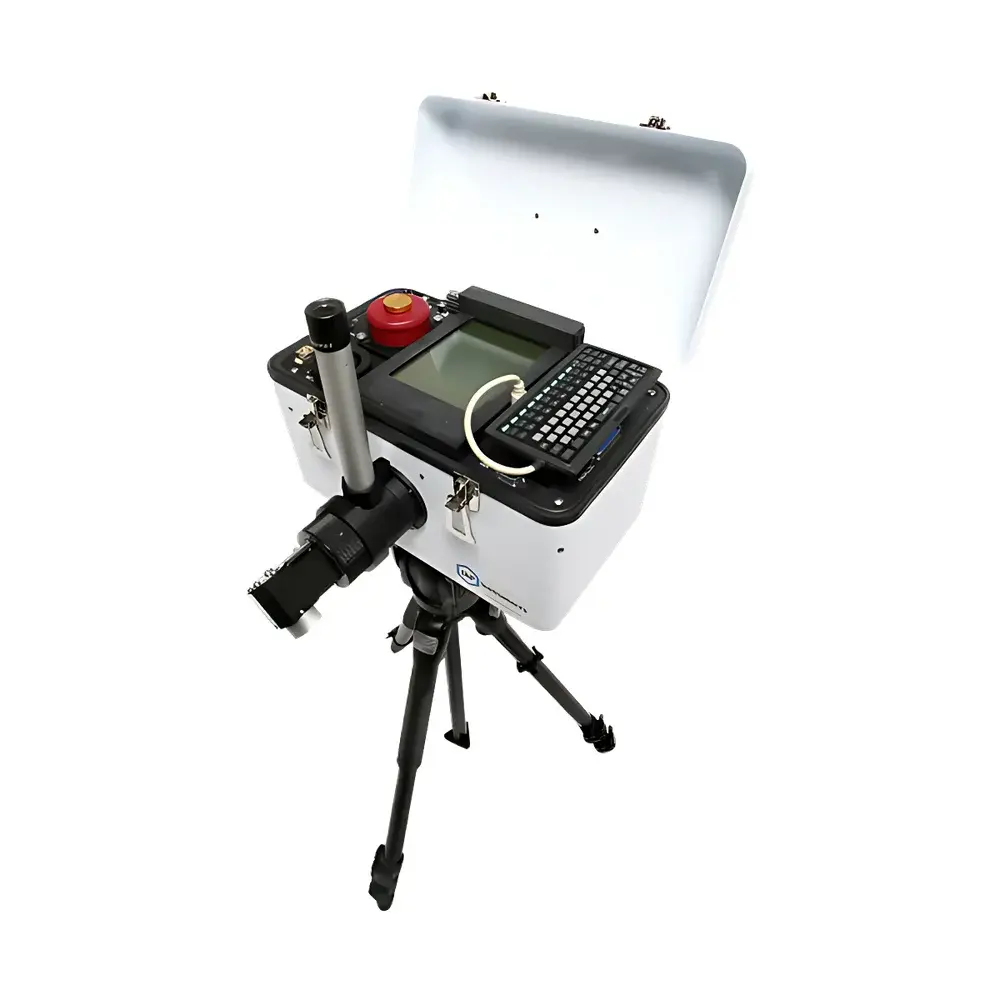
D&P 102F Portable Fourier Transform Thermal Infrared Spectrometer
| Brand | D&P |
|---|---|
| Origin | USA |
| Manufacturer Status | Authorized Distributor |
| Origin Category | Imported |
| Model | 102F |
| Instrument Type | Portable |
| Instrument Principle | Fourier Transform Infrared (FTIR) |
| Spectral Range | 2–16 μm |
| Spectral Resolution | Adjustable at 4, 8, or 16 cm⁻¹ |
| Wavenumber Accuracy | ±1 cm⁻¹ across full spectral range |
| Scan Speed | 1 spectrum/sec (nominal, at 4 cm⁻¹ resolution) |
| Detector | Dual-element InSb/MCT |
| Standard Lens | 1″ aperture (FOV 4.8°) |
| Calibration Sources | Integrated hot/cold blackbody references |
| Dimensions | 36 cm × 20 cm × 23 cm |
| Weight | 7 kg |
Overview
The D&P 102F Portable Fourier Transform Thermal Infrared Spectrometer is engineered for high-fidelity mid- to long-wave infrared (MWIR–LWIR) spectral acquisition in field-deployable and resource-constrained environments. Operating on the principle of interferometric modulation and Fourier transformation, the instrument captures thermal emission spectra from ambient-temperature or elevated-temperature targets without external illumination. Its optical path leverages a permanently aligned Michelson interferometer with solid-state vibration compensation, ensuring phase stability during mobile operation. The 2–16 μm spectral coverage corresponds to wavenumbers of approximately 5000–625 cm⁻¹, enabling identification of fundamental vibrational modes of organic functional groups (e.g., C=O stretch at ~1700 cm⁻¹), inorganic lattice vibrations (e.g., Si–O–Si at ~1000 cm⁻¹), and atmospheric trace gas signatures (e.g., CO₂ at 2349 cm⁻¹, CH₄ at 1306 cm⁻¹). Designed for standoff and contactless measurement, the 102F delivers laboratory-grade spectral fidelity while meeting MIL-STD-810G environmental robustness requirements for shock, humidity, and thermal cycling.
Key Features
- True portable architecture: Compact footprint (36 × 20 × 23 cm) and 7 kg mass enable single-operator deployment on tripods, UAV gimbals, or vehicle-mounted platforms.
- Adjustable spectral resolution: User-selectable 4, 8, or 16 cm⁻¹ resolution supports trade-offs between spectral detail (e.g., gas species deconvolution) and signal-to-noise ratio (SNR) in low-flux conditions.
- Dual-detector configuration: Integrated InSb (2–5.5 μm) and MCT (5–16 μm) elements provide seamless broadband response with automatic detector switching synchronized to wavenumber range.
- Thermally stabilized optics: All reflective optics are housed in an actively temperature-controlled enclosure (±0.1 °C stability), minimizing drift-induced baseline artifacts over extended acquisitions.
- Field-calibration-ready design: Includes integrated hot (323 K) and cold (273 K) blackbody references with NIST-traceable emissivity >0.999, enabling radiometric calibration prior to each measurement sequence.
- Ruggedized lens interface: Standard 1″ f/2.0 germanium lens (4.8° FOV) accepts optional 2″ and 4″ focal-length variants for variable spatial sampling—critical for plume mapping, surface emissivity profiling, or micro-area analysis.
Sample Compatibility & Compliance
The 102F is optimized for non-contact thermal emission spectroscopy of solids, liquids, gases, and heterogeneous surfaces at temperatures ranging from −40 °C to +500 °C. It supports ASTM E1421–22 (Standard Practice for Describing and Measuring Performance of FTIR Spectrometers) and ISO 18381:2015 (Infrared spectroscopy — Vocabulary and general principles). No sample preparation is required for bulk material identification; thin films, particulates, and aerosol plumes may be analyzed via background subtraction using built-in reference spectra libraries. The system complies with IEC 61326-1:2013 for electromagnetic compatibility in industrial environments and meets Class II laser safety requirements per IEC 60825-1:2014 (no Class 3B/4 lasers present). Data integrity protocols align with FDA 21 CFR Part 11 for electronic records when used in regulated QA/QC workflows.
Software & Data Management
The instrument ships with SpectraView Pro v4.2, a Windows-based application supporting real-time interferogram visualization, phase correction, apodization selection (Happ-Genzel, Blackman-Harris), and absolute radiance conversion. Spectral libraries include the NIST Chemistry WebBook IR database, USGS mineral spectral library, and EPA toxic vapor reference set. Raw interferograms (.ifg) and calibrated spectra (.spc) are stored in open-format HDF5 containers with embedded metadata (timestamp, GPS coordinates, lens ID, detector status, calibration history). Audit trails record all parameter changes, user logins, and calibration events—enabling GLP/GMP-compliant reporting. Export options include CSV, JCAMP-DX, and Bruker OPUS-compatible formats for third-party chemometric analysis (e.g., PLS regression, PCA clustering).
Applications
- Remote sensing of industrial emissions: Quantitative detection of VOCs, NOₓ, SO₂, and NH₃ in stack plumes or fugitive releases.
- Field geology and planetary analog studies: In situ mineral identification (e.g., carbonates, sulfates, phyllosilicates) via spectral matching against reference libraries.
- Defense and security: Standoff detection of explosives residues (e.g., RDX, TNT), chemical warfare agent simulants, and illicit drug precursors.
- Materials science: Thermal degradation monitoring of polymers, coatings, and composites under accelerated aging or fire-test conditions.
- Environmental monitoring: Surface emissivity mapping of urban heat islands, volcanic gas composition tracking, and wildfire smoke characterization.
FAQ
What is the minimum detectable temperature difference for emissivity-corrected measurements?
The system achieves <0.5 K thermal resolution (NETD) at 300 K target temperature with 4 cm⁻¹ resolution and 16-s integration, assuming standard 1″ lens and ambient background subtraction.
Can the 102F operate continuously in outdoor environments below 0 °C?
Yes—the internal thermal management subsystem maintains detector and interferometer stability down to −20 °C ambient; battery life reduces by ~25% at −10 °C compared to 25 °C.
Is spectral data export compatible with MATLAB or Python-based analysis pipelines?
Yes—HDF5 output includes standardized attributes (wavenumber axis, radiance units, calibration coefficients) and can be ingested directly via h5py or MATLAB’s hdf5read() without proprietary drivers.
Does the instrument support automated spectral library search with confidence scoring?
Yes—SpectraView Pro implements correlation-based matching (Pearson, Euclidean distance) with false-alarm rate estimation per match, configurable thresholds, and hierarchical library grouping.
How often must the internal blackbodies be recalibrated?
NIST-traceable calibration is performed at factory; no field recalibration is required. Annual verification using external transfer standards is recommended per ISO/IEC 17025 quality systems.



