
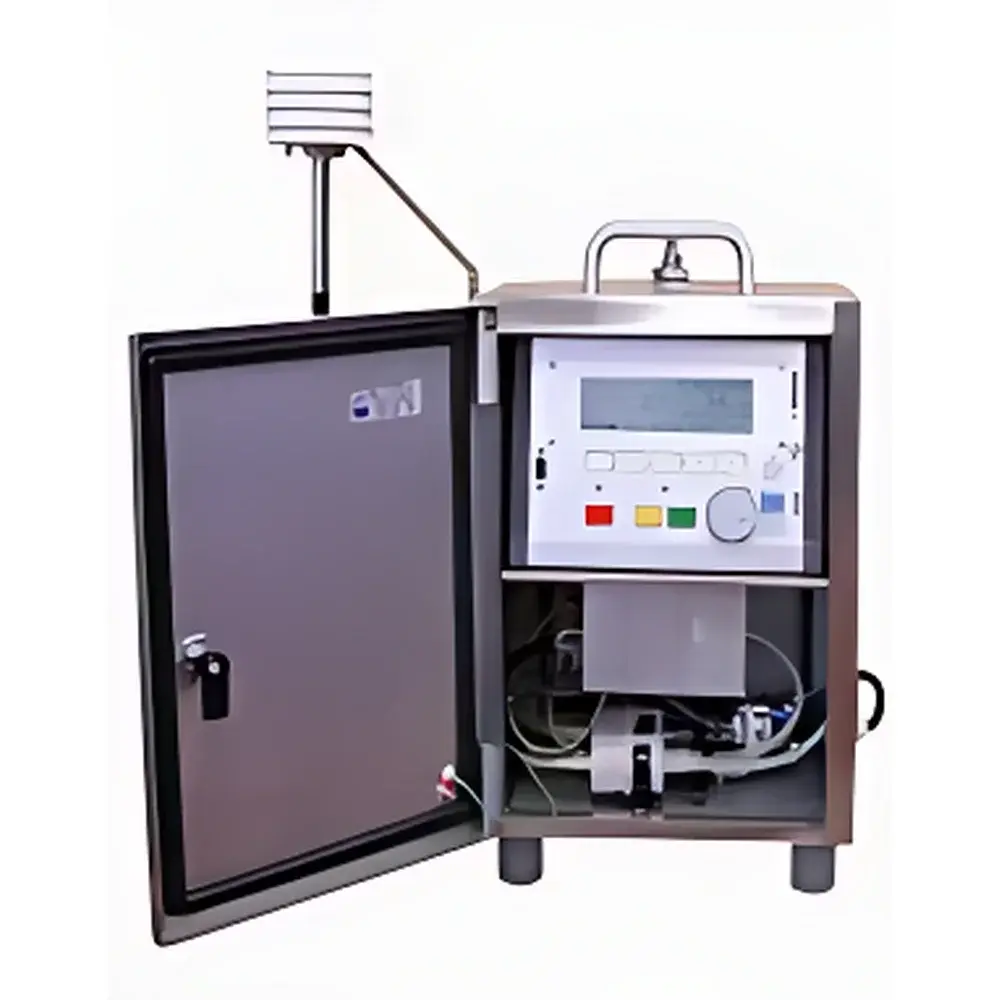
Dr. Drenda APM-2 Ambient Air Particulate Matter Monitor (PM₂.₅ & PM₁₀)
| Origin | Germany |
|---|---|
| Manufacturer Type | Authorized Distributor |
| Origin Category | Imported |
| Model | Dr. Drenda APM-2 |
| Pricing | Upon Request |
| Flow Rate | 3.3 L/min |
| Sampling Mode | Continuous |
| Power Supply | 230 V, 50/60 Hz |
| Power Consumption | ~80 VA |
| Measurement Range | 0–1000 µg/m³ |
| Dimensions (W×H×D, excl. inlet & antenna) | 300 × 450 × 250 mm |
| Weight | ~17 kg |
| Ingress Protection | IP65 |
Overview
The Dr. Drenda APM-2 Ambient Air Particulate Matter Monitor is a CE-marked, type-approved continuous monitoring instrument engineered for regulatory-grade measurement of airborne particulate mass concentrations in ambient air. Based on the well-established beta attenuation monitoring (BAM) principle—complemented by integrated optical scattering compensation—the APM-2 alternately quantifies PM₁₀ and PM₂.₅ mass concentrations in real time, delivering compliant, traceable, and reproducible data aligned with EU Directive 2008/50/EC and EN 12341:2014 (PM₁₀) and EN 14907:2005 (PM₂.₅). The system employs a dual-channel sequential sampling design: ambient air is drawn through a standardized size-selective inlet (EN 12341-compliant for PM₁₀ and PM₂.₅), with particles deposited onto a moving filter tape. A calibrated beta-ray source (¹⁴C) measures attenuation before and after deposition, while an integrated nephelometric sensor provides dynamic optical correction for humidity- and composition-dependent scattering effects. Temperature stabilization of the photometric chamber at 40 °C ensures long-term signal stability and minimizes thermal drift—a critical requirement for unattended operation in variable outdoor environments.
Key Features
- Sequential, automated dual-fraction measurement of PM₁₀ and PM₂.₅ within a single instrument platform—eliminating need for parallel analyzers or manual filter changes
- Integrated temperature- and humidity-compensated optical correction, enhancing accuracy under high-humidity conditions without requiring external meteorological stations
- Self-cleaning photometric chamber with thermostatically controlled 40 °C operating temperature—reducing maintenance frequency and preserving optical path integrity
- IP65-rated enclosure suitable for permanent outdoor installation; robust against dust ingress and water jets from any direction
- Continuous sampling at 3.3 L/min with gravimetrically validated flow control, meeting EN 12341 flow tolerance requirements (±5%)
- GPRS-enabled telemetry for remote data transmission; supports configurable reporting intervals (e.g., 1-, 5-, or 15-minute averages) to central air quality management systems
- Onboard SD card storage (FAT32 formatted) for local archival of raw attenuation signals, calibration logs, environmental metadata, and firmware update packages
Sample Compatibility & Compliance
The APM-2 is validated for use with standard EN 12341-compliant PM₁₀ and PM₂.₅ inlets (e.g., conical cyclones or impactor-based separators) and operates across ambient temperature ranges of −20 °C to +50 °C and relative humidity up to 95% non-condensing. It meets the performance criteria defined in EU Reference Method for PM (Commission Decision 2011/814/EU) and demonstrates strong correlation (r² > 0.98) with gravimetric reference methods across diverse urban, traffic, and rural monitoring sites. Its measurement traceability is anchored to national metrology institutes via factory calibration against certified aerosol standards (e.g., ammonium sulfate, Arizona Test Dust). The device supports audit-ready logging per ISO/IEC 17025:2017 requirements and includes timestamped calibration verification records.
Software & Data Management
The embedded firmware (v3.x+) supports secure, encrypted GPRS communication using TLS 1.2 and configurable authentication (APN, username/password). Local configuration and diagnostics are accessible via a web-based interface (HTTPS) or serial console. All measurement data—including raw beta counts, corrected mass concentration values, RH/T readings, flow rate, tape position, and system health flags—are stored in ASCII-delimited format (CSV) on the SD card with ISO 8601 timestamps. Firmware updates are performed offline via SD card—no internet connection required during field deployment. Data export complies with EEA Air Quality e-reporting schema (AQER v2.2), enabling direct ingestion into national reporting platforms such as AirBase or national AQMS portals.
Applications
- Fixed-site ambient air quality monitoring networks operated by national environmental agencies (e.g., UBA, DEFRA, EPA regional offices)
- Urban background, traffic, and industrial fence-line monitoring in compliance with EU Air Quality Directive reporting obligations
- Long-term trend analysis and source apportionment studies requiring high temporal resolution (sub-hourly) PM fraction data
- Calibration and co-location validation of low-cost sensor networks and mobile monitoring units
- Research-grade field campaigns requiring ruggedized, low-maintenance instrumentation with metrological traceability
FAQ
Does the APM-2 require consumables such as filter cartridges or radioactive source replacements?
No. The beta source (¹⁴C) has a half-life of 5730 years and requires no replacement during the instrument’s operational lifetime. The filter tape is designed for ≥30 days of continuous operation at standard flow rates and is user-replaceable in <5 minutes without tools.
Is the instrument compliant with US EPA equivalency requirements (e.g., EQPM-1215-222)?
The APM-2 is not currently listed on the EPA’s List of Equivalent Methods; however, its BAM + optical correction architecture aligns with the technical principles underlying EPA-approved BAM instruments (e.g., Thermo Scientific pDR-1500, MetOne BAM-1020). Site-specific equivalency testing per 40 CFR Part 53 is supported via documented protocol adaptation.
How is data integrity ensured during power interruptions or network outages?
All measurements are buffered in non-volatile memory and written to SD card upon recovery. Timestamps are maintained by an internal RTC with supercapacitor backup (>72 h hold-up time), ensuring continuity of time-series alignment even after extended blackouts.
Can the APM-2 be integrated into existing SCADA or GIS-based environmental monitoring platforms?
Yes. The device supports Modbus TCP and ASCII over TCP/IP protocols, enabling native integration with industry-standard SCADA systems (e.g., Ignition, Siemens Desigo, Schneider EcoStruxure). JSON API endpoints are available for custom middleware development.







