
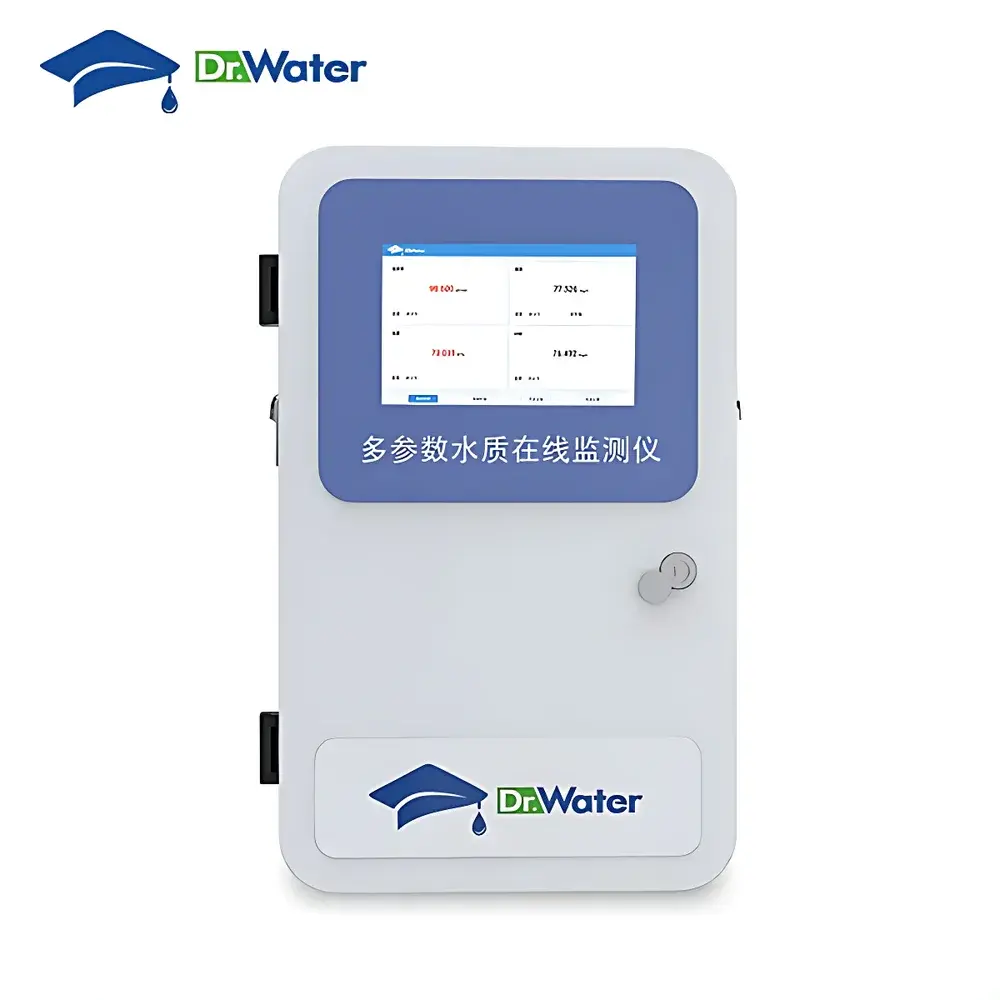
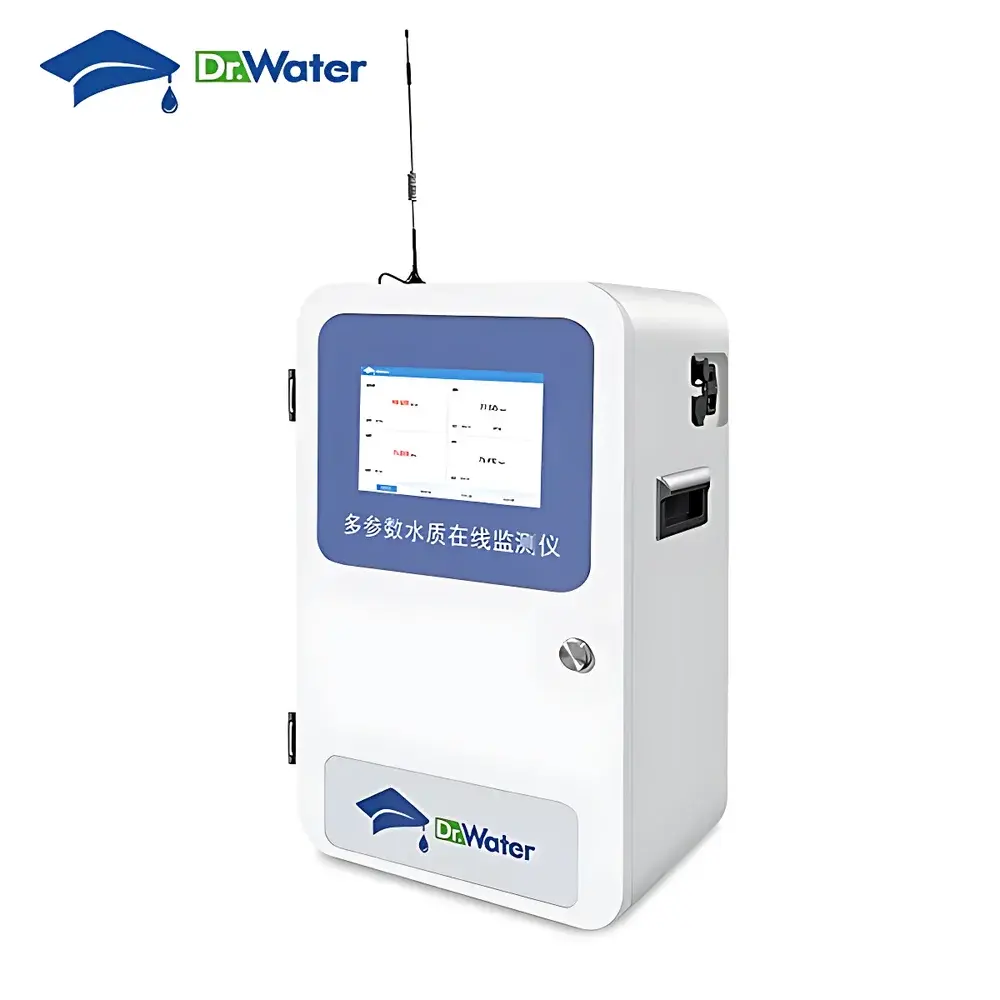
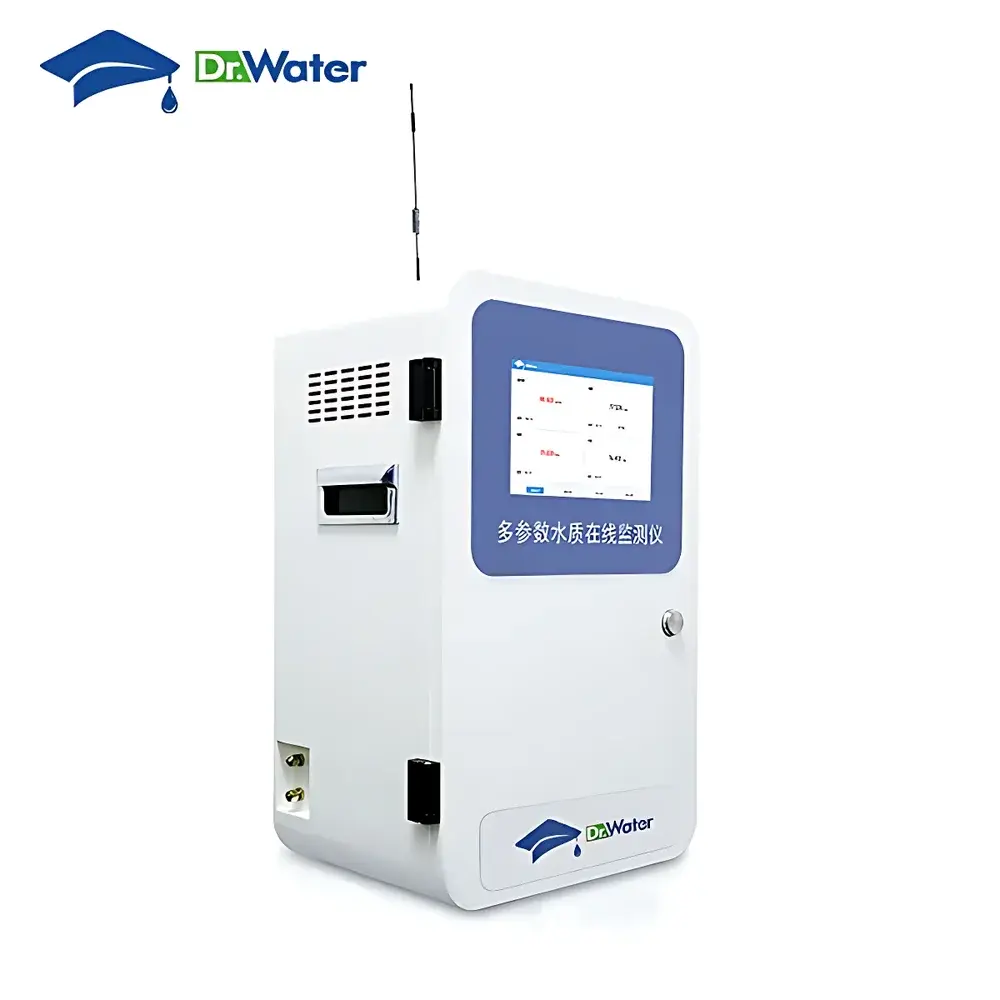
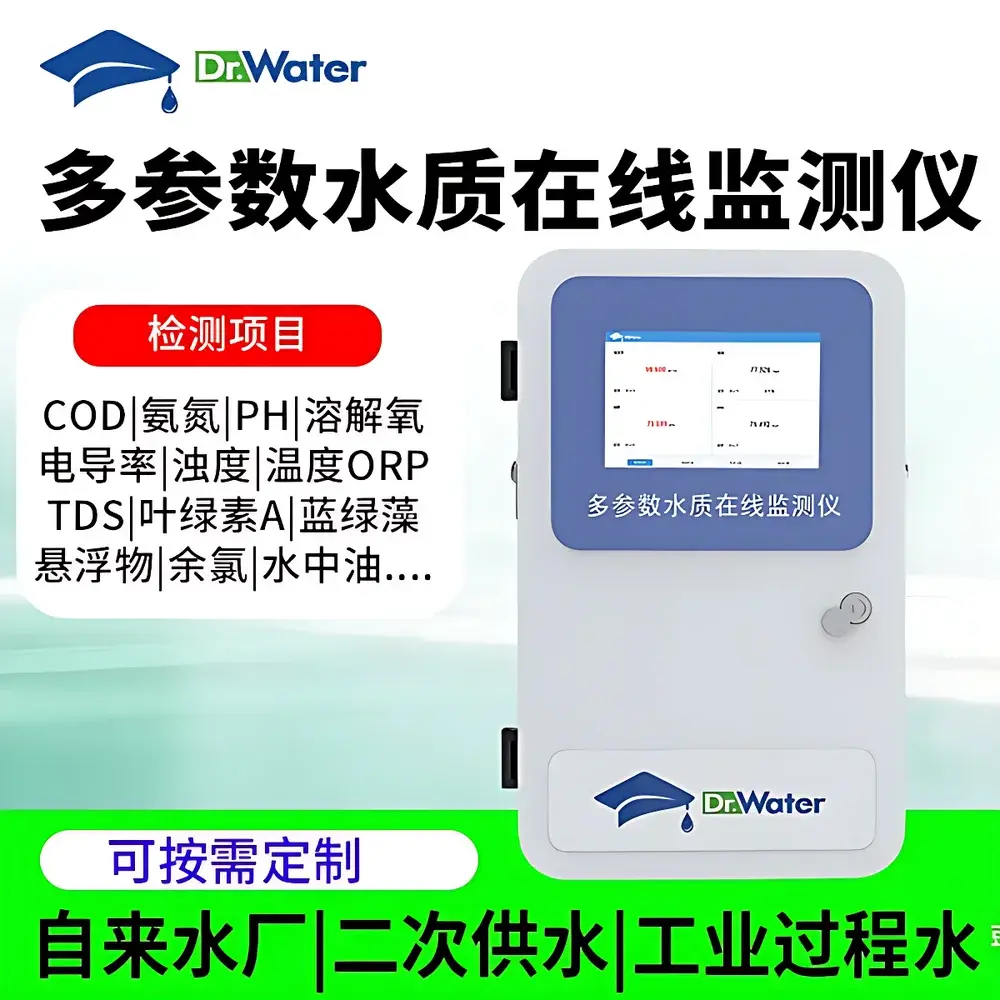
Dr-W380 Multi-Parameter Online Water Quality Analyzer by DoctorWater
| Brand | DoctorWater |
|---|---|
| Origin | Hunan, China |
| Model | Dr-W380 |
| Instrument Type | Online Water Quality Analyzer |
| Detection Parameters | COD, Ammonia Nitrogen, pH, Dissolved Oxygen (DO), Conductivity, Turbidity, Temperature, ORP, TDS, Chlorophyll-a, Phycocyanin (Blue-Green Algae), Suspended Solids (SS), Residual Chlorine, Oil-in-Water, Salinity |
| pH Measurement Range | 0–14 pH |
| Display | 10.1-inch Android-based industrial capacitive touchscreen |
| Flow Rate | 5–30 L/h |
| Installation | Wall-mounted |
| Power Supply | AC 220 V ±15%, 50 Hz ±5% |
| Power Consumption | <50 W |
| Operating Temperature | 0–60 °C |
| Relative Humidity | <90% RH |
| Dimensions (L×W×H) | 428 × 308 × 650 mm |
| Communication Interfaces | RS-485, Ethernet, 4G, Wi-Fi |
| Calibration | On-device electrode calibration via touchscreen |
| Alarm Function | Fault detection with remote alerting |
| Housing Design | Electrically isolated chambers, corrosion-resistant materials, integrated air-bleed valve in flow cell |
| Measurement Mode | Continuous or programmable intermittent monitoring |
| Sample Path | Series-connected flow-through cell with low-volume consumption |
Overview
The Dr-W380 Multi-Parameter Online Water Quality Analyzer is an integrated, industrial-grade platform engineered for continuous, real-time monitoring of critical water quality parameters in diverse aquatic environments. Designed and manufactured in Hunan, China, the system employs a modular flow-through architecture combining electrochemical, optical, and physical sensing technologies—enabling simultaneous measurement of up to 15 parameters without reagent addition. Its core measurement principles include potentiometric pH sensing, amperometric residual chlorine detection, galvanic or optical dissolved oxygen measurement, conductivity-based salinity/TDS derivation, nephelometric turbidity assessment, and fluorescence-based quantification of chlorophyll-a and phycocyanin. The analyzer is not based on wet-chemistry methods; instead, it relies on solid-state sensor arrays calibrated per ISO 7027 (turbidity), ISO 5814 (DO), and ASTM D1293 (pH), ensuring long-term stability and minimal maintenance. The unit is intended for unattended deployment in municipal drinking water distribution systems, secondary water supply facilities, swimming pool management, industrial process water loops, agricultural irrigation channels, and environmental surface/groundwater surveillance stations.
Key Features
- 10.1-inch high-resolution Android-based industrial capacitive touchscreen with intuitive HMI—supporting multi-language UI, real-time trend visualization, and on-device calibration workflows.
- Modular sensor architecture with standardized electrical and hydraulic interfaces—enabling field-replaceable probes and parameter customization (e.g., adding COD or ammonia nitrogen modules).
- Patented series-connected flow cell design with integrated air-bleed valve—eliminating air bubble interference on electrode surfaces and maintaining measurement consistency across variable inlet flow rates (5–30 L/h).
- Electrically isolated, corrosion-resistant housing with IP65-rated enclosure—featuring segregated compartments for electronics, fluid path, and power supply to ensure EMI immunity and long-term reliability in humid or chemically aggressive environments.
- Low-power operation (<50 W) with dual-mode monitoring—configurable for continuous acquisition or time-scheduled intermittent sampling to extend sensor lifetime and conserve energy.
- Embedded fault diagnostics with auto-alert functionality—triggering local visual/audio warnings and transmitting error codes (e.g., sensor drift, flow interruption, temperature out-of-range) to centralized SCADA or cloud platforms via RS-485, Ethernet, or 4G/Wi-Fi.
Sample Compatibility & Compliance
The Dr-W380 is validated for use with potable water, treated wastewater effluent, surface water (rivers, lakes), groundwater, recirculating pool water, and industrial cooling water. It meets mechanical and environmental requirements outlined in IEC 60529 (IP65), IEC 61000-6-2 (immunity to electromagnetic disturbances), and GB/T 30087–2013 (Chinese national standard for online water quality analyzers). While not certified under US EPA or EU WFD regulatory frameworks as a primary compliance instrument, its sensor outputs are traceable to NIST-traceable reference standards when calibrated using certified buffer solutions (e.g., pH 4.01/7.00/10.01, DO saturation standards). Data integrity aligns with GLP principles through timestamped audit logs, user-access controls, and non-volatile storage of calibration history—supporting internal QA/QC protocols in municipal and industrial laboratories.
Software & Data Management
The analyzer operates with embedded Linux-based firmware and supports seamless integration into existing infrastructure via Modbus RTU/TCP, MQTT, or HTTP RESTful APIs. A dedicated PC-based configuration and analysis software enables advanced functions including historical data replay, multi-parameter correlation plots, alarm threshold configuration, and export to CSV/Excel formats. Remote access is facilitated through secure TLS-enabled web interface and optional mobile application (iOS/Android), allowing operators to monitor live values, review calibration status, and download event-triggered reports. All data entries—including sensor readings, calibration events, system errors, and user logins—are time-stamped and stored with write-once-read-many (WORM) attributes to satisfy basic 21 CFR Part 11 readiness requirements for electronic records in non-GMP contexts.
Applications
- Municipal water utilities: Real-time verification of disinfection residual (free chlorine), pH stability, and turbidity compliance at entry points, reservoirs, and zone pressure valves.
- Building water safety: Monitoring secondary supply tanks and rooftop water systems for stagnation indicators (e.g., declining DO, rising ORP, elevated temperature).
- Aquatic facility management: Automated control of chlorine dosing and pH correction in swimming pools and spas based on closed-loop feedback from integrated sensors.
- Environmental monitoring networks: Deployment at river gauging stations or groundwater wells to track seasonal variations in conductivity (salinity intrusion), turbidity (sediment load), and algal pigment concentrations.
- Industrial process water: Ensuring feedwater quality for boiler makeup, reverse osmosis pre-treatment, or food-grade rinse lines where conductivity, TOC proxy (via conductivity/pH ratio), and chlorine residuals are critical.
FAQ
Does the Dr-W380 require chemical reagents for operation?
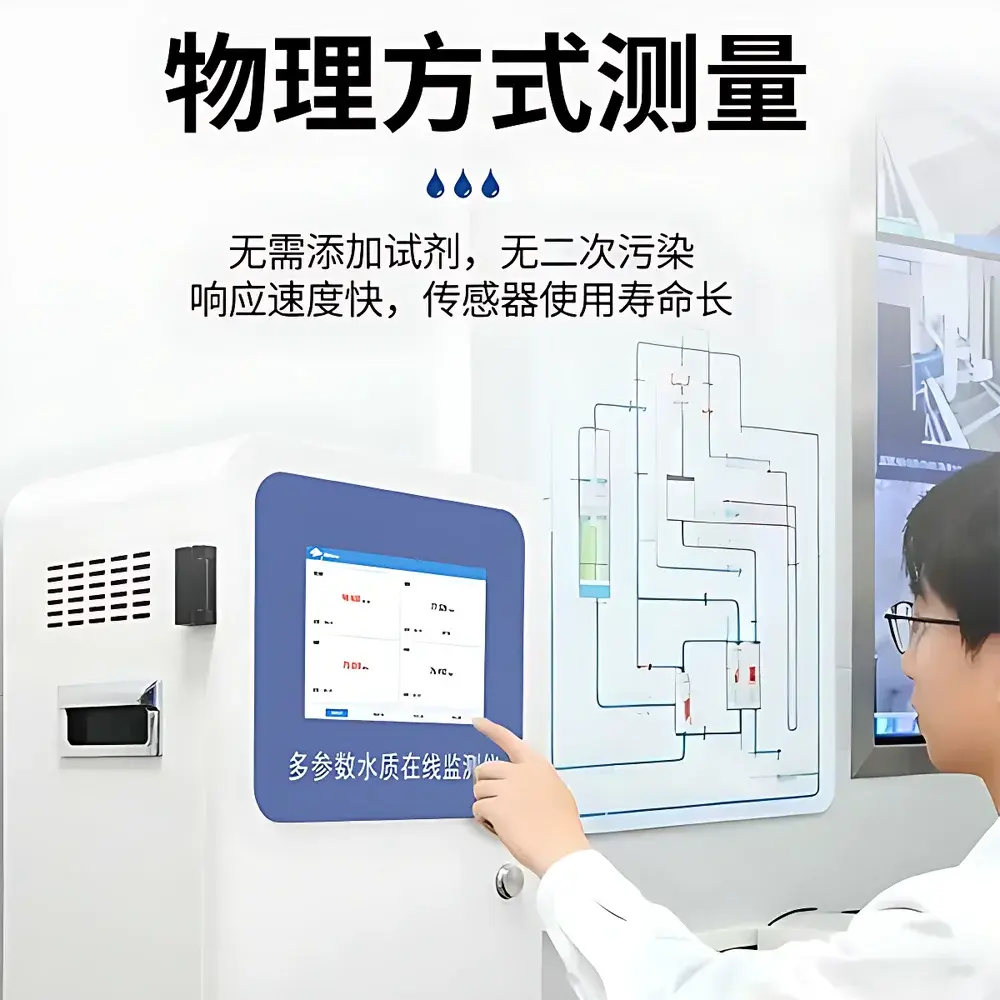
No. All measurements are performed using maintenance-free electrochemical and optical sensors. Reagent-free operation eliminates consumables, reduces operational cost, and avoids secondary contamination.
Can the system be integrated with existing SCADA or BMS platforms?
Yes. Standard communication protocols—including Modbus RTU over RS-485, Modbus TCP over Ethernet, and MQTT over 4G/Wi-Fi—are natively supported for plug-and-play integration.
What is the recommended calibration frequency for field-deployed units?
For routine applications, pH and ORP electrodes should be verified weekly and calibrated biweekly; DO and conductivity sensors typically require monthly verification. Calibration intervals may be extended under stable conditions with documented performance validation.
Is remote firmware update capability available?
Yes. Firmware upgrades can be deployed over-the-air (OTA) via secure HTTPS connection or locally via USB drive, with version rollback and checksum validation to ensure integrity.
How is sensor drift compensated during long-term deployment?
The system implements adaptive baseline correction algorithms for conductivity and turbidity channels, while pH and ORP rely on periodic two-point calibration. Raw sensor outputs are logged alongside diagnostic flags (e.g., signal noise level, response time) to support predictive maintenance planning.
Related Products







