

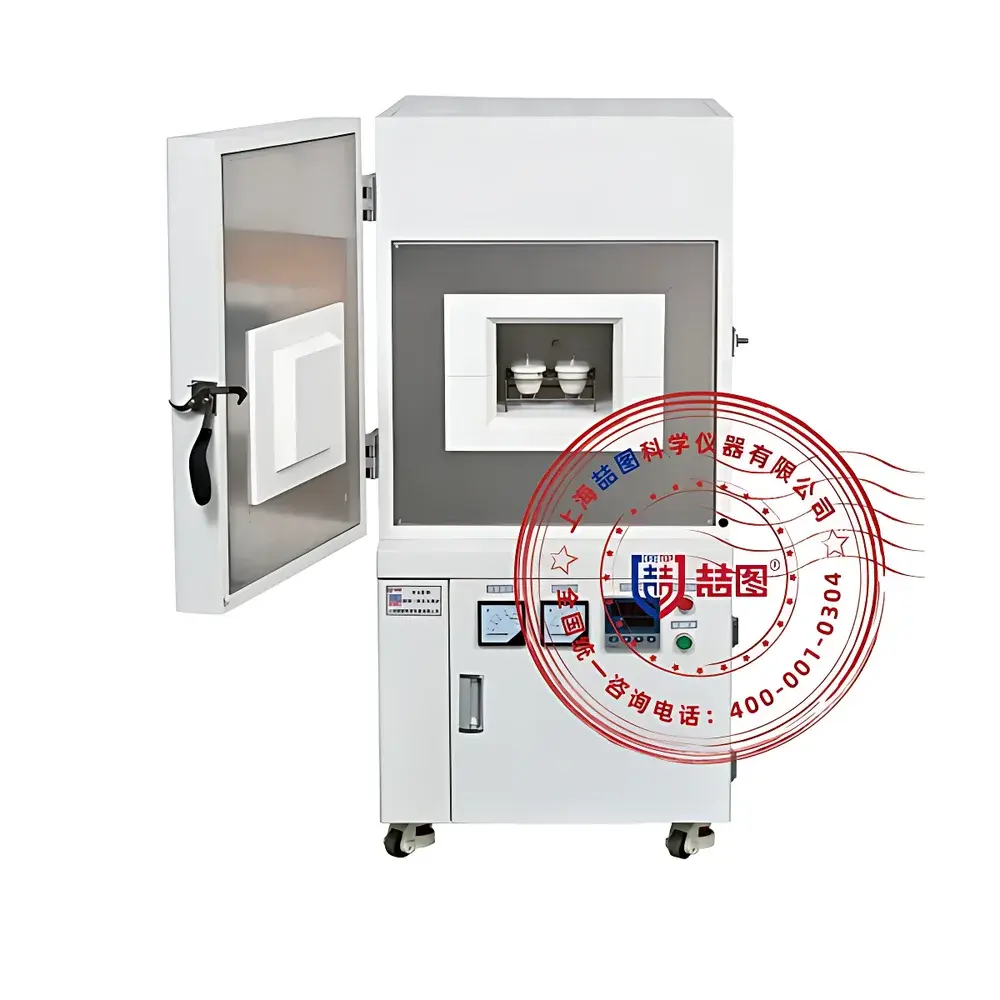
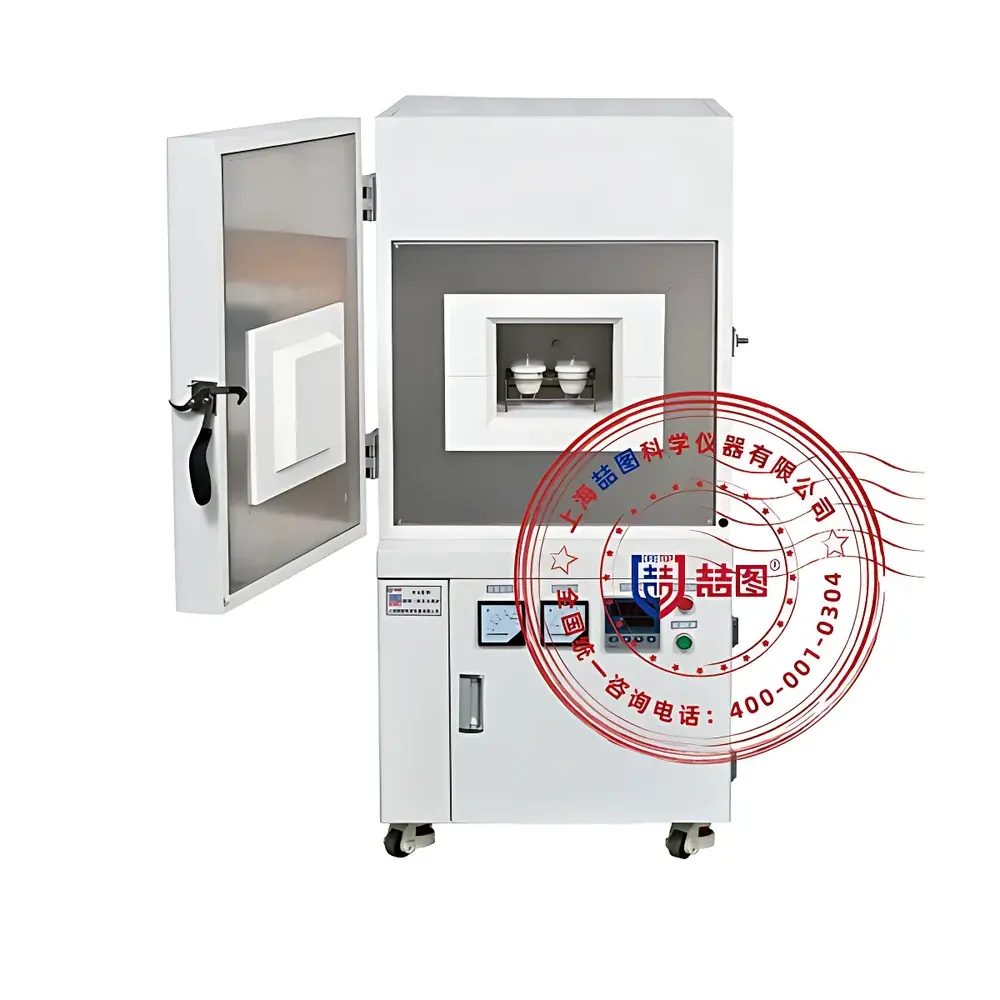
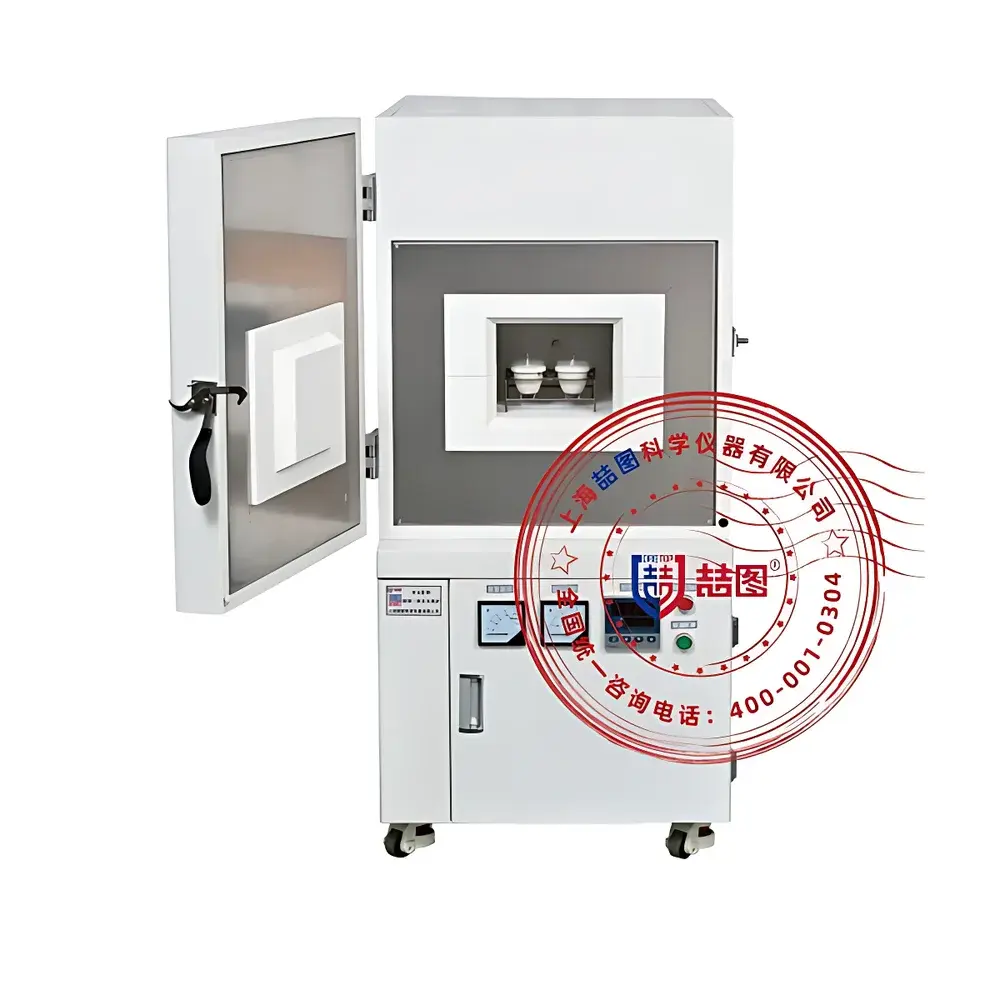
DRETOP B18-12P Programmable High-Temperature Box-Type Muffle Furnace
| Brand | DRETOP |
|---|---|
| Origin | Shanghai, China |
| Manufacturer Type | Direct Manufacturer |
| Product Type | Box-Type Muffle Furnace |
| Model | B18-12P |
| Maximum Temperature | 1800 °C |
| Temperature Control Accuracy | ±1 °C |
| Rated Power | 15 kW |
| Heating Time to Max Temp | 70 min |
| Heating Element | Silicon Molybdenum (MoSi₂) Rods |
| Internal Chamber Dimensions | 200 × 300 × 200 mm |
| Nominal Volume | 12 L |
| Control System | Programmable Digital Controller with Color Touchscreen Interface |
| Insulation Material | Vacuum-Microporous Ceramic Fiber Board |
| Chamber Lining | Polycrystalline Alumina Fiber |
| Transformer | Integrated Three-Phase Dry-Type Isolation Transformer |
| Safety Features | Dual-Stage Overtemperature Protection, Door-Interlocked Power Cut-off, Power Failure Memory, Phase Loss & Thermocouple Break Detection |
Overview
The DRETOP B18-12P is a programmable high-temperature box-type muffle furnace engineered for precision thermal processing in research laboratories, materials science departments, and industrial quality control environments. It operates on resistive Joule heating principles, utilizing silicon molybdenum (MoSi₂) rods as the primary heating element—capable of stable operation up to 1800 °C in air atmosphere. The furnace integrates a three-phase dry-type isolation transformer directly into the base structure, minimizing electromagnetic interference and ensuring stable voltage regulation under dynamic load conditions. Its triple-wall heating configuration—rods embedded symmetrically in the left, right, and rear chamber walls—produces uniform radiant heat distribution, validated per ASTM E220 and ISO/IEC 17025 calibration protocols for thermal uniformity across the working zone. Designed for repeatable high-temperature treatments—including sintering, ashing, calcination, annealing, and fusion analysis—the B18-12P meets fundamental requirements for GLP-compliant thermal processing workflows.
Key Features
- Programmable temperature profile control with multi-segment ramp-hold-cool capability; supports up to 30 user-defined segments per program, with linear or custom curve-fitting interpolation.
- AI-based self-tuning PID algorithm enabling adaptive parameter optimization for varying load mass and thermal inertia; eliminates manual tuning during routine operation.
- Integrated 7-inch color touchscreen HMI with real-time trend graphing, historical data overlay, and USB export (CSV format) for post-processing in Excel or MATLAB.
- Door-interlocked safety circuit: power to heating elements is automatically disabled upon door opening; resumes at pre-interruption setpoint upon re-closure.
- Vacuum-microporous ceramic fiber insulation reduces standby heat loss by >40% compared to conventional refractory brick; chamber weight reduced by 65% without compromising thermal retention.
- Dual-stage overtemperature protection: primary controller limit + independent mechanical overheat cutoff; supplemented by thermocouple break detection and phase-loss monitoring.
- Front-panel analog voltmeter and ammeter with needle indicators—providing immediate visual verification of input electrical status without reliance on digital interface.
Sample Compatibility & Compliance
The B18-12P accommodates standard crucibles (alumina, zirconia, platinum, graphite) and sample boats up to 180 mm in length, compatible with ASTM C1171 (ceramic sintering), USP (heavy metal residue testing), and ISO 1171 (ash content determination). Its polycrystalline alumina fiber chamber lining resists chemical attack from alkaline fluxes and halide-containing samples. All electrical components comply with IEC 61000-4 immunity standards; the integrated isolation transformer satisfies EN 61558-2-2 for industrial control transformers. The system supports optional inert gas purging (N₂, Ar) via front-mounted inlet valve—enabling controlled-atmosphere experiments compliant with ASTM F1921 (thermal stability under inert conditions).
Software & Data Management
The embedded controller firmware supports audit-trail-enabled operation per FDA 21 CFR Part 11 requirements when configured with password-protected engineering access levels (Operator / Technician / Administrator). Temperature logs include timestamped entries with operator ID, program name, segment number, actual vs. setpoint deviation, and alarm event codes. Data export supports time-synchronized CSV files with millisecond-resolution sampling. Optional RS485 Modbus RTU interface enables integration into centralized SCADA or LIMS platforms for automated batch record generation and electronic signature capture.
Applications
- High-temperature sintering of advanced ceramics (e.g., Si₃N₄, ZrO₂, AlN) requiring precise dwell control at 1600–1800 °C.
- Thermal gravimetric analysis (TGA) pre-conditioning and residue quantification per ISO 1171 and ASTM D2866.
- Metallurgical heat treatment: austenitizing, solution annealing, and stress-relief cycles for stainless steels and superalloys.
- Geochemical sample preparation: fusion bead preparation for XRF analysis using lithium tetraborate fluxes.
- Calibration reference furnace applications where traceable uniformity (±2 °C across 90% of chamber volume) is required per EURAMET cg-18 guidelines.
FAQ
What is the maximum recommended continuous operating temperature?
The furnace is rated for continuous operation at 1750 °C; 1800 °C is specified as the absolute upper limit for short-duration (<30 min) peak exposures.
Can this furnace be used under vacuum or reducing atmospheres?
No—this model is designed exclusively for air or inert-gas-purged operation. MoSi₂ elements oxidize rapidly below 1700 °C in reducing or vacuum environments; alternative heating elements (e.g., tungsten, molybdenum) would be required.
Is the temperature uniformity validated across the entire chamber volume?
Yes—typical uniformity is ±3 °C at 1600 °C within the central 70% of the chamber volume (per ASTM E220 Annex A3); optional NIST-traceable validation reports are available upon request.
Does the system support remote monitoring or network connectivity?
Standard configuration includes RS485 Modbus RTU; Ethernet/Wi-Fi modules and cloud-based telemetry gateways are available as factory-installed options.
What maintenance intervals are recommended for the heating elements and insulation?
MoSi₂ rods require no scheduled replacement under normal use; inspect annually for surface crystallization or warping. Ceramic fiber insulation has a service life exceeding 5 years at ≤1600 °C continuous duty—visual inspection recommended every 6 months for physical integrity.



