
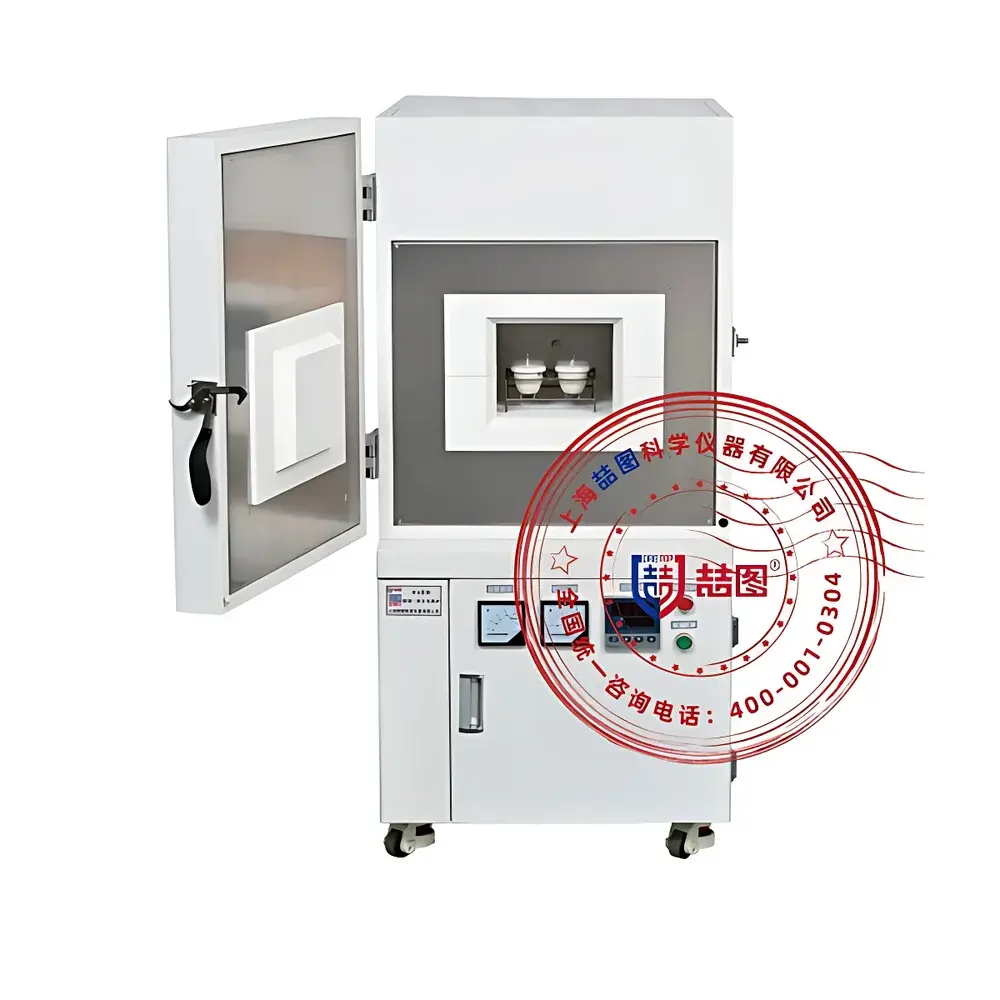
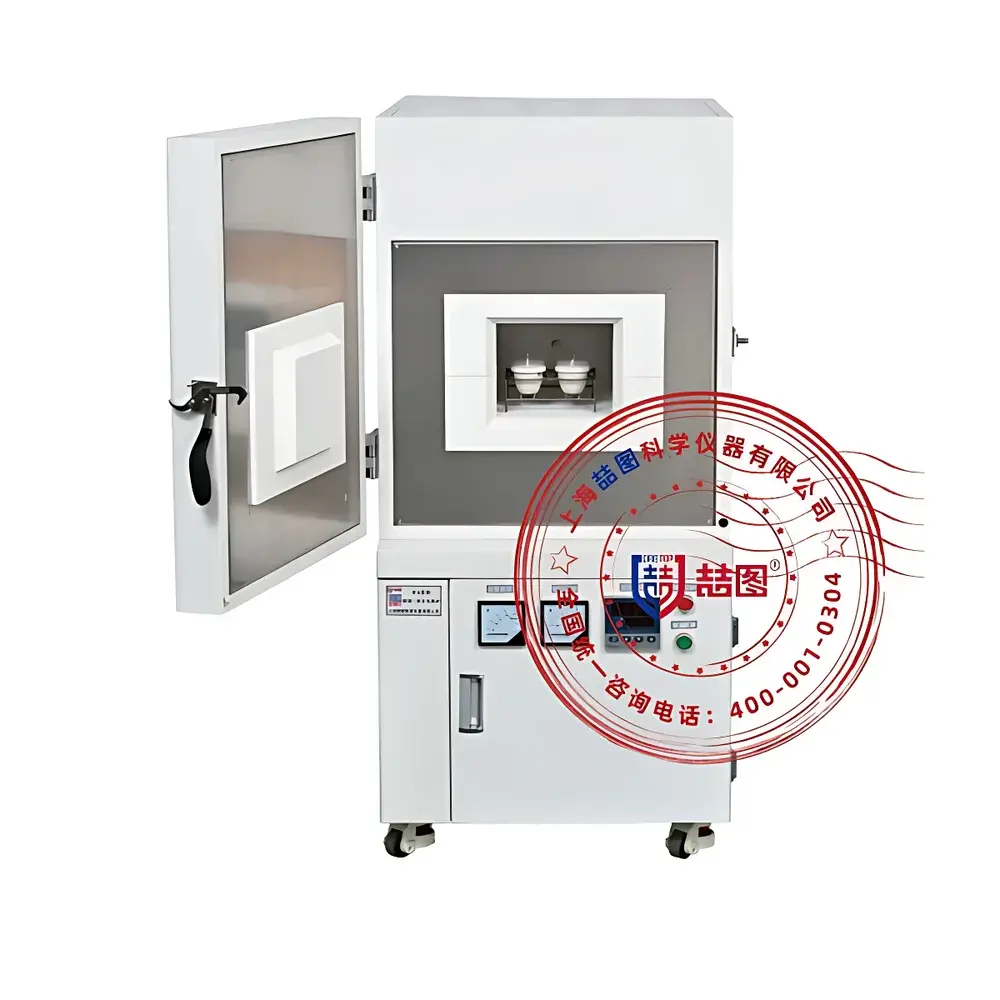
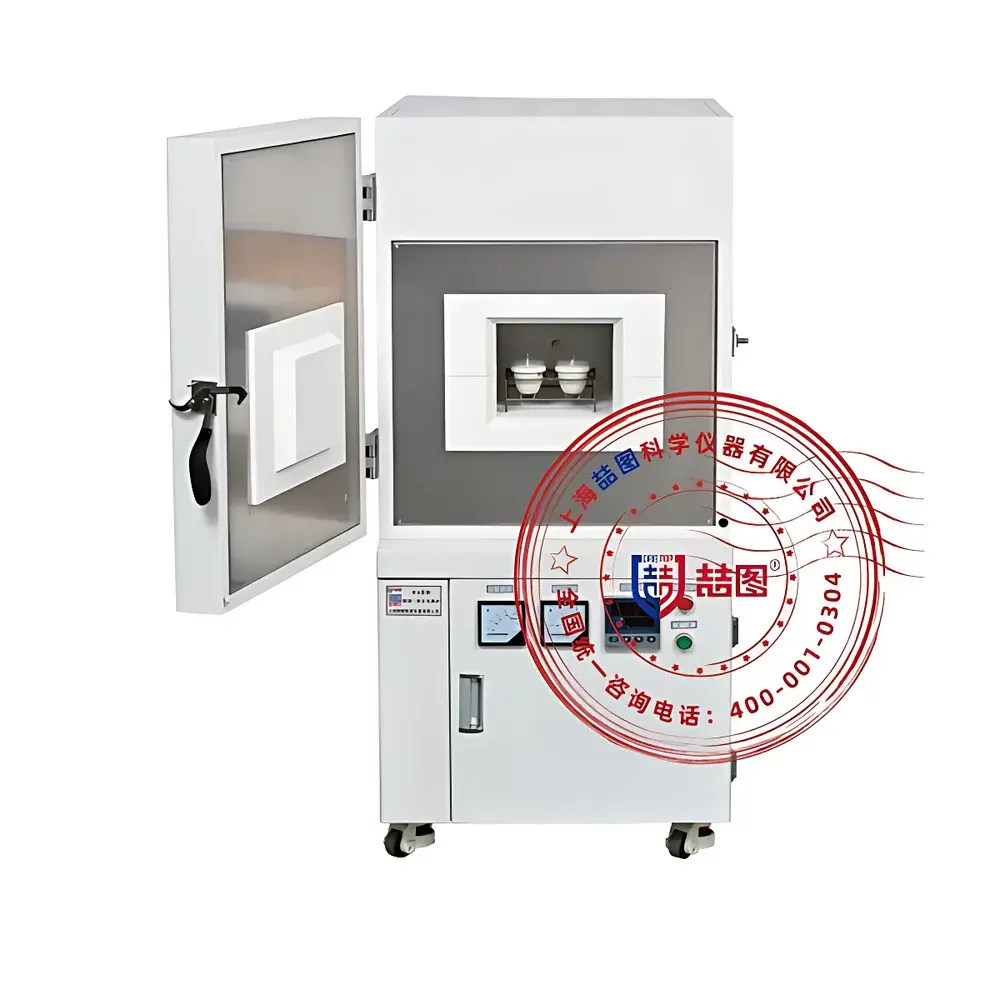
DRETOP B18-36AI Programmable High-Temperature Box-Type Muffle Furnace
| Brand | DRETOP |
|---|---|
| Origin | Shanghai, China |
| Model | B18-36AI |
| Type | Box-Type Muffle Furnace |
| Max. Temperature | 1800 °C |
| Temperature Control Accuracy | ±1 °C |
| Rated Power | 30 kW |
| Heating Time to Max. Temp. | ≤60 min |
| Heating Element | Silicon-Molybdenum (MoSi₂) Rods |
| Internal Chamber Dimensions | 300 × 400 × 300 mm (W × D × H) |
| Nominal Volume | 36 L |
| Control System | AI-Based Programmable Controller with 7″ Color Touchscreen |
| Insulation Material | Vacuum-Microporous Ceramic Fiber Board |
| Heating Configuration | Triple-Wall Radiant Heating (Front, Back, Top Walls) |
| Safety Features | Dual-Stage Over-Temperature Protection, Door-Interlocked Power Cut-off, Power Segment Limitation, Power-Fail Memory Retention, Phase-Loss & Thermocouple Break Detection |
| Transformer | Integrated Three-Phase Dry-Type Isolation Transformer |
Overview
The DRETOP B18-36AI is a high-precision, programmable box-type muffle furnace engineered for demanding high-temperature laboratory and industrial applications requiring thermal stability up to 1800 °C. It operates on the principle of resistive Joule heating via silicon-molybdenum (MoSi₂) rods embedded in triple-wall radiant configuration—ensuring uniform thermal distribution across the entire 36 L chamber volume. Unlike tubular or vertical furnaces, its horizontal box design provides optimal accessibility, reproducible sample positioning, and consistent heat transfer geometry—critical for quantitative thermal analysis, sintering, ashing, calcination, and heat treatment protocols in materials science, metallurgy, ceramics, and geochemistry laboratories. The integrated three-phase dry-type isolation transformer enables stable voltage regulation under high-load conditions while suppressing electromagnetic interference—supporting compliance with IEC 61000-4 electromagnetic compatibility standards.
Key Features
- AI-powered programmable controller with adaptive parameter self-tuning, enabling precise ramp-hold-cool profiles with adjustable slope rates, multi-segment hold times, and continuous or discontinuous temperature sequences.
- 7-inch full-color touchscreen interface displaying real-time temperature trends, historical curves, numeric readouts, and alarm status—with data export capability via USB and configurable engineering access levels.
- Triple-wall radiant heating architecture using MoSi₂ rods wound into spiral coils and embedded in all three heated surfaces (front, back, and top), minimizing axial and radial thermal gradients.
- Vacuum-microporous ceramic fiber insulation board lining the chamber walls and door—achieving low thermal mass, rapid heating/cooling response, and energy efficiency exceeding ISO 50001 benchmark thresholds.
- Interlocked door safety mechanism: automatic power cutoff upon opening; immediate resumption of programmed sequence upon closure—eliminating manual intervention during mid-cycle sampling.
- Dual-stage over-temperature protection system with independent thermocouple monitoring and hardware-based cut-off relays—meeting UL 746C and EN 61000-6-2 functional safety requirements.
- Integrated three-phase dry-type isolation transformer mounted at the base—reducing line noise coupling, enhancing measurement integrity, and ensuring long-term operational reliability under fluctuating grid conditions.
Sample Compatibility & Compliance
The B18-36AI accommodates standard crucibles (alumina, zirconia, graphite), ceramic setters, and metal alloy samples up to 300 mm in width and 400 mm in depth. Its inert, sealed chamber environment supports ASTM E1111 (ash content determination), ISO 1171 (determination of ash in coal and coke), and USP <231> heavy metals testing workflows. The furnace complies with GLP audit requirements through built-in event logging—including power failure timestamps, setpoint deviations, door-open events, and alarm triggers—with optional RS485 Modbus RTU interface for integration into LIMS or SCADA systems. All electrical components conform to CE marking directives (2014/30/EU EMC and 2014/35/EU LVD), and thermal performance validation follows ISO/IEC 17025-accredited calibration practices using NIST-traceable reference thermocouples.
Software & Data Management
The embedded AI controller firmware supports up to 32 user-defined programs, each with 32 segments. Temperature profiles are stored in non-volatile flash memory with battery-backed real-time clock—retaining settings for ≥10 years without power. Data logging records temperature, setpoint, power output, and alarm status at user-selectable intervals (1–60 s). Export formats include CSV and PDF reports compatible with Excel, MATLAB, and LabArchives. Optional 4G-enabled remote monitoring module allows secure cloud-based access via TLS 1.2–encrypted MQTT protocol—enabling centralized fleet management across multi-site laboratories. Audit trail functionality satisfies FDA 21 CFR Part 11 requirements when paired with role-based authentication and electronic signature modules.
Applications
- High-temperature sintering of advanced ceramics (e.g., SiC, AlN, ZrO₂) and powder metallurgy compacts.
- Thermal gravimetric analysis (TGA) pre-conditioning and residue quantification per ASTM E1131.
- Heat treatment of tool steels, stainless alloys, and Ni-based superalloys (annealing, normalizing, stress-relieving).
- Ash content determination in environmental samples (soils, sludges, biomass) per EPA Method 9080A.
- Pre-firing and densification of catalyst supports, battery cathode precursors, and optical glass batches.
- Calibration of thermocouples and radiation pyrometers in metrology labs operating under ISO/IEC 17025 scope.
FAQ
What type of thermocouple is recommended for operation at 1800 °C?
Type B (Pt/Rh 30–6) thermocouples are standard-equipped and certified for continuous use up to 1800 °C in oxidizing atmospheres. Optional Type S or R configurations are available for specialized calibration traceability.
Can inert gas purging be implemented?
Yes—optional inert gas inlet valve (with mass flow controller interface) enables controlled N₂ or Ar atmosphere establishment, reducing oxidation risk during high-temperature processing of reactive metals or carbon-containing materials.
Is the furnace suitable for vacuum operation?
No—the B18-36AI is designed for ambient-pressure or positive-pressure inert gas environments only. Vacuum-rated variants require reinforced sealing and flange-mounted feedthroughs not included in this model.
How is temperature uniformity validated across the working zone?
Uniformity is verified per ASTM E2203 using a 9-point mapping procedure at 1600 °C and 1800 °C, with typical deviation ≤±3 °C across the central 70% of the chamber volume.
What maintenance intervals are recommended for MoSi₂ heating elements?
Under proper operating conditions (no rapid thermal cycling below 800 °C, avoidance of sulfur/halogen contaminants), MoSi₂ elements exhibit service life exceeding 2000 hours at 1800 °C—verified by periodic resistance measurement and visual inspection per manufacturer’s PM checklist.



