
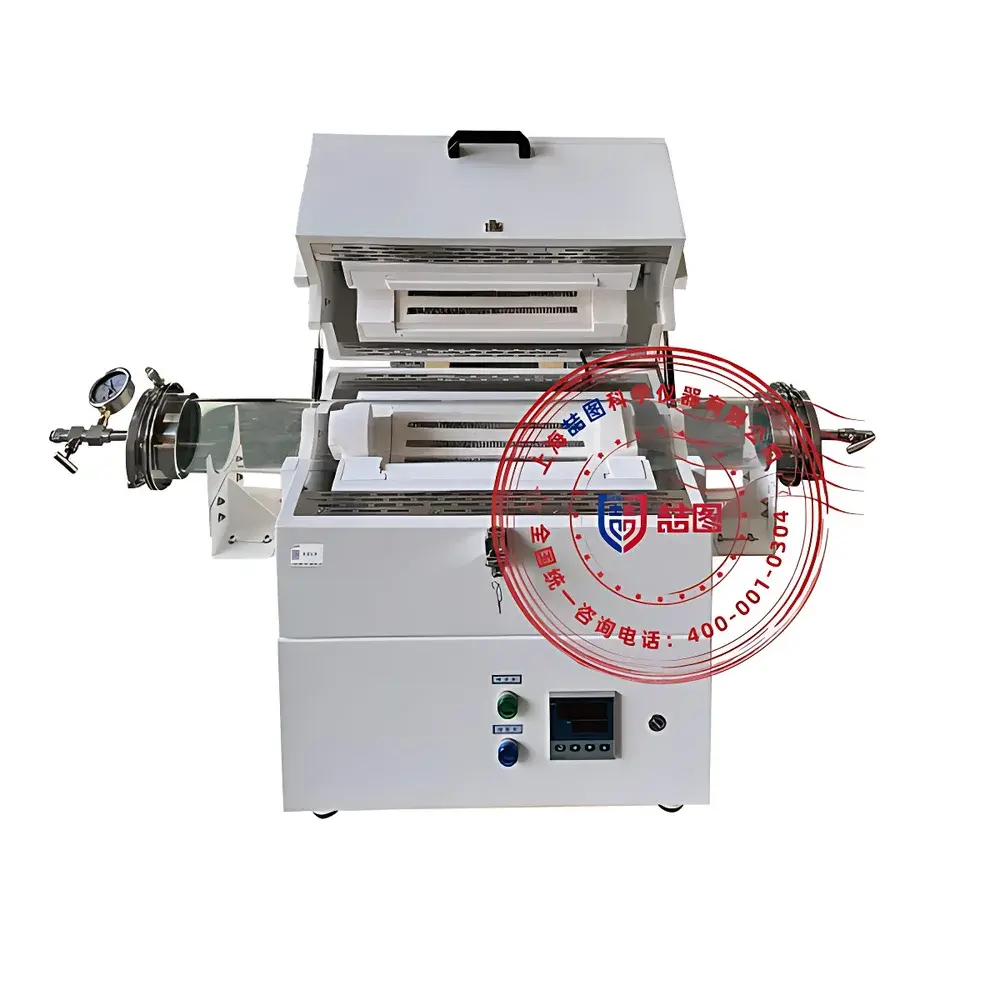
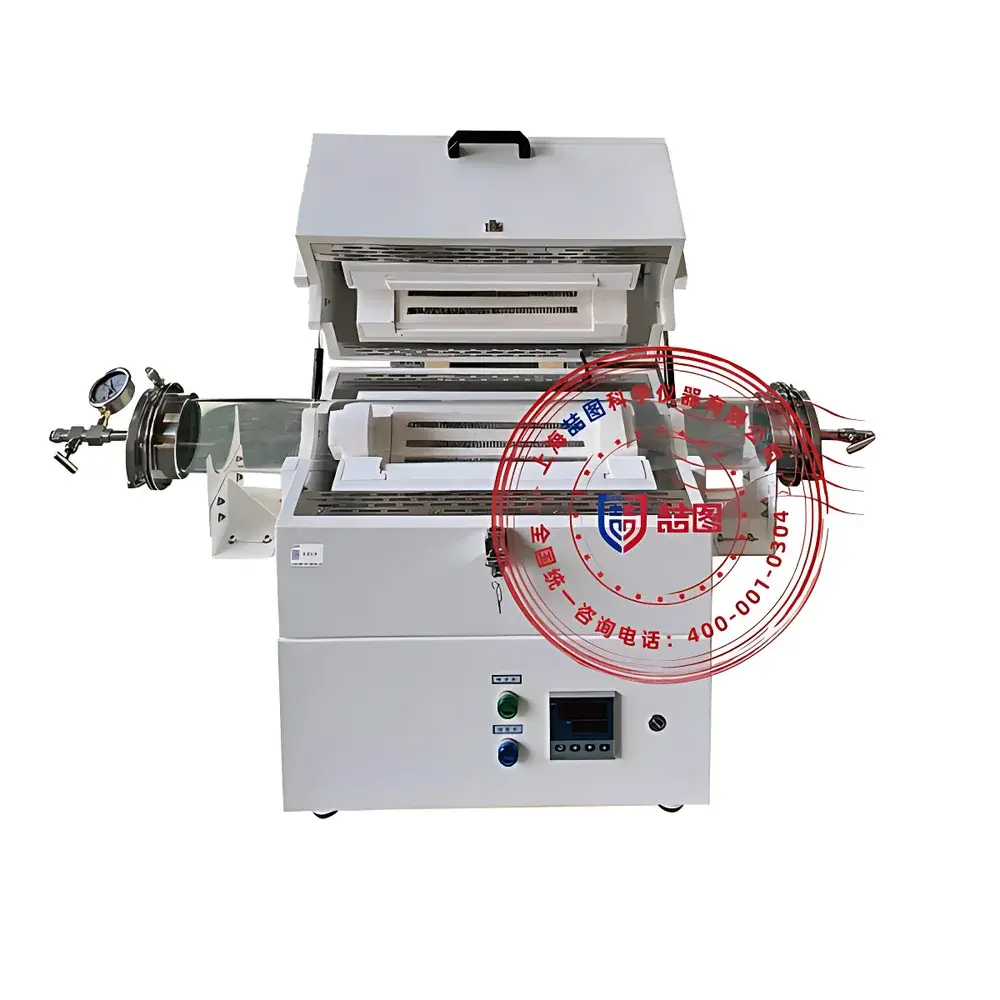
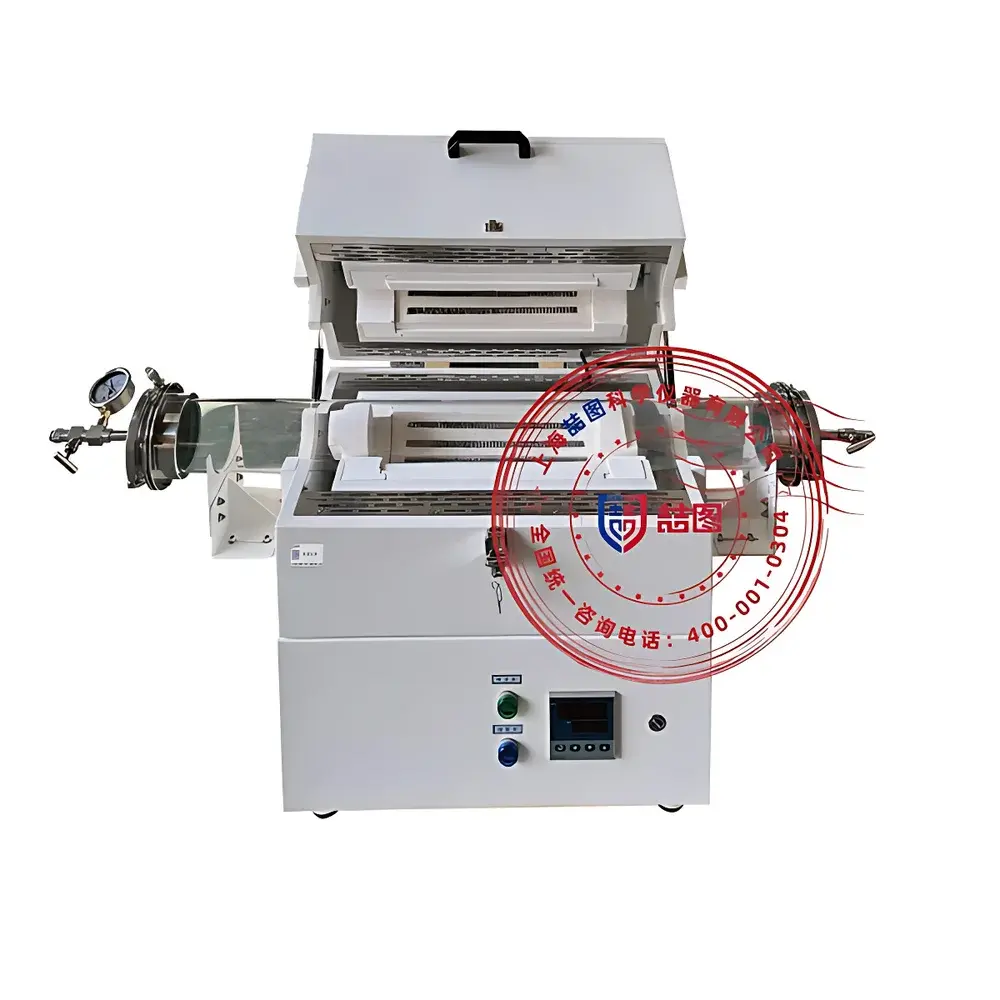
DRETOP GLK-1210B Vacuum & Controlled-Atmosphere Tube Furnace
| Brand | DRETOP |
|---|---|
| Origin | Shanghai, China |
| Manufacturer Type | Authorized Distributor |
| Product Category | Domestic |
| Model | GLK-1210B |
| Instrument Type | Horizontal Tube Furnace |
| Max Temperature | RT+50°C to 1200°C (Continuous Use ≤1100°C) |
| Temperature Control Accuracy | ±1°C |
| Max Power | 3 kW |
| Heating Rate | 1–20°C/min (adjustable) |
| Heating Element | Ni-Cr Alloy |
| Tube Dimensions | Φ100 mm × 350 mm (ID × effective heated length) |
| Vacuum Level | ≤1×10⁻³ Pa (with compatible vacuum pump) |
| Sealing | Dual O-ring KF-25 stainless steel flanges with mechanical compression |
| Atmosphere Options | N₂, Ar, H₂, forming gas, or custom mixtures via side-mounted gas inlets |
| Tube Material | High-purity fused quartz (standard) or recrystallized alumina (optional) |
| Safety Features | Over-temperature cutoff, thermocouple break detection, door-interlocked heating shutdown, earth leakage protection |
| Structural Design | Top-hinged furnace body with optional tilt mechanism (±15°), side-loading configuration, integrated multi-zone insulation chamber |
Overview
The DRETOP GLK-1210B is a horizontally oriented, programmable vacuum and controlled-atmosphere tube furnace engineered for high-precision thermal processing under reproducible low-pressure or inert/reducing gas environments. It operates on resistive heating principles using high-stability Ni-Cr alloy elements embedded within a multi-layered insulation architecture composed of sintered polycrystalline mullite fiber. The furnace achieves stable thermal uniformity across its 350 mm heated zone—critical for applications demanding strict thermal history control, such as solid-state reaction synthesis, thin-film precursor decomposition, or controlled-phase transformation studies. Its design conforms to fundamental requirements for materials science workflows where oxygen exclusion, volatile byproduct removal, or reactive gas introduction must be precisely managed without compromising thermal stability or experimental repeatability.
Key Features
- Multi-segment programmable temperature controller enabling up to 30-step ramp-soak profiles with independent rate and dwell settings—essential for complex heat treatments including sintering, annealing, carburizing, and CVD precursor pyrolysis.
- High-integrity dual-O-ring KF-25 stainless steel flange system with mechanical compression sealing ensures reliable vacuum integrity down to 1×10⁻³ Pa when paired with a suitable two-stage rotary vane or turbomolecular pump.
- Side-access tube configuration with top-hinged furnace body allows unobstructed sample insertion/removal; interlocked safety circuit automatically terminates heating upon lid opening.
- Optional tilting mechanism (±15°) facilitates gravity-assisted gas venting during thermal decomposition cycles and simplifies powder loading/unloading for viscous or particulate samples.
- Fused quartz tube (standard) offers excellent UV transparency, low thermal expansion (5.5×10⁻⁷/K), and resistance to thermal shock—suitable for rapid quenching protocols; recrystallized alumina tube option available for >1300°C compatibility and enhanced chemical inertness against halides or alkalis.
- Integrated gas manifold ports (NPT 1/4″) on both flanges support continuous purge, dynamic atmosphere switching, or pressure-controlled gas flow—compatible with mass flow controllers and residual gas analyzers for process validation.
Sample Compatibility & Compliance
The GLK-1210B accommodates cylindrical samples up to Φ90 mm × 300 mm within its 100 mm ID quartz tube. It supports crucibles made from alumina, graphite, silicon carbide, or molybdenum disilicide—subject to compatibility with target atmosphere and temperature. The furnace meets baseline mechanical and electrical safety requirements per IEC 61010-1:2010 for laboratory electrical equipment. While not certified to UL or CE standards out-of-the-box, its architecture enables integration into GLP/GMP-compliant environments when deployed with validated procedures, calibrated Class 1 thermocouples (Type S or K), and audit-trail-capable data loggers. Vacuum and gas-handling components comply with ISO 2852 and ASTM F2788 for leak-tightness verification.
Software & Data Management
The embedded PID controller includes RS485 Modbus RTU interface for integration with SCADA systems or third-party lab automation platforms (e.g., LabVIEW, MATLAB, or DeltaV). Optional PC software provides real-time temperature logging, alarm event timestamping, and export of CSV-formatted thermal profiles—including ramp rate deviation alerts and hold-time accuracy metrics. All operational parameters are stored in non-volatile memory with power-fail recovery. For regulated environments, the system supports 21 CFR Part 11-compliant electronic signatures when used with validated software extensions and user access controls.
Applications
- Synthesis of cathode/anode materials for Li-ion batteries (e.g., LiCoO₂, NMC, Si/C composites) under argon or forming gas atmospheres.
- Thermal treatment of carbon fiber precursors (PAN-based) during oxidative stabilization and low-temperature carbonization stages.
- Chemical vapor deposition (CVD) of graphene, transition metal dichalcogenides (TMDs), or metal oxide nanowires using volatile precursors.
- Controlled oxidation/reduction of catalysts (e.g., Cu/ZnO/Al₂O₃) for structure–activity correlation studies.
- Debinding and sintering of metal injection molded (MIM) and ceramic injection molded (CIM) green parts under nitrogen or hydrogen-nitrogen mixtures.
- High-temperature annealing of semiconductor wafers and optoelectronic substrates requiring ultra-low oxygen partial pressure.
FAQ
What vacuum level can the GLK-1210B achieve?
With a properly sized two-stage rotary vane pump (≥4 m³/h), the system typically reaches ≤1×10⁻³ Pa after 30–45 minutes of pumping. For higher vacuum performance (≤1×10⁻⁵ Pa), a turbomolecular pump upgrade is recommended.
Is the furnace compatible with hydrogen atmospheres?
Yes—when equipped with H₂-rated stainless steel fittings, leak-tested KF connections, and appropriate ventilation monitoring per NFPA 55 guidelines. A dedicated H₂ purge cycle and flame arrestor integration are strongly advised.
Can the tube be replaced with a larger diameter?
No—the furnace chamber and heating zone geometry are optimized for Φ100 mm tubes. Larger diameters would compromise thermal uniformity and exceed power supply capacity.
Does the system include vacuum gauge and pump?
No—vacuum gauges (capacitance manometer or Pirani) and pumps must be selected and procured separately based on application-specific vacuum class and throughput requirements.
What maintenance intervals are recommended for long-term reliability?
Inspect O-rings and flange surfaces every 200 operating hours; replace quartz tubes after 500 cumulative hours above 1000°C or upon visible devitrification; recalibrate thermocouples annually or per ISO/IEC 17025 internal procedure.



