
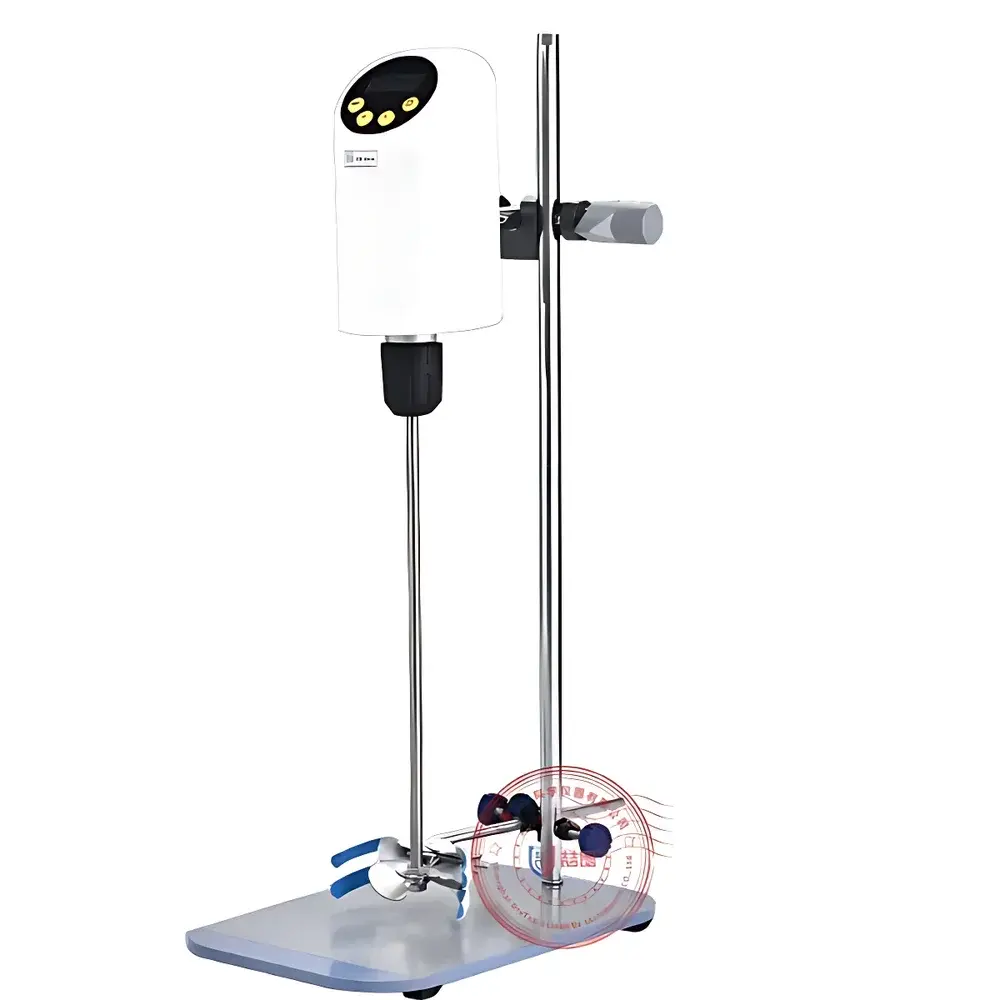
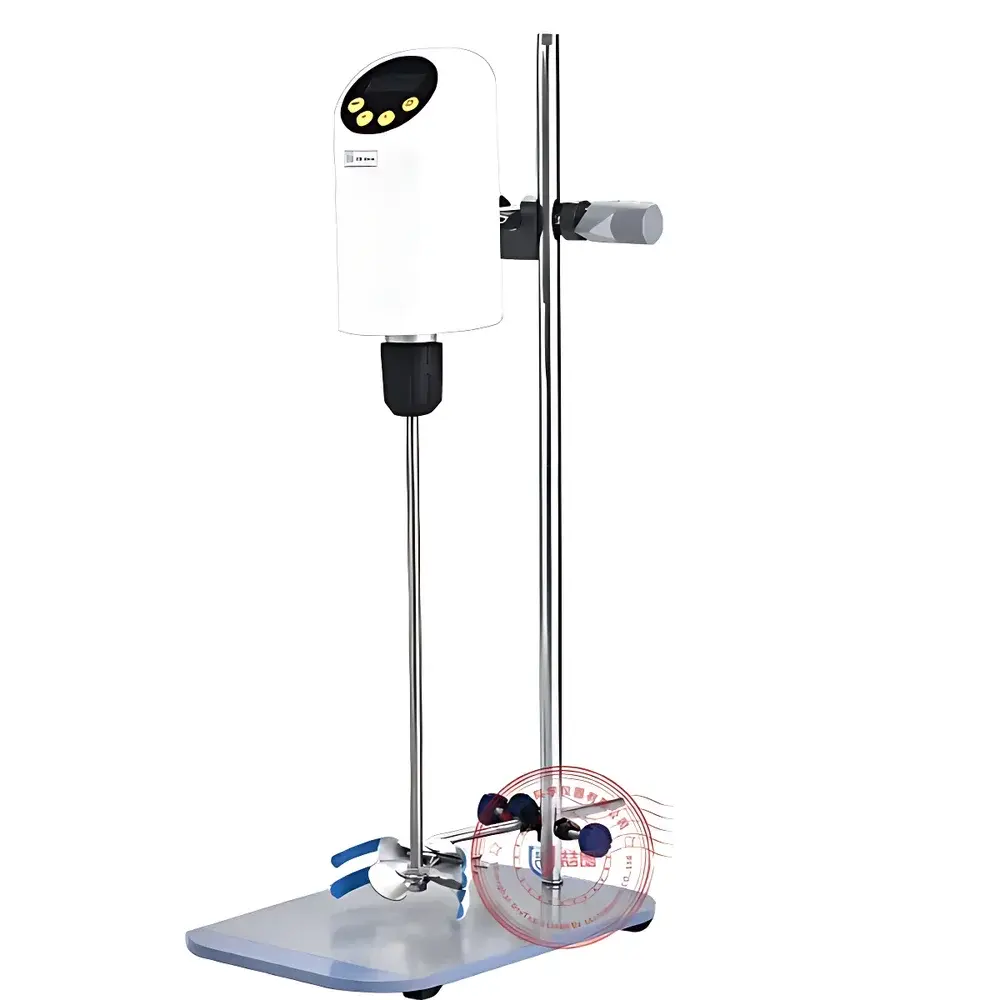
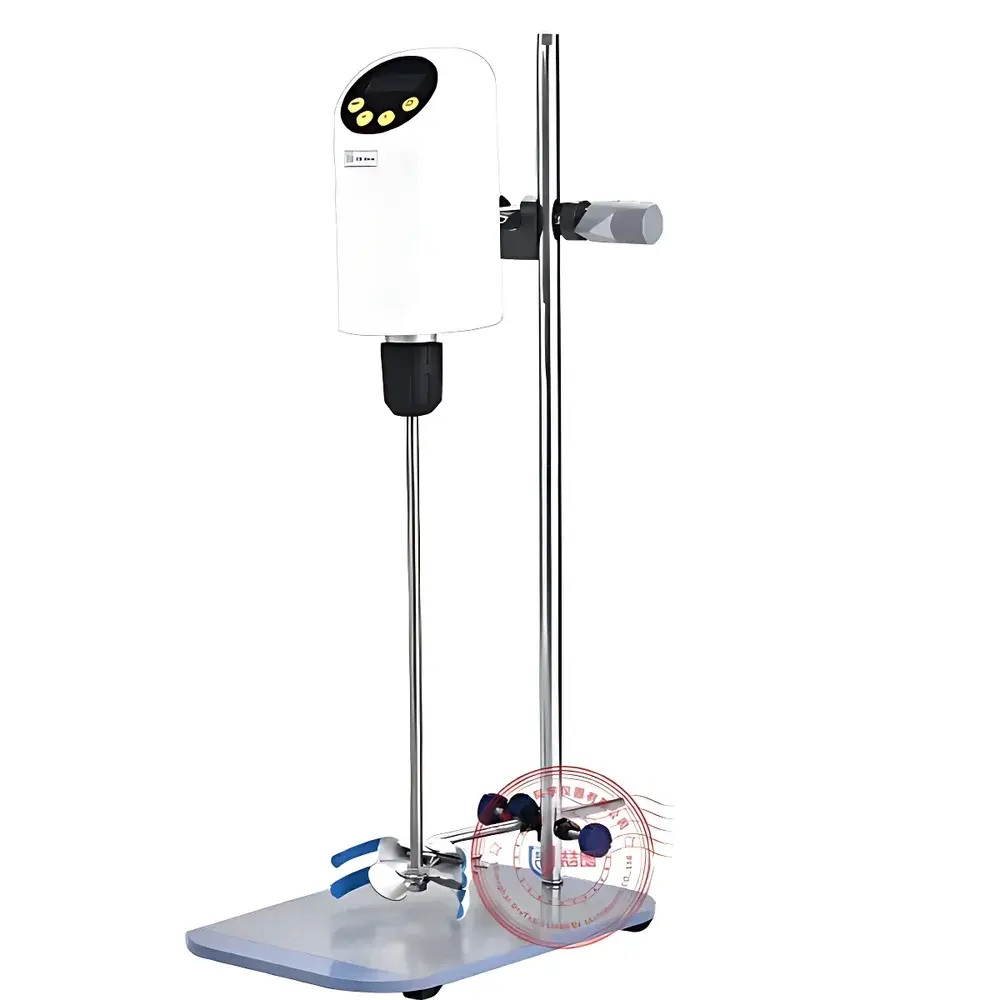
DRETOP OS5-60 Overhead Stirrer
| Brand | DRETOP |
|---|---|
| Origin | Shanghai, China |
| Manufacturer Type | Manufacturer |
| Product Category | Domestic |
| Model | OS5-60 |
| Instrument Type | Overhead Stirrer |
| Maximum Mixing Volume | 5 L |
| Speed Range | 30–2200 rpm |
| Motor Output Power | 60 W |
| Voltage | 220 V, 50 Hz |
| Speed Increment/Decrement | 20 rpm |
| Maximum Torque | 40 N·cm |
| Maximum Viscosity Handling | 10,000 mPa·s |
| Chuck Capacity | 0.5–10 mm |
| Dimensions (D×W×H) | 160 × 230 × 600 mm |
| Safety Features | Automatic Overload Protection, Circuit Protection, Soft-Start Function |
| Drive Type | Brushless DC Motor |
| Display | LED (Set Speed & Actual Speed), Timer Function |
| Rotation Direction | Forward/Reverse |
| Standard Accessories | Stainless Steel Straight Blade Impeller, Adjustable Clamp Stand Assembly |
Overview
The DRETOP OS5-60 Overhead Stirrer is an engineered solution for precise, high-torque mechanical agitation in laboratory-scale mixing and dispersion applications. Unlike magnetic stirrers, this overhead system employs a direct-drive brushless DC motor coupled to a vertically mounted shaft and interchangeable impellers—enabling reliable operation across a broad viscosity spectrum (up to 10,000 mPa·s) and large-volume configurations (up to 5 L). Its top-mounted control module minimizes benchtop footprint while maintaining ergonomic access to speed and timer controls. The device operates on the principle of rotational mechanical shear, delivering consistent torque output and stable angular velocity under variable load conditions—critical for reproducible suspension of particulates, homogenization of polymer solutions, gas sparging into viscous media, or continuous-phase blending in chemical synthesis and bioprocess development.
Key Features
- Brushless DC motor design ensures maintenance-free operation, low acoustic noise (<55 dB(A) at 1 m), and thermal stability during extended duty cycles—validated for continuous operation exceeding 8 hours at rated load.
- Microprocessor-controlled speed regulation with ±1% accuracy across the full 30–2200 rpm range; real-time LED display shows both setpoint and actual rotational speed, along with elapsed time.
- Soft-start functionality prevents sample splashing during initiation; forward/reverse rotation mode supports controlled de-agglomeration and vortex management in heterogeneous systems.
- Integrated electronic overload protection triggers automatic shutdown upon torque exceedance (>40 N·cm), accompanied by visual fault indication and circuit-level current limiting per IEC 61000-4-5 compliance.
- Universal chuck accepts standard impeller shanks from 0.5 to 10 mm diameter; modular stand assembly (included) accommodates round-bottom flasks, beakers, and jacketed reactors up to Ø150 mm base diameter.
- Ergonomic rotary encoder enables tactile, stepwise speed adjustment in 20 rpm increments; non-volatile memory retains last-used parameters after power cycling.
Sample Compatibility & Compliance
The OS5-60 is validated for use with Newtonian and pseudo-plastic fluids—including mineral oils, epoxy resins, pharmaceutical suspensions, wastewater sludge simulants, and aqueous hydrocolloid gels. It complies with CE marking requirements (2014/30/EU EMC Directive and 2014/35/EU LVD Directive) and meets IP20 ingress protection standards for indoor laboratory environments. While not certified to ISO/IEC 17025 as a measurement instrument, its performance characteristics align with ASTM D2196 (Standard Test Methods for Rheological Properties of Non-Newtonian Materials) and USP (Viscosity) test preparation protocols. All stainless-steel wetted parts conform to ASTM A276 Type 316 specifications; PTFE-coated impellers satisfy FDA 21 CFR 177.1550 for incidental food contact.
Software & Data Management
This model operates as a standalone analog-controlled unit without digital interface or PC connectivity. However, its timer function (0–99 min 59 s) and dual-speed display support GLP-compliant manual data recording. Users may integrate it into validated workflows by logging speed, duration, impeller type, and vessel geometry in laboratory notebooks or LIMS-compatible spreadsheets. For regulated environments requiring audit trails, external data loggers (e.g., Omega OM-DAQPRO-5300 series) can capture analog tachometer outputs via optional 0–10 V signal taps (available upon request with OEM firmware revision).
Applications
- Chemical process development: Emulsion formation, catalyst suspension, solvent-based polymer dissolution.
- Pharmaceutical R&D: Uniform dispersion of active pharmaceutical ingredients (APIs) in semi-solid bases; excipient blending for topical gel formulations.
- Environmental testing: Homogenization of sediment cores prior to heavy metal extraction; activated sludge mixing in BOD incubation studies.
- Materials science: Dispersion of nanofillers (e.g., carbon black, SiO₂) in thermoset precursors; rheological preconditioning of battery electrode slurries.
- Academic instruction: Demonstration of shear-thinning behavior, Reynolds number transitions, and power number correlations in fluid dynamics laboratories.
FAQ
Is the OS5-60 suitable for use with corrosive solvents such as concentrated acids or halogenated hydrocarbons?
Yes—when equipped with PTFE-coated or Hastelloy-C276 impellers (optional); standard 316 stainless steel components resist mild organic acids and alkaline media but are not recommended for prolonged exposure to HCl, HF, or hot HNO₃.
Can the stirrer maintain constant speed when viscosity increases during a reaction?
Yes—the closed-loop microprocessor control dynamically adjusts motor current to compensate for torque fluctuations, sustaining set speed within ±1.5% deviation up to maximum rated viscosity.
What is the recommended maintenance interval for the brushless motor?
None—brushless DC motors contain no consumable brushes; routine inspection of chuck integrity and impeller balance every 500 operating hours is sufficient.
Does the unit support external triggering or programmable ramp profiles?
No—this is a manually operated instrument without RS-232, USB, or analog output ports; programmable sequences require integration with third-party PID controllers or PLCs.
How is centering accuracy verified when using conical vessels like Erlenmeyer flasks?
Centering is achieved mechanically: adjust the vertical clamp position until the impeller tip traces concentric circles within ±0.5 mm radial deviation at operating speed; laser alignment tools (e.g., Thorlabs LA190) may be used for validation in metrology-critical applications.



