
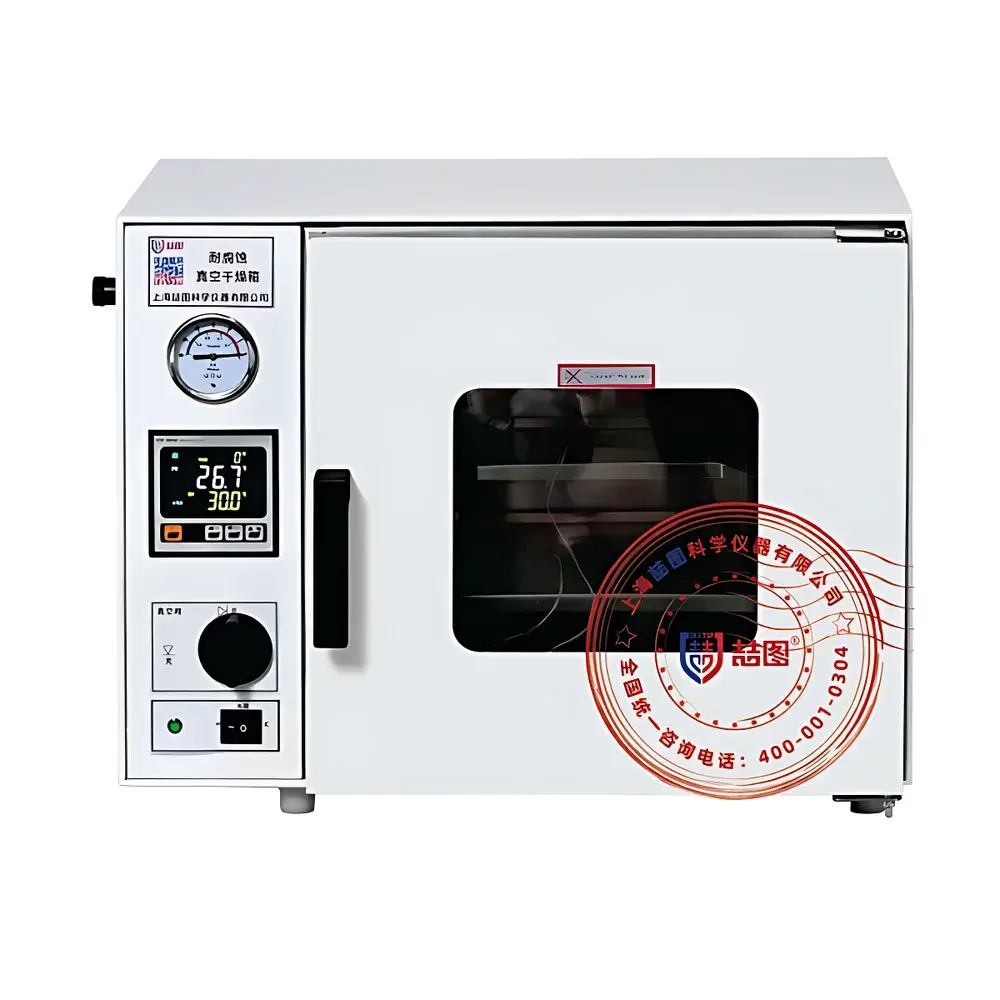
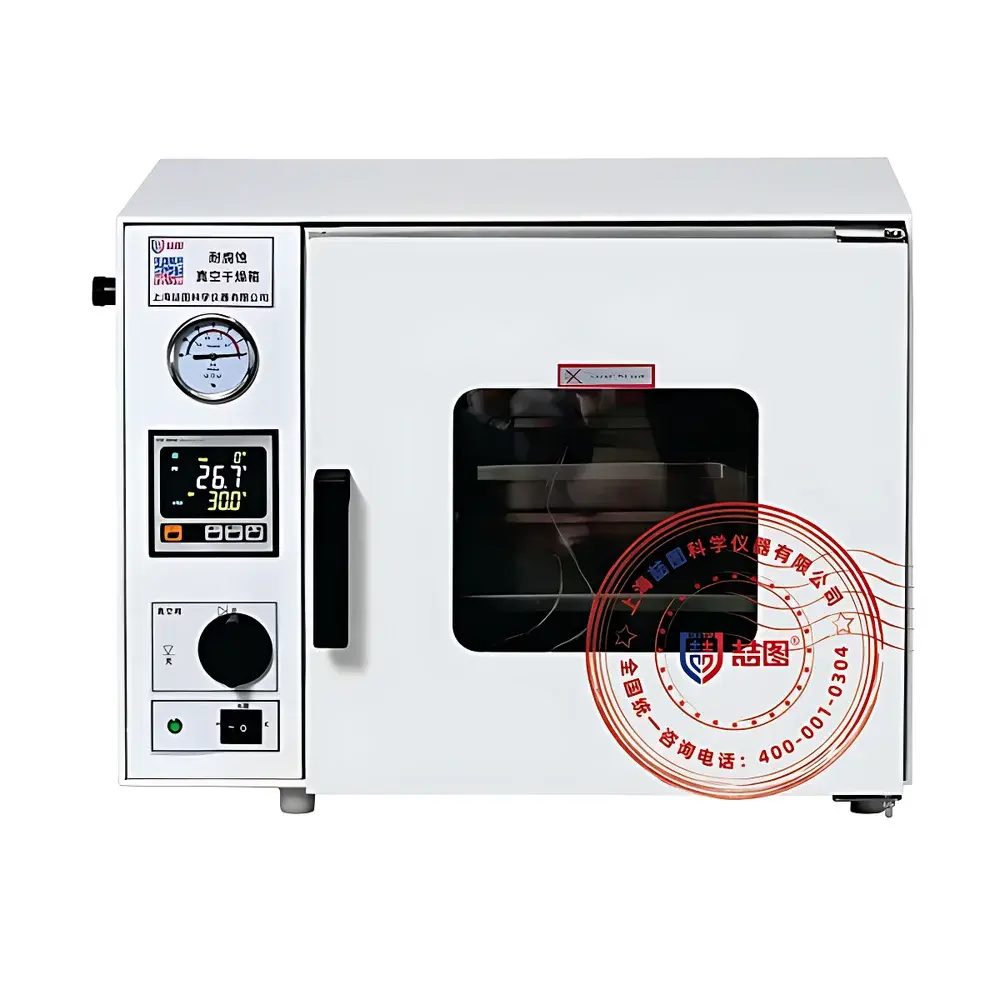
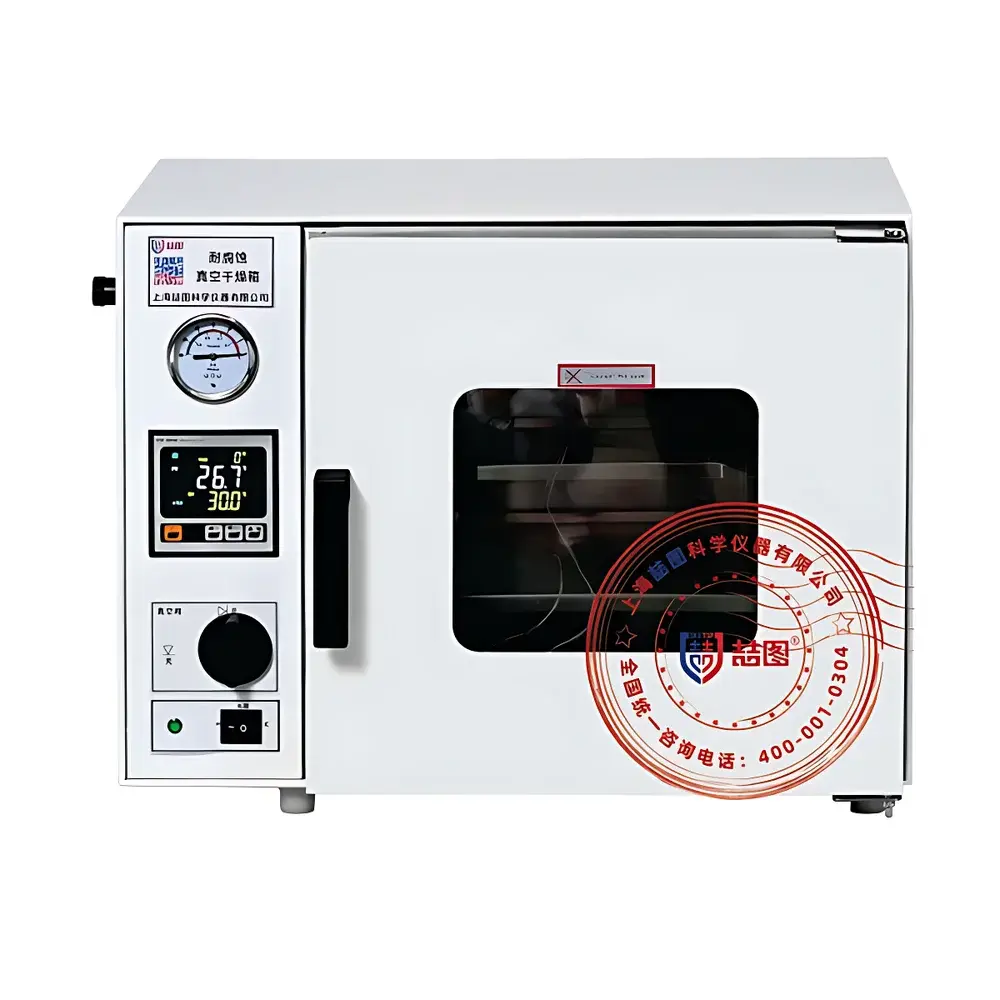
DRETOP PFA-90GF PFA-Coated Vacuum Drying Oven
| Brand | DRETOP |
|---|---|
| Origin | Shanghai, China |
| Manufacturer Type | Direct Manufacturer |
| Product Category | Domestic |
| Model | PFA-90GF |
| Instrument Type | Vacuum Oven |
| Temperature Range | RT+10–150 °C |
| Temperature Fluctuation | ±0.5 °C |
| Interior Dimensions | 450 × 450 × 450 mm |
| Temperature Resolution | 0.1 °C |
| Operating Ambient Temperature | +5–40 °C |
| Chamber Lining Material | PFA (Perfluoroalkoxy) Coating |
| Heating Method | External Heating |
| Vacuum Level | ≤133 Pa |
Overview
The DRETOP PFA-90GF is a high-integrity vacuum drying oven engineered for laboratories and production environments where chemical resistance, material purity, and process reproducibility are non-negotiable. Unlike conventional stainless-steel or aluminum-lined ovens, the PFA-90GF features a uniformly applied PFA (perfluoroalkoxy) polymer coating on its interior chamber walls and shelves—providing exceptional inertness against aggressive inorganic acids (e.g., concentrated H₂SO₄, HCl, HNO₃), strong alkalis (e.g., 50% NaOH, KOH), halogenated solvents (e.g., chloroform, dichloromethane), and polar organics (e.g., methanol, acetonitrile). Its vacuum operation eliminates atmospheric oxygen and moisture, preventing oxidation, hydrolysis, or surface degradation of sensitive materials such as lithium-ion battery cathode precursors, semiconductor-grade metal oxides, pharmaceutical intermediates, and ultra-trace analytical standards. The oven operates under controlled low-pressure conditions (≤133 Pa), enabling gentle yet efficient solvent removal at reduced temperatures—critical for thermolabile compounds and nanoscale powders prone to sintering or agglomeration.
Key Features
- PFA-coated interior chamber (450 × 450 × 450 mm) with zero metallic ion leaching—validated for semiconductor-grade cleanliness and USP compliance in extractables profiling;
- External heating architecture ensures uniform thermal distribution across the chamber volume, minimizing hot/cold spots and supporting ISO 17025-compliant temperature homogeneity verification;
- Integrated tempered glass observation window enables real-time visual monitoring without vacuum break or thermal disturbance;
- Programmable digital temperature controller with 0.1 °C resolution and ±0.5 °C stability over full operating range (RT+10 to 150 °C);
- Dual safety architecture: independent over-temperature cut-off (mechanical backup) and grounded chassis with leakage current protection per IEC 61010-1;
- Chemically resistant sealing system using FFKM (perfluoroelastomer) gaskets rated for continuous exposure to pH 0–14 and organic vapors—preventing seal degradation and vacuum integrity loss;
- Modular shelf design with adjustable height positions accommodates heterogeneous sample geometries (powders, wafers, coated foils, porous monoliths) without reconfiguration downtime.
Sample Compatibility & Compliance
The PFA-90GF is routinely deployed in GMP-regulated pharmaceutical development (ICH Q5C stability studies), high-purity electronics manufacturing (cleanroom-compatible drying of etch-resistant photoresist residues), and nuclear materials handling (ASTM C1174-certified low-background processing of actinide compounds). Its PFA lining meets ASTM D2990 requirements for fluoropolymer adhesion strength and demonstrates no measurable leachables (<0.1 ppb) when challenged with 1 M HNO₃ at 80 °C for 72 h—supporting trace-metal analysis workflows per EPA Method 200.8 and ISO/IEC 17025 accreditation. All electrical components conform to CE marking directives (2014/30/EU EMC, 2014/35/EU LVD), and optional audit-trail-enabled controllers comply with FDA 21 CFR Part 11 for electronic records and signatures.
Software & Data Management
The standard configuration includes an embedded LCD interface with password-protected parameter locking, cycle logging (date/time, setpoint, actual temperature, vacuum level), and USB export capability for raw data archiving. Optional Ethernet-enabled controllers integrate with LabArchives ELN and DeltaV DCS systems via Modbus TCP, providing real-time telemetry, remote alarm notification (SMTP/SNMP), and automated report generation aligned with ALCOA+ data integrity principles. All temperature and vacuum profiles are time-stamped with hardware-based RTC and support retrospective validation per Annex 11 (EU GMP) and ISPE GAMP 5.
Applications
- Drying hygroscopic catalysts (e.g., Pt/C, NiMo/Al₂O₃) without surface oxidation or metal agglomeration;
- Removing residual solvents from API crystallization batches under inert vacuum—reducing residual DMF, THF, or ethyl acetate to <10 ppm;
- Conditioning quartz crystal microbalance (QCM) sensors and MEMS substrates prior to thin-film deposition;
- Stabilizing perovskite precursors (e.g., MAPbI₃) for photovoltaic R&D with sub-ppm O₂/H₂O control;
- Dehydrating reference standards for ICP-MS calibration (e.g., NIST SRM 3100 series) without chloride contamination;
- Post-etch drying of GaN-on-Si wafers to prevent native oxide formation and interfacial delamination.
FAQ
What vacuum pumps are compatible with the PFA-90GF?
The unit is factory-matched with corrosion-resistant diaphragm vacuum pumps (GF-series), featuring PTFE-coated chambers and FFKM valves—rated for continuous operation at ≤133 Pa with aggressive vapors. Oil-sealed rotary vane pumps are not recommended due to hydrocarbon backstreaming risk.
Can the PFA coating withstand repeated thermal cycling between ambient and 150 °C?
Yes. PFA exhibits a service temperature range of –200 °C to +260 °C and retains adhesion and chemical resistance after >500 cycles per ASTM D3359 cross-hatch testing.
Is the oven suitable for Class 100 cleanroom integration?
When equipped with HEPA-filtered purge gas inlet and static-dissipative exterior finish, the PFA-90GF meets ISO 14644-1 Class 5 particle emission limits during operation.
How is temperature uniformity verified across the chamber?
DRETOP provides a 9-point validation certificate (per ISO 17025-accredited third-party lab) documenting spatial deviation ≤±1.2 °C at 120 °C under vacuum—traceable to NIST-calibrated RTDs.
Does the system support automated vacuum ramping during heating?
Yes. Optional programmable vacuum control modules enable synchronized pressure reduction and temperature ramping—critical for avoiding bumping or foaming in viscous slurries.



