
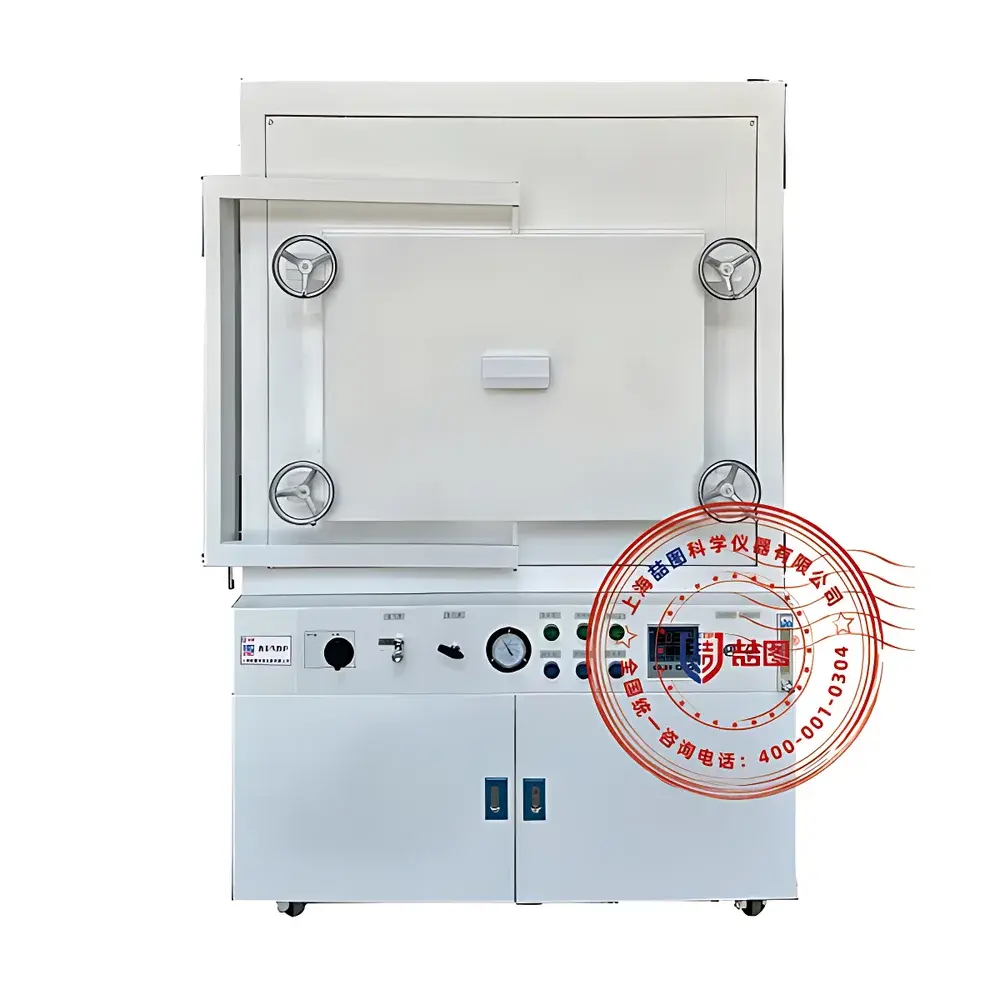
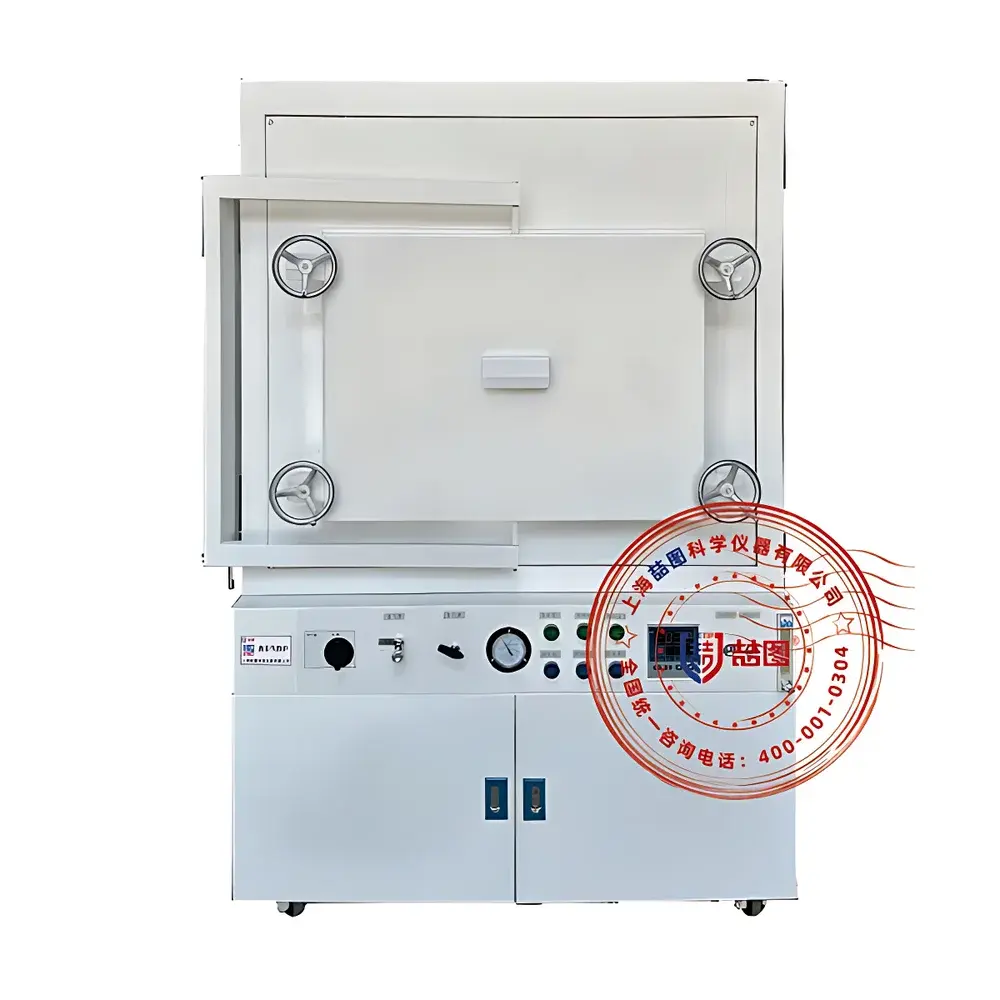
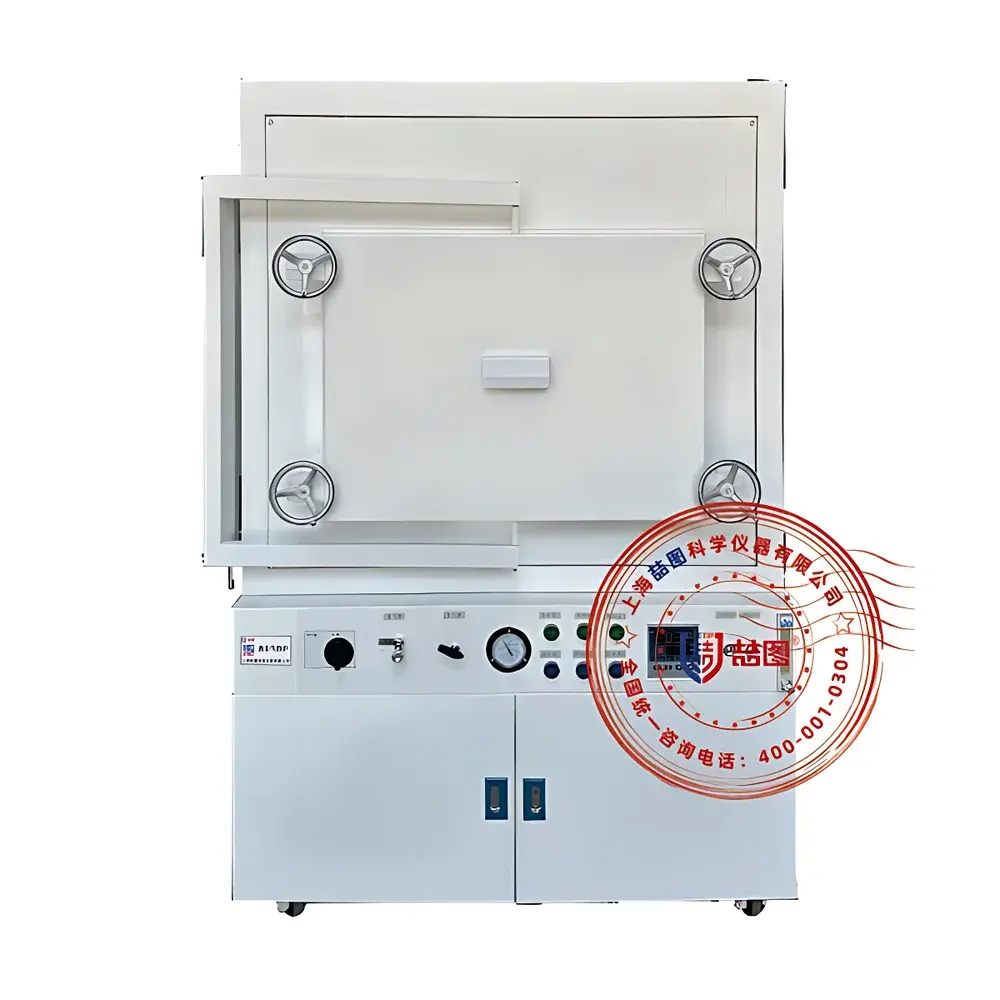
DRETOP QSV-1-14P Benchtop Vacuum/Atmosphere-Controlled Muffle Furnace
| Brand | DRETOP |
|---|---|
| Origin | Shanghai, China |
| Model | QSV-1-14P |
| Instrument Type | Box-Type Muffle Furnace |
| Max Operating Temperature | 1400 °C (Continuous at ≤1300 °C) |
| Temperature Uniformity | ±1 °C |
| Rated Power | 2000 W |
| Heating Rate to Max Temp | 25–35 °C/min (reaches 1400 °C in ~40 min) |
| Heating Element | Silicon Carbide Rods |
| Internal Chamber Dimensions | 100 × 100 × 100 mm |
| Nominal Volume | 1 L |
| Pressure Range | −0.1 MPa to +1 MPa (differential control from 10–1000 mbar) |
| Max Safe Internal Gas Pressure | 0.02 MPa |
| Cooling Options | Natural convection or inert-gas purging |
| Voltage | 220 V AC |
Overview
The DRETOP QSV-1-14P is a compact, benchtop vacuum and atmosphere-controlled muffle furnace engineered for precision thermal processing in research laboratories and small-scale production environments. It integrates vacuum technology with programmable temperature control to enable oxidation-free, decarburization-free, and contamination-minimized heat treatment—critical for metallurgical annealing, ceramic sintering, powder metallurgy, and advanced material synthesis. Unlike conventional air-atmosphere furnaces, the QSV-1-14P operates under dynamically regulated pressure conditions (from rough vacuum to mild overpressure), allowing users to eliminate ambient oxygen prior to heating and introduce controlled inert or reducing atmospheres (e.g., N₂, Ar, forming gas) during thermal cycles. Its core architecture employs silicon carbide (SiC) heating elements embedded in high-purity alumina fiber insulation, delivering rapid thermal response, excellent temperature homogeneity (<±1 °C), and long-term stability across repeated thermal cycling up to 1400 °C.
Key Features
- Benchtop form factor (1 L chamber volume) with side-sliding door for ergonomic sample loading and minimal heat loss during access
- Dual-shell construction with high-efficiency ceramic fiber insulation—surface temperature remains <50 °C at full operating temperature, enhancing lab safety and energy efficiency
- Integrated vacuum system including oil-free rotary vane pump and calibrated analog vacuum gauge (range: 0.1–1000 mbar)
- Modular gas handling subsystem with mass flow controller, pressure-regulated inlet valves, and dual-stage pressure monitoring (vacuum & positive pressure)
- Intelligent PID-based temperature controller with auto-tuning, multi-segment programmability (up to 30 segments), and real-time ramp/soak profiling
- Comprehensive safety architecture: over-temperature cutoff (independent thermocouple), over-pressure interlock, ground-fault detection, short-circuit protection, and thermocouple break alarm
- Front-panel password-protected parameter lockout to prevent unauthorized modification of critical settings
Sample Compatibility & Compliance
The QSV-1-14P supports diverse sample geometries and materials—including metallic alloys (e.g., Cu, Al, stainless steel, Pt, Ag), ceramics (Al₂O₃, ZrO₂), graphite crucibles, and composite precursors—within its 100 mm × 100 mm × 100 mm isothermal zone. Its pressure-rated chamber (ASME BPVC Section VIII compliant design basis) accommodates processes requiring strict atmospheric exclusion (e.g., oxide-sensitive Ti alloy annealing) or controlled partial pressures (e.g., carburizing or nitriding pre-treatments). The furnace meets general requirements for GLP-compliant thermal validation protocols and is compatible with ASTM E220, ISO 8065, and IEC 61000-4 electromagnetic compatibility standards. While not certified for hazardous gas service (e.g., H₂), it supports inert gas purging per ISO 857-2 guidelines when equipped with appropriate external regulators and leak-tested fittings.
Software & Data Management
The furnace controller logs time-stamped temperature, pressure, and power data internally (up to 10,000 records) and exports via RS485/Modbus RTU to third-party SCADA or LIMS platforms. Optional USB-to-serial adapter enables direct CSV export for post-process analysis in Excel or Python-based thermal modeling workflows. All program sequences support audit-trail generation with user ID stamping—facilitating compliance with FDA 21 CFR Part 11 when paired with validated electronic signature software. Calibration records, maintenance logs, and operational deviations can be archived alongside thermal profiles for full traceability in QA/QC documentation packages.
Applications
- Controlled-atmosphere annealing of precious metals (Au, Pt, Ag) and non-ferrous alloys (Cu, brass, Al) without surface oxidation
- Sintering of oxide and carbide ceramics under vacuum or nitrogen purge to suppress grain growth
- Thermal decomposition studies of battery cathode precursors (e.g., LiCoO₂, NMC) under inert gas
- Graphitization of carbon composites and pyrolysis of polymer-derived ceramics
- Calibration reference heating for thermocouple verification per ASTM E230
- Small-batch heat treatment R&D for aerospace-grade superalloys and additive manufacturing powders
FAQ
What is the maximum safe internal pressure during gas introduction?
The furnace chamber is rated for continuous operation up to 0.02 MPa (200 mbar) gauge pressure. Exceeding this limit risks seal failure and compromises vacuum integrity. Always use an external pressure-reducing regulator on gas supply lines.
Can hydrogen be used as a process gas?
Hydrogen is not recommended due to flammability hazards (LEL 4.0% in air) and potential embrittlement of SiC heating elements. Only inert gases (N₂, Ar) or low-risk mixtures (e.g., 5% H₂ in N₂) are permitted under strict risk assessment and engineering controls.
Is the furnace suitable for use inside a glovebox?
Yes—the unit operates on standard 220 V single-phase power and features a compact footprint (W320 × D380 × H420 mm). An optional inert-gas inlet port kit enables direct integration with glovebox purge lines.
How is temperature uniformity verified?
Uniformity is characterized per ASTM E220 using a 3-point thermocouple mapping procedure at 1000 °C and 1300 °C. Certified test reports include radial and axial deviation profiles across the hot zone.
What maintenance is required for the vacuum system?
The included oil-free pump requires no oil changes but needs periodic filter replacement (every 6 months under continuous use) and desiccant cartridge refreshment to maintain ≤10 mbar base pressure.



