
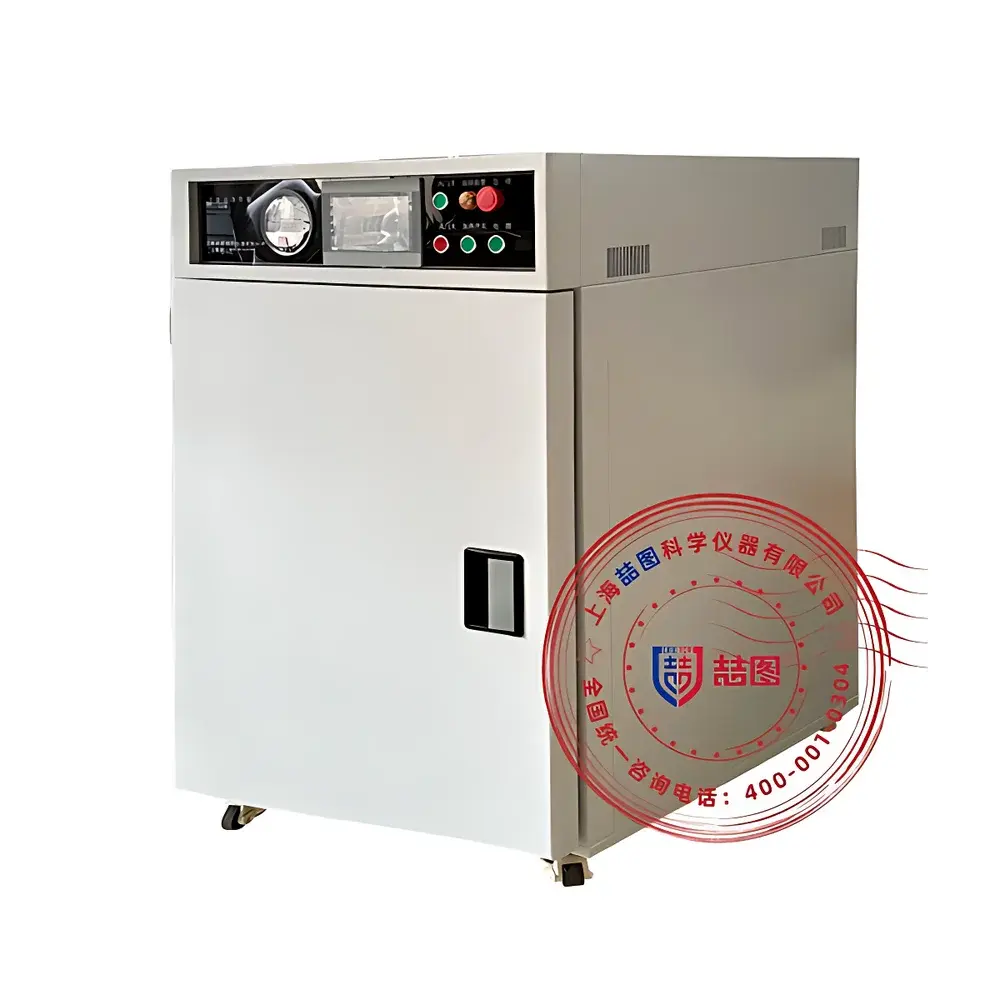
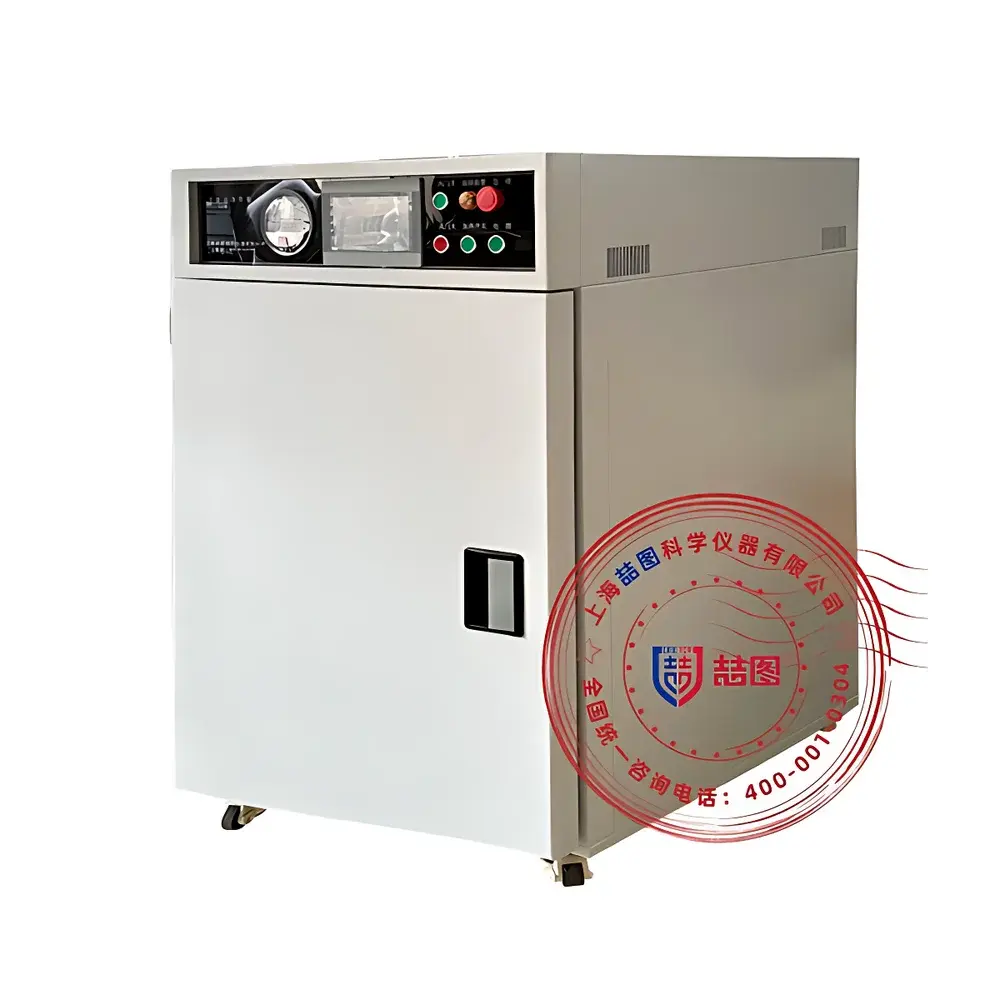
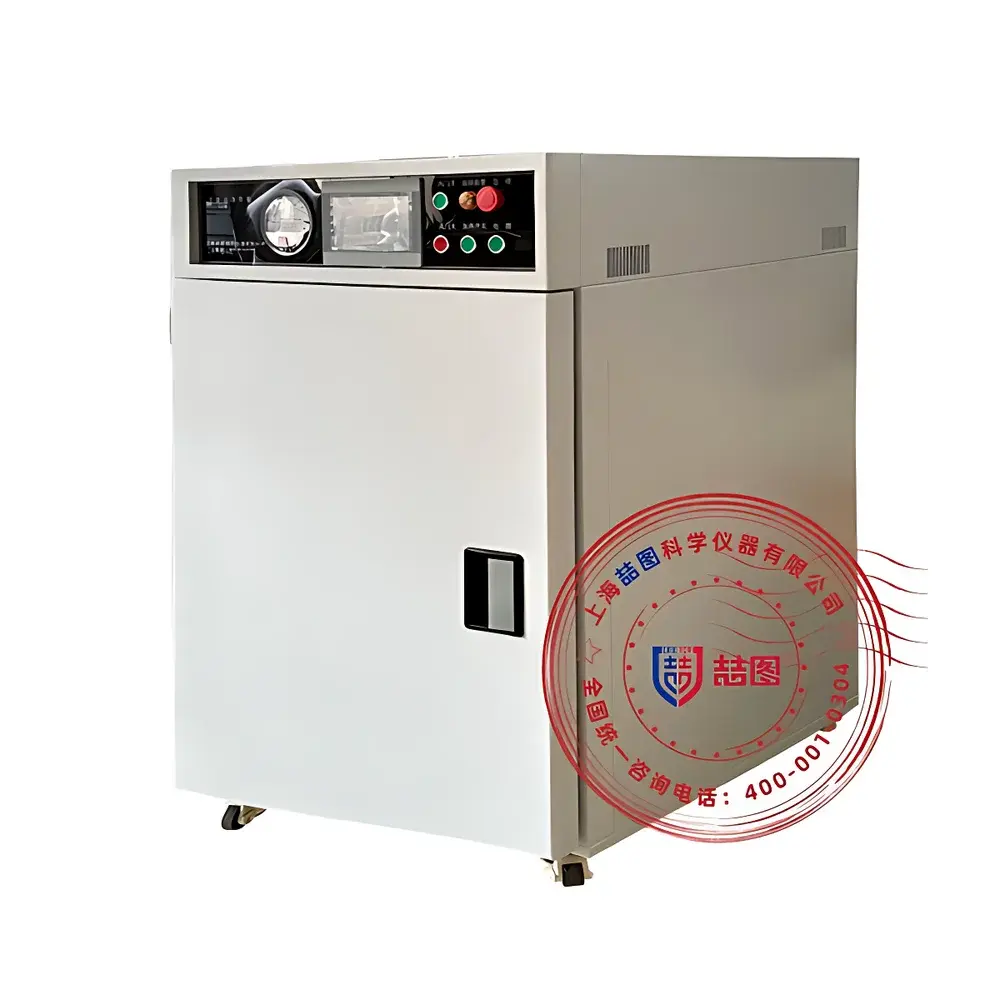
DRETOP TBJ-180 Class 100 Cleanroom Drying Oven
| Brand | DRETOP |
|---|---|
| Origin | Shanghai, China |
| Model | TBJ-180 |
| Instrument Type | Forced-Convection Clean Drying Oven |
| Temperature Range | RT+50°C to 250°C |
| Temperature Uniformity | ±2.5% |
| Temperature Fluctuation | ±1°C |
| Temperature Resolution | 0.1°C |
| Inner Chamber Dimensions (W×D×H) | 600×500×600 mm |
| External Dimensions (W×D×H) | 965×1240×1510 mm |
| Chamber Material | 316 Stainless Steel |
| Heating Method | Hot-Air Circulation with Stainless Steel Finned Electric Heaters |
| Working Ambient Temperature | 30–40°C |
| Filter Class | H14 HEPA (99.995% @ 0.3 µm) |
| Compliance | ISO 14644-1 Class 5 (FS209E Class 100), SEMI S2/S8, GMP-aligned design |
| Power Supply | AC 220 V / 50 Hz |
| Rated Power | 3500 W |
| Volume | 180 L |
| Shelf Capacity | 2 adjustable shelves, ≤15 kg total load |
| Timer Range | 1–9999 min |
| Control Interface | Color TFT Touchscreen with PID Auto-Tuning, USB Data Export, Optional RS-485 for MES Integration |
| Security | Password-protected lock screen, optional multi-level user permissions and audit trail (21 CFR Part 11–compatible logging) |
Overview
The DRETOP TBJ-180 Class 100 Cleanroom Drying Oven is an engineered solution for thermal processing in controlled environments where particulate contamination must be rigorously suppressed. Unlike conventional drying ovens, this system integrates ISO 14644-1 Class 5 (formerly FS209E Class 100) cleanroom performance with precise temperature control—enabling applications requiring both thermal stability and ultra-low airborne particle concentration. Its operational principle relies on continuous positive-pressure airflow generated by an internal centrifugal fan, passing through a high-efficiency H14 HEPA filter (99.995% efficiency at 0.3 µm), followed by uniform recirculation via a spiral duct system and multi-layer thermal insulation. This architecture ensures dynamic cleanliness maintenance—not merely static “clean-at-start” conditions—thereby eliminating post-cycle recontamination risks common in non-ventilated ovens. Designed for semiconductor wafer pre-bake, photoresist hardbake, optical component low-oxygen drying, and sterile pharmaceutical intermediate handling, the TBJ-180 meets the physical and procedural expectations of GMP, SEMI S2/S8, and ISO 14644-compliant facilities.
Key Features
- Class 100 (ISO 5) clean environment sustained dynamically during operation via H14 HEPA filtration and positive-pressure airflow management
- 316 stainless steel inner chamber with full-perimeter argon welding—corrosion-resistant, non-shedding, and compatible with aggressive solvents and high-purity process gases
- Intelligent PID temperature controller with auto-tuning, ramp-soak programming, and real-time deviation monitoring; resolution of 0.1°C, fluctuation ±1°C, uniformity ±2.5%
- Color TFT touchscreen interface supporting parameter logging, alarm history review, USB data export (CSV), and optional RS-485 Modbus RTU integration with laboratory MES or SCADA systems
- Comprehensive safety architecture: over-temperature cut-off, phase-loss detection, fan overheat protection, leakage current monitoring, short-circuit and overload relays, thermocouple break detection, and automatic parameter retention upon power interruption
- Thermal insulation using multi-layer ceramic fiber and vacuum-sealed air gaps minimizes external surface temperature rise and improves energy efficiency
Sample Compatibility & Compliance
The TBJ-180 accommodates non-volatile, non-flammable, and non-explosive samples—including silicon wafers, lithium niobate substrates, optical lenses, pharmaceutical excipients, and nanomaterial precursors—within its 180 L chamber (600 × 500 × 600 mm). It is explicitly unsuitable for volatile organic solvents, pyrophoric substances, or biological agents requiring biosafety containment. Regulatory alignment includes design adherence to ISO 14644-1:2015 (Class 5), SEMI F21-0217 (for semiconductor tool cleanliness), and GMP Annex 1 principles for aseptic processing equipment qualification. While not certified as FDA 21 CFR Part 11–compliant out-of-the-box, its audit-trail-capable firmware (with optional user permission tiers and timestamped operator logs) supports validation under GLP/GMP frameworks when configured per site-specific SOPs.
Software & Data Management
The embedded control software provides full-cycle traceability: all setpoints, actual temperatures, alarm events, operator IDs (when logged in), and timestamped system status changes are stored internally and exportable via USB flash drive in CSV format. Optional firmware enables RS-485 communication using Modbus RTU protocol, allowing bidirectional integration with centralized lab informatics platforms (e.g., LabVantage, Thermo Fisher SampleManager). Audit trail functionality—when enabled—records user login/logout, parameter modifications, start/stop commands, and fault acknowledgments with immutable timestamps, satisfying ALCOA+ data integrity requirements for regulated environments.
Applications
- Semiconductor manufacturing: Pre-deposition bake, post-coating soft-bake and hard-bake, post-lithography development bake, and low-oxygen annealing of thin-film devices
- Optoelectronics: Drying of anti-reflective coatings on precision optics, moisture removal from laser cavity components
- Pharmaceutical R&D: Solvent-free drying of lyophilized intermediates, thermal stabilization of sterile APIs under controlled particulate conditions
- Academic & national labs: High-temperature aging of MEMS sensors, thermal cycling of piezoelectric ceramics, and inert-atmosphere curing of functional nanocomposites
- Advanced materials: Degassing of metal-organic frameworks (MOFs), binder burnout in ceramic green bodies, and controlled oxidation of 2D material precursors
FAQ
Does the TBJ-180 support inert gas purging (e.g., N₂ or Ar)?
No standard inert gas inlet is provided; however, custom porting can be implemented during factory configuration upon request.
Is the H14 filter replaceable in-situ without tools?
Yes—the filter housing is front-accessible with quick-release latches, enabling tool-free replacement while maintaining chamber seal integrity.
Can temperature uniformity be verified per ASTM E2207 or IEC 60068-3-5?
Yes—its chamber geometry and airflow design comply with sensor placement requirements in those standards; validation kits and IQ/OQ documentation templates are available separately.
What is the maximum allowable load mass per shelf?
Standard configuration supports ≤15 kg distributed across two shelves; heavy-duty shelving (≥30 kg capacity) is available as a factory option.
Is remote monitoring via Ethernet or Wi-Fi supported?
Ethernet/Wi-Fi is not natively integrated; however, third-party industrial gateways may bridge the RS-485 interface to IP networks under IT security review.



