
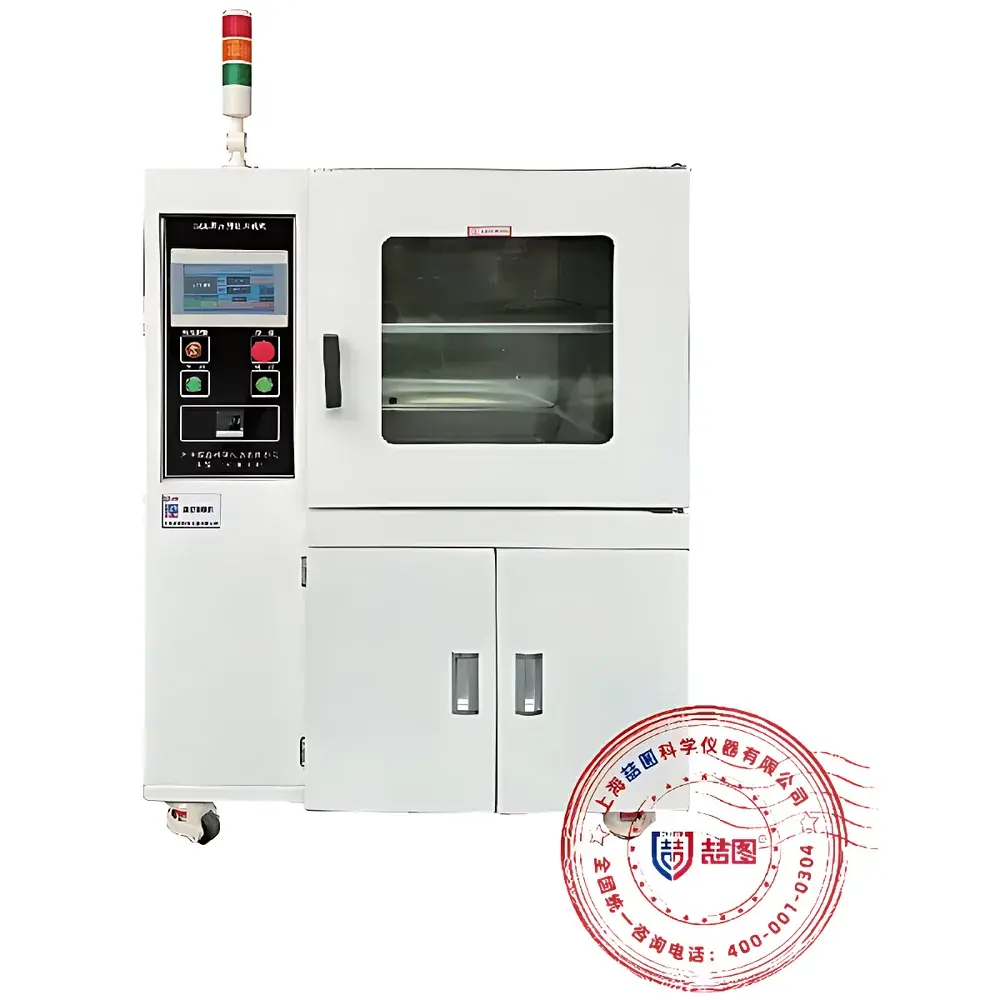
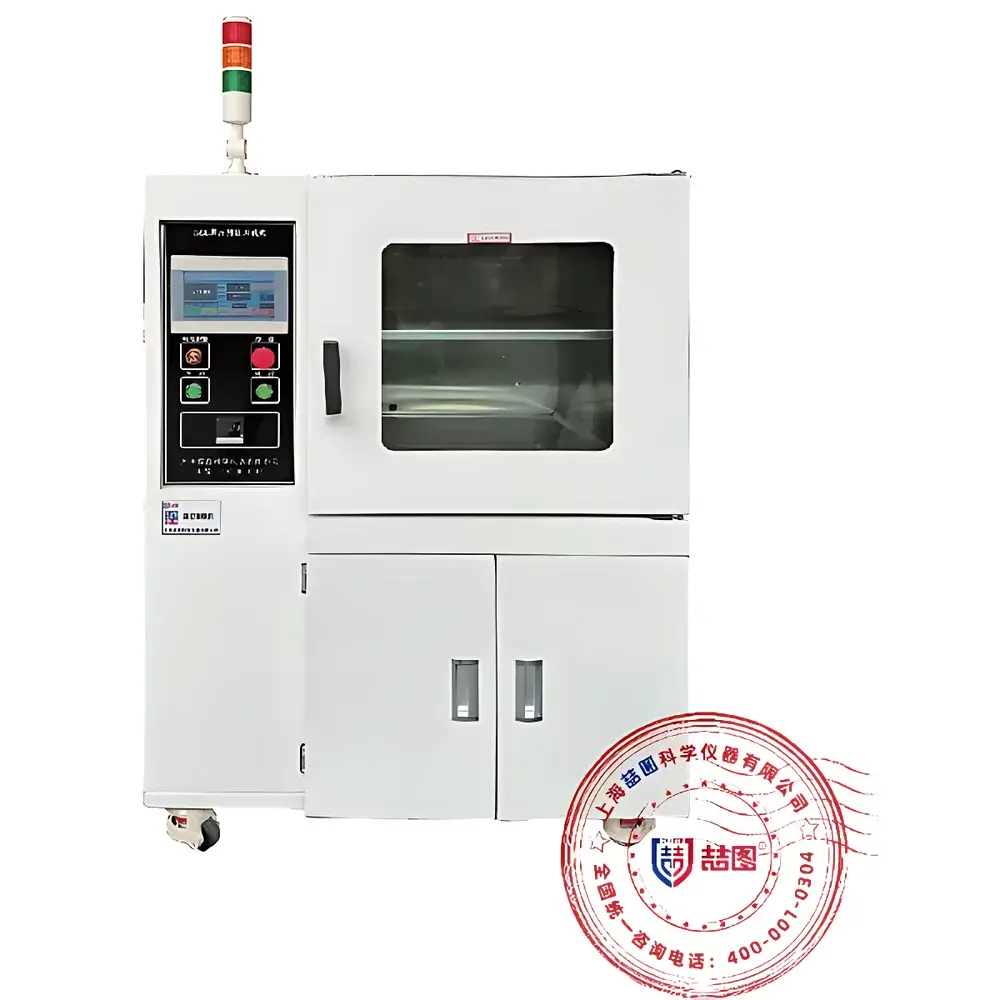
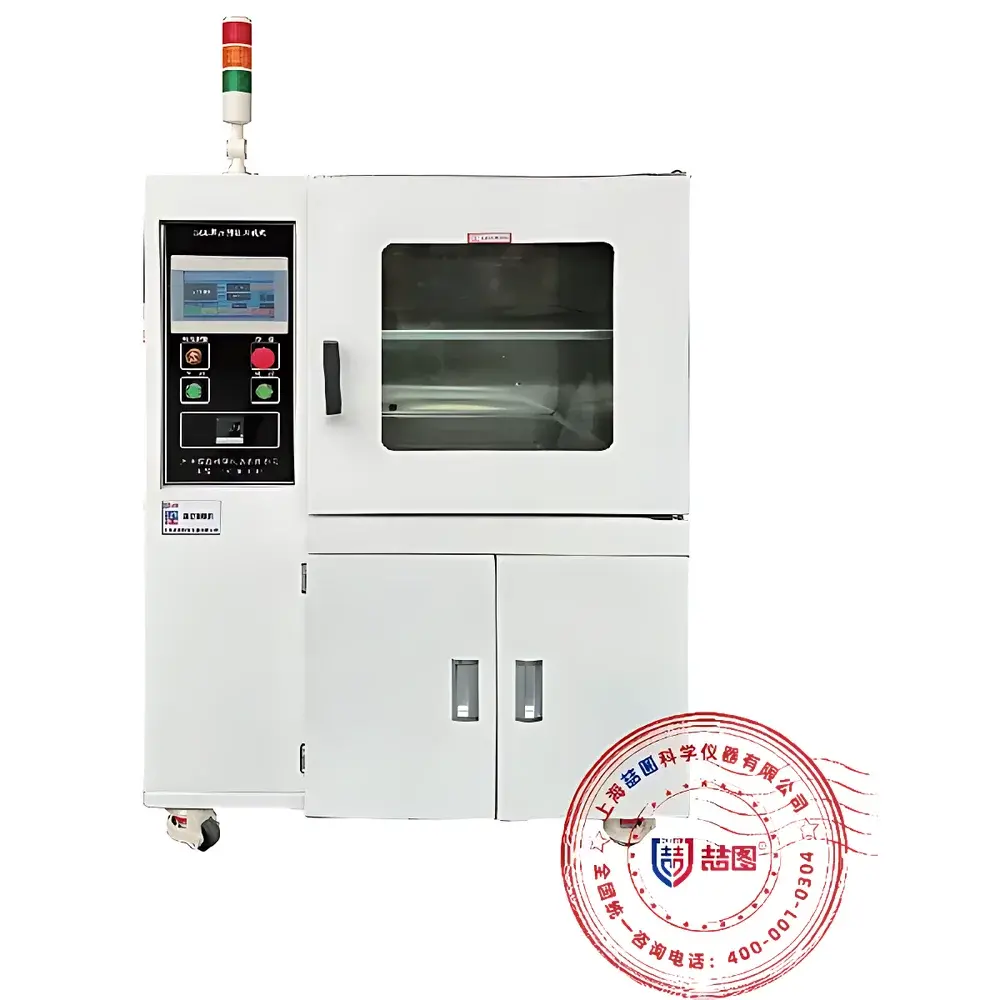
DRETOP TDM-64V HMDS Pre-treatment Vacuum Oven
| Brand | DRETOP |
|---|---|
| Origin | Shanghai, China |
| Manufacturer Type | OEM Manufacturer |
| Product Category | Domestic |
| Model | TDM-64V |
| Instrument Type | Vacuum Oven |
| Temperature Range | RT+10 to 200 °C |
| Temperature Fluctuation | ±0.1 °C |
| Inner Chamber Dimensions | 400 × 400 × 400 mm |
| Temperature Resolution | 0.1 °C |
| Operating Ambient Temperature | 5–45 °C |
| Inner Chamber Material | Stainless Steel (HMDS-resistant grade) |
| Heating Method | Forced-air Circulation |
| Vacuum Level | ≤133 Pa |
| Compliance | Designed for ISO/IEC 17025-aligned lab environments, compatible with GLP/GMP documentation workflows and ASTM F2289 (Standard Practice for HMDS Vapor Priming of Silicon Wafers) |
Overview
The DRETOP TDM-64V HMDS Pre-treatment Vacuum Oven is a purpose-engineered process tool for vapor-phase hexamethyldisilazane (HMDS) priming of substrates prior to photolithography. It operates on the principle of controlled vacuum-assisted vapor deposition: under reduced pressure (≤133 Pa), liquid HMDS is heated to generate a saturated vapor phase that uniformly condenses onto clean, dehydrated substrate surfaces—typically silicon wafers, sapphire, glass, or ITO-coated carriers. This forms a monolayer silanization film that converts surface hydroxyl groups into hydrophobic trimethylsilyl moieties, thereby enhancing photoresist adhesion, reducing standing-wave effects, and improving pattern fidelity in sub-micron and nanoscale lithographic processes. The system integrates thermal uniformity control, inert atmosphere management, and condensate recovery—critical for reproducible HMDS monolayer formation across 1–12 inch wafers and MEMS/LED substrates used in advanced semiconductor fabrication, optoelectronics R&D, and academic cleanroom labs.
Key Features
- HMDS-resistant stainless steel chamber (AISI 316L-equivalent grade) with electropolished interior finish to minimize residual adsorption and facilitate cleaning between runs
- Integrated cold trap condensation system with automatic post-process discharge, capturing unreacted HMDS vapor to prevent backstreaming and ensure operator safety per OSHA 29 CFR 1910.1200 (HCS)
- Forced-air circulation heating architecture with dual-zone thermal control: independent regulation of chamber wall temperature and sample-stage temperature ensures uniform vapor saturation and minimizes thermal gradients (<±0.3 °C across 400 mm³ volume)
- PLC-based control system with 7-inch color TFT touchscreen interface supporting up to 32 programmable steps per recipe—including ramp rate, dwell time, vacuum setpoint, and HMDS injection timing
- Reinforced borosilicate glass viewport with anti-fog coating and integrated silicone gasket seal (IP65-rated door closure) enabling real-time visual monitoring without process interruption
- Modular cavity design supports future expansion to dual- or quad-chamber configurations with independent vacuum and thermal control channels
Sample Compatibility & Compliance
The TDM-64V accommodates standard semiconductor substrates including Si, SiC, GaN, fused silica, BK7, CaF₂, and patterned MEMS wafers up to 300 mm (12 inch) diameter. Customizable carrier trays—available in quartz, aluminum, or ceramic—are compatible with flat, warped, or edge-beveled substrates. All wetted components comply with SEMI F21-0201 (Materials Compatibility for Semiconductor Processing Equipment). The system meets electromagnetic compatibility requirements per EN 61326-1 and is designed to support audit-ready documentation for ISO 9001:2015 quality management systems and FDA 21 CFR Part 11 electronic record/electronic signature (ER/ES) validation when paired with optional data logging software.
Software & Data Management
The embedded HMI provides real-time graphing of chamber pressure, temperature profiles, and vacuum pump status. Optional Ethernet/IP connectivity enables integration into centralized facility monitoring platforms (e.g., LabArchives, DeltaV, or custom SCADA). Raw process data—including timestamped temperature, pressure, and step completion events—is exportable in CSV or XML format for traceability. Audit trail functionality logs all user actions (login/logout, parameter changes, recipe execution), satisfying GLP-compliant data integrity requirements per ALCOA+ principles (Attributable, Legible, Contemporaneous, Original, Accurate, Complete, Consistent, Enduring, Available).
Applications
- Semiconductor front-end: HMDS priming for 3nm logic node metal interconnect layers, reducing resist lift-off defects by >40% versus ambient bake methods
- Advanced packaging: Surface preparation of fan-out wafer-level packages (FOWLP) and 2.5D/3D interposers prior to redistribution layer (RDL) patterning
- Optical thin-film manufacturing: Pretreatment of AR/HR coated lenses and laser cavity mirrors to suppress interfacial delamination during ion-assisted deposition
- Perovskite photovoltaics: Controlled HMDS passivation of SnO₂ electron transport layers to inhibit iodide migration and extend device operational lifetime
- Academic microfabrication: Reproducible surface functionalization for soft lithography, microfluidic PDMS bonding, and graphene transfer protocols
FAQ
What vacuum level is required for effective HMDS monolayer formation?
A stable base pressure ≤133 Pa (1 Torr) is necessary to achieve sufficient HMDS vapor partial pressure while suppressing ambient moisture interference—verified per ASTM F2289 Annex A2.
Can the TDM-64V be validated for GMP production use?
Yes—the system supports IQ/OQ/PQ protocol execution; DRETOP provides factory-issued calibration certificates for temperature sensors (traceable to NIST) and vacuum gauges (calibrated against capacitance manometers).
Is HMDS condensate recovery mandatory for safe operation?
Yes—uncondensed HMDS vapor poses inhalation hazards (TLV-TWA: 0.2 ppm) and risks cross-contamination; the integrated cold trap meets NFPA 45 chemical hood exhaust equivalency standards.
How does the dual-zone heating improve process repeatability?
Independent control of chamber wall and substrate temperatures eliminates thermal lag during ramp phases, ensuring consistent HMDS saturation kinetics across batch loads—critical for <±2% CV in contact angle measurements.
What maintenance intervals are recommended for the vacuum system?
Oil-sealed rotary vane pump oil should be changed every 500 operating hours; stainless steel chamber interior requires citric acid passivation quarterly if processing >50 wafers/week.
Related Products



