
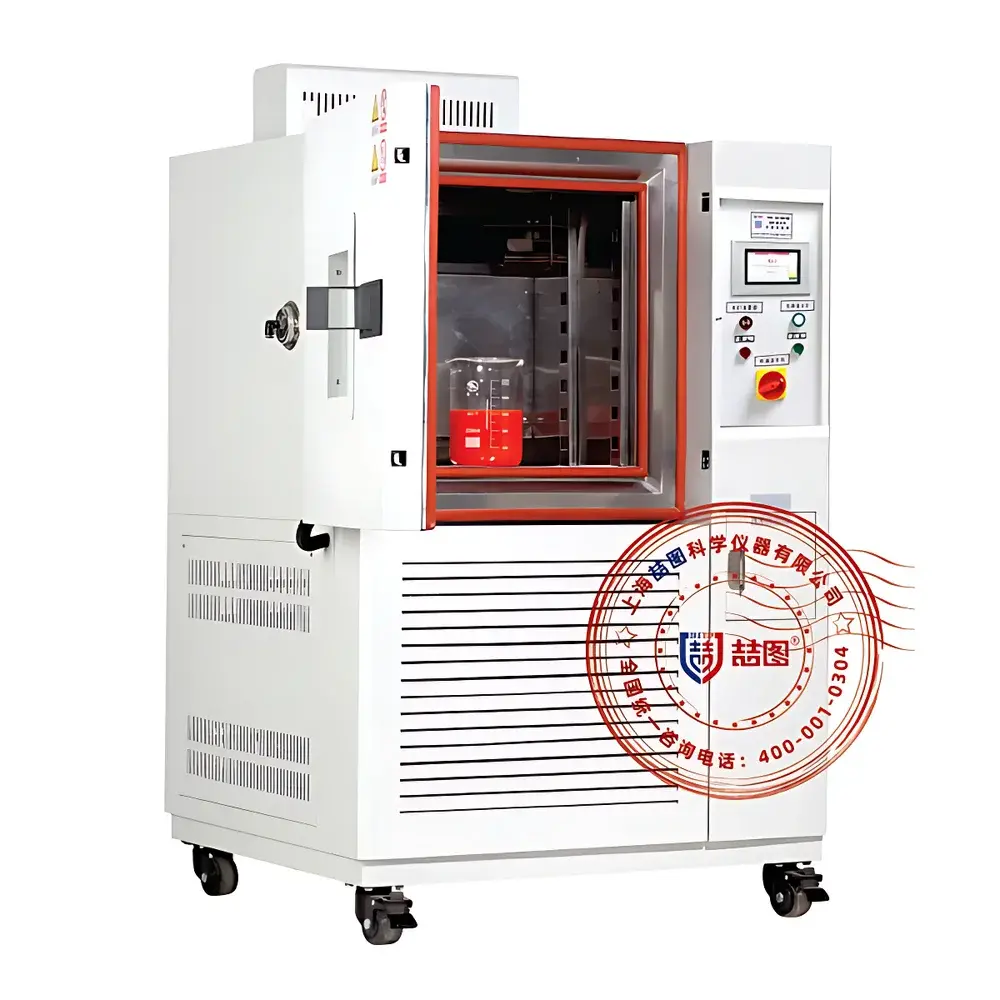
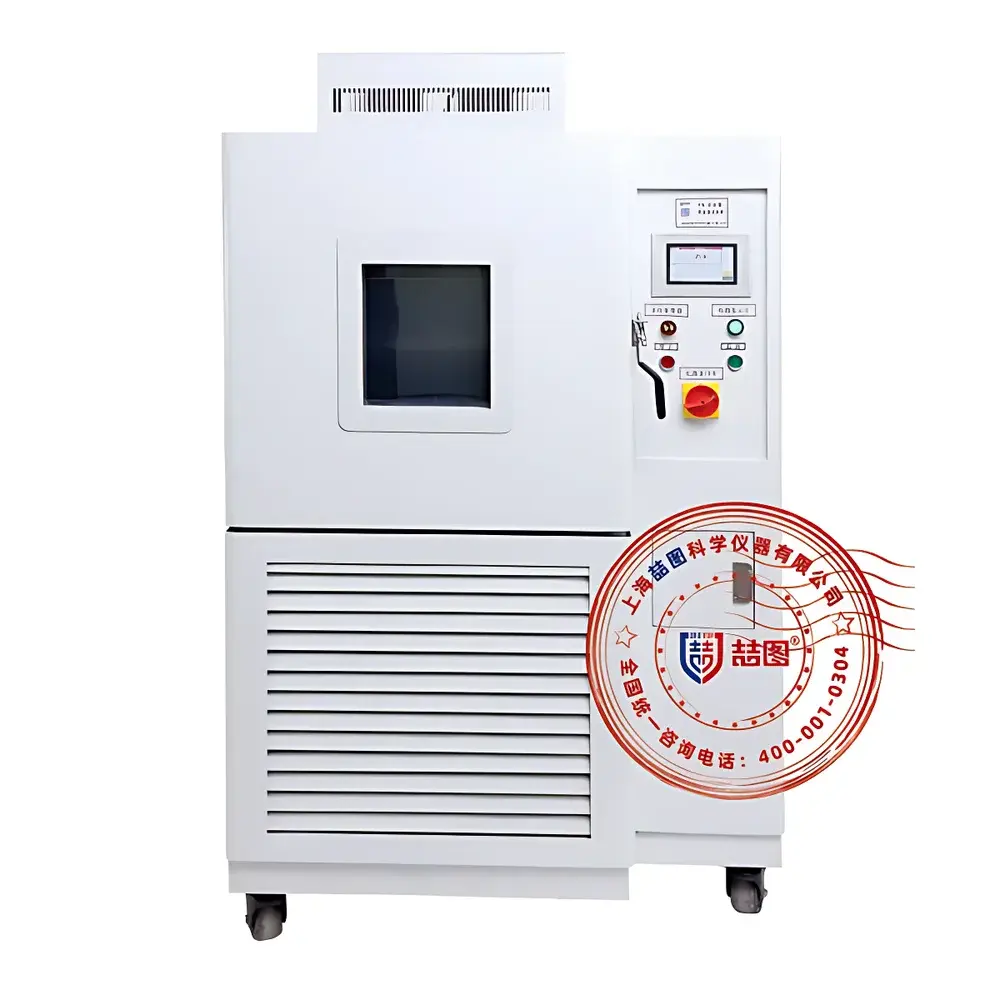
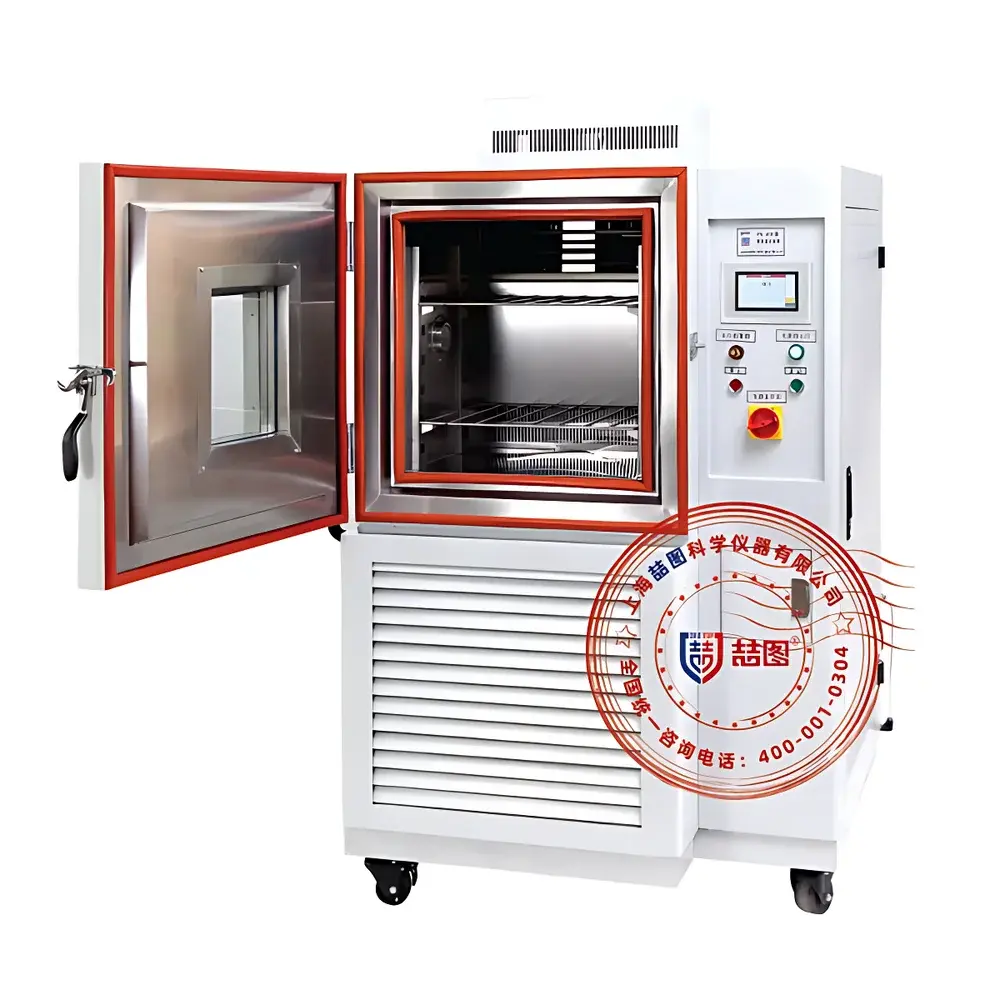
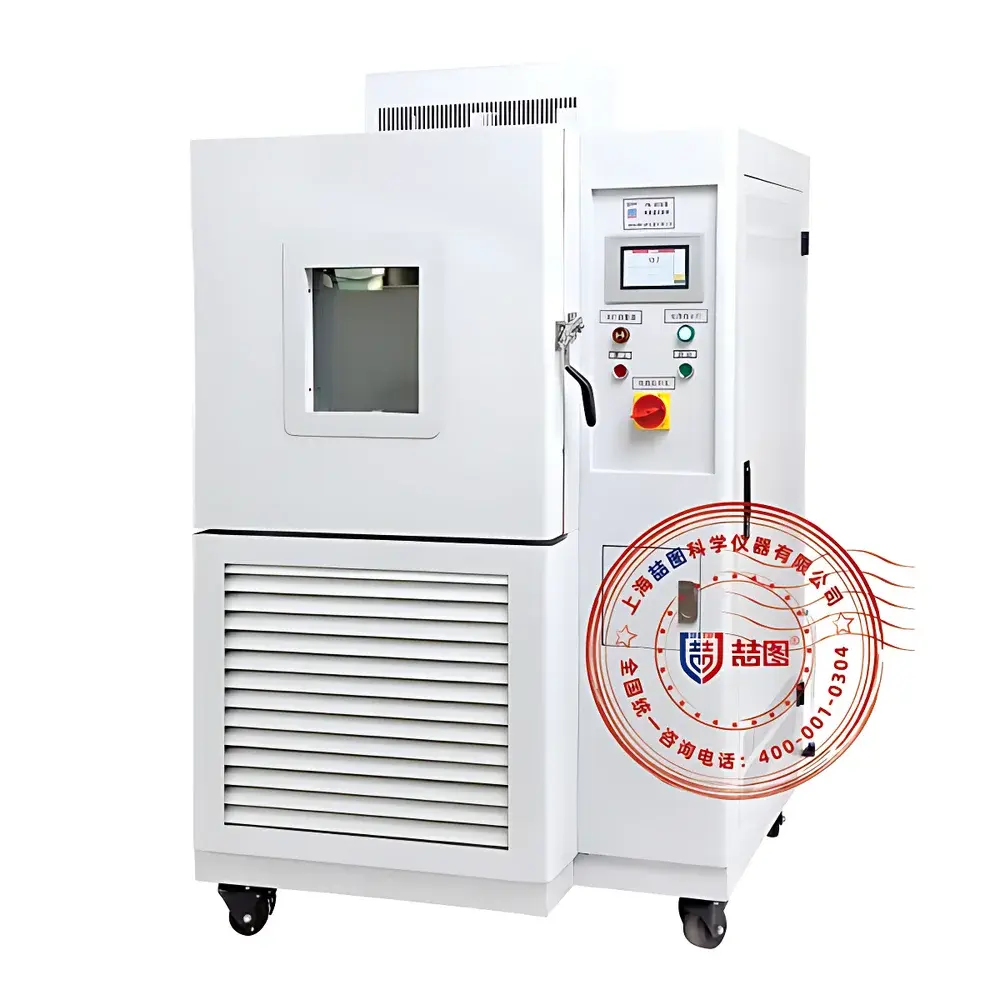
DRETOP THL-D150 High-Low Temperature Environmental Test Chamber
| Brand | DRETOP |
|---|---|
| Origin | Shanghai, China |
| Manufacturer Type | Direct Manufacturer |
| Model | THL-D150 |
| Temperature Range | −70 °C to 120 °C |
| Refrigeration Method | Hermetic Compressor-Based Cooling |
| Explosion-Proof Design | Standard (Non-Explosion-Proof) |
| Temperature Fluctuation | ±0.5 °C |
| Temperature Uniformity | ≤2 °C |
| Temperature Deviation | ±2 °C |
| Heating Rate | 1–3 °C/min (adjustable) |
| Cooling Rate | 0.7–1 °C/min (adjustable) |
| Internal Chamber Dimensions (W×D×H) | 500×500×600 mm |
| Internal Volume | 150 L |
| Control System | Color Touchscreen with 1000 Programmable Profiles (100 Segments per Profile) |
| Power Supply | AC 220 V, 50/60 Hz |
| Input Power | 5500 W |
Overview
The DRETOP THL-D150 High-Low Temperature Environmental Test Chamber is an engineered precision system designed for controlled thermal stress testing of industrial components and materials under dynamically varying temperature conditions. Based on forced-air convection and dual-stage refrigeration architecture, the chamber replicates real-world environmental thermal profiles—including rapid transitions between extreme low and high temperatures—to evaluate product reliability, material integrity, and functional stability. It operates across a validated temperature range of −70 °C to +120 °C, making it suitable for qualification testing in accordance with IEC 60068-2-1 (Cold), IEC 60068-2-2 (Dry Heat), and MIL-STD-810G Method 502.5 (Low Temperature) and Method 501.6 (High Temperature). Its robust thermal management design supports both steady-state and cyclic test protocols required in product development, quality assurance, and regulatory validation workflows.
Key Features
- Advanced color touchscreen controller with intuitive HMI interface, supporting up to 1000 user-defined test programs—each comprising up to 100 individual segments with independent ramp/soak settings, slope control, and event-triggered actions (e.g., lighting activation, data logging start/stop).
- Multi-level password-protected access control enabling role-based operation (operator, engineer, administrator), ensuring audit-compliant usage and preventing unauthorized parameter modification.
- Dual-layer tempered glass observation window with integrated anti-frost heating and LED interior lighting, permitting unobstructed visual monitoring without thermal disturbance or condensation interference.
- Optimized air circulation system featuring high-efficiency centrifugal blower and asymmetric wind tunnel geometry, delivering uniform airflow distribution and minimizing thermal gradients (≤2 °C uniformity across full working volume).
- Independent heating (nickel-chromium alloy resistive elements) and cooling (hermetically sealed imported compressor with cascade refrigeration circuit) subsystems—enabling precise decoupled control, reduced cross-talk, and enhanced long-term calibration stability.
- Full-silicone door gasket sealing system maintaining structural integrity and leak-tight performance across the entire operational temperature span (−70 °C to +120 °C), with no hardening, cracking, or adhesion degradation.
Sample Compatibility & Compliance
The THL-D150 accommodates a broad spectrum of test specimens—from PCB assemblies and automotive ECUs to polymer housings, battery modules, and aerospace fasteners—via its 150 L internal workspace (500 × 500 × 600 mm) and two standard stainless-steel adjustable shelves. Standard 50 mm diameter test ports (optional cable/air/signal feedthroughs) allow live electrical, pneumatic, or data connectivity during operation. The chamber meets essential safety and electromagnetic compatibility requirements per CE directives (2014/30/EU, 2014/35/EU) and conforms to ISO 17025-relevant environmental conditioning practices. Optional RS485/USB interfaces support integration into GLP/GMP-compliant laboratory information management systems (LIMS), enabling traceable data acquisition and 21 CFR Part 11–compliant electronic records when paired with validated software.
Software & Data Management
The embedded controller logs real-time temperature data at user-selectable intervals (1–60 s), storing up to 30 days of continuous history internally. Export functionality supports CSV-formatted Excel files and native .DRE file archives compatible with DRETOP’s optional PC-based analysis suite—capable of generating time-series plots, deviation heatmaps, and pass/fail compliance reports against preloaded test standards. All logged events—including power interruptions, alarm triggers, program jumps, and manual overrides—are timestamped and retained with immutable audit trails. Remote supervision is supported via optional Ethernet module (not included), allowing secure web-based monitoring through HTTPS-enabled dashboard interfaces compliant with TLS 1.2 encryption.
Applications
This chamber serves critical roles across R&D, QA/QC, and certification labs: thermal cycling validation of printed circuit boards per IPC-9701; accelerated aging of elastomeric seals and adhesives; pre-conditioning of lithium-ion cells prior to electrochemical testing; environmental stress screening (ESS) of avionics subassemblies; and qualification of medical device enclosures under ISO 14971 risk management frameworks. Its −70 °C capability supports cryogenic material embrittlement studies, while the +120 °C upper limit enables solder reflow simulation and polymer thermal degradation analysis. Users in automotive (ISO 16750-4), electronics (JEDEC JESD22-A104), and defense sectors routinely deploy the THL-D150 for HALT/HASS precursor testing and design margin verification.
FAQ
What is the lowest achievable temperature, and how is it maintained?
The THL-D150 achieves and stabilizes at −70 °C using a two-stage cascade refrigeration system with environmentally compliant R404A/R23 mixed-refrigerant circuitry and oil return optimization.
Does the chamber support automated test sequencing across multiple temperature setpoints?
Yes—its programmable logic controller supports multi-step ramp-soak cycles, loop repeats, conditional branching (e.g., “if T ≥ 100 °C, hold for 30 min, then initiate cooldown”), and seamless transitions between profiles.
Is calibration documentation provided with shipment?
Each unit ships with a factory calibration certificate (traceable to NIM, China) covering temperature uniformity, fluctuation, and deviation at three reference points (center, top-front-right, bottom-back-left) per IEC 60068-3-5.
Can the chamber be integrated into a centralized lab automation network?
With optional RS485 Modbus RTU or USB CDC interface, it interoperates with SCADA platforms, MES systems, and custom Python/LabVIEW control scripts using open protocol documentation.
What maintenance intervals are recommended for sustained accuracy?
Compressor oil inspection every 24 months; condenser coil cleaning quarterly; door gasket integrity check semiannually; and full sensor recalibration annually—or after 2000 cumulative operating hours—per ISO/IEC 17025 guidelines.



