
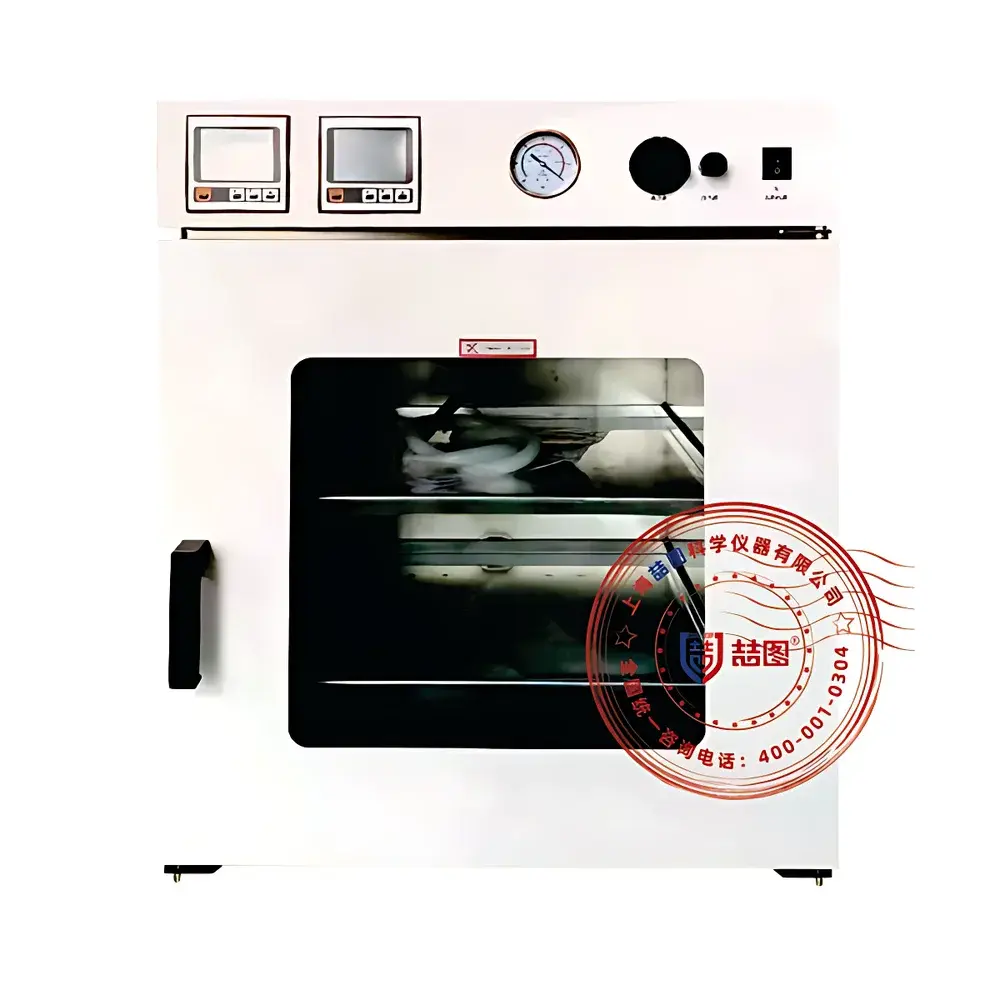
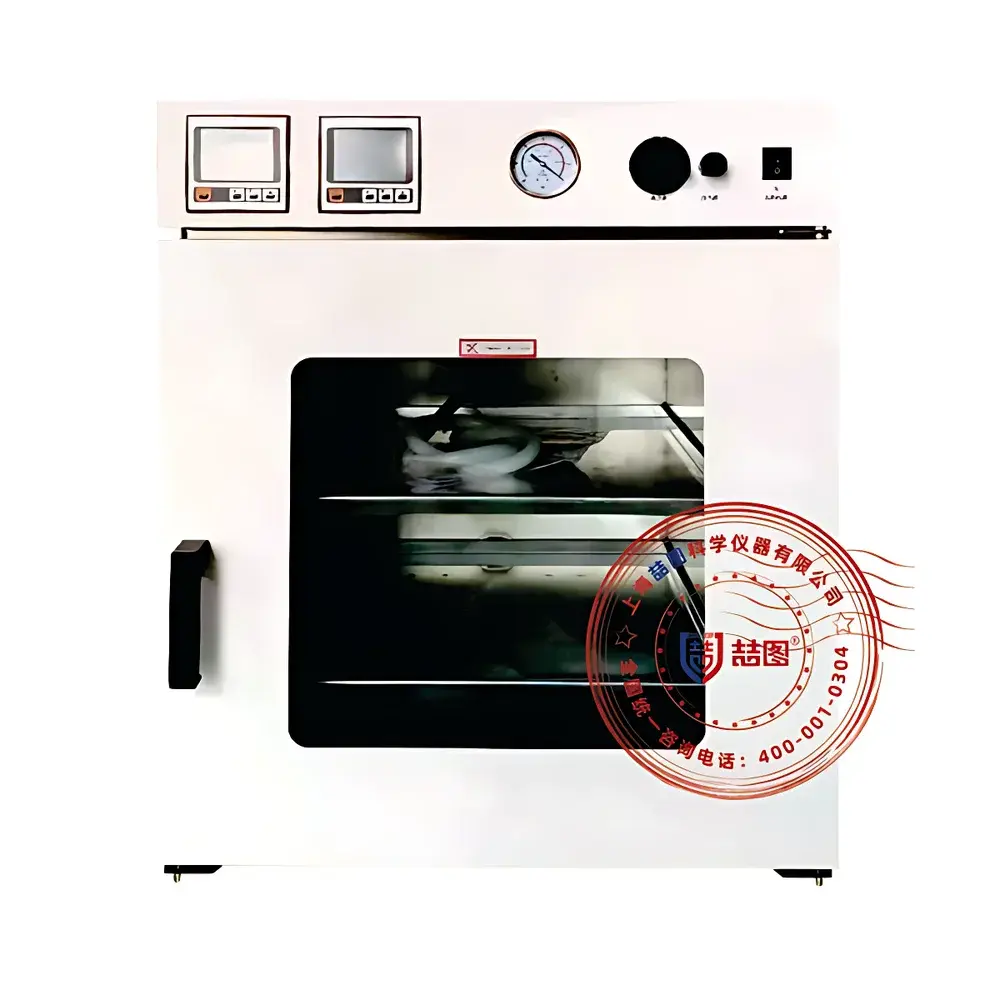
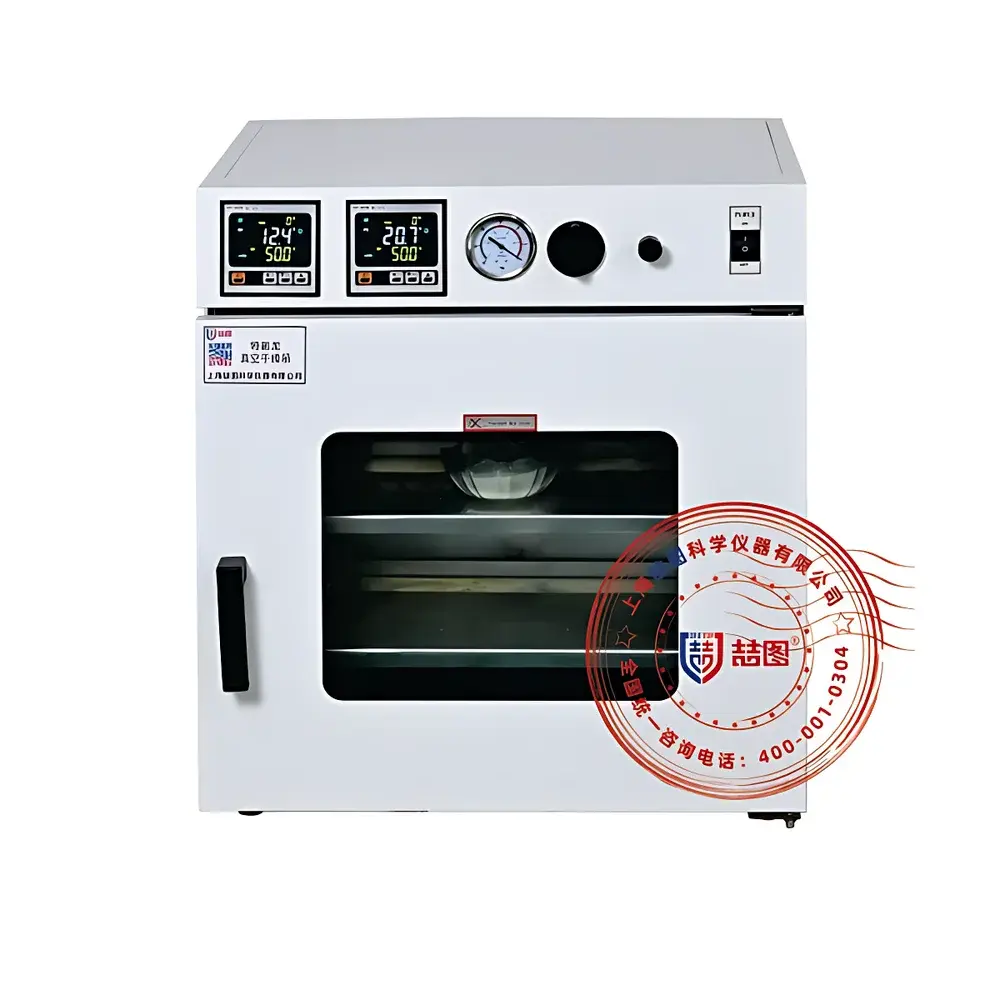
DRETOP TUF-6030V Vacuum Drying Oven
| Brand | DRETOP |
|---|---|
| Origin | Shanghai, China |
| Manufacturer | Yes |
| Country of Origin | China |
| Model | TUF-6030V |
| Instrument Type | Vacuum Oven |
| Temperature Range | RT+10°C to 300°C |
| Temperature Fluctuation | ±0.5°C |
| External Dimensions | 595 × 480 × 480 mm |
| Internal Chamber Dimensions | 300 × 300 × 275 mm |
| Temperature Resolution | 0.1°C |
| Operating Ambient Temperature | 4–45°C |
| Interior Material | 304 Stainless Steel |
| Heating Method | Internal Direct Heating |
| Vacuum Level | ≤133 Pa |
Overview
The DRETOP TUF-6030V Vacuum Drying Oven is an engineered solution for low-temperature, oxygen-sensitive thermal processing under controlled reduced-pressure conditions. It operates on the principle of vacuum-assisted drying—lowering the ambient pressure inside the chamber to reduce the boiling point of solvents and volatile components, thereby enabling effective moisture and solvent removal at significantly lower temperatures than atmospheric ovens. This mechanism is critical for preserving thermolabile compounds, preventing oxidation, inhibiting polymerization or decomposition reactions, and maintaining structural integrity in sensitive samples. Designed for laboratory-scale R&D, quality control testing, and pilot-scale process validation, the TUF-6030V supports applications across pharmaceutical development, biotechnology, electronic materials manufacturing, fine chemical synthesis, and food science. Its internal heating architecture—where heating elements are embedded directly into the stainless steel chamber walls—ensures rapid thermal response and superior heat transfer efficiency in vacuum environments, where conventional convection or jacketed heating systems fail due to absence of gaseous medium.
Key Features
- Internal direct heating system with 304 stainless steel chamber walls for optimal thermal conductivity and uniform energy distribution under vacuum
- PID-based digital temperature controller offering ±0.5°C stability and 0.1°C resolution across a wide operating range (RT+10°C to 300°C)
- Vacuum capability down to ≤133 Pa, compatible with standard rotary vane vacuum pumps (included as base configuration)
- Robust safety architecture including over-temperature cut-off, vacuum loss alarm, and pressure-relief safety valve
- Compact footprint (595 × 480 × 480 mm) with 30 L usable chamber volume (300 × 300 × 275 mm), optimized for benchtop integration in regulated lab spaces
- Optional programmable temperature ramping (multi-segment profile control) for staged drying protocols requiring precise thermal transitions
- Configurable inert gas inlet port (optional) for purging or backfilling with nitrogen or argon to further suppress oxidative degradation
Sample Compatibility & Compliance
The TUF-6030V accommodates diverse sample formats—including glass vials, aluminum trays, ceramic crucibles, and custom fixtures—without compromising vacuum integrity or thermal homogeneity. Its 304 stainless steel interior meets ISO 14644-1 Class 7 cleanroom compatibility standards for surface finish and corrosion resistance. While not certified for GMP production use out-of-the-box, the unit supports GLP-compliant documentation workflows when paired with optional RS485 serial interface for data logging and audit trail generation. For pharmaceutical applications, it aligns with USP general chapter requirements for residual solvent removal and complies with ASTM E2040-22 guidelines for vacuum drying equipment qualification. The absence of lubricants or organic seals in the chamber design minimizes outgassing risk, ensuring suitability for high-purity material processing in semiconductor and battery R&D environments.
Software & Data Management
The standard configuration includes a microprocessor-based digital controller with real-time display of chamber temperature and setpoint. Optional RS485 communication enables integration with LabVIEW, MATLAB, or SCADA platforms for remote monitoring and automated protocol execution. When equipped with programmable logic, the system supports up to 32-step temperature profiles with independent dwell time, ramp rate, and hold parameters per segment—critical for optimizing drying kinetics in lyophilization pre-treatment or catalyst activation studies. All temperature events and vacuum status changes can be timestamped and exported in CSV format, satisfying FDA 21 CFR Part 11 requirements for electronic records when deployed with validated third-party data acquisition software and user access controls.
Applications
- Pharmaceutical: Low-temperature drying of APIs, excipients, and sterile powders; residual solvent removal from coated tablets and inhalation formulations
- Biotechnology: Stabilization of enzymes, monoclonal antibodies, and viral vectors via gentle dehydration without denaturation
- Electronics: Degassing of encapsulants, desorption of moisture from PCB substrates prior to conformal coating, and solvent extraction from thin-film precursors
- Materials Science: Thermal conditioning of MOFs, aerogels, and nanocomposites under inert vacuum to preserve porosity and surface area
- Food & Agriculture: Dehydration of probiotic cultures, flavor volatiles, and botanical extracts while retaining bioactive constituents
- Quality Assurance: Accelerated stability testing per ICH Q1A(R3) under defined vacuum/temperature stress conditions
FAQ
What vacuum pump is recommended for optimal performance with the TUF-6030V?
A two-stage rotary vane pump capable of achieving ≤10 Pa ultimate pressure is recommended; the included pump meets baseline requirements for most R&D applications.
Can the TUF-6030V be used for sterilization or depyrogenation?
No—it is not designed for steam sterilization or dry-heat depyrogenation cycles; maximum temperature rating (300°C) does not meet ISO 17665 or USP dry-heat validation thresholds.
Is temperature uniformity data available for the chamber under vacuum?
Yes—DRETOP provides chamber mapping reports upon request per ASTM E2207-21; typical uniformity is ±2.0°C at 80°C under 100 Pa vacuum with single shelf loading.
Does the unit support inert gas purging during operation?
Yes—optional inert gas inlet valve allows continuous or pulsed nitrogen/argon flow during drying, enabling controlled partial-pressure environments.
What maintenance intervals are specified for long-term reliability?
Vacuum pump oil change every 500 hours; chamber seal inspection every 12 months; calibration of temperature sensor annually per ISO/IEC 17025 recommendations.
Related Products



