
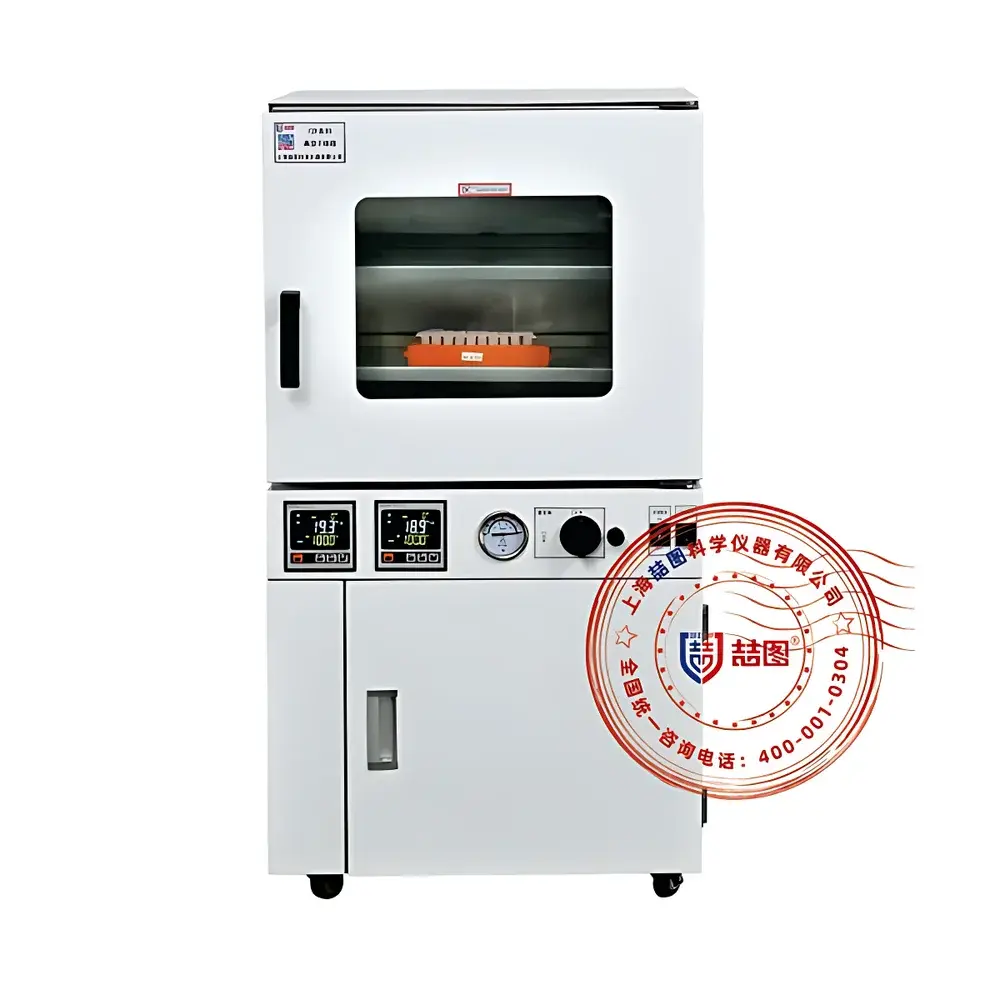
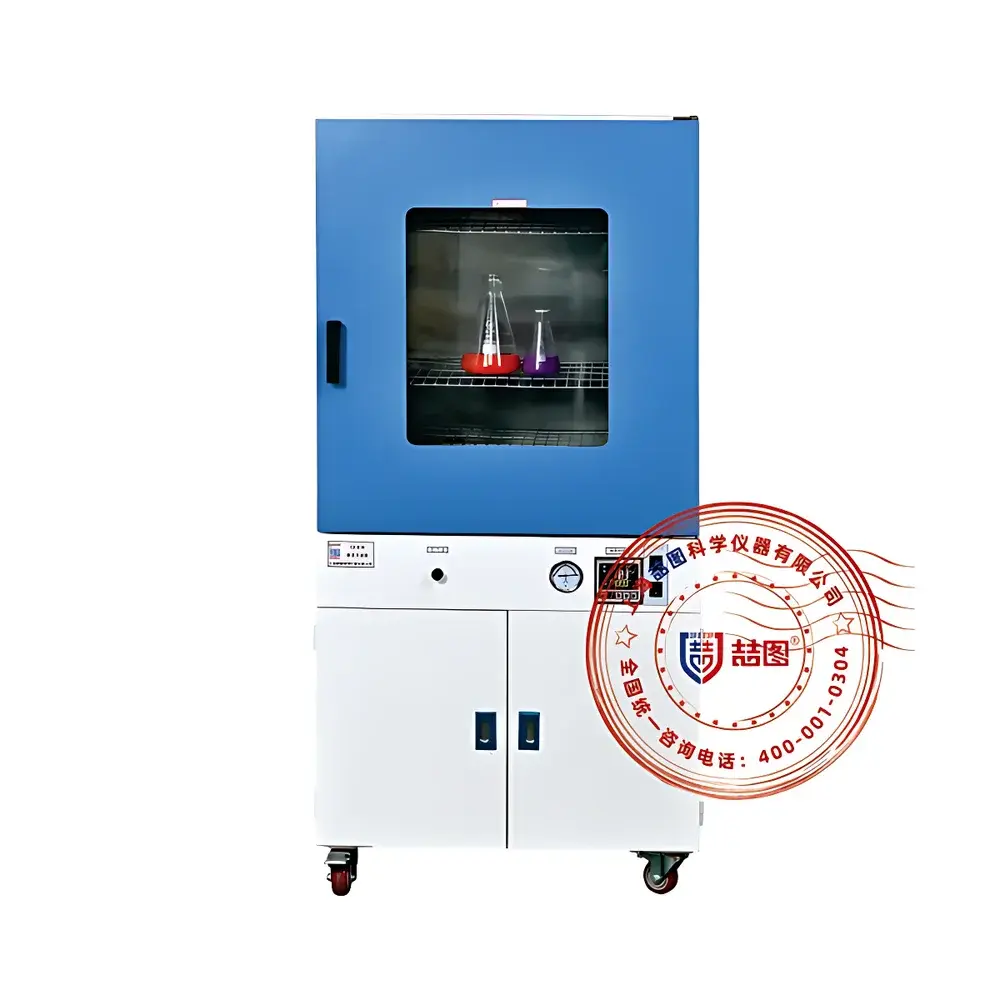
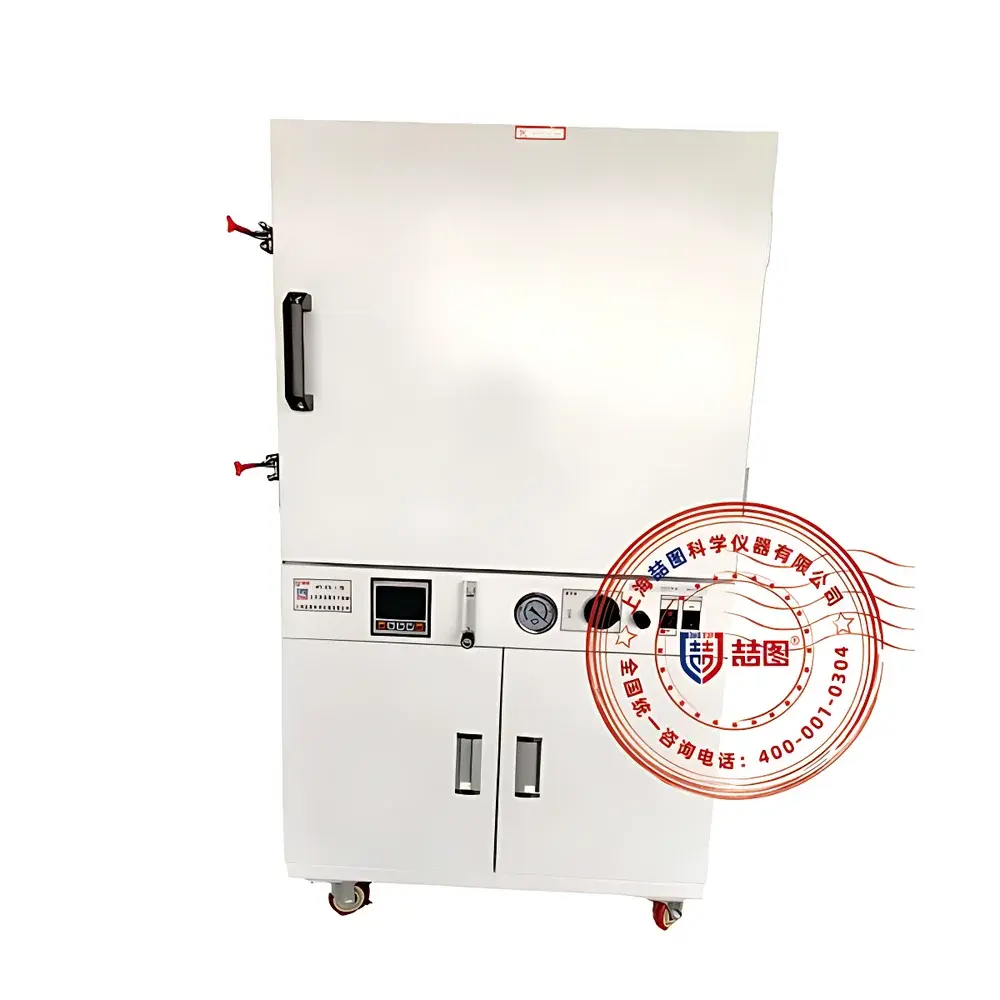
DRETOP TZS-6125VDT Programmable Vacuum Drying Oven
| Brand | DRETOP |
|---|---|
| Origin | Shanghai, China |
| Manufacturer Type | Direct Manufacturer |
| Product Category | Domestic |
| Model | TZS-6125VDT |
| Instrument Type | Vacuum Oven |
| Temperature Range | RT +10 to 250°C |
| Temperature Uniformity | ±1°C |
| Temperature Fluctuation | ±0.5°C |
| Temperature Resolution | 0.1°C |
| Vacuum Level | ≤133 Pa |
| Internal Chamber Dimensions (W×D×H) | 500 × 500 × 600 mm |
| External Dimensions (W×D×H) | 690 × 705 × 1520 mm |
| Chamber Material | 304 Stainless Steel |
| Heating Method | External Heating |
| Operating Ambient Temperature | 5–40°C |
| Insulation | Glass Fiber |
Overview
The DRETOP TZS-6125VDT Programmable Vacuum Drying Oven is an engineered solution for precise, oxidation-free thermal processing under controlled low-pressure environments. It operates on the principle of vacuum-assisted moisture removal: by evacuating ambient air via integrated vacuum interface (compatible with optional dual-stage rotary vane pumps), the system lowers the boiling point of solvents and volatile compounds, enabling gentle dehydration of thermally sensitive materials without thermal degradation. Unlike conventional convection ovens, this unit eliminates convective heat transfer and atmospheric oxidation—critical for preserving structural integrity, chemical stability, and biological activity in high-value samples. Designed for laboratory and pilot-scale manufacturing applications, it supports ISO/IEC 17025-aligned workflows and meets foundational requirements for GLP-compliant documentation when paired with optional RS485 data logging or embedded printer modules.
Key Features
- External heating architecture with seamless 304 stainless steel chamber walls—optimized for rapid thermal recovery, ease of cleaning, and compatibility with irregularly shaped or oversized specimens (e.g., optical molds, long glass tubing, or assembled electronic subassemblies).
- Microprocessor-based PID temperature controller with 0.1°C resolution, ±0.5°C fluctuation tolerance, and programmable ramp-soak profiles; includes over-temperature alarm, auto-shutdown, and non-volatile parameter memory to retain settings after power interruption.
- Large-format LCD display with tri-color status indicators showing real-time vacuum level (digital vacuum gauge), setpoint temperature, actual chamber temperature, and elapsed timer—enabling intuitive multivariable monitoring.
- Robust mechanical sealing system: dual-stage rotating latch mechanism with silicone gasket compression ensures consistent vacuum integrity down to ≤133 Pa; reinforced tempered glass observation window permits continuous visual inspection without compromising pressure stability.
- Energy-efficient insulation using high-density glass fiber between double-walled chamber and outer enclosure minimizes thermal loss and maintains stable internal conditions across ambient temperatures from 5°C to 40°C.
Sample Compatibility & Compliance
The TZS-6125VDT accommodates a broad spectrum of sample types—including hygroscopic powders, nanoparticle suspensions, thin-film coatings, lithium-ion battery electrode sheets, semiconductor wafers, pharmaceutical excipients, and enzymatic reagents—without particle dispersion or surface oxidation. Its external heating design prevents airflow-induced cross-contamination, making it suitable for cleanroom-adjacent operations per ISO 14644-1 Class 7 protocols. The 304 stainless steel chamber complies with FDA-recommended material standards for non-reactive contact surfaces (21 CFR Part 111). While not certified to UL/CSA or CE for standalone medical device use, its construction and control logic align with general-purpose laboratory equipment safety norms (IEC 61010-1) and supports audit-ready traceability when integrated with optional data export interfaces.
Software & Data Management
This model features a programmable digital control platform supporting up to 9999-minute timed operation and multi-step temperature ramping. Optional upgrades include RS485 serial communication for integration into centralized lab management systems (LIMS), real-time data streaming to SCADA platforms, or automated CSV log generation. When equipped with the VDT-series color touchscreen variant, users gain access to graphical trend visualization, password-protected user levels, and electronic signature-capable operation logs—facilitating compliance with 21 CFR Part 11 Annex 11 expectations for electronic records. All firmware adheres to deterministic timing execution, ensuring reproducible thermal cycles critical for method validation in QC/QA environments.
Applications
The TZS-6125VDT serves mission-critical roles across multiple technical domains: in semiconductor R&D, it enables solvent-free curing of photoresists and low-k dielectrics; in battery manufacturing, it removes residual NMP from cathode slurries prior to calendering; in biopharma, it stabilizes lyophilized intermediates and monoclonal antibody formulations without denaturation; in materials science, it facilitates controlled pyrolysis of MOFs and carbonization of polymer precursors. Its 125 L usable volume and 500 × 500 × 600 mm chamber accommodate stacked trays or custom fixtures—ideal for batch processing of LED substrates, quartz crystal blanks, or ceramic green bodies. The absence of internal heating elements also simplifies validation of thermal distribution (per ASTM E2297) during IQ/OQ protocols.
FAQ
What vacuum pump is recommended for achieving ≤133 Pa?
A dual-stage rotary vane pump (e.g., DRETOP D8 or D16 series) is factory-specified and supplied as standard equipment for the VD/VDT configurations.
Can inert gas purging be integrated?
Yes—optional inert gas inlet valves (N₂ or Ar) are available for backfilling under controlled partial pressure, supporting oxygen-sensitive drying or passivation steps.
Is the chamber compatible with corrosive solvents like HF or chlorinated hydrocarbons?
The 304 stainless steel chamber provides moderate resistance; for aggressive chemistries, we recommend supplemental PTFE-coated trays or consultation with our application engineering team for material compatibility assessment.
How is temperature uniformity validated across the working volume?
DRETOP provides a 9-point calibration certificate (traceable to NIST standards) upon request; users may perform in-house mapping per ISO 17025 Clause 5.10 using calibrated PT100 probes.
Does the unit support remote monitoring via Ethernet or Wi-Fi?
Native Ethernet/Wi-Fi is not included, but RS485-to-Ethernet gateways can be deployed externally to enable networked supervision within existing facility infrastructure.



