
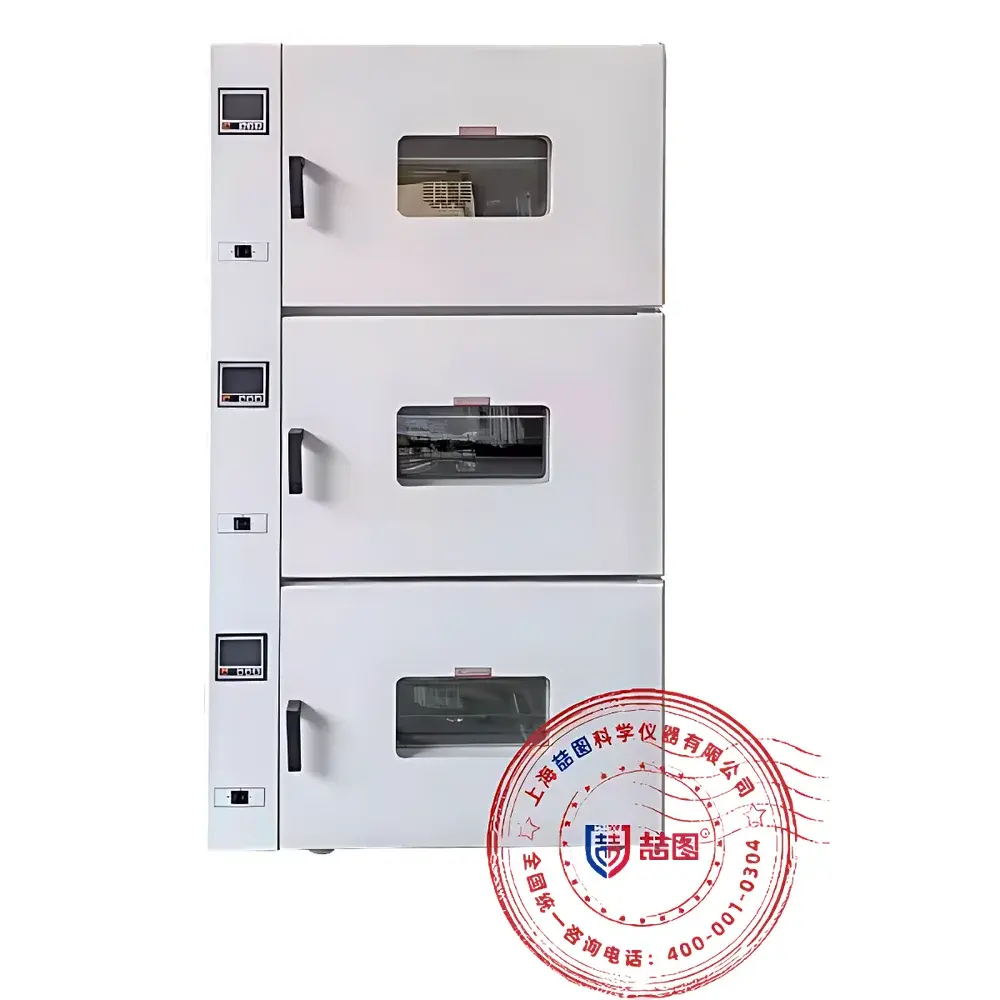
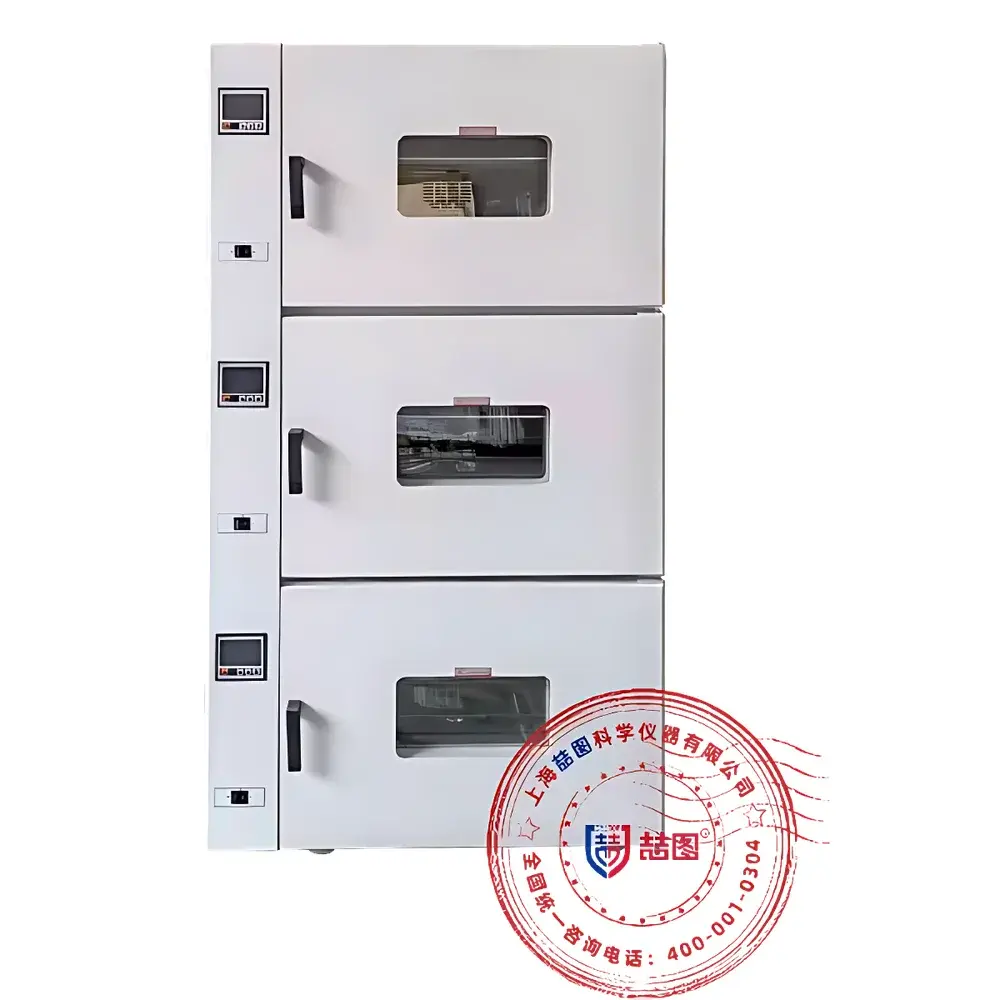
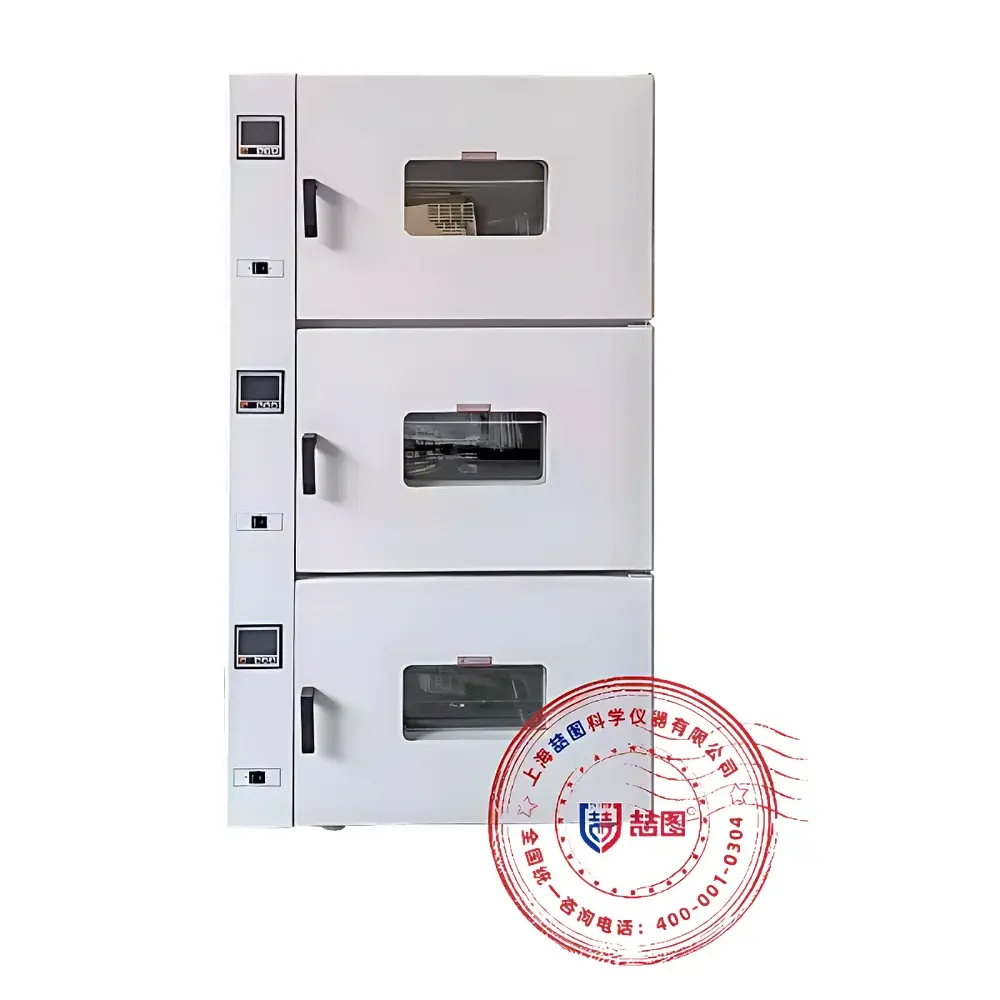
DRETOP XZS-50-II Dual-Chamber Digital Vacuum Drying Oven
| Brand | DRETOP |
|---|---|
| Origin | Shanghai, China |
| Manufacturer Type | Direct Manufacturer |
| Product Category | Domestic |
| Model | XZS-50-II |
| Instrument Type | Vacuum Oven |
| Temperature Range | RT+10 to 250 °C |
| Temperature Uniformity | ±0.5 °C |
| Chamber Dimensions (per chamber) | 415 × 370 × 345 mm (W×D×H) |
| Temperature Resolution | 0.1 °C |
| Operating Ambient Temperature | 5–45 °C |
| Inner Chamber Material | 304 Stainless Steel |
| Heating Method | Forced-Air Circulation (External Heating) |
| Ultimate Vacuum Level | ≤133 Pa |
| Cabinet Configuration | Stacked Dual-Chamber Vertical Design |
Overview
The DRETOP XZS-50-II Dual-Chamber Digital Vacuum Drying Oven is an engineered solution for controlled thermal processing under reduced-pressure conditions. It operates on the fundamental principle of vacuum-assisted drying: by evacuating ambient air via a compatible vacuum pump, the system lowers the partial pressure of water vapor and volatile solvents, thereby significantly reducing their boiling points. This enables gentle, low-temperature dehydration of thermally sensitive materials—such as lithium-ion battery electrode coatings, semiconductor wafers, pharmaceutical active ingredients, and biological specimens—without thermal degradation, oxidation, or structural collapse. Unlike atmospheric ovens, this dual-chamber configuration provides independent operational flexibility: users may run identical protocols in parallel for throughput scaling, or apply differentiated temperature/vacuum profiles across chambers for comparative studies or process optimization. The unit complies with core design expectations for laboratory-grade vacuum thermal equipment per ISO 5667-14 (water quality sampling), ASTM E145 (standard specification for gravity-convection and forced-ventilation ovens), and supports GLP/GMP-aligned workflows through traceable parameter logging and alarm-triggered event recording.
Key Features
- Stacked dual-chamber architecture with fully independent temperature and vacuum control per chamber—enabling simultaneous multi-condition experiments or high-volume batch processing.
- Microprocessor-based PID temperature controller with 0.1 °C resolution, ±0.5 °C uniformity, and programmable ramp/soak cycles; integrated over-temperature cut-off and fault-code diagnostics for operational integrity.
- 304 stainless steel inner chamber and reinforced door seal assembly with dual-stage rotary latch mechanism—ensuring long-term vacuum integrity at ≤133 Pa and resistance to corrosive vapors encountered in chemical synthesis or battery electrolyte handling.
- Forced-air circulation heating system located externally around the chamber walls—eliminating internal heating elements that could cause arcing or carbon deposition under vacuum, while enabling rapid thermal recovery after door opening.
- Large-format backlit LCD display showing real-time chamber temperature, setpoint, elapsed time, and vacuum status; intuitive menu navigation with password-protected parameter editing.
- Robust thermal insulation using high-density glass fiber between chamber and outer casing—reducing surface temperature rise and minimizing energy consumption during extended operation.
Sample Compatibility & Compliance
The XZS-50-II accommodates a broad spectrum of sample formats including petri dishes, crucibles, aluminum foil trays, quartz boats, and custom fixtures—compatible with powders, thin films, gels, coated substrates, and hygroscopic solids. Its vacuum environment mitigates oxidation risks for metal oxide cathodes (e.g., NMC, LFP), prevents hydrolysis of moisture-sensitive APIs, and eliminates bubble entrapment in encapsulated LED assemblies. For regulatory compliance, the oven supports audit-ready documentation when paired with optional RS485 interface and external data loggers compliant with FDA 21 CFR Part 11 requirements. All electrical components meet IEC 61010-1 safety standards for laboratory equipment, and the stainless steel construction satisfies USP material compatibility guidelines for pharmaceutical manufacturing environments.
Software & Data Management
While the base model features embedded firmware without PC connectivity, optional upgrades include RS485 serial communication for integration into centralized lab management systems (LIMS), and USB data export (with compatible memory devices) for time-stamped temperature/vacuum logs. The optional color touchscreen controller (VT-series upgrade) adds graphical trend visualization, multi-step program storage (up to 32 segments), and alarm history with timestamped event codes—including over-temperature, vacuum loss, and door-open interruptions. All controllers retain user-defined parameters after power interruption, satisfying continuity-of-operation requirements in QA/QC laboratories subject to ISO/IEC 17025 accreditation.
Applications
- Lithium-ion battery R&D: drying cathode/anode slurries and separator films under inert gas purging (with optional inlet valve) to suppress residual solvent and ensure interfacial stability.
- Semiconductor packaging: post-molding moisture removal from IC substrates and conformal-coated PCBs prior to hermetic sealing.
- Pharmaceutical formulation: solvent-free drying of lyophilized intermediates, excipient blends, and controlled-release matrix tablets without polymorphic transition.
- Materials science: thermal stabilization of MOFs, perovskite precursors, and nanocomposites where ambient oxygen exposure compromises crystallinity or stoichiometry.
- Environmental testing labs: gravimetric moisture analysis per ASTM D2231 and EPA Method 5035A for solid waste characterization.
FAQ
What vacuum level does the XZS-50-II achieve, and which pump is recommended?
The unit achieves ≤133 Pa (1 Torr) with a standard 20 m³/h rotary vane pump (e.g., DRETOP V-20). For faster evacuation or lower base pressure, a corrosion-resistant diaphragm pump (VGM series) or upgraded oil-sealed pump (V-30) is advised.
Can both chambers operate at different temperatures simultaneously?
Yes—the dual-chamber design includes separate PID controllers, sensors, and heating circuits, allowing independent setpoints and timing schedules per chamber.
Is inert gas purging supported?
Optional inert gas inlet valves (N₂ or Ar) can be factory-installed to enable vacuum-purge cycles, critical for oxygen-sensitive materials such as sodium-ion battery components or organometallic catalysts.
How is temperature uniformity validated across the chamber volume?
Uniformity is verified per ASTM E2207 using nine calibrated thermocouples placed at standardized locations (center, corners, mid-walls); typical results show ≤±0.5 °C deviation at 105 °C steady state.
Does the system support regulatory-compliant electronic records?
With the VT-series touchscreen upgrade and external validation-compatible data logger, full 21 CFR Part 11 compliance—including electronic signatures, audit trails, and secure user access—is achievable.



