
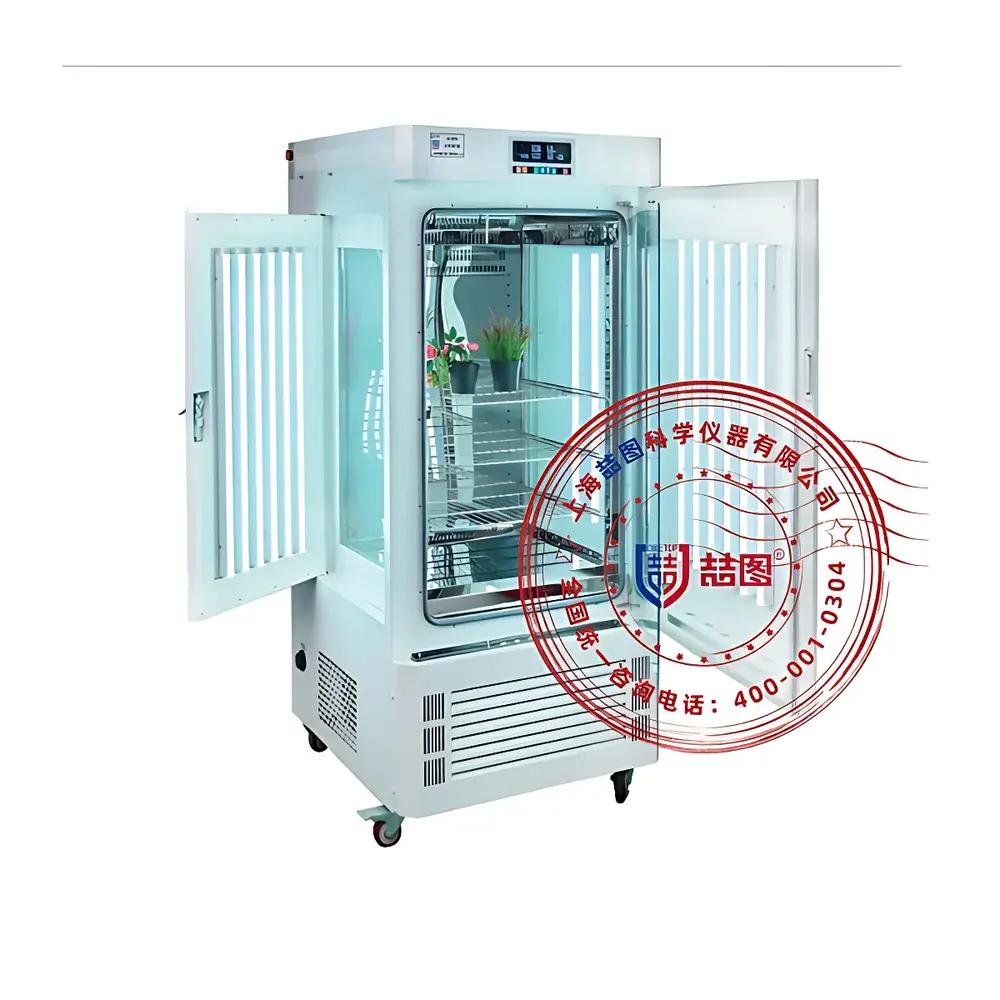
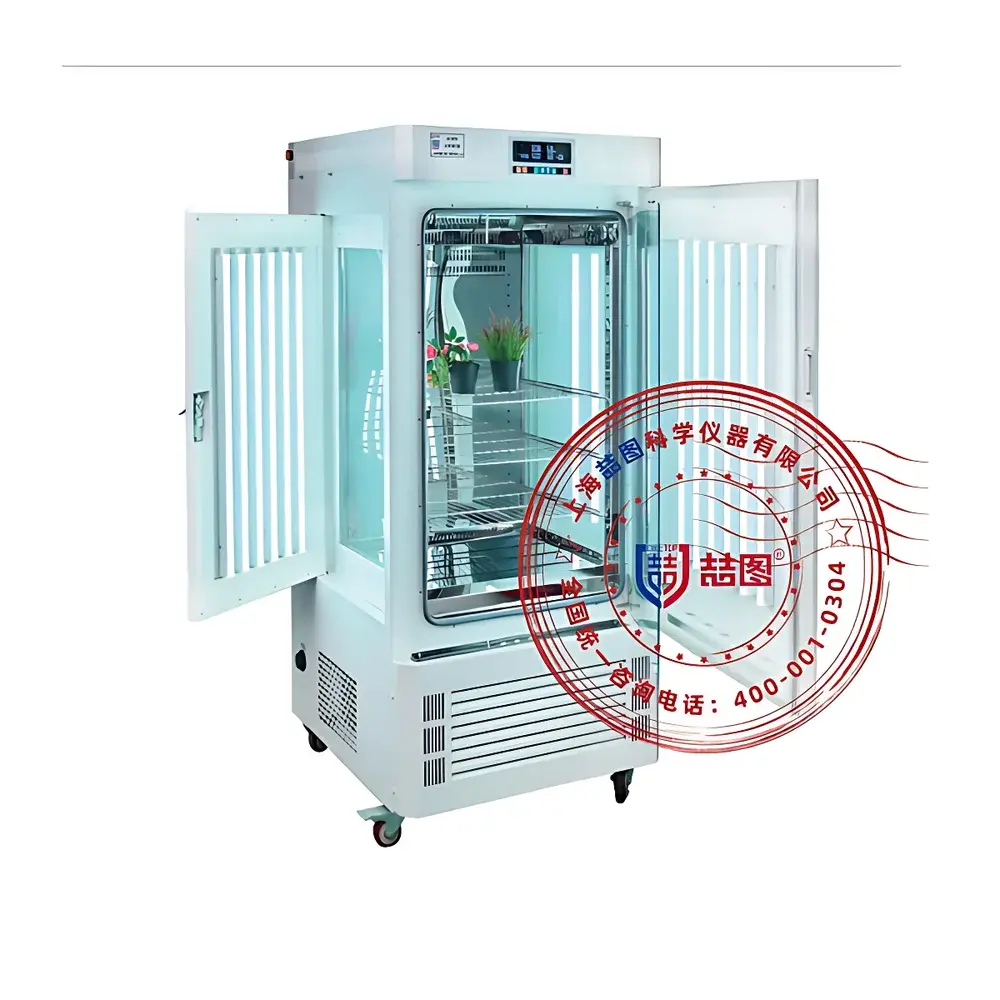
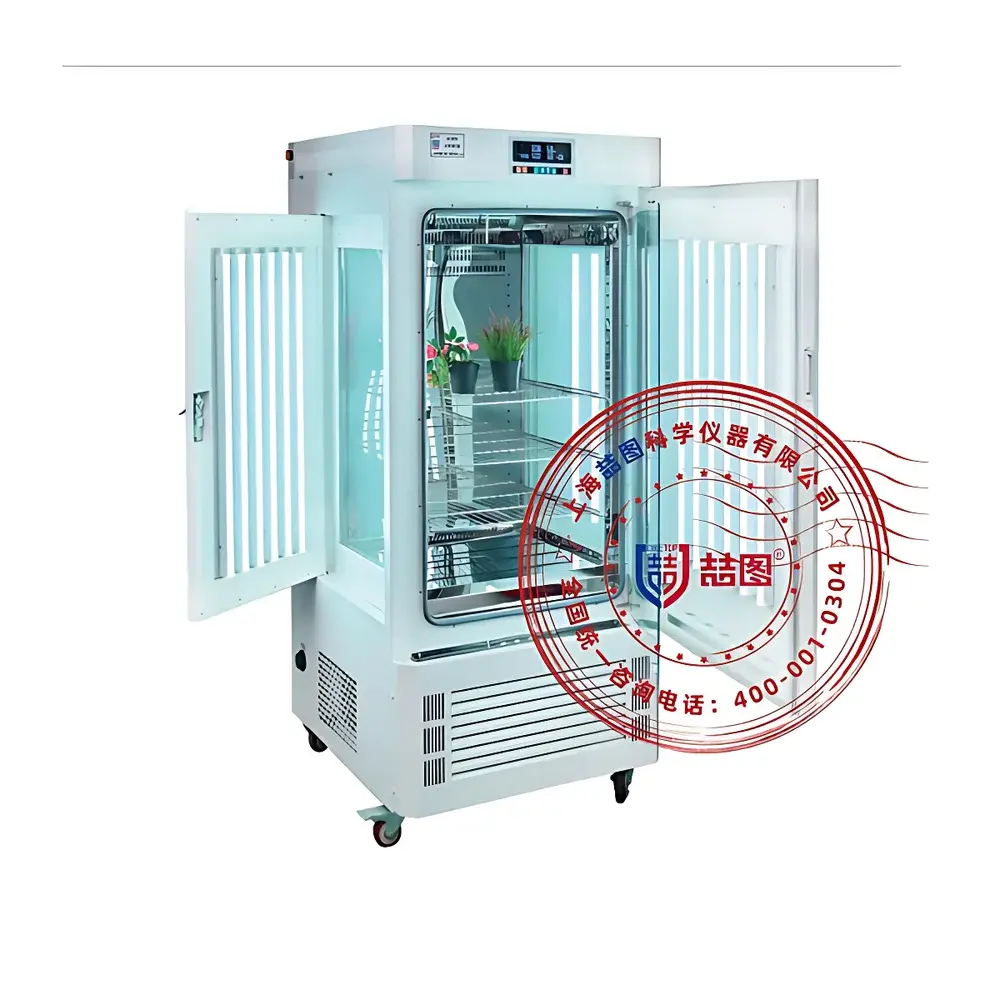
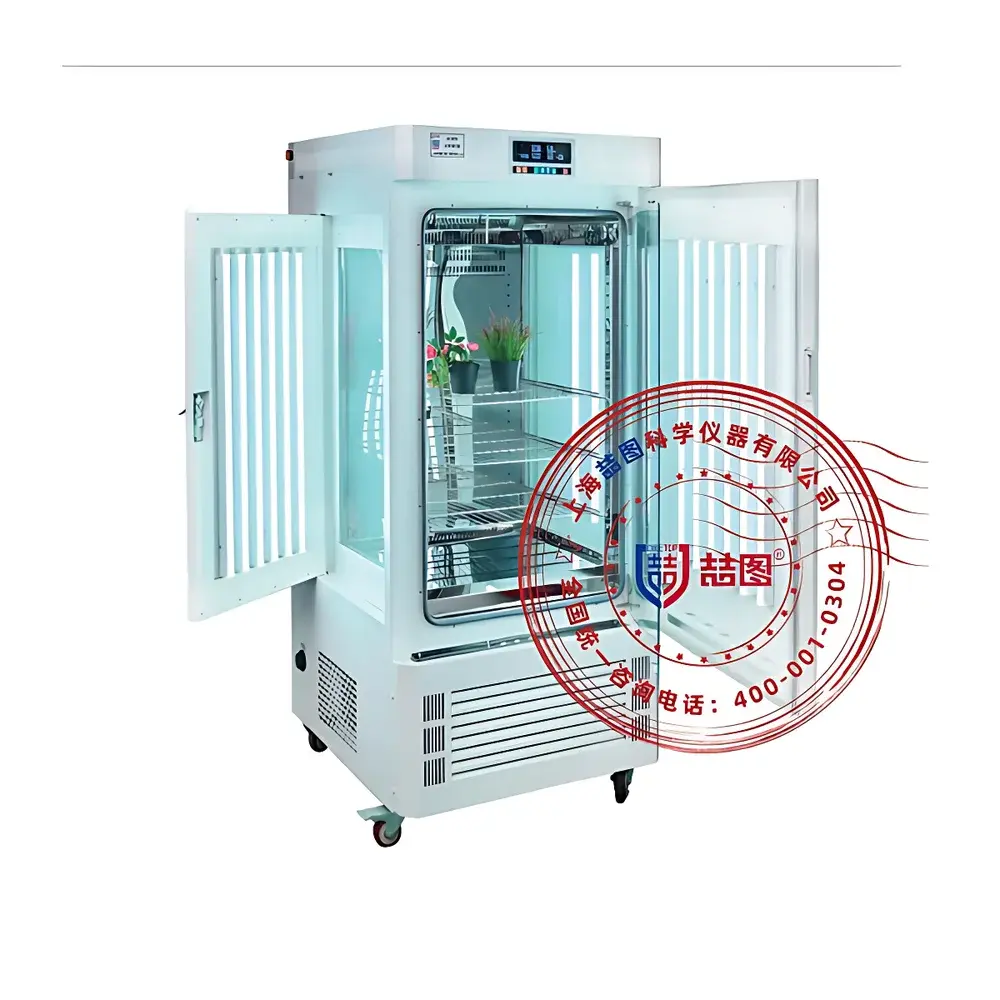
DRETOP ZGC-250T Plant Growth Chamber
| Brand | DRETOP |
|---|---|
| Origin | Shanghai, China |
| Manufacturer Type | Direct Manufacturer |
| Model | ZGC-250T |
| Illumination Method | Triple-Side Illumination |
| Light Source | Fluorescent Lamps |
| Spectrum Range | Visible Spectrum (400–700 nm) |
| Temperature Control Range | 10–65°C (with illumination), 0–65°C (without illumination) |
| Temperature Fluctuation | ±0.5°C |
| Temperature Uniformity | ±1.5°C |
| Illuminance Range | 0–15,000 lx |
| Illuminance Adjustment | 6-Step Adjustable |
| Capacity | 250 L |
| External Dimensions (W×D×H) | 790 × 790 × 1585 mm |
| Power Supply | AC 220 V, 50 Hz |
| Input Power | 1350 W |
| Interior Dimensions (W×D×H) | 580 × 500 × 850 mm |
| Shelving | 3 Adjustable Stainless Steel Shelves |
| Standard Light | Cool White Fluorescent |
| Optional Light Configurations | Red/Blue LED Spectral Modules (660 nm / 450 nm) |
Overview
The DRETOP ZGC-250T Plant Growth Chamber is a precision-engineered environmental control system designed for reproducible, long-term plant physiology studies, photobiological assays, and microbiological cultivation under tightly regulated temperature and light conditions. Built upon Couette-type air circulation architecture and microprocessor-driven dual-loop control logic, the chamber integrates thermoelectric heating, vapor-compression refrigeration, and spectrally optimized fluorescent illumination to emulate natural diurnal cycles. Its triple-side illumination configuration ensures uniform photon flux distribution across sample zones—critical for quantitative growth analysis, photomorphogenesis research, and standardized seed germination testing per ISO 20783 and ASTM E2912 protocols. The unit operates within a validated thermal envelope of 0–65°C (dark) and 10–65°C (lit), with real-time compensation for lamp-induced thermal load—a feature essential for maintaining physiological fidelity in light-sensitive assays.
Key Features
- Triple-side fluorescent illumination system delivering up to 15,000 lx at shelf level, with six discrete intensity levels calibrated via integrated photometric feedback.
- 30-segment programmable controller supporting complex day/night temperature-light profiles—including ramp-and-soak transitions, stepwise photoperiod modulation, and event-triggered parameter shifts.
- Stainless steel interior (304 grade) with fully removable, autoclavable shelves; rounded internal corners and seamless welds minimize microbial retention and simplify GLP-compliant decontamination.
- Dual-door observation window: outer magnetic gasket seal + inner tempered glass pane—reducing thermal bridging and maintaining >92% insulation efficiency during frequent access.
- Intelligent refrigeration subsystem featuring R134a-free eco-refrigerant (R600a), adaptive compressor cycling, and 60-second startup delay to prevent voltage surge damage.
- Integrated safety architecture: independent overtemperature cutoff (mechanical backup), power-fail memory retention (EEPROM-based), and audible/visual alarm escalation for deviation thresholds.
Sample Compatibility & Compliance
The ZGC-250T accommodates standard plant growth vessels (e.g., Magenta boxes, square petri dishes, hydroponic trays), microbial culture plates, and BOD bottles up to 250 mm height. Its 250 L working volume supports multi-tier experimental designs while maintaining ISO 14644-1 Class 8 cleanroom-equivalent particulate stability. Regulatory alignment includes design conformity with IEC 61000-6-3 (EMC emissions), UL 61010-1 (safety), and functional compatibility with FDA 21 CFR Part 11 requirements when paired with optional RS485 data logging and audit-trail-enabled software. Humidity control is available as a factory-integrated module (consult technical specifications sheet for RH range and tolerance).
Software & Data Management
Equipped with a 7-inch capacitive touchscreen interface (T-series variant), the chamber provides real-time graphical overlays of temperature and illuminance trends over the preceding 60 minutes. Firmware supports user-defined alarm triggers—including cumulative low-light exposure time thresholds—and configurable password protection with three-tier access levels (operator, supervisor, administrator). Logged data exports in CSV format via USB port; optional RS485 interface enables integration into centralized LabVantage or Siemens Desigo CC environments. All parameter changes are timestamped and attributed to user ID, satisfying ALCOA+ data integrity principles for GxP-regulated workflows.
Applications
- Controlled-environment phenotyping of crop mutants under defined PAR regimes
- Standardized BOD5 incubation per APHA 5210B methodology
- Phototropism and circadian rhythm studies in Arabidopsis thaliana and Zea mays
- Light-dependent fungal sporulation assays (e.g., Aspergillus niger, Penicillium chrysogenum)
- Pre-acclimation protocols for tissue-cultured orchids and medicinal herbs (e.g., Dendrobium officinale)
- Validation of spectral response curves for horticultural LED retrofitting projects
FAQ
Does the ZGC-250T support custom spectral configurations beyond white fluorescent lighting?
Yes—red (660 nm) and blue (450 nm) LED modules can be factory-installed as drop-in replacements for fluorescent tubes, enabling PAR optimization for specific photoreceptor activation (phytochrome vs. cryptochrome pathways).
Is humidity control available as a standard feature?
Humidity regulation is an optional add-on module; base configuration maintains ambient RH only. Contact engineering support for dew-point-limited humidification/dehumidification specifications.
Can the chamber operate continuously for extended periods (e.g., >30 days)?
Yes—the system is rated for unattended operation up to 90 days under nominal load, supported by redundant thermal sensors, compressor duty-cycle monitoring, and auto-diagnostic boot sequence.
What validation documentation is provided with shipment?
Each unit ships with Factory Acceptance Test (FAT) report, calibration certificate traceable to NIM (China National Institute of Metrology), and IQ/OQ protocol templates compliant with ISO/IEC 17025.
Is remote monitoring possible without third-party middleware?
Native Modbus RTU support via RS485 allows direct SCADA integration; Ethernet/WiFi connectivity requires optional communication gateway (DRETOP Part #ZGC-NET-01).




