
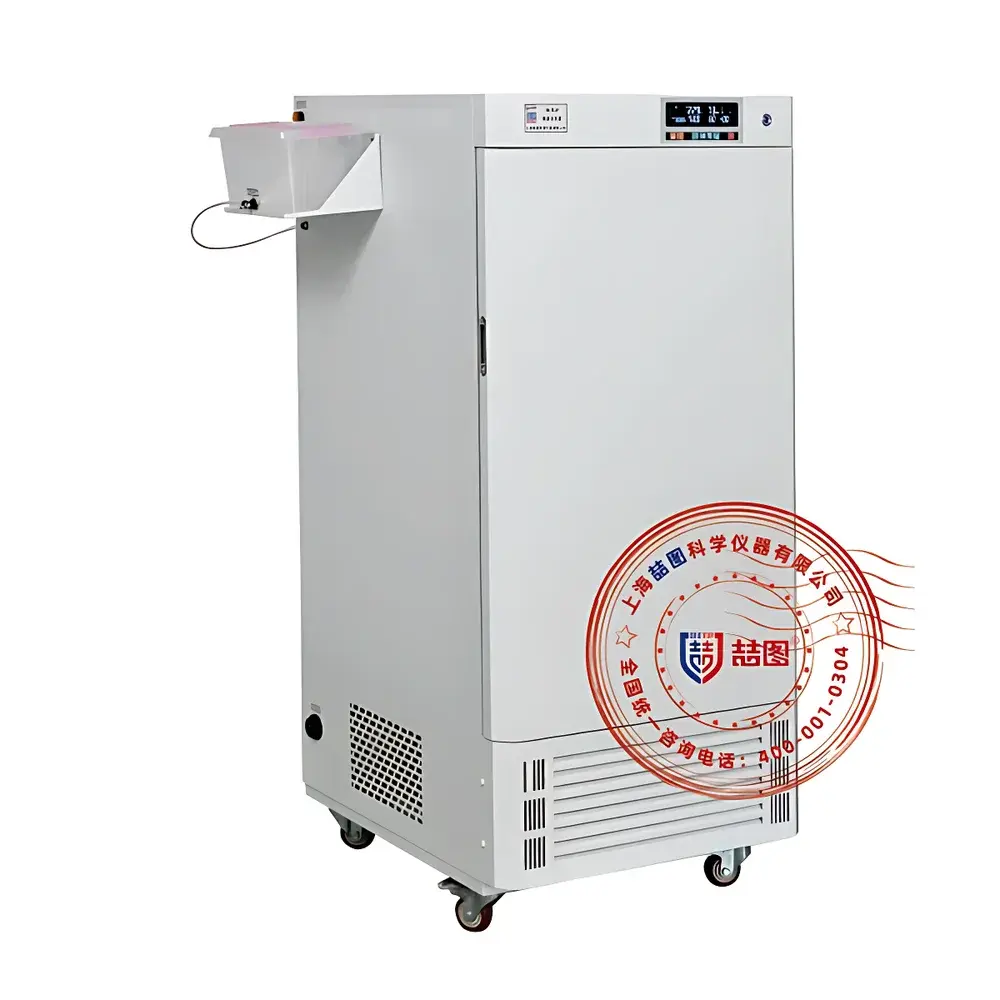
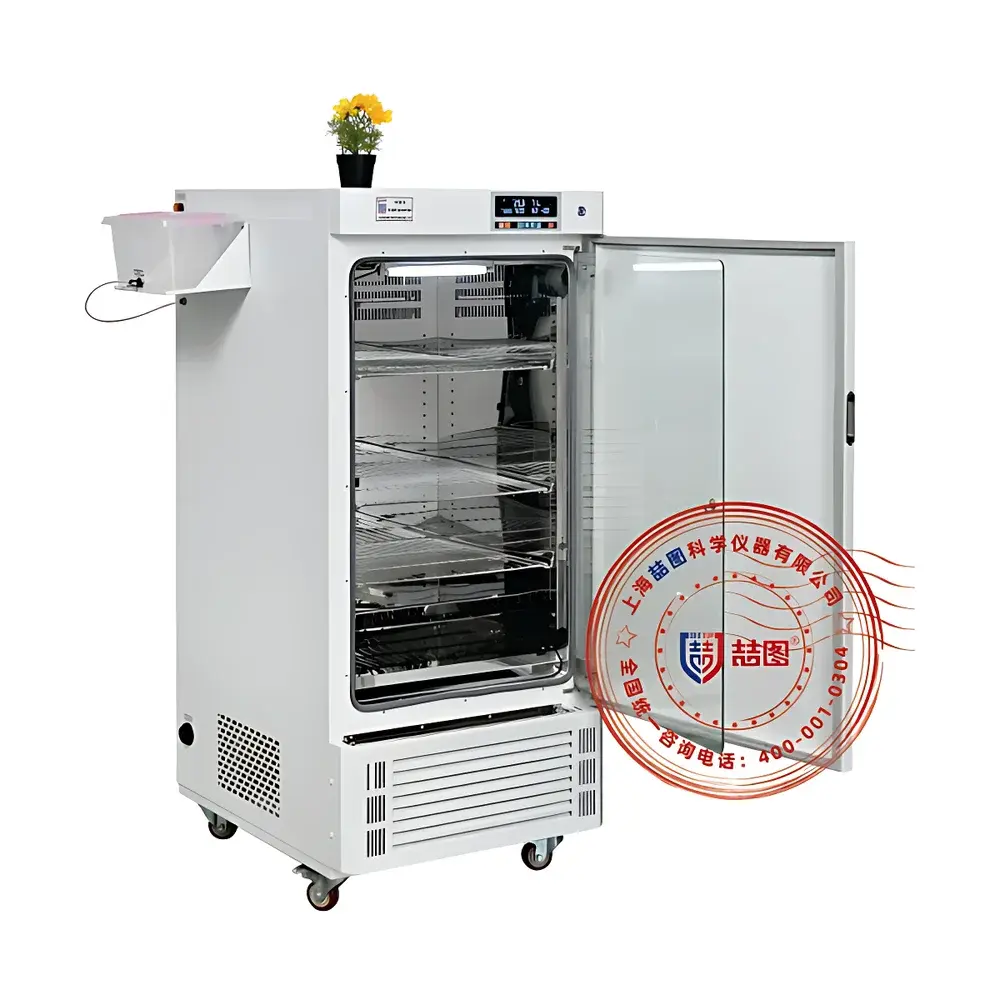
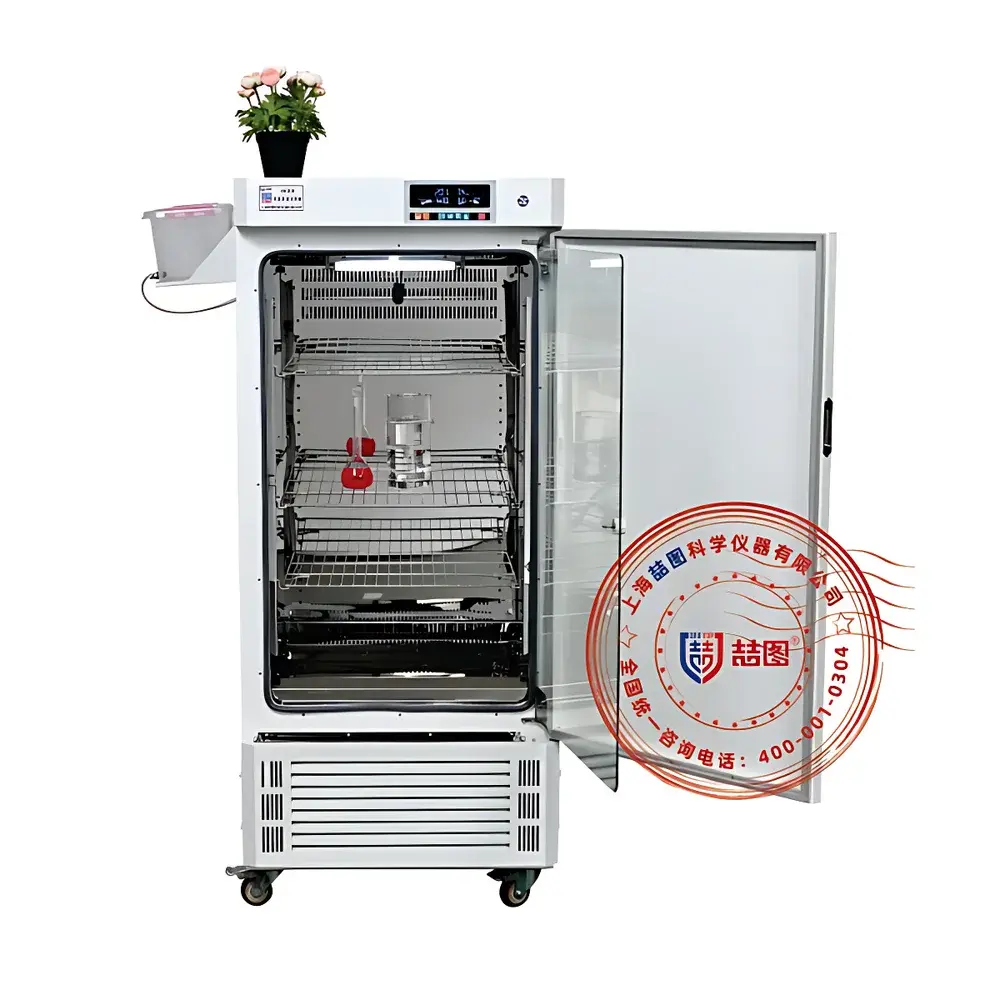
DRETOP ZHS-1000HC Temperature and Humidity Controlled Incubator
| Brand | DRETOP |
|---|---|
| Origin | Shanghai, China |
| Model | ZHS-1000HC |
| Refrigeration Method | Compressor-based cooling |
| Water Reservoir Type | External humidification tank |
| Temperature Range (with humidity control) | 0–65 °C |
| Temperature Uniformity | ±0.5 °C at high temperature, ±1 °C at low temperature |
| Humidity Range | 40–95 % RH |
| Chamber Capacity | 1000 L |
| Power Supply | AC 220 V, 50 Hz |
| Heating Element | Nickel-Chromium Alloy Heater |
| Cooling System | Modular compressor unit with start-delay and stop-interval protection |
| Air Circulation | Axial flow fan with optimized internal ducting |
| Control System | Microprocessor-based P.I.D. controller with 30-segment programmable logic |
| Display | Backlit LCD touchscreen interface |
| Safety Features | Over-temperature alarm, parameter memory, power-failure recovery, independent temperature limiter (optional) |
| Construction | Cold-rolled steel outer shell, 304 stainless steel interior chamber, adjustable removable stainless steel shelves |
| Door Design | Dual-door structure with tempered glass inner door and magnetic seal outer door |
| Environmental Compliance | R-134a or R-600a eco-friendly refrigerant |
| Standards Support | Designed for compliance with ISO 14644-1 (cleanroom air classification), USP <1151> (drug stability testing), ICH Q1A–Q1E guidelines, and GLP/GMP-relevant environmental monitoring workflows |
Overview
The DRETOP ZHS-1000HC Temperature and Humidity Controlled Incubator is an engineered environmental simulation platform designed for long-term, high-fidelity stability testing and biological cultivation under precisely regulated thermal and hygroscopic conditions. Based on the principle of dual-loop feedback control—separate proportional-integral-derivative (P.I.D.) algorithms govern heating/cooling and humidification/dehumidification subsystems—the system maintains stable setpoints across its full operational envelope (0–65 °C / 40–95 % RH). Its 1000 L chamber volume supports large-scale batch validation, accelerated aging studies, and multi-condition comparative trials common in pharmaceutical development, textile durability assessment, food shelf-life modeling, and material science research. The unit complies with foundational requirements for environmental chambers used in ICH-aligned stability programs, including controlled ramp rates, uniform spatial distribution of climatic parameters, and traceable operational logging when integrated with optional RS485 or data export modules.
Key Features
- Microprocessor-driven dual-channel P.I.D. control system with real-time digital display of chamber temperature, relative humidity, elapsed time, and program stage.
- 30-segment programmable cycle capability enabling complex multi-step profiles—for example: 25 °C/60 % RH for 7 days → ramp to 40 °C/75 % RH over 24 h → hold for 14 days—executed unattended with automatic transition logic.
- Modular compressor refrigeration architecture incorporating start-delay timers and mandatory off-cycle intervals to mitigate mechanical stress and extend service life beyond 15,000 operating hours under continuous duty.
- Optimized air management via axial-flow fans and laminar-optimized internal duct geometry ensures ≤±1.0 °C vertical/horizontal temperature deviation (measured per ASTM E2875-22) and ≤±3 % RH spatial variation across the full working volume.
- Stainless steel 304 interior chamber with fully removable, autoclavable shelves; seamless welded corners and radiused internal edges eliminate microbial harborage zones and simplify validated cleaning protocols.
- Dual-door observation system: inner tempered glass panel with anti-fog coating and outer magnetic gasketed door providing thermal resistance ≥0.85 m²·K/W (tested per ISO 10292), minimizing heat/moisture loss during routine access.
- External humidification reservoir reduces internal condensation risk and allows refill without interrupting active chamber operation—a critical advantage for extended stability runs exceeding 168 hours.
Sample Compatibility & Compliance
The ZHS-1000HC accommodates diverse sample formats—including stacked trays (up to 400 mm height), stacked pallets (max. 800 × 800 mm footprint), sealed vials, blister packs, and open petri dishes—without compromising parameter fidelity. Its construction materials meet ISO 10993-5 cytotoxicity requirements for indirect medical device contact applications. While not certified as a Class II biological safety cabinet, the chamber satisfies prerequisite environmental controls for ISO 13485-compliant manufacturing environments and supports FDA 21 CFR Part 11–compliant data integrity when paired with audit-trail-enabled software (e.g., DRETOP LabLink Pro, sold separately). Humidity calibration traceability aligns with ISO/IEC 17025-accredited laboratories using chilled-mirror hygrometers (e.g., Vaisala HMT337); temperature mapping reports may be generated per PQ protocol using calibrated thermocouple arrays.
Software & Data Management
The incubator’s embedded controller stores up to 100 program sequences and retains all runtime logs—including timestamped deviations, alarm events, and manual overrides—for minimum 30 days. Optional RS485 serial interface enables integration with SCADA platforms (Modbus RTU) or centralized LIMS systems. When configured with the DRETOP LabLink Pro software suite (Windows-based), users gain access to automated PDF report generation, configurable email/SMS alerts on threshold breaches, electronic signature support for SOP adherence, and encrypted SQLite database archiving compliant with ALCOA+ principles. All data exports include ISO 8601 timestamps, instrument ID, operator ID (if authenticated), and checksum verification to satisfy GxP audit readiness requirements.
Applications
- Pharmaceutical stability testing per ICH Q1A(R3), including long-term (25 °C/60 % RH), accelerated (40 °C/75 % RH), and intermediate condition protocols.
- Biological culture maintenance for mycological, bacterial, and fungal strains requiring strict moisture retention—particularly relevant for antibiotic susceptibility assays and spore germination kinetics.
- Textile and polymer aging studies evaluating colorfastness, tensile degradation, and hydrolytic breakdown under cyclic humidity exposure.
- Food packaging permeability validation, including water vapor transmission rate (WVTR) correlation under dynamic RH gradients.
- Electronics component reliability screening where condensation-induced corrosion must be simulated at sub-zero dew points within the 0–65 °C range.
- Regulatory submission support for ANDA, NDA, and MDR technical dossiers requiring documented environmental chamber qualification (IQ/OQ/PQ).
FAQ
What is the maximum allowable ambient temperature for continuous operation?
The unit is rated for installation in rooms maintained at ≤30 °C ambient with ≥150 mm clearance on all sides for heat dissipation.
Can the ZHS-1000HC operate at 0 °C with 95 % RH without internal icing?
Yes—the refrigeration system includes adaptive defrost cycling and dew-point monitoring to prevent frost accumulation on evaporator coils during low-temperature/high-humidity operation.
Is third-party temperature/humidity mapping validation supported?
Yes—standard 12-point sensor ports (M4 threaded) are provided at defined ISO 14644-1 grid locations; DRETOP supplies IQ/OQ documentation templates aligned with Annex 15 of the EU GMP Guide.
Does the controller support password-protected parameter locking?
Yes—three-tier access levels (Operator, Technician, Administrator) with configurable permissions for setpoint editing, program upload, and calibration adjustment.
What is the mean time between failures (MTBF) for the compressor module?
Based on field data from >1,200 installed units, MTBF exceeds 22,000 hours under nominal load conditions (25 °C/60 % RH, 8 h/day duty cycle).




