
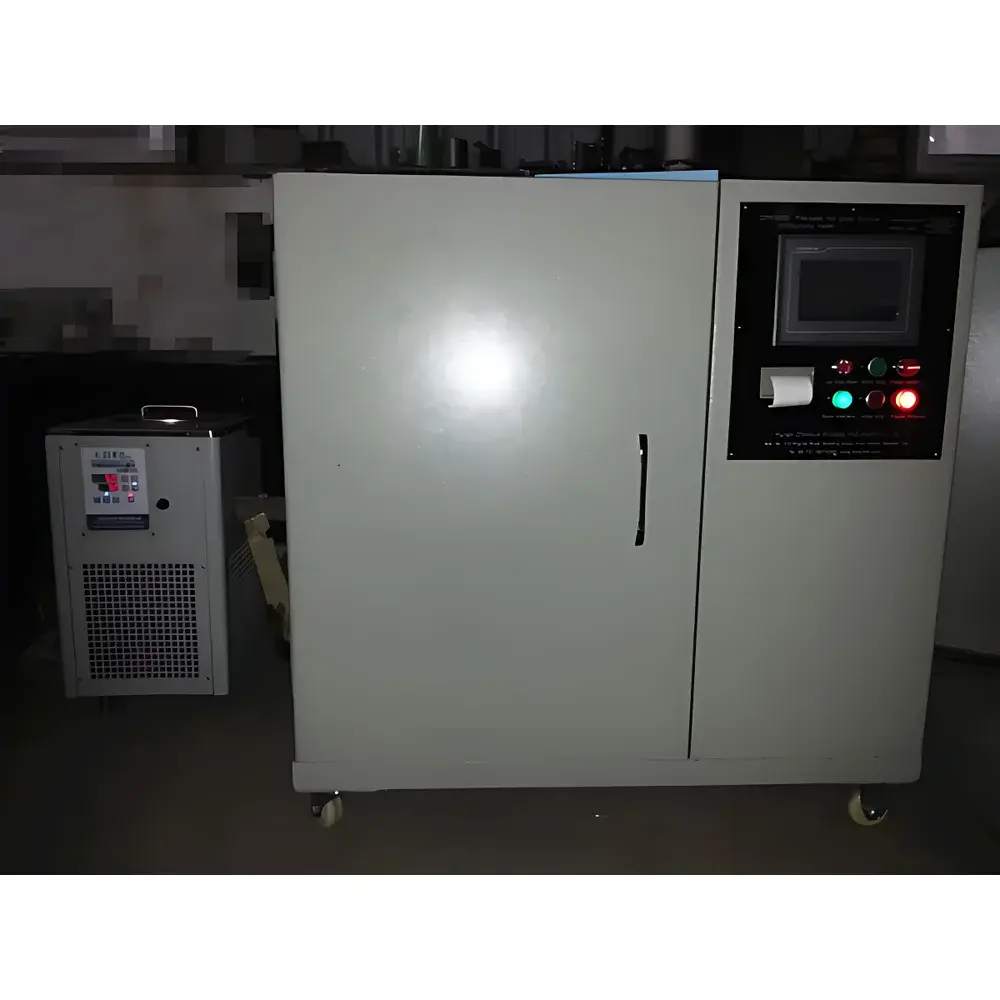
DREXEL DRX-II-300A Guarded Hot Plate Thermal Conductivity Analyzer
| Origin | Hunan, China |
|---|---|
| Manufacturer Type | Authorized Distributor |
| Origin Category | Domestic (China) |
| Model | DRX-II-300A |
| Price Range | USD 7,000–14,000 |
| Instrument Type | Guarded Hot Plate Method |
| Measurement Range | 0.01–2.2 W/m·K |
| Repeatability | ±1.0% |
| Accuracy | ±2.5% |
| Thickness Capacity | Up to 200 mm |
| Cold Plate Temp Range | −40 °C to +60 °C |
| Hot Plate Temp Range | Ambient to 110 °C (optional up to 300 °C or 600 °C) |
| Temperature Control Precision | ±0.1 °C |
| Temp Resolution | 0.01 °C |
| Sample Size | 200 × 200 × (5–20) mm or 300 × 300 × (5–100) mm |
| Power Supply | AC 220 V ±5%, 3.0 kW |
| Compliance | GB/T 10294–2008, ASTM C518, ISO 8302 |
Overview
The DREXEL DRX-II-300A Guarded Hot Plate Thermal Conductivity Analyzer is a precision-engineered instrument designed for steady-state measurement of thermal conductivity (λ) in solid and quasi-solid materials using the guarded hot plate method—recognized as the primary reference technique per ISO 8302, ASTM C518, and GB/T 10294–2008. Unlike transient methods (e.g., laser flash or transient plane source), the guarded hot plate approach establishes a one-dimensional, steady-state heat flux across a flat, homogeneous specimen sandwiched between precisely controlled hot and cold plates. The DRX-II-300A implements a triple-layer thermal guard system surrounding the central heating zone to minimize lateral heat loss, ensuring high fidelity in boundary condition definition and enabling traceable, low-uncertainty measurements (±2.5% accuracy) across a broad λ range (0.01–2.2 W/m·K). Its modular thermal management architecture supports multiple cooling modalities—including Peltier-based electronic refrigeration, chilled water circulation, compressed air, and ethanol-based mechanical refrigeration—allowing users to select optimal cold-side performance for low-temperature applications down to −40 °C.
Key Features
- Triple-zone thermal guarding system with active temperature tracking via fuzzy PID control, reducing environmental thermal drift and edge losses.
- Motorized parallelism adjustment mechanism ensures automatic alignment between specimen surfaces and hot/cold plates; surface non-parallelism error < 0.5 mm over 300 mm span.
- Integrated real-time thickness measurement module eliminates manual caliper use and enables dynamic compensation during test cycles.
- In-situ pressure monitoring and closed-loop regulation (optional) maintain consistent interfacial contact conditions across soft, compressible, or layered specimens.
- Dual-plate symmetric design with high-stability platinum RTD sensors (±0.1 °C accuracy) and microprocessor-based thermal compensation circuitry.
- Expandable configuration options: standard (max 50 mm), extended (60–100 mm), and heavy-duty (up to 200 mm) sample chambers with reinforced structural support.
- Self-calibration routines for both thermal conductivity and heater power output, traceable to internal reference standards.
Sample Compatibility & Compliance
The DRX-II-300A accommodates heterogeneous and anisotropic materials commonly encountered in building science, aerospace composites, and industrial insulation R&D. Validated specimen categories include rigid and semi-rigid foams (XPS, EPS, PUR), fiber-based insulators (glass wool, ceramic fiber blankets), cementitious boards, gypsum panels, rubber elastomers, vacuum-insulated panels (VIPs), powdered media (with optional containment fixture), and laminated composites. All measurements adhere strictly to the geometric, thermal, and procedural requirements defined in GB/T 10294–2008 (equivalent to ISO 8302), ASTM C518–22, and EN 12664. The system meets GLP documentation requirements through full audit-trail logging, user-access-level permissions, and timestamped raw data archives—supporting regulatory submissions under FDA 21 CFR Part 11 when deployed with validated software configurations.
Software & Data Management
The instrument operates under a native Windows-based thermal analysis platform compatible with Windows 10/11 (64-bit). The software provides fully automated test sequencing—from initial thermal equilibration and gradient stabilization to final λ calculation and uncertainty propagation per ISO/IEC 17025 guidelines. Real-time visualization includes dual-channel temperature profiles, power consumption curves, thickness vs. time plots, and thermal resistance convergence metrics. All datasets are stored in vendor-neutral CSV and XML formats, supporting third-party statistical analysis (e.g., JMP, MATLAB) and LIMS integration via OPC UA or TCP/IP protocols. Reporting modules generate customizable PDF certificates compliant with ISO/IEC 17025 clause 7.8, including calibration history, environmental logs, and operator metadata.
Applications
- Quality assurance of thermal insulation products in manufacturing facilities (e.g., extruded polystyrene, phenolic foam, aerogel composites).
- Material qualification for passive building envelope certification (e.g., LEED, BREEAM, Passive House Institute criteria).
- Fundamental research on phonon transport mechanisms in nanostructured ceramics and polymer blends.
- Validation of computational models (e.g., finite element simulations of heat transfer in multilayer assemblies).
- Regulatory testing for construction material compliance with national energy codes (e.g., China’s GB 50176, ASHRAE 90.1).
- Educational laboratories requiring ISO-traceable, hands-on instruction in steady-state conduction physics.
FAQ
What standards does the DRX-II-300A comply with for thermal conductivity measurement?
It conforms to GB/T 10294–2008, ASTM C518–22, ISO 8302, and EN 12664, all of which specify guarded hot plate methodology, specimen geometry, temperature uniformity, and uncertainty reporting requirements.
Can the system measure materials with high thermal resistance (e.g., VIPs or aerogels)?
Yes—the extended-range configuration (up to 200 mm thickness) and sub-0.01 W/m·K resolution capability enable reliable characterization of ultra-low-conductivity materials when tested under stabilized low-ΔT conditions.
Is the software compliant with FDA 21 CFR Part 11 for regulated environments?
The base software supports electronic signatures, audit trails, and role-based access control; full 21 CFR Part 11 compliance requires site-specific validation documentation and IT infrastructure alignment per organizational SOPs.
What cooling options are available for sub-ambient operation?
Four configurable modes: thermoelectric (Peltier), chilled water, compressed air, and ethanol-circulating mechanical refrigeration—each selectable based on required minimum cold-plate temperature and laboratory infrastructure.
Does the system require periodic recalibration by an external metrology lab?
While built-in self-calibration verifies heater output and sensor linearity, annual verification against NIST-traceable reference materials (e.g., SRM 1450c Fibrous Glass Board) is recommended for accredited testing labs operating under ISO/IEC 17025.



