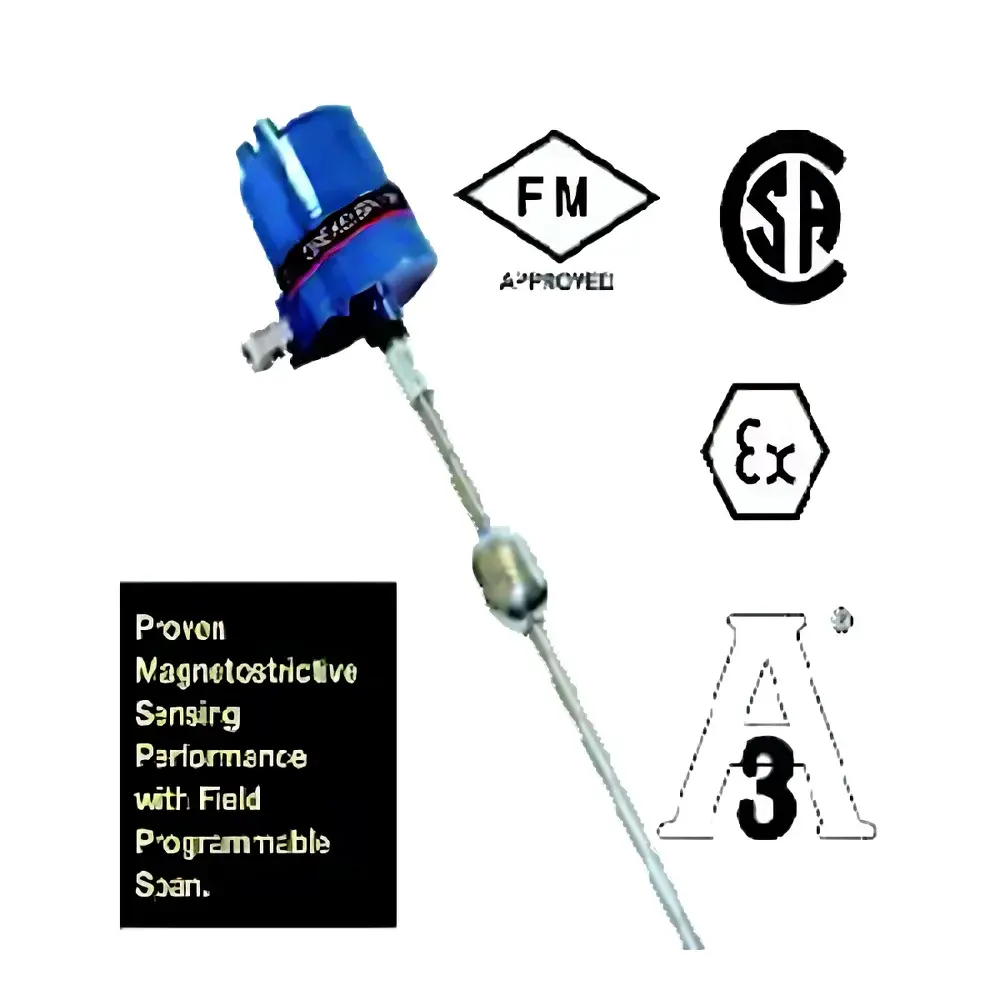
Drexelbrook DM330 Series Magnetostrictive Level Transmitter
| Brand | Drexelbrook |
|---|---|
| Origin | Shanghai, China |
| Manufacturer Type | Authorized Distributor |
| Product Category | Domestic (China-sourced) |
| Model | DM330 Series Magnetostrictive Level Transmitter |
| Output Signal | 4–20 mA (HART optional) |
| Accuracy | ±0.1% of full scale |
| Measurement Capability | Continuous liquid level and interface level (dual-point density discrimination) |
| Pressure Rating | Up to 6.9 MPa (1000 psi) for rigid probe variants |
| Temperature Range | –20 °C to +100 °C |
| Probe Configurations | Rigid rod (max. 7.3 m), Flexible cable (max. 12 m) |
| Integrated Temperature Sensing | Five discrete Pt100 RTD points along probe length |
| Enclosure Options | IP66/IP67 aluminum or stainless steel housing |
| Electrical Connection | Conduit or M20 threaded entry |
| Process Connection | Threaded (NPT, BSP), flanged (ANSI/DIN), or sanitary clamp |
| Compliance | ATEX II 1G Ex ia IIC T4 Ga, IECEx ia IIC T4 Ga, SIL2 per IEC 61508 |
Overview
The Drexelbrook DM330 Series Magnetostrictive Level Transmitter is an industrial-grade continuous level measurement instrument engineered for high-accuracy, stable, and maintenance-free operation in demanding process environments. It operates on the magnetostrictive principle: a torsional strain pulse is generated at the precise location where a permanent magnet—mounted on a float—intersects a specially wound waveguide inside the probe. The time-of-flight between the initiation of an interrogation current pulse and the return of the torsional wave is measured with nanosecond resolution, enabling direct, absolute position determination of the float—and thus the liquid surface—without drift or recalibration. This physics-based measurement method delivers intrinsic linearity and long-term stability, making the DM330 suitable for custody transfer, batch control, inventory management, and interface detection in tanks containing immiscible liquids (e.g., oil/water, hydrocarbon/aqueous phases).
Key Features
- High-precision level measurement with ±0.1% full-scale accuracy under standard calibration conditions, traceable to NIST-certified reference standards.
- Simultaneous continuous level and interface level output via dual-float configuration (optional), supporting density-discriminative applications without additional instrumentation.
- Integrated five-point temperature profiling using calibrated Pt100 RTDs distributed along the probe length—enabling real-time thermal compensation and stratification analysis.
- Rigid rod probe variant rated for pressures up to 6.9 MPa (1000 psi) and temperatures from –20 °C to +100 °C; flexible cable probe extends range to 12 meters while maintaining structural integrity in agitated or viscous media.
- Robust mechanical architecture with explosion-proof (ATEX/IECEx) and functional safety (SIL2) certifications—designed for Zone 0/1 hazardous areas in petrochemical, pharmaceutical, and bulk chemical facilities.
- Configurable 4–20 mA analog output with HART 7 protocol support for remote configuration, diagnostics, and multi-variable data access (level, temperature gradients, fault status).
Sample Compatibility & Compliance
The DM330 is compatible with a broad spectrum of industrial fluids—including hydrocarbons, solvents, acids, bases, and food-grade liquids—provided float material (e.g., 316SS, Hastelloy C-276, PTFE-coated) is selected to match process chemistry and density requirements (typically 0.5–2.0 g/cm³). Probe wetted parts comply with FDA 21 CFR 177.2600 for indirect food contact where applicable. All units are manufactured and tested in accordance with IEC 61298-1 (industrial level measurement devices) and IEC 60079-0/-11 (explosion protection). Documentation includes full test reports, material certifications (EN 10204 3.1), and conformity declarations aligned with EU Machinery Directive 2006/42/EC and PED 2014/68/EU.
Software & Data Management
Configuration and diagnostics are performed via Drexelbrook’s proprietary PC-based LevelView™ Configuration Utility, which supports device parameterization, linearization curve editing, temperature compensation setup, and firmware updates. The utility generates audit-ready logs compliant with 21 CFR Part 11 requirements when used with validated IT infrastructure. For integration into DCS/SCADA systems, the DM330 provides native support for FOUNDATION Fieldbus (H1) and PROFIBUS PA upon request. All digital communication channels include built-in diagnostic registers for sensor health monitoring, including waveguide integrity checks, float detachment alerts, and thermal gradient anomaly detection—enabling predictive maintenance planning in accordance with ISO 55001 asset management frameworks.
Applications
- Refinery storage tanks (crude, feedstocks, intermediates) requiring interface detection and API MPMS Chapter 3.2-compliant volume calculation.
- Pharmaceutical clean steam condensate receivers and WFI (Water for Injection) storage vessels, where GMP-aligned calibration records and traceability are mandatory.
- Chemical blending skids with multiple immiscible phase inputs, leveraging dual-float capability for real-time ratio control.
- Wastewater treatment digesters and equalization basins operating under variable temperature and pressure profiles—benefiting from five-point thermal mapping.
- Marine fuel bunkering systems onboard vessels, certified to DNV-GL Marine Guidelines for level instrumentation in hazardous zones.
FAQ
What is the maximum allowable specific gravity for float selection in the DM330 system?
Float density must exceed the process fluid’s specific gravity by ≥0.1 g/cm³ to ensure reliable buoyancy and mechanical coupling. Standard floats cover 0.5–2.0 g/cm³; custom densities are available upon engineering review.
Can the DM330 be calibrated for non-linear tank geometries?
Yes—the LevelView™ software supports user-defined volumetric tables (up to 256 points) for horizontal cylinders, spheres, or irregular vessels, enabling direct volume output in liters or gallons.
Is third-party calibration certification available?
Drexelbrook partners with ISO/IEC 17025-accredited laboratories to provide NIST-traceable calibration certificates with uncertainty budgets, valid for 12 months from issuance.
How does the system handle foam or turbulent surfaces?
The magnetostrictive sensing mechanism is inherently immune to surface turbulence, vapor space conditions, and moderate foam layers—as it measures float position, not surface reflection or capacitance changes.
What is the typical service life of the waveguide assembly under continuous operation?
Based on accelerated life testing per IEC 60721-3-3 Class 3K5, the waveguide exhibits >15 years MTBF in non-corrosive environments; replacement intervals are determined by process-specific corrosion rate assessments.