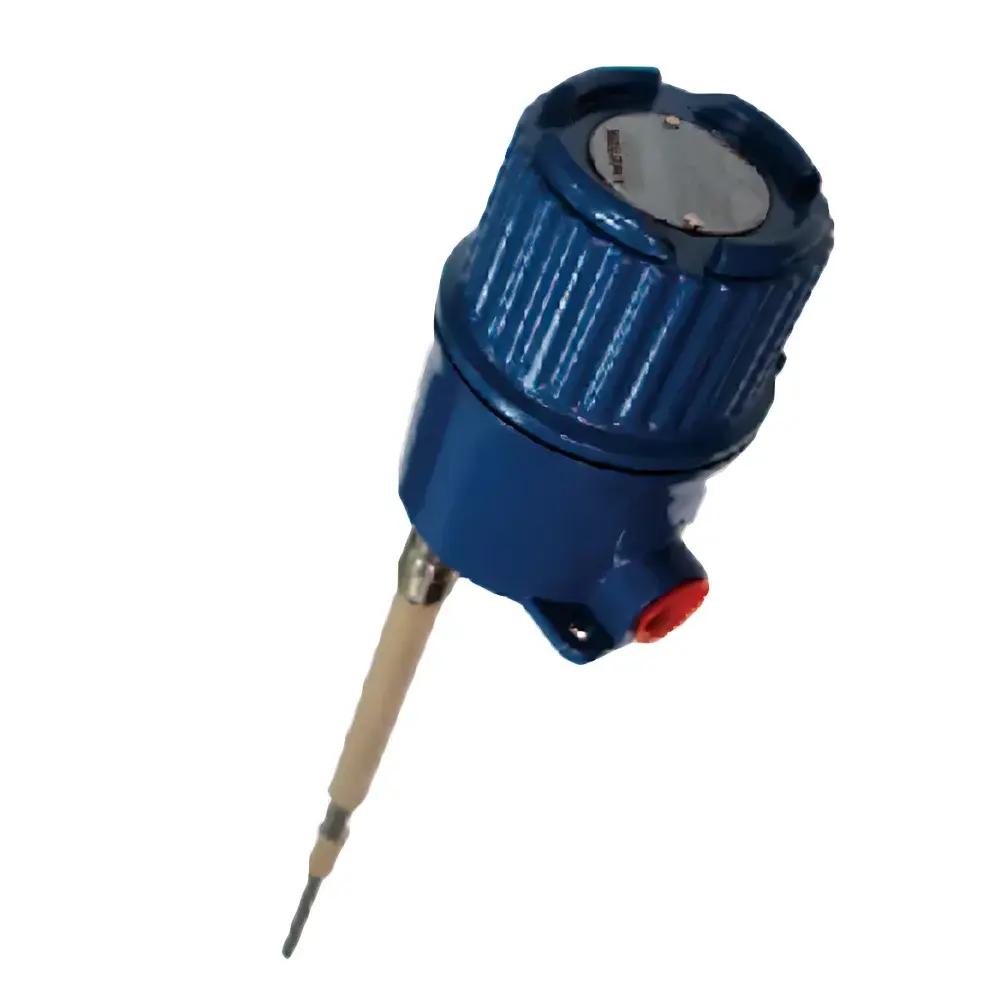
Drexelbrook Z4 Series Economical RF Admittance Level Switch
| Brand | Drexelbrook |
|---|---|
| Origin | Shanghai, China |
| Manufacturer Type | Authorized Distributor |
| Regional Category | Domestic (China) |
| Model | Z4 Series Economical RF Admittance Level Switch |
| Product Type | Level Switch |
| Power Supply Options | 24 VDC / 115 VAC / 220 VAC |
| Output | DPDT (Double-Pole Double-Throw) |
| Temperature Rating | Up to 815 °C (with optional high-temp probe) |
| Pressure Rating | Up to 6.9 MPa (with optional high-pressure housing) |
| Dielectric & Conductivity Insensitivity | Yes |
| Application Scope | Non-hazardous area installations only |
| Compliance | Designed per IEC 61000-6-2/6-4 (EMC), IP66 enclosure standard (standard configuration) |
Overview
The Drexelbrook Z4 Series Economical RF Admittance Level Switch is a robust, field-proven point-level detection instrument engineered for reliable on/off level signaling in bulk solid and liquid storage vessels across non-hazardous industrial environments. It operates on the principle of RF (radio frequency) admittance measurement — a refined evolution of traditional capacitance technology — where a high-frequency AC signal (typically 1–2 MHz) is applied between the probe and vessel wall (or reference electrode), generating an admittance response proportional to the material’s dielectric constant, conductivity, and proximity to the sensing element. Unlike basic capacitance switches, the Z4 series incorporates guard electrode architecture and adaptive signal processing to effectively suppress false triggers caused by coating buildup, humidity, temperature drift, or minor variations in material dielectric properties. This enables stable operation even with highly adhesive, dusty, or hygroscopic media — such as fly ash, limestone slurry, pulverized coal, and desulfurization gypsum — without requiring periodic manual cleaning or recalibration.
Key Features
- DPDT (Double-Pole Double-Throw) relay output providing flexible wiring options for fail-safe or latching alarm configurations
- Wide power input compatibility: selectable 24 VDC (20–30 VDC), 115 VAC (90–130 VAC), or 220 VAC (180–264 VAC) operation — simplifying integration into diverse plant electrical systems
- High-temperature probe variants rated up to 815 °C, suitable for direct insertion into boiler hoppers, economizer ash hoppers, and high-heat pneumatic conveying lines
- High-pressure housing options rated to 6.9 MPa (1000 psi), enabling use in pressurized silos and dense-phase conveying vessels
- Dielectric and conductivity insensitivity ensures consistent switching thresholds across material batches with variable moisture content or particle size distribution
- IP66-rated aluminum or stainless-steel enclosure with NEMA 4X equivalent protection against dust ingress and water jet exposure
- No intrinsic safety or explosion-proof certification — intended exclusively for Class I, Division 2 / Zone 2 non-hazardous area applications per NEC and IEC 60079 standards
Sample Compatibility & Compliance
The Z4 series is optimized for continuous, maintenance-free operation with low-to-medium dielectric materials including coal, fly ash, limestone, lime slurry, activated carbon, catalyst pellets, and dry biomass. Its guard-driven RF circuitry minimizes bridging errors common in sticky or cohesive powders. While not certified for hazardous locations, it complies with electromagnetic compatibility requirements per IEC 61000-6-2 (immunity) and IEC 61000-6-4 (emissions), ensuring stable performance in electrically noisy power plant environments. All units meet RoHS Directive 2011/65/EU and are supplied with CE-marked documentation packages supporting ISO 9001-compliant quality assurance processes. Installation follows ASME B16.5 flange standards (for threaded or flanged probe mounts) and conforms to general good engineering practice (GEP) for level switch placement per ISA-TR18.2.1.
Software & Data Management
As a hardwired, analog point-level switch, the Z4 series does not incorporate embedded firmware, digital communication protocols (e.g., HART, Foundation Fieldbus, or Modbus), or onboard data logging. Its operation is entirely deterministic and state-based — delivering discrete contact closure/open signals directly to PLCs, DCS I/O modules, or local alarm panels. For traceability in regulated environments (e.g., power generation facilities subject to NERC CIP or ISO 55001 asset management frameworks), mechanical installation records, calibration verification logs (per manufacturer-recommended zero-point verification procedure), and relay functional test reports may be maintained manually or integrated into CMMS platforms via external documentation workflows. No FDA 21 CFR Part 11 compliance is applicable, as the device performs no electronic recordkeeping or electronic signature functions.
Applications
Primary deployment domains include coal-fired power generation (coal bunkers, ESP hoppers, bottom ash hoppers, SCR reactor fly ash bins), flue gas desulfurization (FGD) systems (limestone silos, gypsum dewatering hoppers), selective catalytic reduction (SCR) ammonia storage, cement kiln feed hoppers, and pneumatic conveying receiver vessels. It is also widely adopted in non-explosive segments of steelmaking (slag granulation tanks), waste-to-energy plants (refuse-derived fuel silos), and mineral processing (lime dosing hoppers). The Z4 series is not recommended for use with conductive liquids (e.g., acids, caustics), volatile organic compounds, or applications requiring SIL2/SIL3 functional safety certification.
FAQ
Is the Z4 series suitable for explosive atmospheres?
No. The Z4 series carries no ATEX, IECEx, or UL Class I Div 1 certification and must only be installed in non-hazardous areas classified as Class I, Division 2 or Zone 2.
Can it detect level in conductive liquids like water or acid solutions?
Not reliably. The Z4 is optimized for solids and low-conductivity slurries; conductive liquids may cause unstable switching due to shunting effects across the probe surface.
What is the recommended verification interval for routine maintenance?
Drexelbrook recommends functional testing at commissioning and annually thereafter, or after any process change affecting material characteristics — using dry-air purging or manual probe inspection to confirm absence of heavy coating.
Does the unit support remote configuration or diagnostics?
No. Configuration is fixed at manufacture; no field-adjustable sensitivity, delay timers, or diagnostic interfaces are provided.
Are custom probe lengths or flange types available?
Yes — standard NPT, BSPP, and ANSI B16.5 flange mounting options are offered, along with probe lengths from 150 mm to 3000 mm; custom configurations require formal engineering review and lead-time extension.