
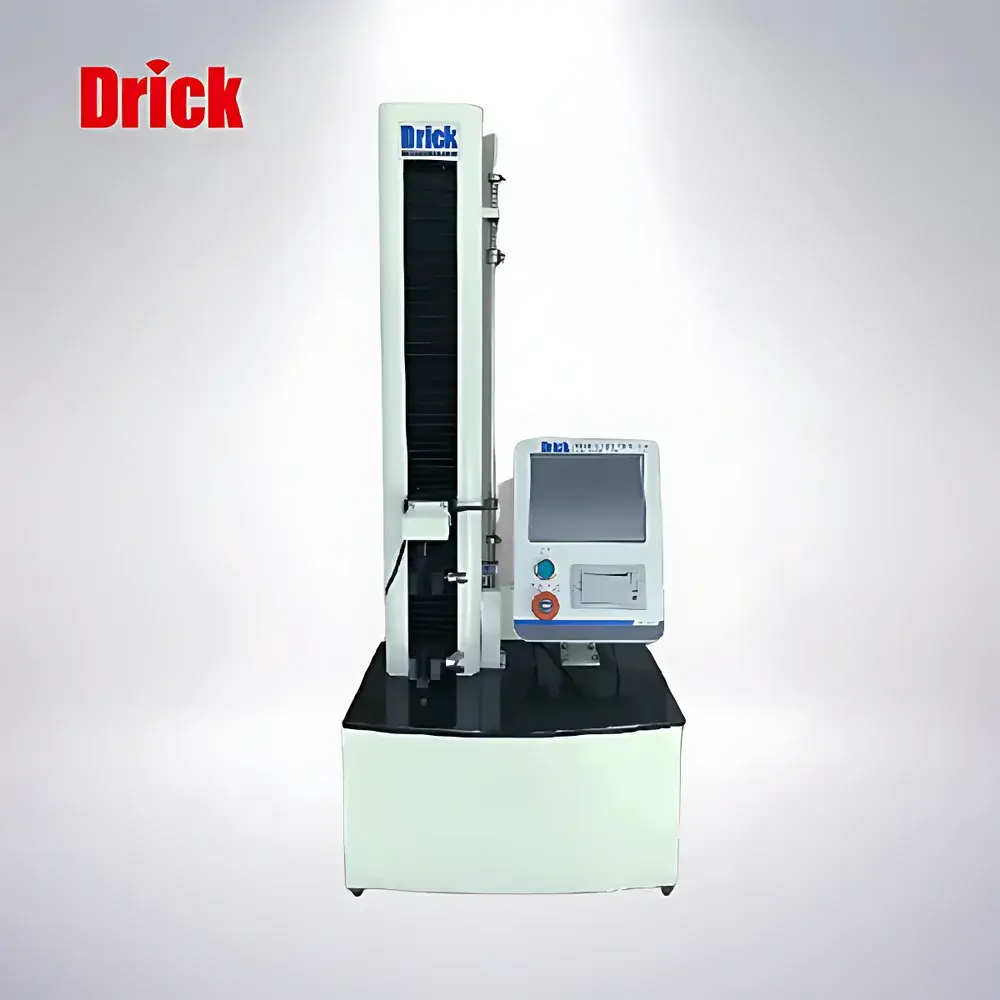
Drick DR101 Cork Pull-Out Tensile Tester
| Brand | Drick |
|---|---|
| Origin | Shandong, China |
| Manufacturer Type | OEM/ODM Producer |
| Model | DR101 |
| Max Test Force | 5 kN |
| Force Range Options | 100 N / 500 N / 1000 N / 5000 N (select one) |
| Force Accuracy | Better than Class 0.5 |
| Test Stroke | 700 mm (customizable) |
| Displacement Resolution | 0.001 mm |
| Speed Range | 1–500 mm/min (infinitely variable) |
| Load Resolution | 0.1 N |
| Dimensions (L×W×H) | 500 × 300 × 1500 mm |
| Weight | Approx. 85 kg |
| Power Supply | AC 220 V ±10%, 50 Hz |
Overview
The Drick DR101 Cork Pull-Out Tensile Tester is a microprocessor-controlled electromechanical testing system engineered specifically for quantitative measurement of cork stopper extraction force — a critical quality parameter in wine and beverage packaging validation. It operates on the fundamental principle of uniaxial tensile loading, applying controlled axial displacement to a cork sample inserted into a standardized bottle neck or fixture, while continuously recording force vs. displacement data. The instrument complies with the mechanical testing framework defined in ISO 37 (rubber vulcanized or thermoplastic), ASTM D882 (tensile properties of thin plastic sheeting), and GB/T 1040 series (plastics — determination of tensile properties), enabling traceable, repeatable evaluation of pull-out resistance under defined environmental and procedural conditions. Its modular architecture supports both dedicated cork testing per EN 15869-1 (cork stoppers — requirements and test methods) and broader material characterization across flexible packaging, films, foils, and fibrous substrates.
Key Features
- Precision mechanical drive train incorporating preloaded ball screws and imported servo motor for low-noise, high-repeatability motion control and minimal backlash.
- 7-inch capacitive touchscreen interface with dual-language (English/Chinese) menu navigation and real-time graphical display of load–displacement curves during test execution.
- Integrated thermal line printer (modular design) for immediate hard-copy output of test reports including arithmetic mean, standard deviation, coefficient of variation, and individual trial values.
- Auto-reset function, overload protection (120% FS), fault self-diagnosis, and non-volatile memory for up to 100 test records without external storage.
- Modular grip configuration supporting manual clamping for cork stoppers, film strips, metallic foils, and textile specimens; optional pneumatic or hydraulic fixtures available upon request.
- Infinitely variable crosshead speed from 1 to 500 mm/min, programmable in 0.1 mm/min increments, meeting dynamic testing requirements across ISO 6892-1 and ASTM E8/E21 protocols.
Sample Compatibility & Compliance
The DR101 accommodates cylindrical cork stoppers (diameter range: 20–30 mm; length: 35–55 mm) mounted in standardized glass or polymer bottle neck simulators. With interchangeable fixtures, it extends to flat specimens including paperboard (GB/T 453), BOPP/BOPET films (GB/T 1040.3), pressure-sensitive adhesives (GB/T 2792, ASTM D3330), and elastomeric seals (ISO 37). All mechanical and metrological performance parameters conform to national and international calibration and verification standards: GB/T 17200 (general requirements for universal testing machines), JJG 475 (verification regulation for electronic universal testing machines), ASTM E4 (load verification of testing machines), and ISO 7500-1 (static calibration of force-proving instruments). Force transducers are factory-calibrated against NIST-traceable reference standards, with certificate of calibration provided.
Software & Data Management
The embedded firmware supports GLP-compliant data integrity: all tests record timestamp, operator ID (optional login), environmental temperature/humidity (when interfaced with external sensors), test speed, selected range, and raw load–displacement arrays at ≥100 Hz sampling rate. Export formats include CSV and PDF. Optional PC-based software (DRK-TestSuite v3.2) adds advanced statistical analysis, multi-curve overlay, batch reporting, audit trail logging, and 21 CFR Part 11 compliance modules — including electronic signatures, role-based access control, and immutable record archiving. Data files are stored in encrypted SQLite databases with SHA-256 hash verification.
Applications
- Quantitative assessment of cork stopper extraction force per EN 15869-1 and OIV-OENO 455-2017 for winery QC laboratories.
- Tensile strength, elongation at break, and modulus determination for plastic films (ASTM D882), aluminum foil (GB/T 3198), and laminated packaging structures (GB/T 10004).
- Peel strength evaluation at 90° and 180° angles for pressure-sensitive tapes (ASTM D3330), labels (GB/T 2792), and medical device pouches (ISO 11607-2).
- Securing force verification for child-resistant closures (ASTM D3475) and pharmaceutical blister pack lidding (USP ).
- Routine QC of paper tensile properties (GB/T 12914), nonwovens (ISO 9073-3), and rubber gaskets (ISO 37).
FAQ
What standards does the DR101 comply with for cork testing?
It meets EN 15869-1, OIV-OENO 455-2017, and ISO 37 Annex D for cork stopper extraction force, with full traceability to national metrology institutes.
Can the instrument be integrated into a LIMS or ERP system?
Yes — via RS232/USB virtual COM port or optional Ethernet module, supporting ASTM WK33362 (Standard Guide for Data Exchange in Materials Testing) compliant ASCII or XML output.
Is third-party calibration certification available?
Drick provides ISO/IEC 17025-accredited calibration certificates (optional add-on) with uncertainty budgets per ISO/IEC 17025:2017 Clause 6.5.
What is the warranty coverage and service support scope?
Standard 24-month parts-and-labor warranty; extended service plans include annual on-site verification, preventive maintenance, and remote diagnostics support.
Does the system support automated test sequences for high-throughput labs?
With optional PC software and auto-grip actuation module, up to 20 sequential tests can be queued, with pass/fail logic applied per user-defined limits and automatic report generation.



