
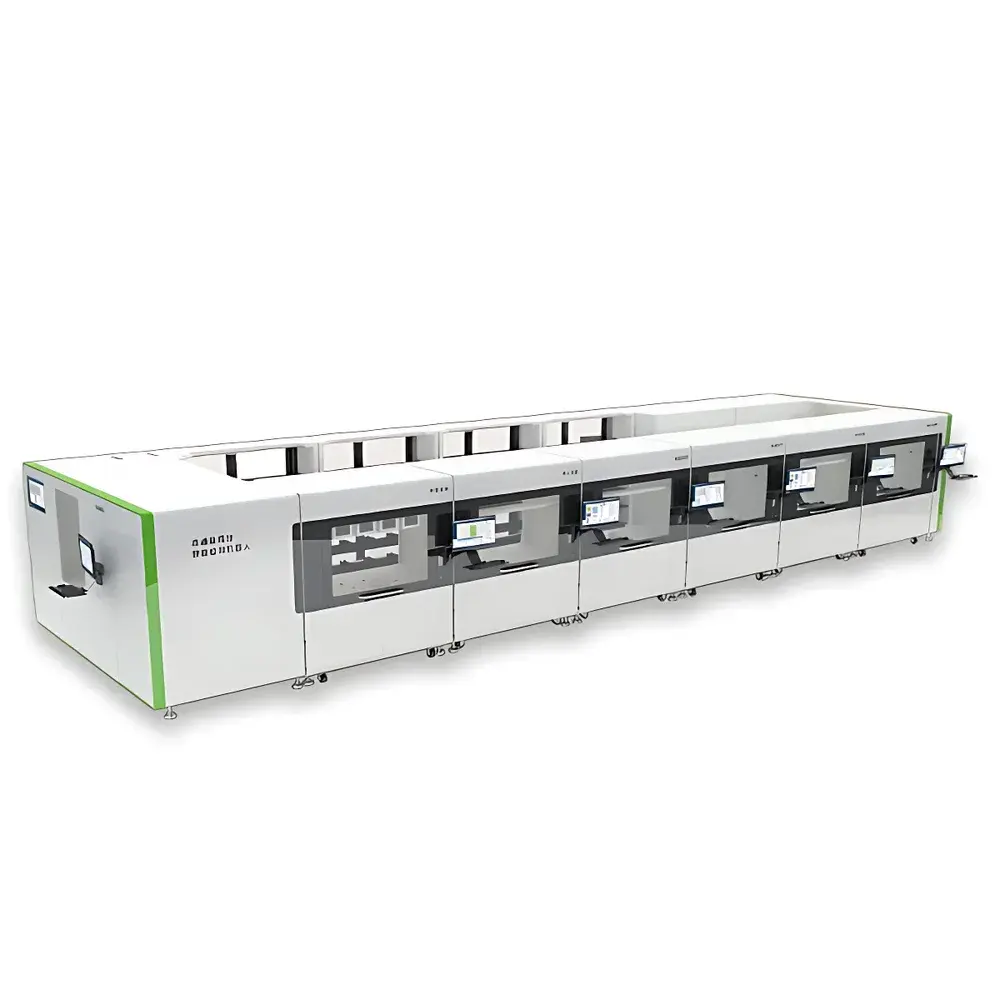
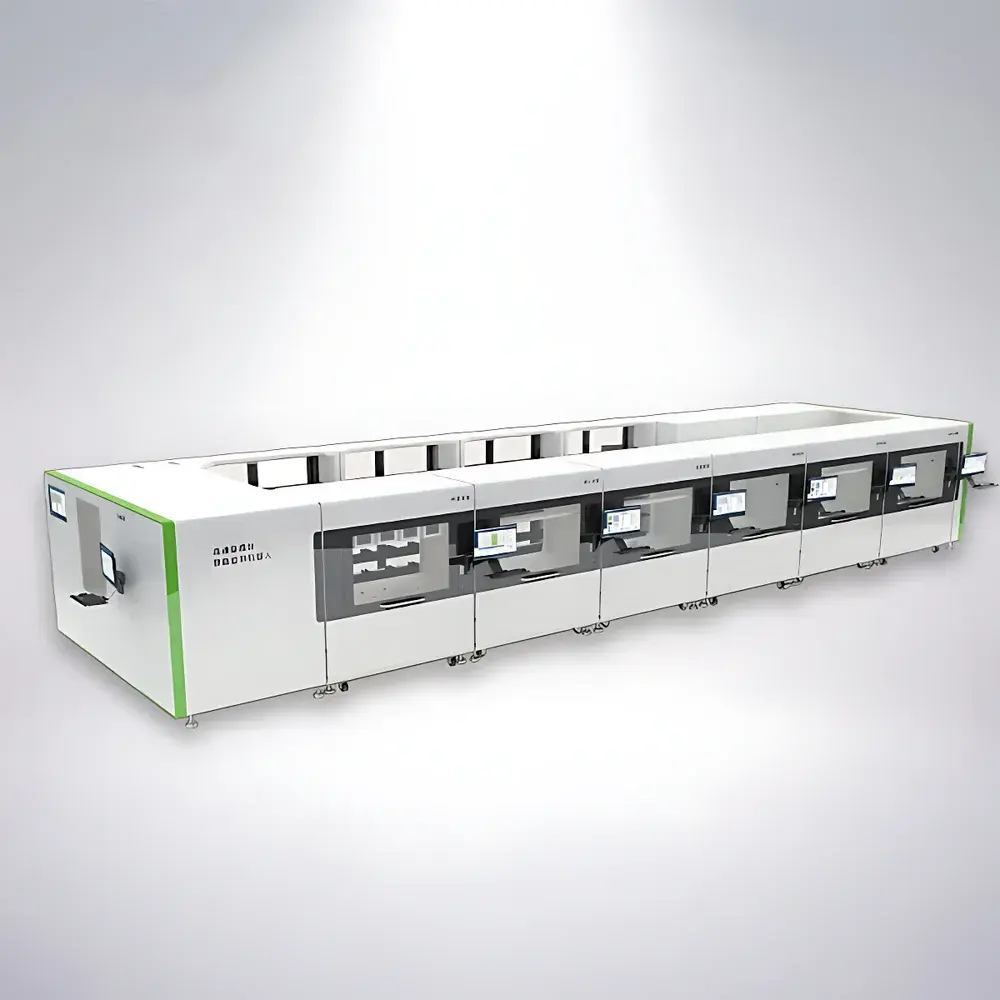
Drick DRK-01 Black-Light Smart Laboratory High-Throughput Intelligent Composition Analysis Robot System
| Brand | Drick |
|---|---|
| Origin | Shandong, China |
| Manufacturer Type | OEM/ODM Manufacturer |
| Regional Classification | Domestic (China) |
| Model | DRK-01 Black-Light Smart Laboratory |
| Price | USD 140,000 (FOB Qingdao) |
Overview
The Drick DRK-01 Black-Light Smart Laboratory is an integrated high-throughput intelligent composition analysis robot system engineered for unattended, end-to-end automation of soil and environmental solid sample testing. It operates on a modular robotic workflow architecture grounded in standardized analytical chemistry principles—including gravimetric sample preparation, controlled thermal digestion (open-vessel and block-heated), solvent extraction under regulated agitation and temperature, volumetric dilution, colorimetric reaction kinetics, ion-selective electrode (ISE) and potentiometric titration, centrifugal phase separation, and spectrophotometric or ICP-OES-compatible endpoint detection. Designed explicitly to meet the operational rigor of national soil survey programs—particularly China’s Third National Soil Census (“San Pu”)—the system executes full analytical sequences compliant with NY/T 1121 (Soil Testing Standards), HJ 781–2016 (Solid Waste – Determination of Metals by ICP-MS), HJ 766–2015 (Total Metal Content in Soils), HJ 491–2019 (Copper, Zinc, Lead, Cadmium in Soils by Flame AAS), and GB/T 22105–2008 (Soil Quality – Determination of Total Nitrogen, Phosphorus, and Potassium). Its black-light (lights-out) operation mode enables 24/7 autonomous execution without human intervention, reducing labor dependency while maintaining metrological traceability per ISO/IEC 17025 requirements.
Key Features
- Modular robotic platform integrating 10 synchronized functional modules: sample drying & homogenization station, robotic micro-balance weighing unit (0.01 mg resolution, auto-calibration), pH and redox potential measurement module with dual-electrode auto-rinsing, organic matter determination via dichromate oxidation/titration, orbital shaker-based leaching (HJ 781-compliant), programmable heating mantle for acid digestion (up to 180°C), precision liquid handling station (1–5000 µL, CV < 0.8%), colorimetric reaction incubator with LED-based absorbance monitoring at 405–850 nm, refrigerated centrifuge module (4°C, 5000 rpm), and integrated ICP-OES or UV-Vis spectrophotometer interface.
- Full-process digital traceability: each sample carries a unique QR-coded vial; all instrument actions, reagent lot numbers, environmental conditions (temperature/humidity), and calibration logs are timestamped and cryptographically signed in accordance with FDA 21 CFR Part 11 Annex 11 and GLP audit requirements.
- Adaptive method routing engine: automatically selects optimal digestion, extraction, and detection protocols based on sample matrix classification (e.g., calcareous vs. acidic soils, sludge vs. agricultural topsoil), minimizing interferences and maximizing recovery rates.
- Throughput-optimized scheduling: processes up to 11,500 analytical determinations per 24-hour cycle across parallel workflows, achieving average turnaround time of 36–72 hours from raw sample receipt to validated report generation.
- Self-diagnostic subsystems: real-time sensor health monitoring (load cell drift, pipette tip seal integrity, photometer dark-current stability), predictive maintenance alerts, and automated QC spike/recovery validation at every 20th sample batch.
Sample Compatibility & Compliance
The DRK-01 accepts solid matrices including air-dried soil (0.15–2 mm particle size after sieving), sediment, compost, biosolids, and mine tailings. All sample introduction, grinding, and subsampling comply with ISO 11464:2022 (Soil quality — Sampling guidance) and GB/T 6682–2008 (Water for analytical laboratory use). Method validation data confirm adherence to repeatability thresholds (>90% RSD ≤ 5% across 6 replicates) specified in NY/T 1121.1–2022 and HJ 766–2015. Instrumental output files are structured in ASTM E2982-21-compliant .csv and .xml formats, supporting direct ingestion into LIMS platforms certified to ISO/IEC 17025:2017 Clause 7.11.
Software & Data Management
The system runs on Drick LabOS v4.2—a deterministic real-time operating system with deterministic task scheduling and dual-redundant database architecture (PostgreSQL + immutable ledger backup). The web-based interface supports role-based access control (RBAC), electronic signatures per ALCOA+ principles, and full audit trail export (ISO/IEC 17025 Clause 7.9). Raw spectral data, chromatograms (if coupled with GC or IC), titration curves, and balance weight logs are stored with SHA-256 hash verification. Integrated reporting engine generates PDF reports conforming to CNAS-CL01:2018 Annex A2 requirements, including uncertainty budgets calculated per GUM (JCGM 100:2008).
Applications
- National-scale soil monitoring programs requiring high-volume, standardized analysis of ≥42 physicochemical parameters—including cation exchange capacity (CEC), base saturation, available micronutrients (Fe, Mn, Cu, Zn, B, Mo), total and extractable heavy metals (Hg, As, Pb, Cd, Cr, Ni), and macronutrient speciation (N-P-K-S-Si).
- Environmental remediation labs performing sequential extraction (BCR protocol) and risk-based screening per EPA Method 6010D and ISO 17294-2:2016.
- Agricultural extension services validating fertilizer recommendations using calibrated rapid-testing protocols aligned with FAO’s Global Soil Partnership indicators.
- Research institutions conducting long-term soil health studies requiring longitudinal data consistency across decades and multi-site deployments.
FAQ
Does the DRK-01 support method customization beyond the preloaded standards?
Yes—users may import validated SOPs via XML templates adhering to ASTM E2500-22 format, subject to internal method verification against reference materials (e.g., NIST SRM 2710a).
What level of operator training is required for routine operation?
Minimal: basic LIMS navigation and emergency stop procedures. All analytical sequence execution, fault recovery, and calibration are fully automated; only QA/QC oversight and consumables replenishment require manual intervention.
Is remote monitoring and diagnostic support available?
Yes—optional Drick Connect Secure Gateway enables encrypted TLS 1.3 telemetry streaming to central IT infrastructure, with remote diagnostics enabled under ISO/IEC 27001-certified support SLA.
How is compliance with data integrity regulations ensured?
Through built-in 21 CFR Part 11 compliance features: electronic signature enforcement, audit trail immutability, role-based permissions, and periodic independent validation of cryptographic hashing integrity.
Can the system integrate with third-party ICP-OES or AAS instruments?
Yes—via standardized ASTM E1382-compliant RS-232/OPC UA interfaces; hardware abstraction layer supports Agilent, PerkinElmer, Thermo Fisher, and Shimadzu models with vendor-specific driver certification.





