
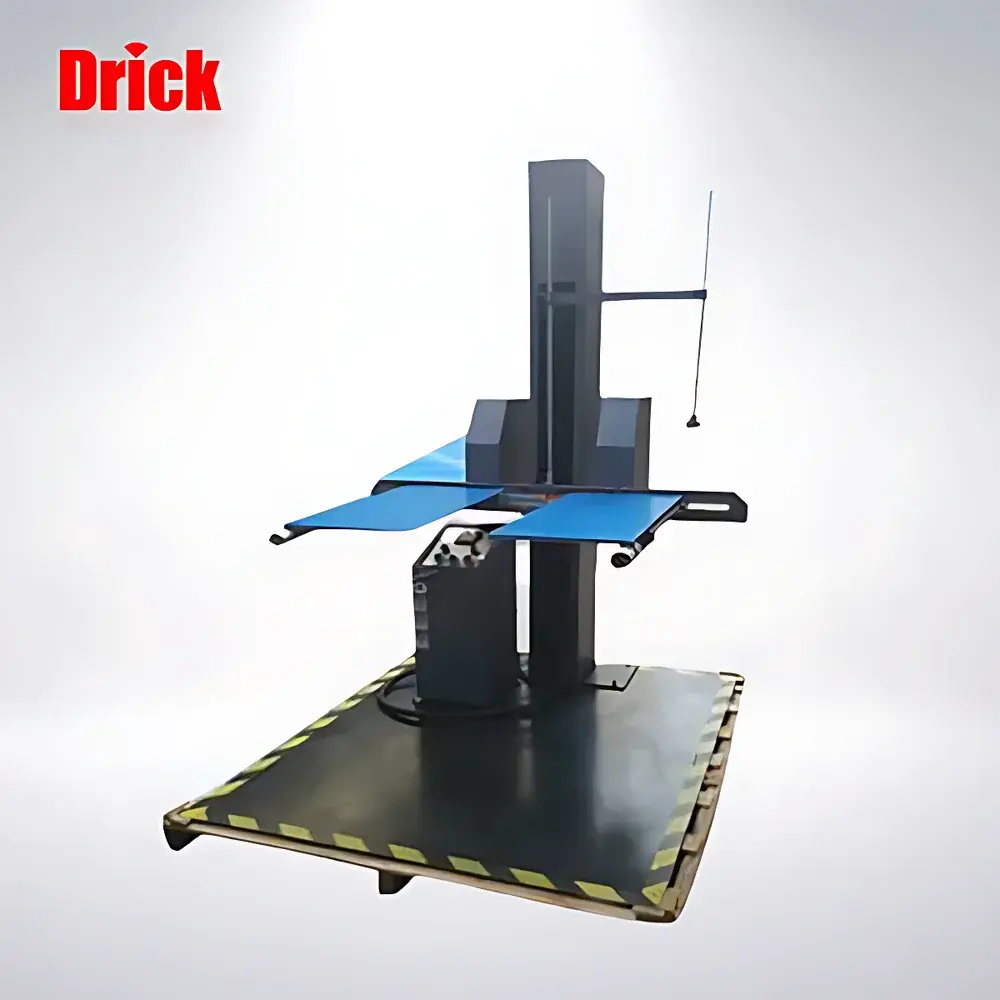
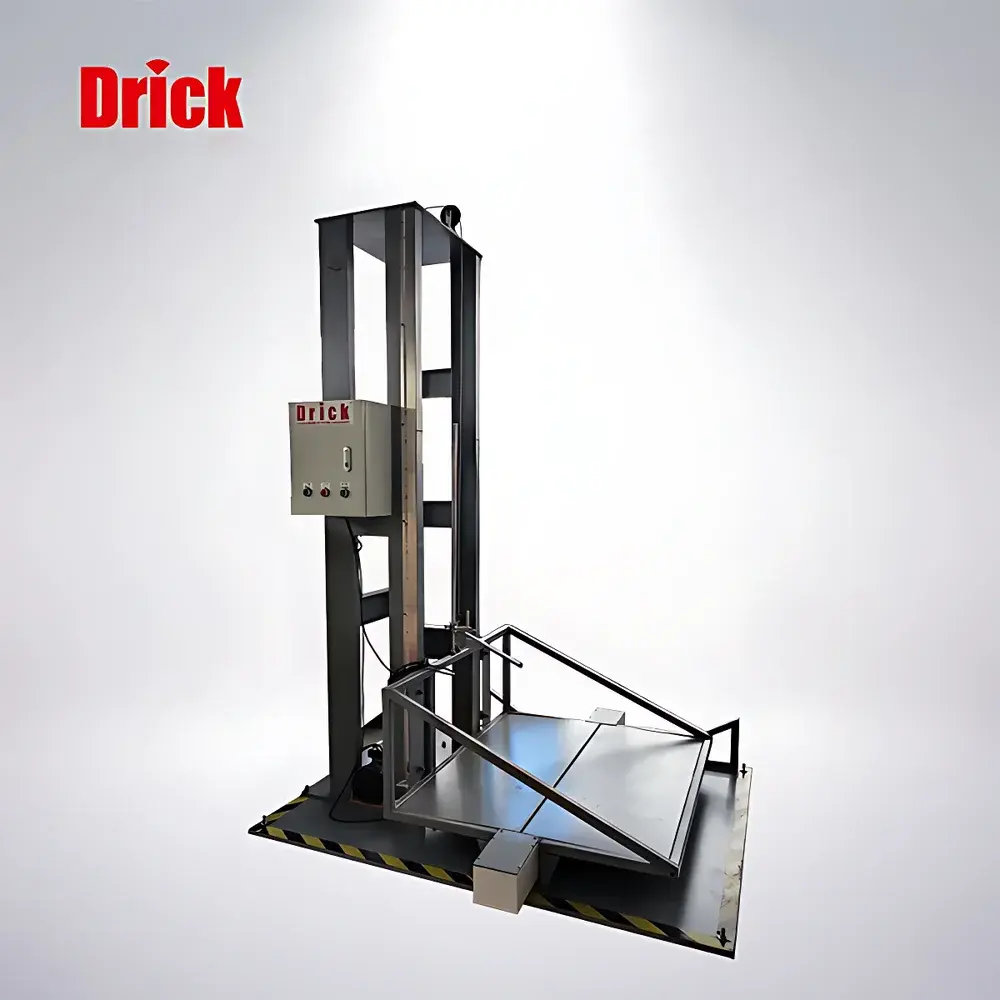
Drick DRK124 Dual-Arm Drop Testing Machine for Edge, Face & Corner Impact Simulation
| Brand | Drick |
|---|---|
| Origin | Shandong, China |
| Manufacturer Type | OEM/ODM Manufacturer |
| Model | DRK 124 |
| Drop Height Range | 40–200 cm (selectable |
| standard configurations | 150 cm, 180 cm, 200 cm) |
| Max. Test Specimen Weight | 100 kg |
| Max. Specimen Dimensions | 1000 × 800 × 1000 mm |
| Impact Base Plate Size | 1400 × 1200 × 10 mm |
| Dual-Arm Dimensions | 700 × 350 mm |
| Drive Mode | Electric Lifting with Manual Reset |
| Compliance | GB/T 4857.5 |
Overview
The Drick DRK124 Dual-Arm Drop Testing Machine is an engineered solution for standardized vertical impact evaluation of transport packaging systems. Designed in strict accordance with GB/T 4857.5—equivalent in functional scope to ISO 2248 and ASTM D5276—the instrument replicates real-world handling hazards by subjecting packaged goods to controlled free-fall impacts at preselected orientations: face, edge, or corner. Its dual-arm support structure enables precise specimen positioning across three orthogonal axes, ensuring repeatable kinematic release conditions without mechanical interference during drop initiation. The system employs electromagnetic holding and release mechanisms to guarantee zero residual torque or lateral constraint at the moment of detachment—critical for maintaining true free-fall dynamics and minimizing measurement uncertainty in peak deceleration and impulse transfer.
Key Features
- Dual-column guided lifting mechanism with precision linear motion control ensures vertical alignment stability and minimizes lateral deviation during ascent.
- Electromagnetic release system provides instantaneous, contactless detachment—eliminating rebound artifacts and preserving impact fidelity.
- Height-adjustable platform with digital presetting (40–200 cm in 1 cm increments) supports multi-level severity testing per ISTA and ASTM protocols.
- Reinforced steel base plate (1400 × 1200 × 10 mm) mounted on vibration-damping rubber isolators maintains structural integrity under repeated 100 kg impact loads.
- Integrated safety interlock circuitry disables lift operation when guard zone proximity sensors detect unauthorized entry—fully compliant with IEC 61508 SIL1 functional safety requirements.
- Manual reset capability after each test cycle ensures operational transparency and facilitates visual verification of arm repositioning prior to next drop.
Sample Compatibility & Compliance
The DRK124 accommodates specimens up to 1000 × 800 × 1000 mm in volume and 100 kg in mass—covering industrial palletized units, e-commerce shipping cartons, medical device kits, and consumer electronics packaging. Its orientation flexibility meets mandatory test sequence requirements defined in GB/T 4857.5, ISO 2248, and ISTA 1A/2A/3A series. All mechanical interfaces—including clamping fixtures, arm pivot joints, and base mounting points—are fabricated from stress-relieved Q345B structural steel and finished with electrostatic epoxy coating (≥75 µm thickness) for corrosion resistance in laboratory and warehouse environments. Documentation includes factory calibration certificate traceable to CNAS-accredited metrology labs, supporting GLP-compliant test record retention.
Software & Data Management
While the DRK124 operates as a standalone electromechanical tester without embedded microprocessor control, it is fully compatible with external high-speed impact data acquisition systems (e.g., PCB Piezotronics ICP accelerometers + National Instruments DAQmx platforms). Its electrical interface includes isolated 24 VDC trigger output synchronized with release activation, enabling precise timestamp alignment between mechanical event and sensor waveform capture. All operational parameters—including height setting, drop count, orientation mode (face/edge/corner), and operator ID—can be logged externally via RS-232 or USB-to-serial adapter into LIMS or ELN platforms adhering to FDA 21 CFR Part 11 audit trail requirements. Optional add-on modules include photogate-based velocity validation and strain-gauge-equipped base plate for direct force integral calculation.
Applications
- Validation of corrugated fiberboard box design against compression-induced corner crush and seam separation.
- Verification of cushioning material performance (e.g., molded pulp, EPS, air pillows) under multi-orientation impact loading.
- Qualification of hazardous materials packaging per UN Manual of Tests and Criteria, Part III, Section 38.3.
- Pre-shipment testing for automotive component suppliers complying with Ford WSS-M99P1111-A and GMW14872.
- Regulatory submission support for Class II medical devices requiring packaging integrity evidence per ISO 11607-1 Annex C.
- Root cause analysis of field failure reports involving transit damage through controlled replication of suspected drop scenarios.
FAQ
What international standards does the DRK124 directly support?
The machine implements core physical test conditions specified in GB/T 4857.5, ISO 2248, ASTM D5276, and ISTA Procedure 1A—enabling direct correlation of results across global supply chain quality gateways.
Is height calibration traceable to national metrology institutes?
Yes—each unit ships with a factory calibration report referencing height measurement against a certified laser interferometer (uncertainty ±0.3 mm, k=2), accredited under CNAS ILAC-MRA framework.
Can the DRK124 perform sequential drop testing across multiple orientations without manual reconfiguration?
No—orientation change requires operator-initiated mechanical repositioning of the specimen and adjustment of arm angle; this aligns with standard practice in GB/T 4857.5 and avoids automated complexity that could compromise repeatability.
What maintenance intervals are recommended for long-term reliability?
Lubrication of linear guide rails every 200 operating cycles using ISO VG 32 mineral oil; torque verification of all M12+ fasteners after first 500 drops and semiannually thereafter per maintenance log sheet included in documentation.
Does the system include emergency stop functionality meeting EN ISO 13850?
Yes—dual-channel hardwired E-stop circuit interrupts power to lifting motor and release solenoid within ≤120 ms, independently verified by third-party CE conformity assessment body.
Related Products



