
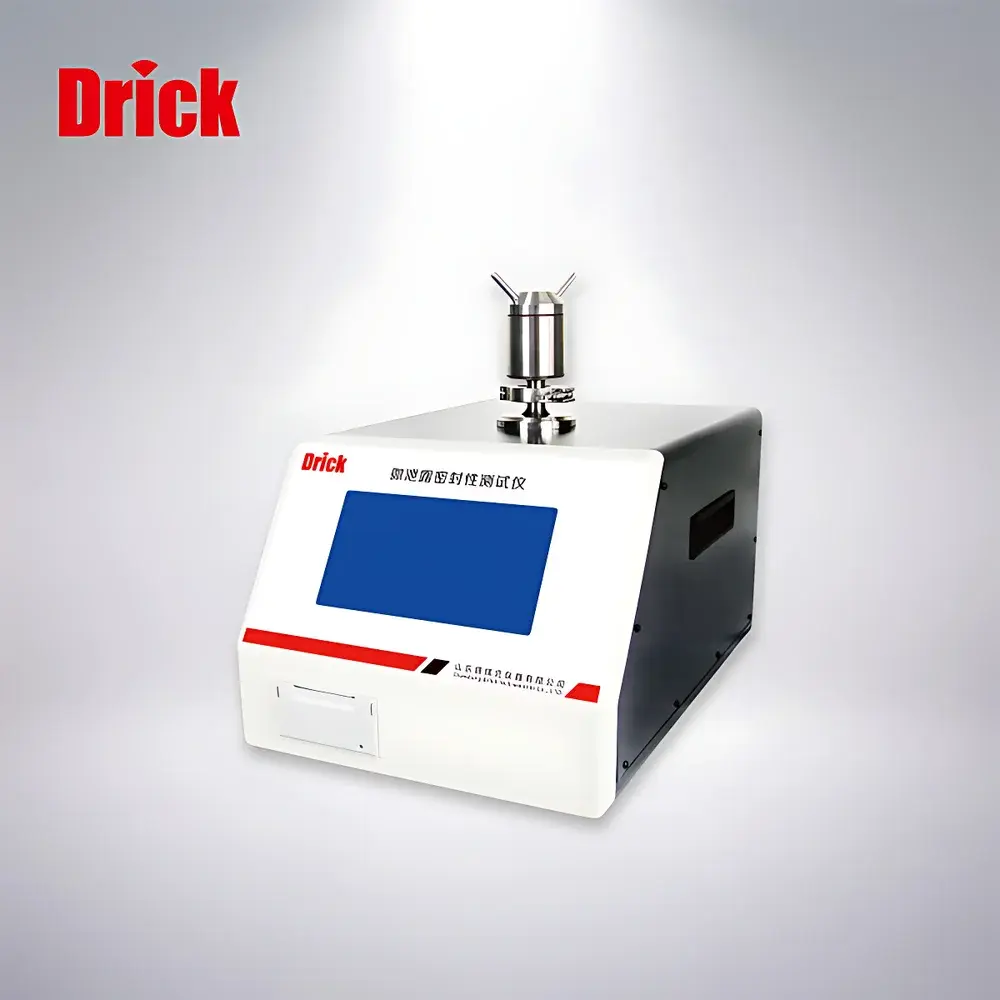
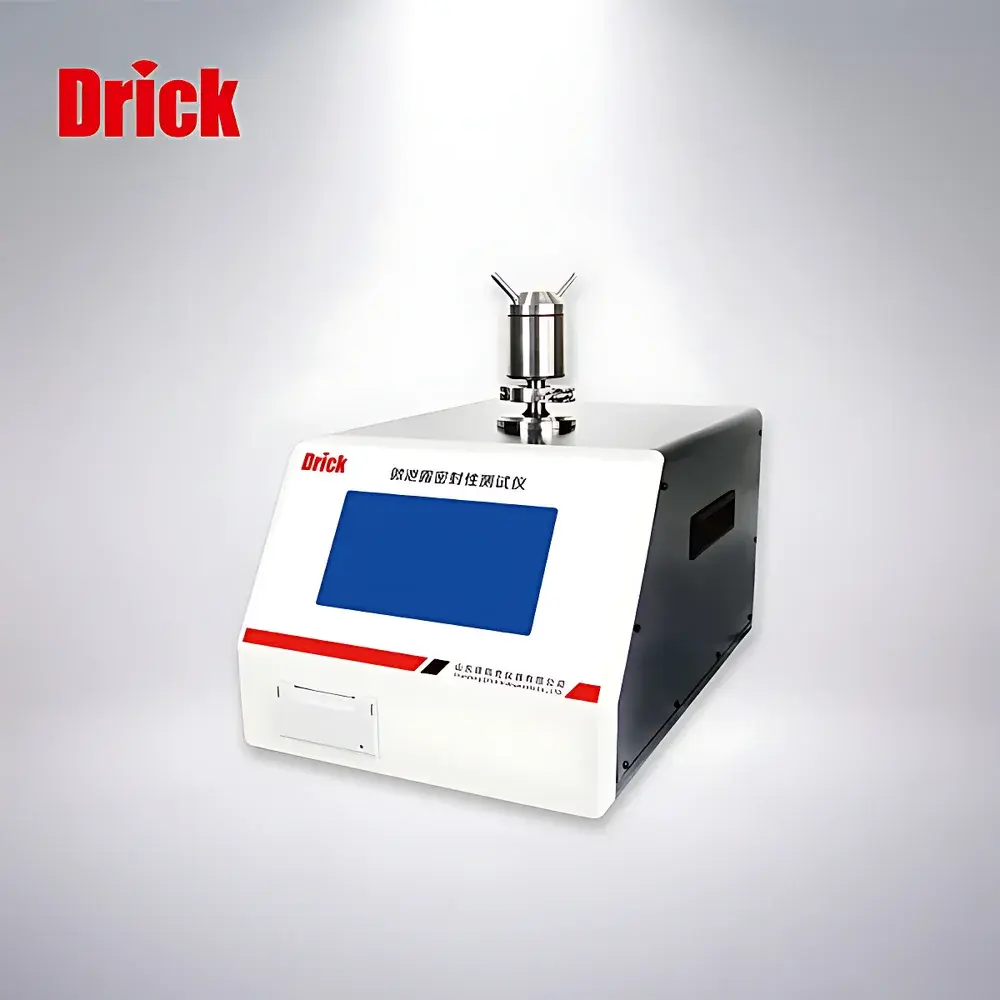
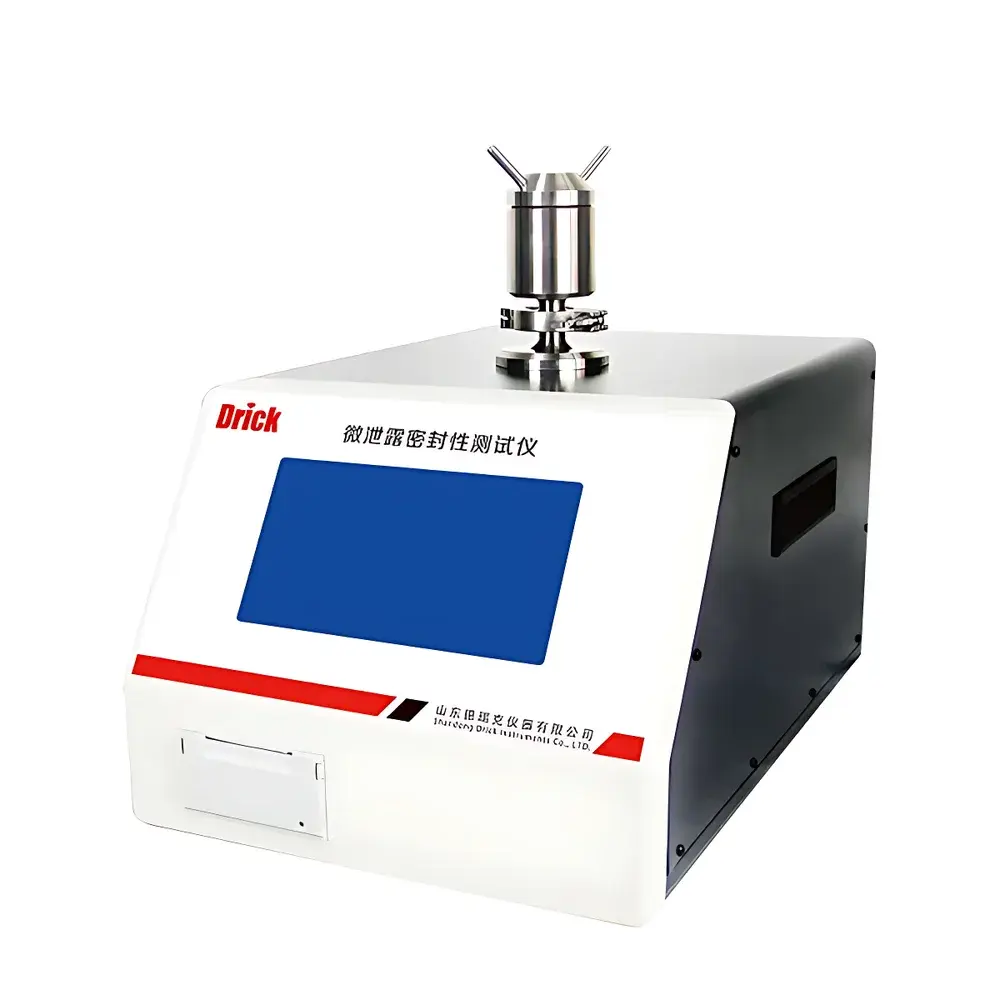
Drick DRK-ASTM F2338 Vacuum Decay Micro-Leak Integrity Tester
| Brand | Drick |
|---|---|
| Origin | Shandong, China |
| Manufacturer Type | OEM/ODM Manufacturer |
| Regional Classification | Domestic (China) |
| Model | DRK- |
| Price | USD 7,000 (FOB Qingdao) |
| Vacuum Range | 0–100 kPa |
| Detection Sensitivity | 1–3 µm equivalent leak rate |
| Test Duration | ≤30 s per sample |
| Operating Pressure | Ambient (atmospheric) during loading |
| Vacuum Source | External vacuum pump (required, not included) |
| Test Chamber | Custom-engineered per package geometry (e.g., vials, ampoules, pre-filled syringes) |
| Principle | Vacuum decay integrity testing per ASTM F2338-09 and USP <1207> |
| Compliance | Fully aligned with ASTM F2338-09, USP <1207>, ISO 15378:2017 (for pharmaceutical primary packaging), and FDA 21 CFR Part 11 data integrity requirements |
| Dimensions (L×W×H) | 550 × 330 × 320 mm |
| Weight | 20 kg |
| Ambient Operating Temperature | 20–30 °C |
| Data Output | Local database (immutable SQLite), PDF export, RS232 interface, thermal printer support |
| Security | Four-tier role-based access control (RBAC) with unique user credentials and audit trail logging |
| Software | Embedded real-time analysis engine with automatic pass/fail classification, statistical process reporting, and GLP/GMP-compliant electronic records |
Overview
The Drick DRK-ASTM F2338 Vacuum Decay Micro-Leak Integrity Tester is an engineered solution for non-destructive, quantitative assessment of container closure integrity (CCI) in sterile pharmaceutical packaging. It operates on the vacuum decay principle—a pressure-based physical method defined in ASTM F2338-09 and harmonized within USP as a deterministic, validated technique for detecting leaks ranging from 1 to 3 µm equivalent orifice size. Unlike subjective dye ingress or subjective bubble emission tests, this instrument measures the temporal pressure rise inside a sealed test chamber following controlled evacuation—quantifying gas efflux from a pressurized package interior through microscopic defects. The system employs dual high-stability pressure transducers operating in synchronized dual-loop configuration: one monitors absolute chamber pressure, while the other tracks differential decay kinetics relative to a reference volume. This architecture eliminates drift-related artifacts and enables reproducible detection at sub-micron sensitivity without requiring tracer gases, vacuum oils, or destructive sample preparation.
Key Features
- Compliance-ready design fully aligned with ASTM F2338-09, USP Category 3 (deterministic methods), ISO 15378:2017 Annex C, and FDA 21 CFR Part 11 for electronic records and signatures.
- Dual-sensor vacuum decay architecture with active temperature compensation and zero-drift correction algorithms ensuring measurement stability across ambient fluctuations (20–30 °C).
- Automated pass/fail classification per user-defined acceptance thresholds—no manual interpretation required.
- Four-level hierarchical access control (administrator, supervisor, operator, viewer) with encrypted credential storage and full audit trail logging of all system events, parameter changes, and test executions.
- Integrated thermal printer generating tamper-evident hardcopy reports including instrument serial number, batch ID, operator ID, timestamp, test result, and environmental conditions.
- Immutable local SQLite database storing raw pressure-time datasets, metadata, and final verdicts—exportable only in read-only PDF or CSV formats compliant with ALCOA+ principles.
- RS232 serial interface for secure LAN integration and remote monitoring; supports firmware updates via Secure Protocol (SP) over USB or network connection.
Sample Compatibility & Compliance
The DRK-ASTM F2338 accommodates standard and custom-configured test chambers optimized for rigid and semi-rigid pharmaceutical containers—including glass and polymer vials (e.g., 2R–30R), ampoules (1–25 mL), pre-filled syringes (1–10 mL), and blow-fill-seal (BFS) containers. Chamber geometry is tailored to minimize dead volume and maximize signal-to-noise ratio during decay measurement. All configurations maintain ISO Class 5 (Grade A) compatibility when integrated into cleanroom environments. The system satisfies GMP Annex 1 requirements for CCI verification and supports validation protocols including IQ/OQ/PQ documentation packages. Its methodology is accepted by EMA, PMDA, and Health Canada for regulatory submissions involving lyophilized products, biologics, and sterile injectables.
Software & Data Management
Firmware-integrated software provides real-time visualization of pressure decay curves, configurable test sequences, and automated statistical summarization (mean, SD, Cp/Cpk) across batches. Each test generates a uniquely timestamped record with cryptographic hash integrity verification. Data retention complies with 21 CFR Part 11 §11.10(a) and §11.300, supporting electronic signatures, audit trail review, and retrospective data reconstruction. Backups are stored in write-once-read-many (WORM) format on internal flash memory and optionally mirrored to external NAS or LIMS via RS232 handshake protocol. No cloud dependency or third-party SaaS components are involved—ensuring full data sovereignty.
Applications
- Final container closure integrity verification for aseptically filled vials prior to release.
- Stability study support: periodic CCI assessment under accelerated and real-time storage conditions.
- Process validation of stoppering, crimping, and sealing operations.
- Root cause analysis of packaging-related sterility failures during investigations.
- Comparative evaluation of alternative closure systems (e.g., rubber formulations, aluminum cap designs).
- Support for Quality Risk Management (ICH Q9) and lifecycle management per ICH Q5C.
FAQ
Does the DRK-ASTM F2338 require helium or other tracer gases?
No. It is a gas-agnostic, pressure-based method requiring no consumables beyond electrical power and an external vacuum pump.
Can it detect both gross and micro-leaks in a single test cycle?
Yes. Its dynamic range covers leak rates from >10−2 mbar·L/s (gross) down to ~10−6 mbar·L/s (sub-µm), enabling binary pass/fail output without retesting.
Is calibration traceable to NIST or other national standards?
Yes. Transducer calibration certificates are provided with NIST-traceable documentation and annual recalibration intervals recommended per ISO/IEC 17025 guidelines.
What vacuum pump specifications are required?
A two-stage rotary vane pump capable of achieving ≤10 mbar ultimate vacuum and ≥10 L/min free air displacement is recommended for optimal cycle time and repeatability.
How is method suitability demonstrated for new container formats?
Through deliberate defect studies using laser-drilled reference leaks (certified per ISO 15378 Annex D) and worst-case geometric modeling per ASTM F2338 Annex A4.





