
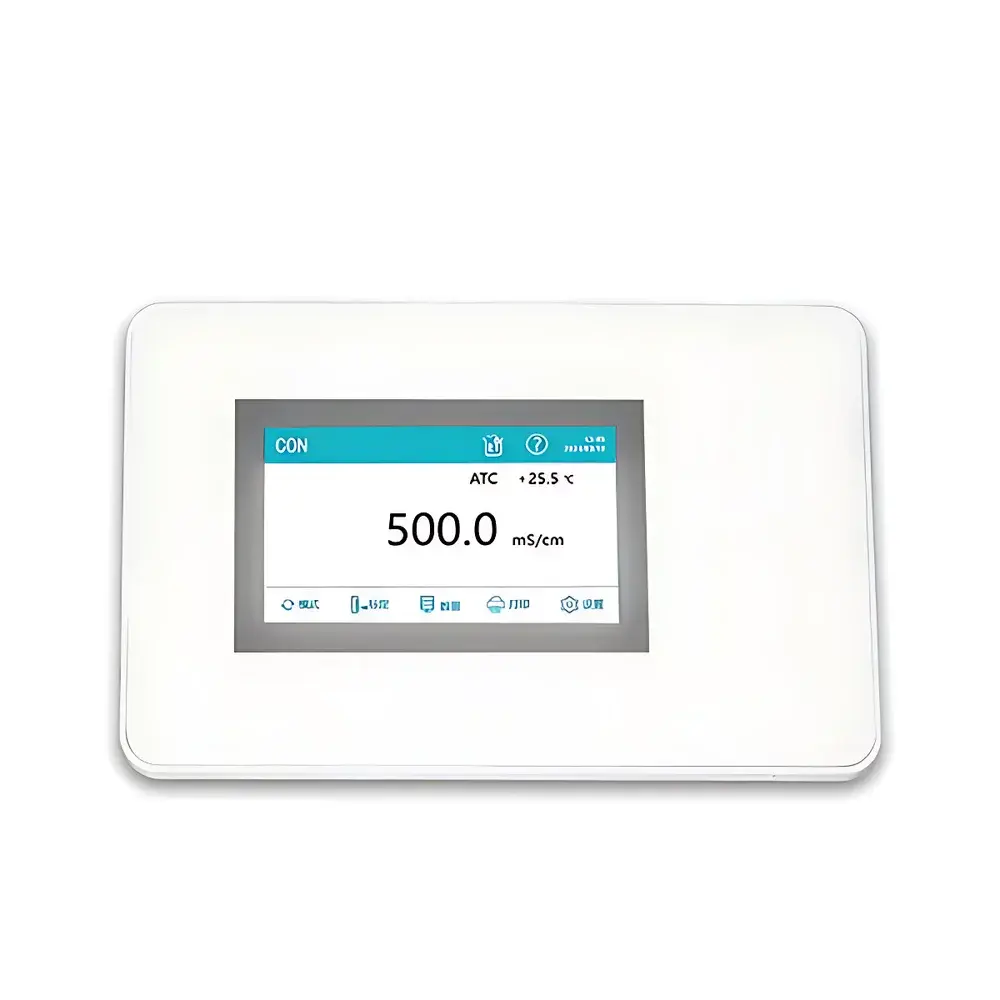
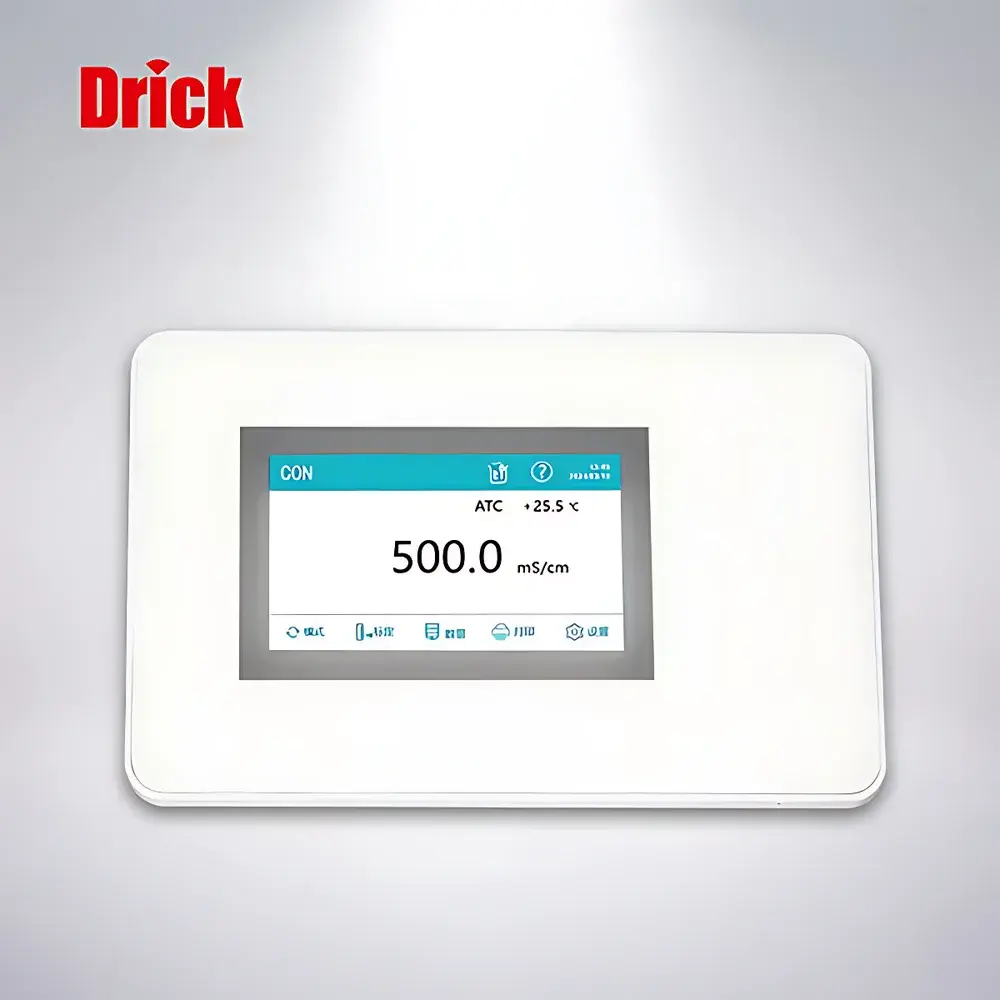
Drick DRK-DDS-411 Benchtop Conductivity Meter
| Brand | Drick |
|---|---|
| Model | DRK-DDS-411 |
| Type | Benchtop Conductivity Meter |
| Measurement Modes | Conductivity, Resistivity, TDS, Salinity, Temperature |
| Display | 4.3-inch color TFT touchscreen with Metro-style UI |
| Calibration | 1–3 point conductivity cell constant calibration, 1-point TDS conversion factor calibration |
| Data Storage | 1500 records with GLP-compliant timestamping |
| Temperature Compensation | Automatic or manual (−5.0 to 110.0 °C) |
| Measurement Ranges | Conductivity 0.05 µS/cm – 500.0 mS/cm |
| Accuracy | ±0.5 % FS (conductivity/resistivity/TDS), ±0.1 % (salinity), ±0.2 °C (temperature) |
| Electrode Interface | BNC + RCA |
| Communication | USB + RS232 |
| Power | DC 12 V, 10 W |
| Dimensions | 200 × 130 × 60 mm |
| Weight | 1.0 kg |
| Compliance | GLP data traceability, audit-ready print reports |
Overview
The Drick DRK-DDS-411 Benchtop Conductivity Meter is a precision electrochemical instrument engineered for reliable, repeatable measurement of solution conductivity — a fundamental parameter directly correlated with ionic strength, electrolyte concentration, and aqueous purity. Based on the principle of two-electrode or four-electrode AC conductometric measurement, the instrument applies a low-frequency alternating current across a defined electrode geometry and calculates conductance from the resulting voltage drop. This value is then converted into standardized units (µS/cm, mS/cm) using a user-defined or calibrated cell constant. Designed for routine quality control, environmental monitoring, pharmaceutical water testing, and academic research labs, the DRK-DDS-411 delivers stable performance under varying temperature conditions and across wide dynamic ranges — from ultrapure water resistivity assessment to high-salinity industrial brine analysis.
Key Features
- Multi-parameter capability: Simultaneous real-time measurement and display of conductivity, resistivity, total dissolved solids (TDS), salinity, and temperature — all traceable to NIST-traceable standards.
- Flexible calibration architecture: Supports 1–3 point cell constant calibration using certified standard solutions (146.5 µS/cm, 1408.3 µS/cm, 12.852 mS/cm, and 111.31 mS/cm), plus independent TDS conversion factor adjustment (e.g., NaCl or KCl-based factors).
- Intelligent electrode management: Auto-ranging and auto-frequency switching ensure optimal signal-to-noise ratio across orders of magnitude — eliminating manual range selection errors and minimizing polarization effects.
- GLP-compliant data handling: Internal storage of up to 1500 measurement records, each stamped with date, time, operator ID (optional), electrode ID, calibration status, and temperature — fully exportable via USB or RS232 for LIMS integration.
- Human-centered interface: 4.3-inch capacitive color touchscreen with Metro-style navigation, context-sensitive help (accessible via “?” icon), and intuitive menu hierarchy — supporting both English and Chinese language modes without firmware reflash.
- Thermal integrity assurance: Dual-mode temperature compensation (linear or non-linear, selectable) referenced to 25 °C, with configurable α coefficient; supports both automatic RTD sensing and manual input for fixed-temperature protocols.
- Regulatory-ready reporting: Integrated thermal printer driver compliant with Good Laboratory Practice (GLP) requirements — enabling immediate hardcopy output of calibration reports, measurement logs, and system verification summaries with full metadata.
Sample Compatibility & Compliance
The DRK-DDS-411 accommodates a broad spectrum of aqueous matrices, including deionized water, boiler feedwater, wastewater effluents, seawater dilutions, buffer solutions, and pharmaceutical purified water (PW) and water for injection (WFI) per USP and EP 2.2.38. Its modular electrode interface accepts industry-standard BNC conductivity cells (e.g., DJS-1N platinum black, DJS-0.01 titanium alloy for ultralow conductivity) and RCA temperature probes (T-820D). The instrument meets IEC 61010-1 safety requirements for laboratory electrical equipment and operates within ambient conditions specified by ISO/IEC 17025:2017 for controlled testing environments (5–40 °C, ≤80% RH non-condensing). All stored data adhere to ALCOA+ principles (Attributable, Legible, Contemporaneous, Original, Accurate, Complete, Consistent, Enduring, Available) — supporting FDA 21 CFR Part 11 readiness when paired with validated IT infrastructure.
Software & Data Management
Data generated by the DRK-DDS-411 is structured in CSV-compatible format with embedded header metadata (instrument ID, firmware version, calibration history hash, sensor serial number). USB mass-storage mode allows direct file transfer to Windows/macOS/Linux systems without proprietary drivers. RS232 output supports ASCII protocol for legacy SCADA or PLC integration. Optional PC software (available separately) enables trend visualization, statistical process control (SPC) charting, automated report generation (PDF/Excel), and electronic signature workflows aligned with 21 CFR Part 11 Annex 11 expectations. Audit trails record all critical events — including parameter changes, calibration initiations, user logins, and data deletions — with immutable timestamps and operator attribution.
Applications
- Pharmaceutical manufacturing: Monitoring conductivity of purified water and WFI in accordance with USP , EP 2.2.38, and JP 2.05 — including TOC correlation studies and validation of purification train performance.
- Power generation: Continuous assessment of condensate and feedwater purity to detect condenser tube leakage or resin breakthrough in demineralization systems.
- Environmental laboratories: Field-deployable benchtop verification of surface water, groundwater, and wastewater conductivity for EPA Method 120.1 compliance and salinity classification (e.g., ISO 10523).
- Food & beverage QA/QC: Quantifying mineral content in beverages, dairy processing water, and brine solutions used in fermentation or preservation.
- Academic research: Teaching electrochemistry fundamentals, calibrating custom cell geometries, and validating ion-exchange membrane performance in desalination studies.
FAQ
What electrode types are compatible with the DRK-DDS-411?
The meter supports standard BNC-interface conductivity cells including DJS-1N (platinum black), DJS-0.01 (titanium alloy), DJS-0.1, DJS-1 (bright platinum), and DJS-10 — each optimized for specific conductivity ranges and matrix viscosities.
Does the instrument support automatic temperature compensation per ISO 7888?
Yes — it implements linear and non-linear (polynomial) temperature compensation algorithms aligned with ISO 7888:2019, with user-selectable reference temperatures and adjustable temperature coefficient (α) values.
Can calibration data be exported for audit purposes?
All calibration events — including standard solution IDs, measured values, calculated cell constants, operator entries, and timestamps — are stored internally and exportable in human-readable text or CSV format.
Is the touchscreen interface suitable for glove use in cleanroom environments?
The capacitive screen responds reliably to standard nitrile and latex gloves; optional stylus support is available for high-precision operation under ISO Class 5–8 conditions.
How is measurement uncertainty quantified per ISO/IEC 17025?
Uncertainty budgets can be constructed using the stated accuracy specifications (±0.5% FS for conductivity), combined with documented contributions from electrode stability, temperature probe tolerance (±0.2 °C), and standard solution CRM uncertainties — all traceable to national metrology institutes.
Related Products



