
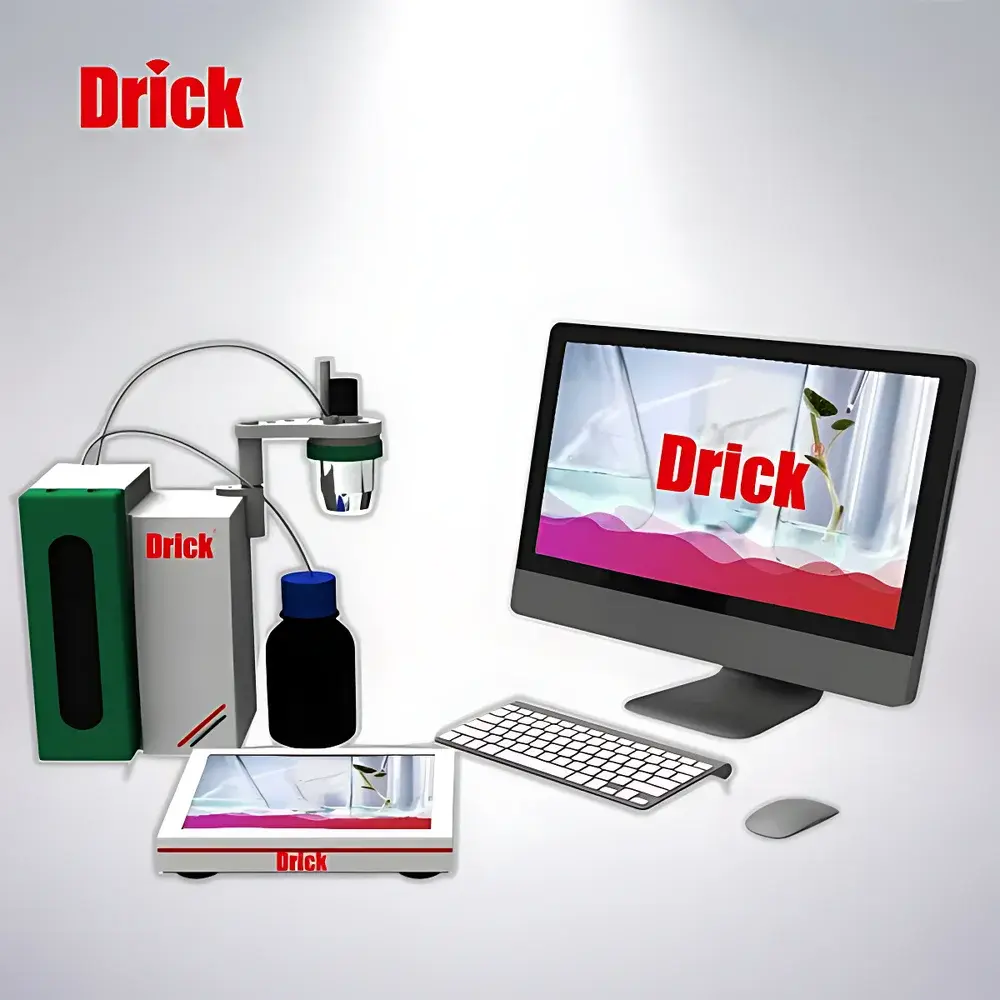
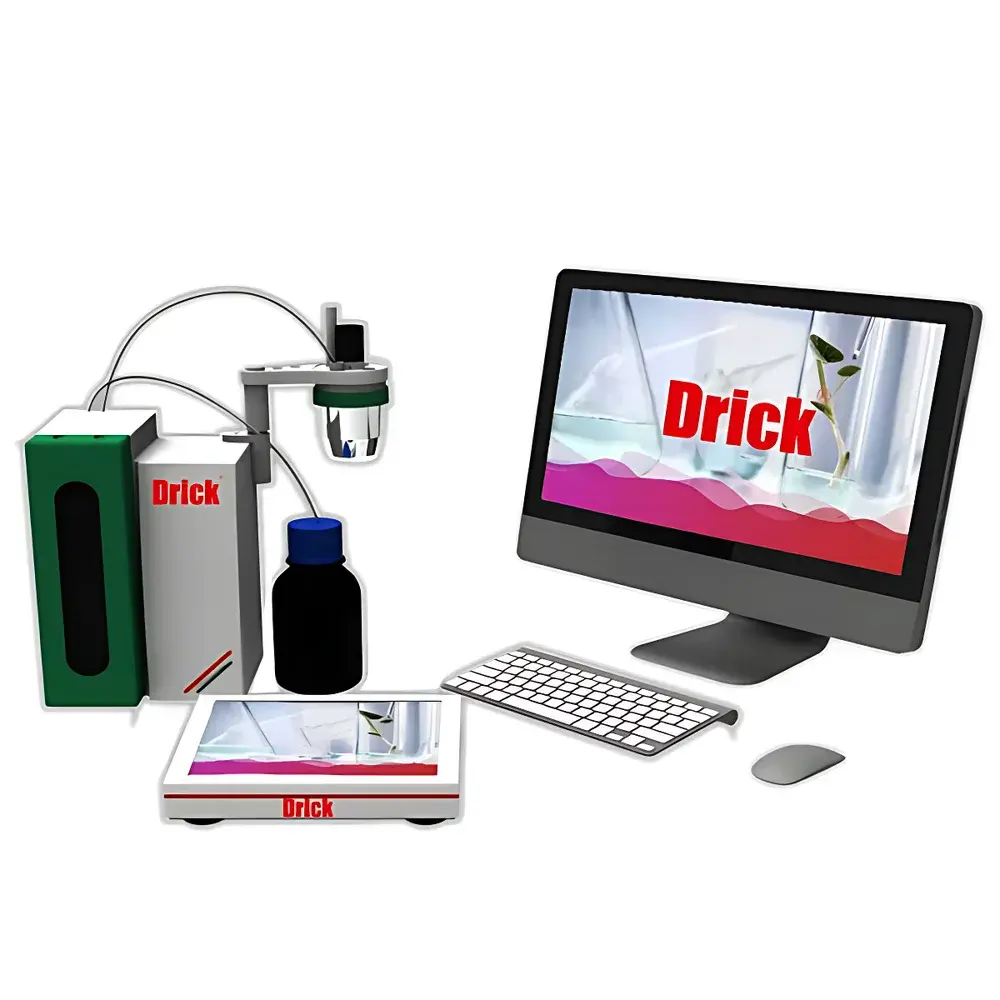
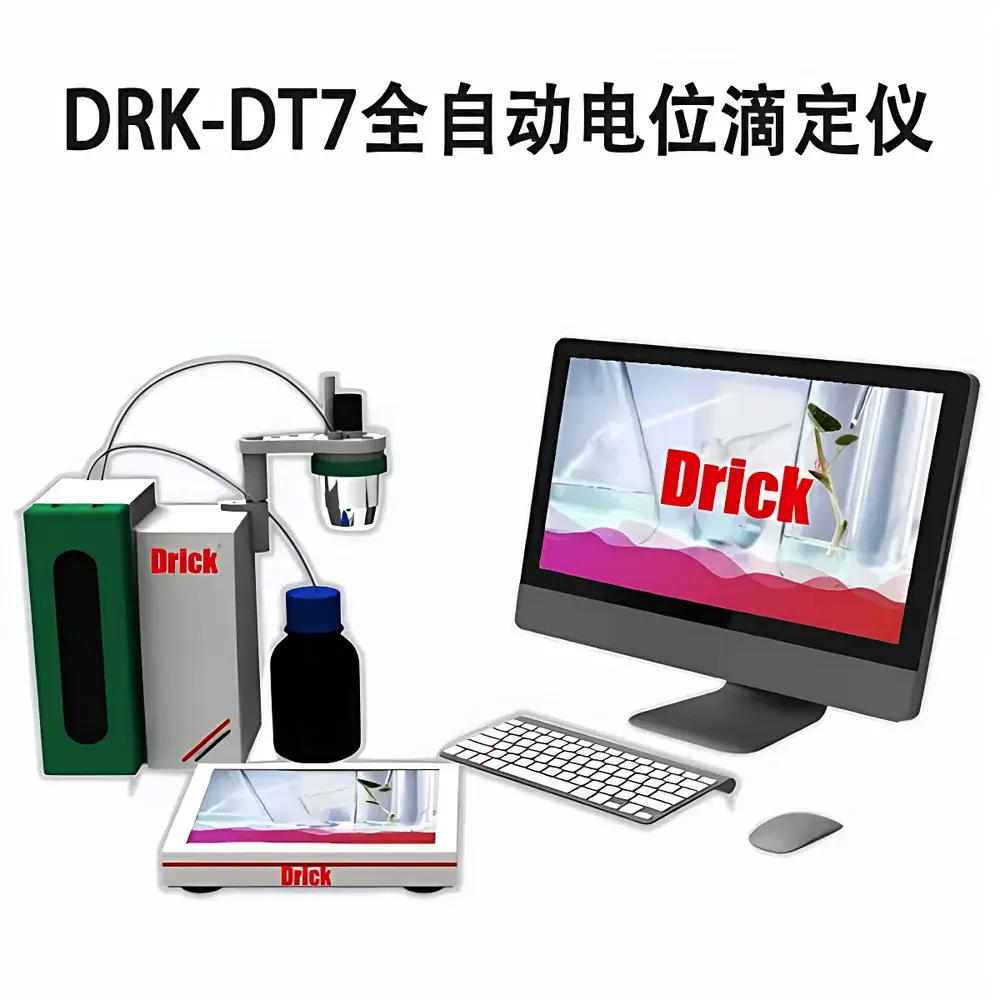
Drick DRK-DT7 Automatic Potentiometric Titrator
| Brand | Drick |
|---|---|
| Origin | Shandong, China |
| Manufacturer Type | Direct Manufacturer |
| Model | DRK-DT7 |
| Instrument Type | General-Purpose Potentiometric Titrator |
| Application Scope | Universal |
| Measurement Range | –2000.0 mV to +2000.0 mV |
| Titration Accuracy | ±0.1 mV, ±0.003 pH |
| Titration Resolution | 0.1 mV, 0.001 pH |
Overview
The Drick DRK-DT7 Automatic Potentiometric Titrator is an engineered solution for precise, reproducible, and compliant acid-base, redox, precipitation, and complexometric titrations in academic, industrial quality control (QC), and regulatory testing laboratories. Based on the fundamental principle of potentiometric endpoint detection—measuring the potential difference between a reference electrode and an indicator electrode as titrant is incrementally added—the DRK-DT7 delivers stable, high-fidelity signal acquisition across wide electrochemical windows. Its dual-range capability supports both millivolt (mV) mode for non-aqueous or redox systems and high-resolution pH mode for aqueous acid-base determinations, making it suitable for method development per ASTM E2087, ISO 8655-6, and USP . The instrument’s robust architecture integrates a precision burette drive mechanism, low-drift electrode interface, and temperature-compensated analog-to-digital conversion to ensure traceable results under GLP and GMP-aligned workflows.
Key Features
- Wide electrochemical measurement range: –2000.0 to +2000.0 mV and –20.000 to +20.000 pH, accommodating diverse titration chemistries including non-aqueous titrations (e.g., perchloric acid in glacial acetic acid) and strong/weak acid–base systems.
- High-resolution detection: 0.1 mV potential resolution and 0.001 pH resolution, enabling reliable identification of subtle inflection points in multi-step titrations such as phosphate or carbonate speciation.
- Endpoint accuracy of ±0.1 mV and ±0.003 pH ensures compliance with ISO 9001 internal calibration requirements and supports validation against certified reference materials (CRMs).
- Motorized, corrosion-resistant burette system with programmable dosing modes—including dynamic stepwise addition, fixed-volume increments, and equivalence-point-driven adaptive dispensing—to minimize reagent consumption and operator variability.
- Integrated electrode holder with automatic recognition interface for common single-junction, double-junction, and combination pH/mV electrodes (BNC and DIN connectors supported).
- Front-panel touchscreen interface with multilingual support (English, Spanish, German, Chinese), local data storage (≥10,000 titration records), and USB export functionality for raw potential vs. volume datasets.
Sample Compatibility & Compliance
The DRK-DT7 accommodates standard 100–250 mL titration vessels and supports sample matrices ranging from clear aqueous solutions to mildly turbid or low-conductivity samples (e.g., ethanol-based extracts, pharmaceutical suspensions, and food-grade oils after appropriate solvent conditioning). It complies with general electrical safety standards IEC 61010-1 and electromagnetic compatibility (EMC) directive 2014/30/EU. While not pre-certified to FDA 21 CFR Part 11, its firmware architecture supports audit-trail-enabling software upgrades and user-access-level configuration—facilitating alignment with GLP/GMP documentation practices. Method templates can be locked, user actions logged (including login/logout, method edit, and result export), and electronic signatures implemented via external LIMS integration.
Software & Data Management
The DRK-DT7 operates with embedded firmware supporting customizable titration methods, real-time curve visualization (E vs. V, dE/dV vs. V, second derivative), and automated equivalence point calculation using first-derivative maximum, second-derivative zero-crossing, or Gran plot algorithms. Raw data (timestamped mV/pH readings, volume delivered, temperature) are stored in CSV format for post-processing in Excel, Origin, or MATLAB. Optional PC-based software (DRK-TitrationSuite™) provides advanced features: multi-method batch processing, statistical reporting (RSD, recovery %), PDF report generation with embedded chromatogram-style titration curves, and secure database archiving compatible with networked lab environments. All data files include metadata headers specifying instrument ID, operator ID, method version, and environmental conditions.
Applications
- Pharmaceutical QC: Assay of active pharmaceutical ingredients (APIs) such as amine hydrochlorides, organic acids, and chelating agents per USP monographs.
- Food & Beverage: Total acidity (TA) in wines and juices, chloride content in dairy products, free fatty acid (FFA) quantification in edible oils.
- Water & Environmental: Alkalinity and hardness profiling (Ca²⁺/Mg²⁺), cyanide determination by silver nitrate titration, residual chlorine analysis.
- Chemical Manufacturing: Purity assessment of catalysts, titration of epoxy equivalents in resins, neutralization value of surfactants.
- Academic Research: Teaching quantitative analysis labs, investigating protonation equilibria, and validating new indicator electrode configurations.
FAQ
What electrode types are compatible with the DRK-DT7?
Standard BNC- or DIN-compatible pH glass electrodes, Ag/AgCl reference electrodes, platinum redox electrodes, and ion-selective electrodes (e.g., fluoride, chloride) can be connected directly; no adapter required.
Does the DRK-DT7 support GLP-compliant data integrity?
Yes—when used with optional DRK-TitrationSuite™ software, it supports electronic signatures, audit trails, and role-based access control aligned with ALCOA+ principles.
Can the instrument perform back-titrations or multi-step titrations?
Yes—programmable method sequences allow up to five distinct titration stages within one run, including initial addition, waiting periods, secondary titrant delivery, and blank correction steps.
Is temperature compensation integrated?
The system accepts input from an external Pt100 temperature probe (optional accessory) and applies Nernst equation corrections to pH measurements in real time.
What maintenance is required for long-term accuracy?
Routine calibration with certified buffer solutions (pH 4.01, 7.00, 10.01) and redox standards (e.g., quinhydrone, Zobell’s solution) is recommended before each analytical session; burette piston lubrication every 6 months.





