
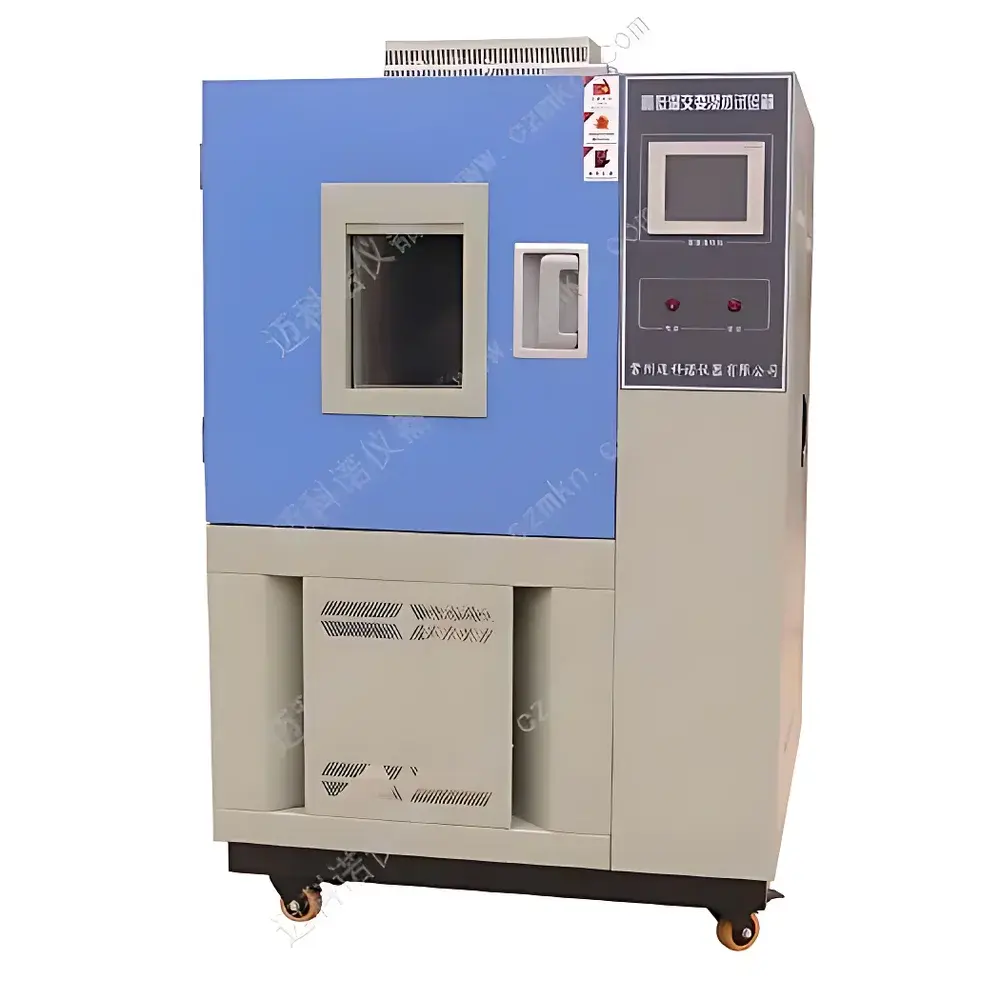
MKN GDJS Series Environmental Test Chamber for Temperature and Humidity Cycling
| Brand | MKN |
|---|---|
| Model | GDJS Series |
| Temperature Range | -70°C to 150°C (selectable) |
| Humidity Range | 30–98% RH |
| Temperature Uniformity | ≤ ±2°C |
| Temperature Fluctuation | ≤ ±0.5°C |
| Humidity Deviation | +2 / -3% RH |
| Heating/Cooling Rate | ≥2°C/min (heat-up), ≤1°C/min (cool-down) |
| Refrigeration | Single-stage or Cascade (dual-stage) system with French Tecumseh hermetic compressors |
| Control System | OYO 7-inch LCD touchscreen programmable controller |
| Construction | Inner chamber – SUS304 stainless steel |
| Insulation | High-density fiberglass |
| Humidification | Shallow-water-tray surface evaporation method |
| Air Circulation | Stainless steel centrifugal fan with extended shaft, low-noise design |
| Compliance | GB/T 2423.1–4, GB/T 10592–2008, GB/T 10586–2012 |
Overview
The MKN GDJS Series Environmental Test Chamber is an engineered solution for accelerated reliability assessment of industrial components and electronic assemblies under controlled temperature and humidity cycling conditions. Based on the principle of balanced heating/humidification and refrigeration/dehumidification, this chamber maintains precise climatic profiles through dynamic modulation of independent thermal and moisture subsystems. Unlike static environmental simulators, the GDJS series implements true cyclic stress testing—reproducing real-world operational extremes such as diurnal thermal gradients, condensation-prone high-humidity intervals, and rapid thermal transients observed in automotive under-hood environments or outdoor telecom enclosures. Its architecture adheres to the physical modeling requirements defined in IEC 60068-2-1 (cold), IEC 60068-2-2 (dry heat), IEC 60068-2-30 (damp heat, cyclic), and ISO 16750-4 (road vehicles—environmental conditions). The chamber supports both steady-state and programmable ramp-and-soak profiles, enabling compliance verification against MIL-STD-810H Method 502.7 (low temperature), Method 503.6 (high temperature), and Method 507.6 (humidity).
Key Features
- Stainless steel inner chamber (SUS304) with seamless welded construction ensures long-term corrosion resistance and ease of cleaning—critical for repeated exposure to condensing moisture and saline atmospheres.
- Dual-mode refrigeration architecture: selectable single-stage or cascade (two-stage) cooling enables stable operation down to -70°C while maintaining high efficiency across the full range from -70°C to +150°C.
- OYO 7-inch color touchscreen controller with embedded non-volatile memory supports up to 100 programmable test profiles, each with up to 99 segments—including ramp, soak, and cycle repetition functions.
- Shallow-tray humidification system utilizes surface evaporation over a stainless steel water reservoir, minimizing mineral deposit accumulation and ensuring stable RH control without ultrasonic mist generation or steam injection artifacts.
- PT100 Class A platinum resistance sensors (per IEC 60751) are installed at multiple spatial locations to support uniformity validation per GB/T 10592–2008 Annex B and ISO 17025 calibration traceability protocols.
- Integrated safety interlocks include overtemperature cut-off, refrigerant high-pressure protection, water-level monitoring, leakage current detection, and redundant fuse protection—all logged with timestamped event records in the controller’s audit trail.
Sample Compatibility & Compliance
The GDJS chamber accommodates samples ranging from PCB assemblies and automotive ECUs to polymer housings and medical device enclosures. Internal dimensions (400 × 500 × 500 mm to 1000 × 1000 × 1000 mm) allow standard test fixtures per IPC-TM-650 2.6.7 (thermal shock) and JEDEC JESD22-A104F (temperature cycling). All models comply with GB/T 2423.1–4 (equivalent to IEC 60068-2-1, -2, -30), GB/T 10592–2008 (chamber performance specification), and GB/T 10586–2012 (humidity chamber requirements). Optional configuration supports GLP/GMP documentation packages including 21 CFR Part 11-compliant electronic signatures, user access levels, and immutable test log export (CSV/Excel) with digital signature embedding.
Software & Data Management
The OYO controller firmware provides native USB and RS-485 interfaces for integration into centralized lab management systems. Real-time data streaming (temperature, humidity, setpoint, alarm status) is supported via Modbus RTU protocol. On-device storage retains ≥30 days of 1-second interval data; exported logs include metadata such as operator ID, profile version, calibration certificate expiry, and sensor drift compensation values. Optional PC-based software (MKN EnviroLog Pro) enables statistical process control (SPC) charting, deviation alerts based on user-defined thresholds, and automated report generation compliant with ISO/IEC 17025 clause 7.8.2 (reporting of results).
Applications
- Qualification testing of aerospace avionics per DO-160G Section 4 (temperature), Section 5 (altitude), and Section 10 (humidity).
- Accelerated life testing of lithium-ion battery modules under combined thermal and hygroscopic stress per UL 1642 Annex C and UN 38.3 T1–T5.
- Validation of conformal coating integrity on printed circuit boards using cyclic damp heat per IPC-CC-830B.
- Material stability assessment of pharmaceutical packaging per USP and ICH Q1A(R2) guidelines.
- Environmental screening of IoT edge devices deployed in tropical climates per Telcordia GR-3108-CORE.
FAQ
What standards does the GDJS series officially certify against?
The chamber is designed and verified to meet GB/T 2423.1–4, GB/T 10592–2008, and GB/T 10586–2012. Third-party verification reports (available upon request) confirm conformance to IEC 60068-2-1, -2, and -30 equivalents.
Can the controller store multiple test programs with different ramp rates and dwell times?
Yes—the OYO controller supports up to 100 distinct profiles, each containing up to 99 programmable segments with independent ramp rates (0.1–10°C/min), dwell durations (1 min to 999 h), and RH setpoints (30–98% RH).
Is remote monitoring and control possible via Ethernet or cloud platforms?
Standard RS-485/Modbus RTU enables integration with SCADA or LabVIEW. Optional Ethernet/WiFi module (MKN-EM100) adds HTTP API access, TLS-secured data upload, and email/SMS alerting for critical alarms.
How is calibration traceability maintained across service intervals?
Each unit ships with a factory calibration certificate traceable to NIM (China National Institute of Metrology). Field recalibration uses NIST-traceable PT100 and capacitive RH references; calibration logs are stored in-controller and exportable with digital signatures.
What maintenance is required to sustain specified temperature uniformity and humidity accuracy?
Quarterly inspection of evaporator fins, humidifier tray cleanliness, and door gasket integrity is recommended. Annual verification of sensor linearity and refrigerant charge pressure ensures continued compliance with ≤±2°C uniformity and +2/−3% RH deviation specifications.



