
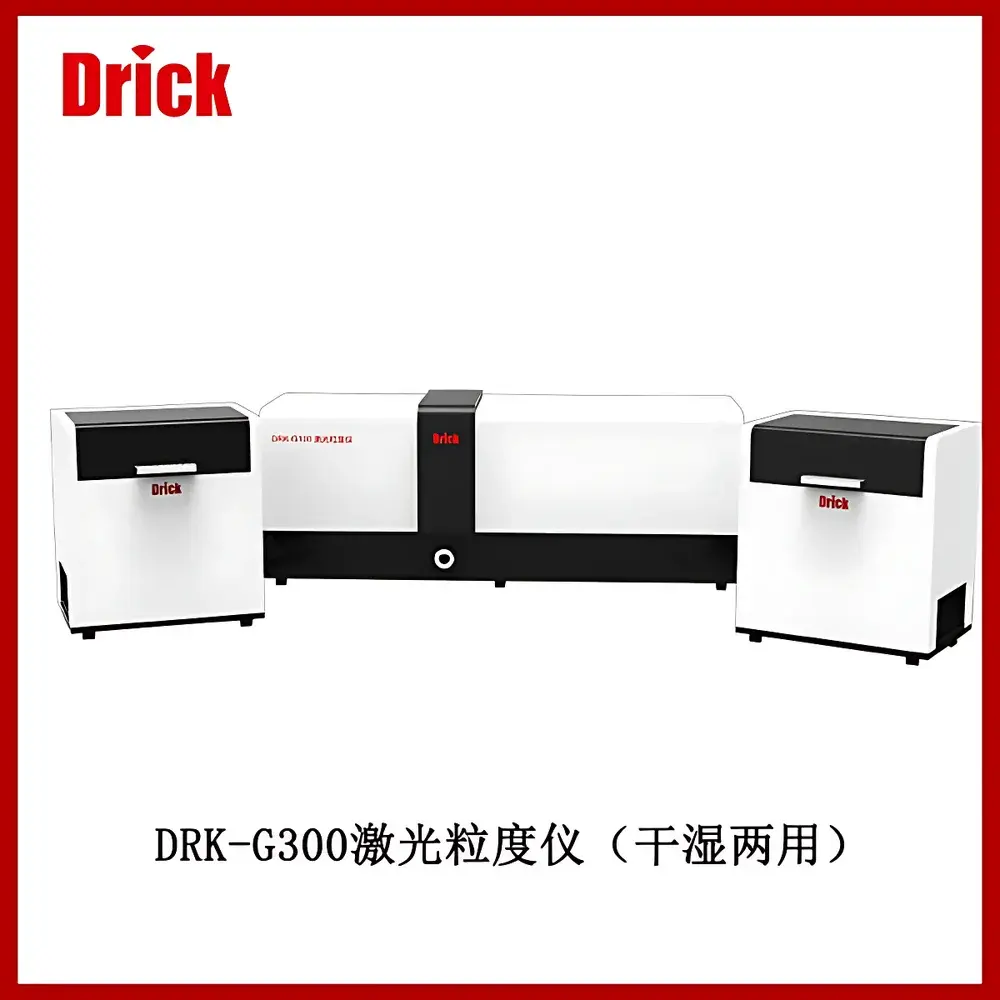
Drick DRK-G300 Modular Universal Laser Particle Size Analyzer (Dry/Wet Dispersion, Full-Range Mie Scattering Theory)
| Brand | Drick |
|---|---|
| Origin | Shandong, China |
| Manufacturer Type | Direct Manufacturer |
| Product Category | Domestic |
| Model | DRK-G300 |
| Dispersion Method | Dry and Wet Dispersion |
Overview
The Drick DRK-G300 Modular Universal Laser Particle Size Analyzer is an engineered solution for high-precision particle size distribution (PSD) measurement across diverse industrial and research environments. Based on full-range Mie scattering theory—rigorously validated for particles from sub-micron to several millimeters—the instrument delivers physically accurate, model-independent size data without reliance on empirical calibration curves. Its modular architecture separates the optical detection unit, sample dispersion system, and control electronics, enabling flexible integration into existing lab workflows or cleanroom-compatible configurations. The dual-dispersion capability supports both dry powder aerosolization via turbulent jet dispersion and wet suspension analysis using integrated ultrasonic probe-assisted deagglomeration and peristaltic circulation. This design ensures consistent particle state control—critical for reproducible measurements of cohesive, fragile, or density-sensitive materials.
Key Features
- Modular optical platform with high-stability He–Ne laser (632.8 nm) and 105-element multi-angle forward/backward scattering detector array
- Simultaneous dry and wet dispersion modules—interchangeable without realignment; dry module features controlled air pressure (0.1–0.4 MPa) and adjustable feed rate; wet module includes 40 W ultrasonic probe (20 kHz), variable-speed stirrer (0–4000 rpm), and 500 mL stainless-steel sample cell with temperature sensor port
- Real-time Mie inversion algorithm compliant with ISO 13320:2020 for laser diffraction particle sizing, supporting refractive index input (1.00–3.00) and absorption coefficient (0–1.0)
- Optical path purging system (N₂ or compressed air) to eliminate ambient humidity interference in dry mode
- Ruggedized aluminum alloy chassis with IP54-rated enclosure; CE-marked for EMC and safety compliance
- Embedded ARM-based controller with 7-inch capacitive touchscreen interface and local data storage (32 GB SSD)
Sample Compatibility & Compliance
The DRK-G300 accommodates a broad spectrum of particulate materials—including metal powders, pharmaceutical actives, ceramic precursors, polymer microspheres, mineral slurries, and food-grade starches—without requiring method-specific hardware changes. Sample volume ranges from 0.1 mL (micro-wet mode) to 500 mL (standard wet mode); dry mass loading spans 1–100 mg depending on material density and dispersibility. All wet components are constructed from 316L stainless steel and borosilicate glass, meeting USP and EP 2.9.19 requirements for particulate matter testing in injectables. The system supports audit-trail-enabled operation under GLP and GMP frameworks, with optional software validation packages aligned with FDA 21 CFR Part 11 for electronic records and signatures.
Software & Data Management
Drick Particle Analysis Suite (DPAS) v4.2 provides comprehensive instrument control, real-time scattering pattern visualization, and ISO-compliant reporting. Key capabilities include batch processing with customizable pass/fail criteria, D10/D50/D90 statistical reporting with confidence intervals (based on bootstrap resampling), overlay comparison of up to eight distributions, and export to CSV, PDF, or XML formats compatible with LIMS integration. Raw scattering data (.dat) and processed reports (.pdf) are time-stamped, digitally signed, and stored with user authentication logs. Software updates are delivered via secure HTTPS channel with SHA-256 hash verification; on-site installation support includes IQ/OQ documentation templates per ASTM E2500-13.
Applications
The DRK-G300 serves critical quality control and R&D functions across regulated and non-regulated sectors. In pharmaceutical manufacturing, it verifies milled API particle size prior to tableting and monitors nanosuspension stability during formulation development. In advanced ceramics, it characterizes spray-dried granules for green body density prediction. In battery materials, it quantifies cathode precursor agglomerate breakage during slurry mixing. In food science, it assesses flour particle fineness impact on dough rheology and baking performance. Environmental labs use it for sediment grain-size classification per ASTM D422, while additive manufacturing facilities rely on its dry-mode repeatability (RSD <1.2% for PSL standards) for metal powder qualification.
FAQ
Does the DRK-G300 require annual recalibration?
No—its optical alignment is factory-sealed and mechanically stabilized; only periodic verification using NIST-traceable PSL standards (e.g., 10 µm, 50 µm) is recommended per ISO/IEC 17025.
Can the system be integrated into a PLC-controlled production line?
Yes—Ethernet/IP and Modbus TCP protocols are supported via optional industrial communication module; analog 4–20 mA output available for real-time D50 feedback control.
Is wet dispersion compatible with organic solvents?
Yes—sample cell seals and tubing are chemically resistant to ethanol, isopropanol, acetone, and xylene; solvent compatibility matrix is provided in the technical manual.
What is the minimum detectable concentration in wet mode?
For optimal signal-to-noise ratio, ≥0.1 vol% solids is recommended; lower concentrations require extended acquisition time and background subtraction protocols.
Does the software support multi-language UI?
Yes—English, German, French, Spanish, Japanese, and Simplified Chinese interfaces are embedded and selectable at runtime without reinstallation.



