
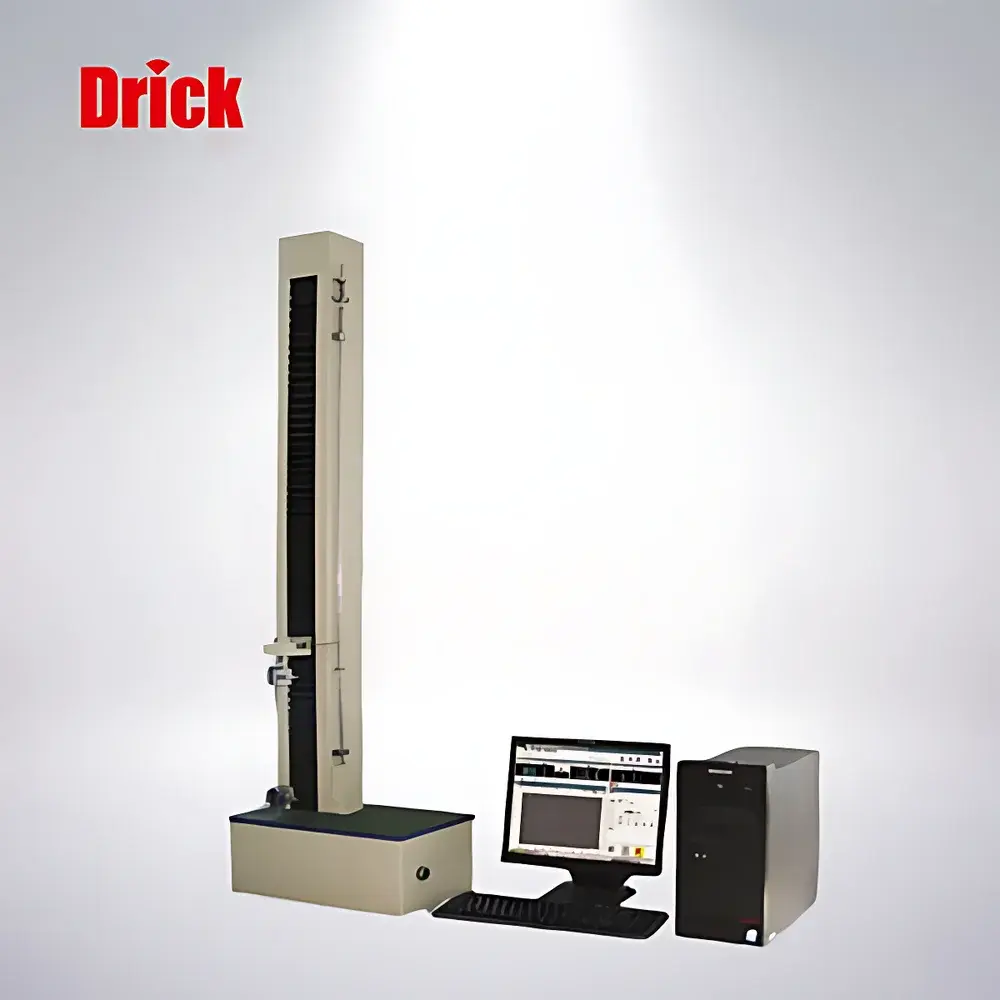
Drick DRK-LDW Series Electronic Tensile Testing Machine for Flexible Packaging Materials
| Brand | Drick |
|---|---|
| Origin | Shandong, China |
| Manufacturer Type | Direct Manufacturer |
| Product Category | Domestic |
| Model | LDW Series |
| Instrument Type | Electronic Tensile Testing Machine |
| Maximum Test Load | 5 kN |
| Load Range | 0–5 kN (Full Scale) |
| Force Accuracy Class | Class 1 (per ISO 7500-1 / ASTM E4) |
| Load Measurement Accuracy | ±0.5% of reading |
| Crosshead Speed Range | 1–500 mm/min |
| Effective Travel Distance | 700 mm (extendable to 1000 mm) |
| Displacement Accuracy | ±0.5% of reading |
| Power Supply | AC 220 V, 50 Hz |
| Dimensions (W×D×H) | 550 × 450 × 1600 mm |
| Weight | 75 kg |
| Standard Configuration | Mainframe, Digital Controller, Flat-faced Pneumatic/Grip Clamps, Brand-name PC with Pre-installed Software |
| Optional Accessories | A4 Thermal Printer, Custom Fixtures (e.g., Peel, Tear, Shear, Loop Tack) |
Overview
The Drick DRK-LDW Series Electronic Tensile Testing Machine is a precision-engineered mechanical testing system designed specifically for the static mechanical characterization of flexible packaging materials and related thin-film substrates. Based on servo-controlled electromechanical actuation and closed-loop load-displacement feedback architecture, the system complies with fundamental principles outlined in ISO 6892-1 (tensile testing of metallic materials), ISO 527-3 (plastics — determination of tensile properties of films and sheets), and ASTM D882 (tensile properties of thin plastic sheeting). Its modular hardware platform supports standardized test protocols including uniaxial tensile strength, elongation at break, Young’s modulus, peel adhesion (180°/90°), tear resistance (Elmendorf, trouser, or pant-leg), and shear strength — all executed under controlled displacement or load rate conditions. The machine integrates a high-resolution load cell calibrated to Class 1 accuracy per ISO 7500-1 and traceable to national metrological standards, ensuring repeatable and auditable results suitable for internal QC, third-party certification, and regulatory submissions.
Key Features
- Servo-motor-driven crosshead with programmable speed control from 1 to 500 mm/min, enabling precise strain-rate-dependent testing across ISO, ASTM, and GB/T standards.
- Dual-channel digital controller supporting real-time acquisition of load, displacement, and time data at up to 100 Hz sampling rate.
- Robust structural frame with reinforced vertical columns and low-inertia moving carriage, minimizing deflection and enhancing measurement fidelity during high-speed or high-load cycles.
- Integrated safety architecture including mechanical limit switches, software-defined upper/lower travel boundaries, overload cut-off, and emergency stop circuitry compliant with IEC 60204-1.
- Windows-based control software built on modular VB.NET framework, supporting multi-language UI (English default), customizable test templates, and automated report generation with embedded graphs and statistical summaries.
- Standard flat-faced pneumatic clamps with adjustable pressure (0.2–0.6 MPa) ensure uniform gripping force without specimen slippage or premature edge failure — critical for low-modulus films and laminates.
Sample Compatibility & Compliance
The DRK-LDW accommodates specimens ranging from 5 mm to 50 mm wide and up to 1000 mm in effective gauge length. It is routinely deployed for testing polyethylene (PE), polypropylene (PP), polyester (PET), nylon (PA), aluminum foil composites, metallized films, heat-seal layers, pressure-sensitive adhesives (PSAs), nonwovens, coated papers, and laminated structures used in food, pharmaceutical, and medical device packaging. All test methods align with internationally recognized standards including ISO 11607-2 (packaging for terminally sterilized medical devices), ASTM F88 (seal strength of flexible barrier materials), ASTM F904 (peel resistance of laminates), and GB/T 1040.3 (plastics — tensile testing — films and sheets). The system supports GLP-compliant operation when paired with audit-trail-enabled software configuration and electronic signature modules.
Software & Data Management
The proprietary DRK-TMS (Tensile Measurement Suite) software provides full lifecycle data handling: test method definition, real-time curve visualization, post-test parameter extraction (e.g., yield point, breaking load, % elongation, energy to break), statistical analysis (mean, SD, CV%), and export to CSV, PDF, or XML formats. Raw data files are stored with metadata tags (operator ID, timestamp, calibration certificate ID, environmental conditions). Optional 21 CFR Part 11 compliance package includes role-based access control, electronic signatures, and immutable audit trails for regulated environments. Data integrity is preserved via automatic backup, versioned firmware updates, and checksum-verified file storage.
Applications
- Quality assurance of roll-to-roll converted packaging films prior to filling and sealing operations.
- Validation of adhesive bond integrity in pouch seals, blister lidding, and label applications.
- Comparative evaluation of material substitutions (e.g., bio-based vs. conventional polymers) under identical test conditions.
- R&D support for optimizing extrusion coating parameters, corona treatment levels, and lamination dwell times.
- Failure analysis of field-returned packages exhibiting delamination, seal rupture, or catastrophic tearing.
- Supplier qualification testing against contractual mechanical specifications (e.g., minimum peel strength ≥ 1.2 N/15 mm).
FAQ
What international standards does the DRK-LDW support out-of-the-box?
The system includes pre-configured test templates for ISO 527-3, ASTM D882, ASTM F88, ASTM F904, and GB/T 1040.3, with editable parameters to accommodate custom or emerging standards.
Can the machine perform peel and tear tests without hardware modification?
Yes — using optional fixtures (sold separately), the same base platform executes 180° peel, T-peel, Elmendorf tear, and puncture tests; no recalibration is required between fixture changes.
Is calibration traceability provided with the instrument?
Each unit ships with a factory calibration certificate traceable to CNAS-accredited laboratories, covering load cell, encoder, and speed verification per ISO 7500-1 and ISO 4548-1.
How is data security ensured during long-term deployment in regulated labs?
With the optional Part 11 module, all user actions, method edits, and result modifications are logged with timestamps and operator IDs; exported reports include digital signatures and hash-verified integrity checks.
What maintenance intervals are recommended for sustained Class 1 accuracy?
Annual verification of load cell linearity and displacement encoder resolution is advised; routine cleaning of guide rails and periodic lubrication of drive screws are documented in the included maintenance logbook.



