
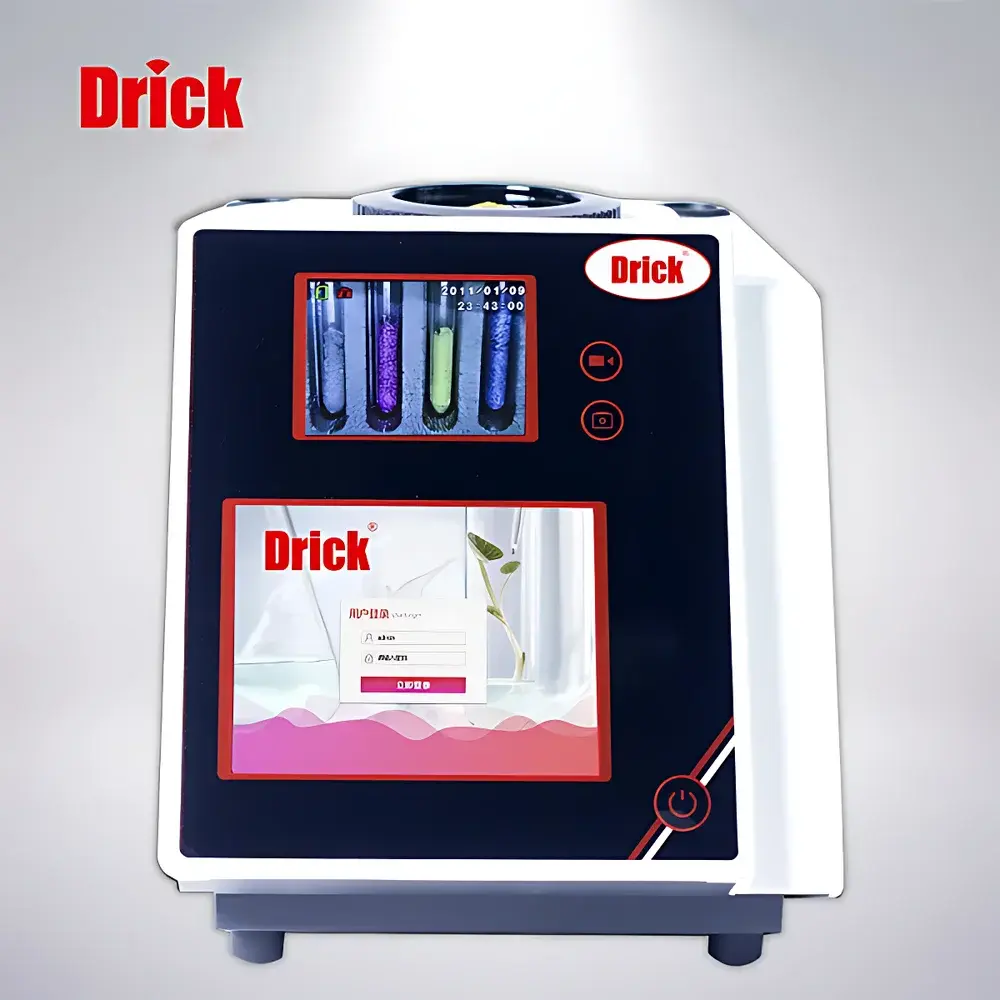
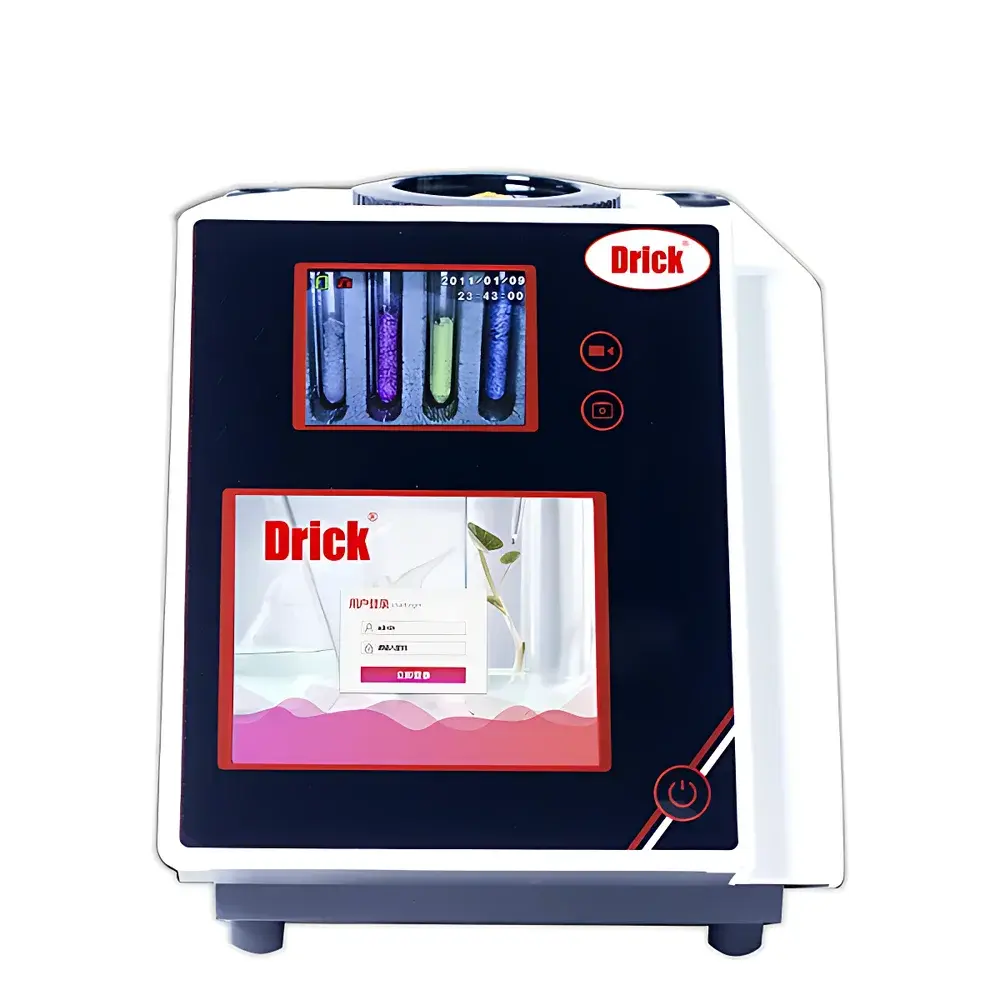
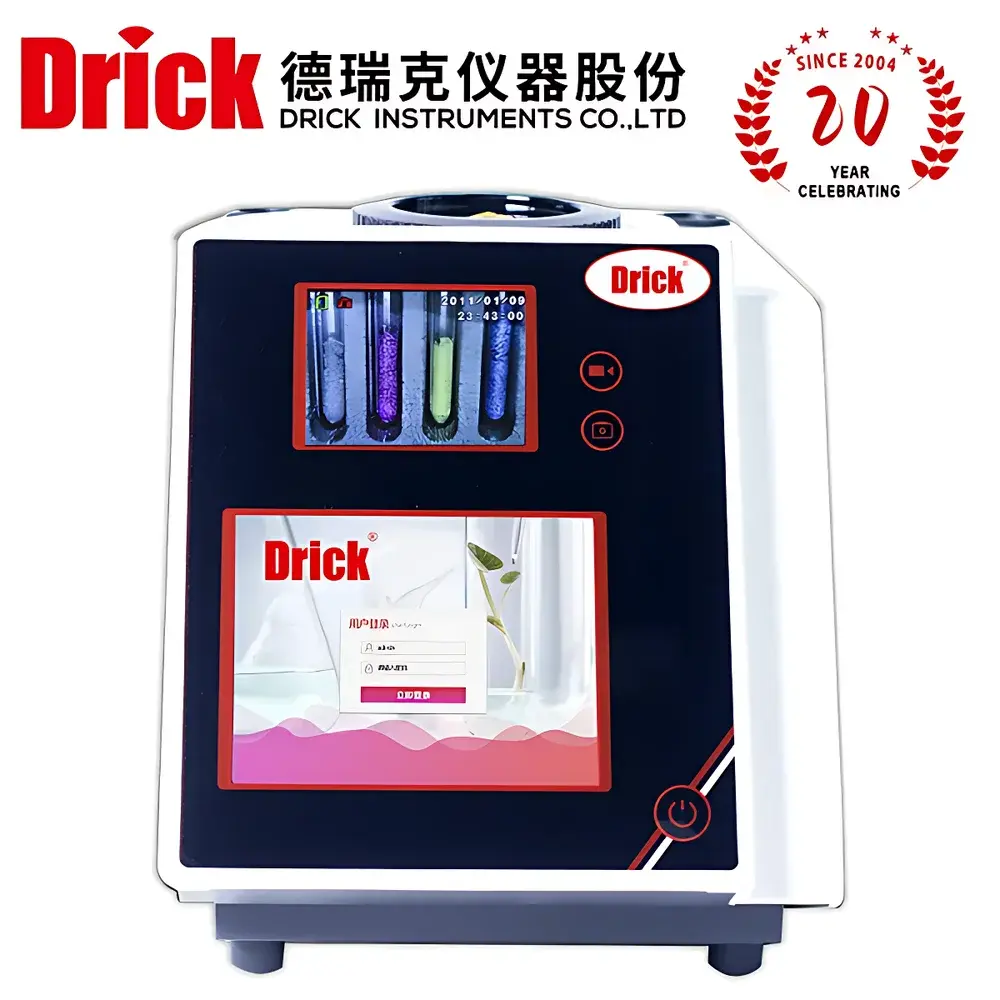
Drick DRK-R90 Automated Video Melting Point Apparatus
| Brand | Drick |
|---|---|
| Origin | Shandong, China |
| Manufacturer Type | Direct Manufacturer |
| Model | DRK-R90 |
| Temperature Range | Ambient to 420 °C |
| Heating Rate | 0.1–20 °C/min (200-step continuous adjustment) |
| Melting Point Repeatability | ±0.1 °C at 0.1 °C/min |
| Temperature Accuracy | ±0.3 °C (<250 °C) |
| Capillary Dimensions | OD 1.4 mm, ID 1.0 mm |
Overview
The Drick DRK-R90 Automated Video Melting Point Apparatus is a precision thermal analysis instrument engineered for fully automated, real-time visual determination of melting point and melting range in solid organic compounds, pharmaceuticals, polymers, and fine chemicals. Utilizing high-resolution digital video microscopy coupled with programmable Peltier-based heating control, the system captures dynamic phase transitions frame-by-frame, enabling objective endpoint detection based on morphological changes—such as meniscus formation, collapse, and complete liquefaction—rather than subjective operator interpretation. Designed for compliance-critical environments, the DRK-R90 operates within a calibrated temperature domain from ambient to 420 °C, supporting both single-point and multi-stage heating protocols. Its architecture adheres to fundamental principles of thermal transition analysis defined in ASTM E324 and ISO 6387, ensuring traceable, reproducible results suitable for QC release testing, R&D screening, and regulatory documentation.
Key Features
- Fully automated one-button operation: Initiate measurement, heating, image capture, and result reporting with a single interface command.
- High-definition coaxial video system: 5-megapixel CMOS sensor with adjustable LED illumination and 20× optical magnification ensures clear visualization of capillary sample behavior throughout the entire thermal cycle.
- Precise Peltier temperature control: Dual-zone thermal regulation enables rapid stabilization and linear ramping across 200 discrete heating rate settings (0.1–20 °C/min), minimizing thermal lag and overshoot.
- Calibration traceability: Factory-calibrated against NIST-traceable reference standards; user-accessible calibration verification using certified melting point standards (e.g., indium, tin, bismuth).
- Robust mechanical design: Stainless-steel heating block with integrated capillary holder ensures uniform heat distribution and long-term dimensional stability under repeated thermal cycling.
- Intuitive touchscreen HMI: 7-inch capacitive display with multilingual UI (English, German, French, Spanish) and context-sensitive prompts guides users through method setup, sample loading, and report generation.
Sample Compatibility & Compliance
The DRK-R90 accepts standard thin-walled glass capillaries (OD 1.4 mm, ID 1.0 mm), compatible with ASTM D1560, USP , and Ph. Eur. 2.2.17 methodologies. Sample mass requirements are consistent with pharmacopeial guidelines (1–3 mg), and the instrument accommodates both crystalline and semi-crystalline materials—including APIs, excipients, intermediates, and polymer resins. All temperature measurements are validated per ISO/IEC 17025:2017 requirements for testing laboratories. The system supports audit-ready data integrity through timestamped image sequences, raw thermal profiles, and immutable result logs—enabling alignment with FDA 21 CFR Part 11 when paired with optional electronic signature modules and secure network configuration.
Software & Data Management
The embedded firmware includes Drick MPStudio v3.2 software, which provides method library management, customizable pass/fail criteria, automatic baseline correction, and dual-channel comparison (reference vs. test). Data export is supported in CSV, PDF, and XML formats, with metadata fields including operator ID, calibration date, environmental conditions, and instrument serial number. Local storage retains ≥10,000 test records with SHA-256 hash verification. Optional network integration enables centralized data archiving via LIMS or ELN systems using HTTPS/RESTful API protocols. Audit trail functionality logs all user actions—including parameter edits, calibration events, and report exports—with non-erasable timestamps and operator attribution.
Applications
- Pharmaceutical quality control: Identity confirmation and purity assessment of active pharmaceutical ingredients per ICH Q5A and USP monographs.
- Chemical synthesis validation: Monitoring reaction completion and intermediate purity during process development.
- Polymers and resins: Characterization of crystallinity onset, degradation thresholds, and thermal history effects.
- Academic research: Teaching thermodynamic principles of phase transitions and solid-state behavior in undergraduate and graduate laboratories.
- Regulatory submissions: Generating GLP-compliant datasets for dossier preparation under EMA, PMDA, and Health Canada requirements.
FAQ
What capillary specifications are required for optimal performance?
Standard thin-walled capillaries with outer diameter 1.4 mm and inner diameter 1.0 mm are recommended. Use only dry, homogeneous samples packed to a height of 3–5 mm.
Does the DRK-R90 support multi-sample sequential analysis?
No—it is a single-capillary instrument optimized for high-precision individual determinations. For throughput demands, parallel operation of multiple units is advised.
Is external calibration verification possible?
Yes. Users may perform periodic verification using certified reference materials (e.g., caffeine, acetanilide, phenacetin) and document deviations against factory calibration certificates.
Can test data be exported to laboratory information management systems (LIMS)?
Yes—via configurable HTTP POST or SFTP transfer. Required metadata fields align with ASTM E1469 and ISO/IEC 17025 data exchange standards.
What is the expected service life of the Peltier module under routine use?
Rated for ≥50,000 thermal cycles (based on 100 daily tests at 200 °C), with field-replaceable design and documented maintenance intervals in the technical manual.



