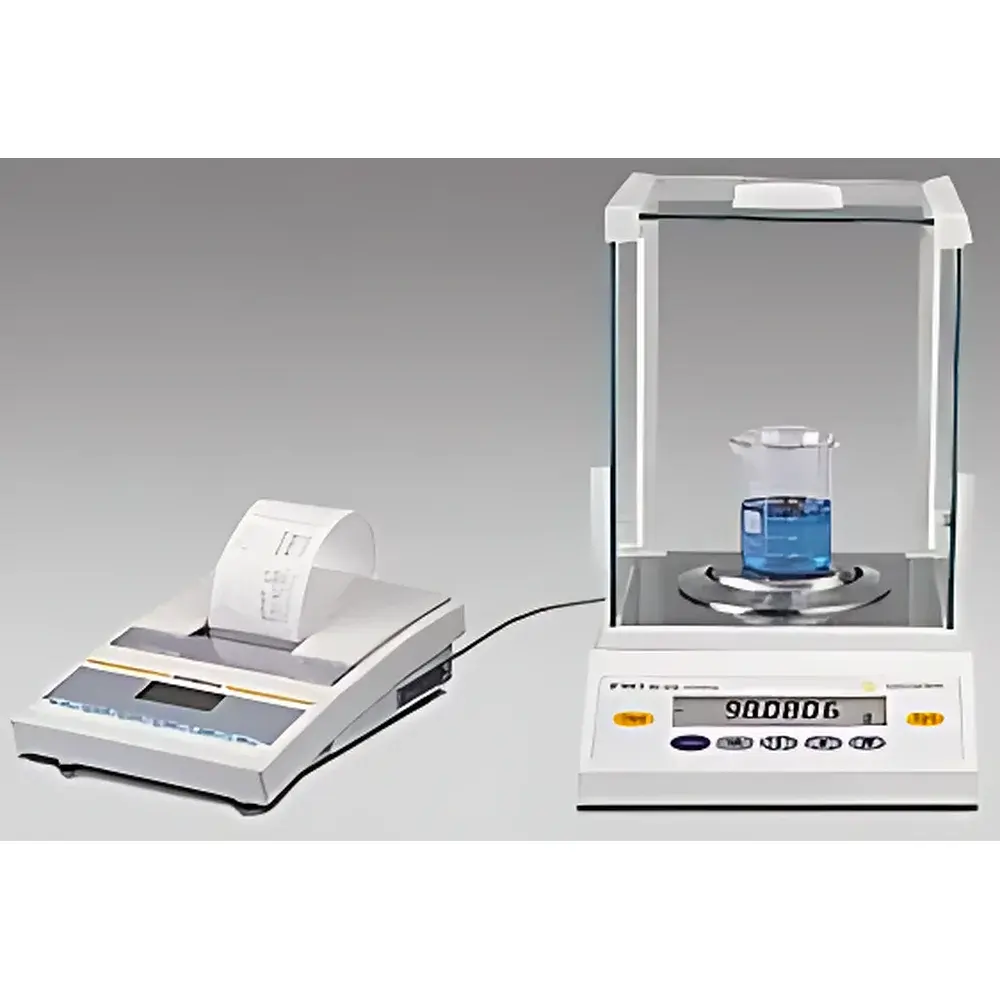
Sartorius BT125D Analytical Balance
| Origin | Germany |
|---|---|
| Manufacturer Type | Authorized Distributor |
| Origin Category | Imported |
| Model | BT125D |
| Instrument Type | Analytical Balance |
| Capacity Range | 41 g / 120 g (dual-range mode) |
| Readability | 0.01 mg / 0.1 mg (dual-interval) |
| Calibration | Internal |
| Repeatability | ≤ 0.02 mg / ≤ 0.1 mg |
| Linearity | ≤ 0.06 mg / ≤ 0.2 mg |
| Pan Size | Ø80 mm |
| Interface | RS232 (GLP-compliant) |
| Features | Bottom hook, anti-static glass draft shield, dynamic temperature compensation, automatic fault diagnostics, four-level shock protection, built-in calibration weights |
Overview
The Sartorius BT125D Analytical Balance is a high-precision dual-interval weighing instrument engineered for laboratories requiring traceable accuracy and operational reliability in routine and regulated analytical workflows. Based on Sartorius’ proprietary monolithic dual-lever electromagnetic force compensation sensor architecture, the BT125D delivers stable, drift-resistant measurements under variable environmental conditions. Its core transduction principle relies on real-time feedback control of coil current to counteract gravitational load—ensuring linearity, hysteresis-free response, and long-term stability without mechanical wear. Designed and manufactured in Germany, the balance meets stringent metrological requirements for Class I analytical applications per OIML R76 and ISO/IEC 17025–accredited environments. The dual-range functionality (41 g at 0.01 mg readability; 120 g at 0.1 mg readability) enables seamless transition between ultra-micro and semi-micro tasks—ideal for pharmaceutical formulation, reference standard preparation, catalyst dosing, and QC sample verification.
Key Features
- Monolithic dual-lever electromagnetic force compensation sensor with integrated thermal mass stabilization
- MC1 40 MHz microprocessor enabling sub-second stabilization time and real-time dynamic temperature compensation (DTC)
- Internal motor-driven calibration system with traceable stainless-steel reference weights (certified per ISO 9001 and ISO/IEC 17025)
- Four-stage mechanical damping system optimized for benchtop vibration isolation in shared lab spaces
- Anti-static coated glass draft shield with optimized airflow geometry to minimize convective drift and electrostatic interference
- RS232 serial interface compliant with GLP data integrity requirements—including timestamped weight output, operator ID fields, and audit-ready print logs
- Dual-interval operation with automatic range switching and independent linearity validation per interval
Sample Compatibility & Compliance
The BT125D accommodates diverse sample formats via its Ø80 mm stainless-steel weighing pan and optional bottom-loading hook for volumetric or suspended-density applications (e.g., density determination, magnetic susceptibility measurement). Its design supports compliance with pharmacopeial standards including USP , EP 2.1.6, and JP 2.03 for analytical balance qualification. All internal calibration events generate electronic records meeting FDA 21 CFR Part 11 requirements when paired with validated Sartorius LabX software. The unit undergoes factory verification against national metrology institute (PTB, Germany) traceable standards, with full calibration certificate supplied. Environmental operating specifications: 10–30 °C, ≤80% RH non-condensing, minimal air turbulence (<0.2 m/s at pan level).
Software & Data Management
While the BT125D operates autonomously via front-panel controls, its RS232 port enables bidirectional integration with Sartorius LabX™ standalone software or third-party LIMS systems. LabX provides full 21 CFR Part 11 compliance—including electronic signatures, role-based access control, and immutable audit trails for all calibration, weighing, and configuration events. Raw weight data exports include metadata such as date/time stamp, operator ID, balance ID, environmental status flags (e.g., draft shield open/closed), and calibration history. The balance also supports direct printing to GLP-compliant label printers (e.g., Zebra GK420t) with customizable templates adhering to ISO/IEC 17025 documentation protocols.
Applications
- Pharmaceutical: Active pharmaceutical ingredient (API) dispensing, reference standard weighing, excipient ratio verification
- Academic Research: Catalyst loading in heterogeneous catalysis studies, nanomaterial mass quantification prior to TEM/SEM analysis
- Chemical Manufacturing: Batch reconciliation of high-value intermediates, titrant standardization
- Food & Agriculture: Nutrient fortification dosage control, mycotoxin reference material preparation
- Environmental Testing: Filter membrane gravimetry for PM2.5/PM10 analysis per EPA Method IO-4.2
- Materials Science: Coating thickness validation via mass-thickness correlation on substrate coupons
FAQ
What does “dual-interval” mean for the BT125D?
The BT125D offers two distinct readability modes: 0.01 mg up to 41 g, and 0.1 mg up to 120 g. The balance automatically selects the optimal interval based on load magnitude, preserving precision at low masses while extending capacity for larger samples.
Is internal calibration traceable to national standards?
Yes—each internal calibration uses factory-certified weights traceable to PTB (Physikalisch-Technische Bundesanstalt, Germany) with documented uncertainty budgets included in the calibration certificate.
Can the BT125D be used in a fume hood?
It is not recommended for continuous operation inside active fume hoods due to airflow-induced instability. For volatile or hazardous samples, use the bottom hook with external containment or consult Sartorius Application Note AN-BT-023 for hood-compatible mounting configurations.
Does the balance support user-defined units or custom tare offsets?
The BT125D supports 19 pre-programmed units (g, mg, oz, ct, etc.) and allows stored tare values per application mode—but does not permit arbitrary unit definition or floating-point offset programming, maintaining metrological integrity per ISO 9001 clause 7.1.5.2.
How frequently should performance verification be performed?
Per USP and ISO/IEC 17025, daily checks with certified test weights (at ≥20% and ≥100% of min/max range) are required before first use. Full recalibration is recommended every 6–12 months, depending on usage intensity and risk assessment per ICH Q7 Annex 19.