
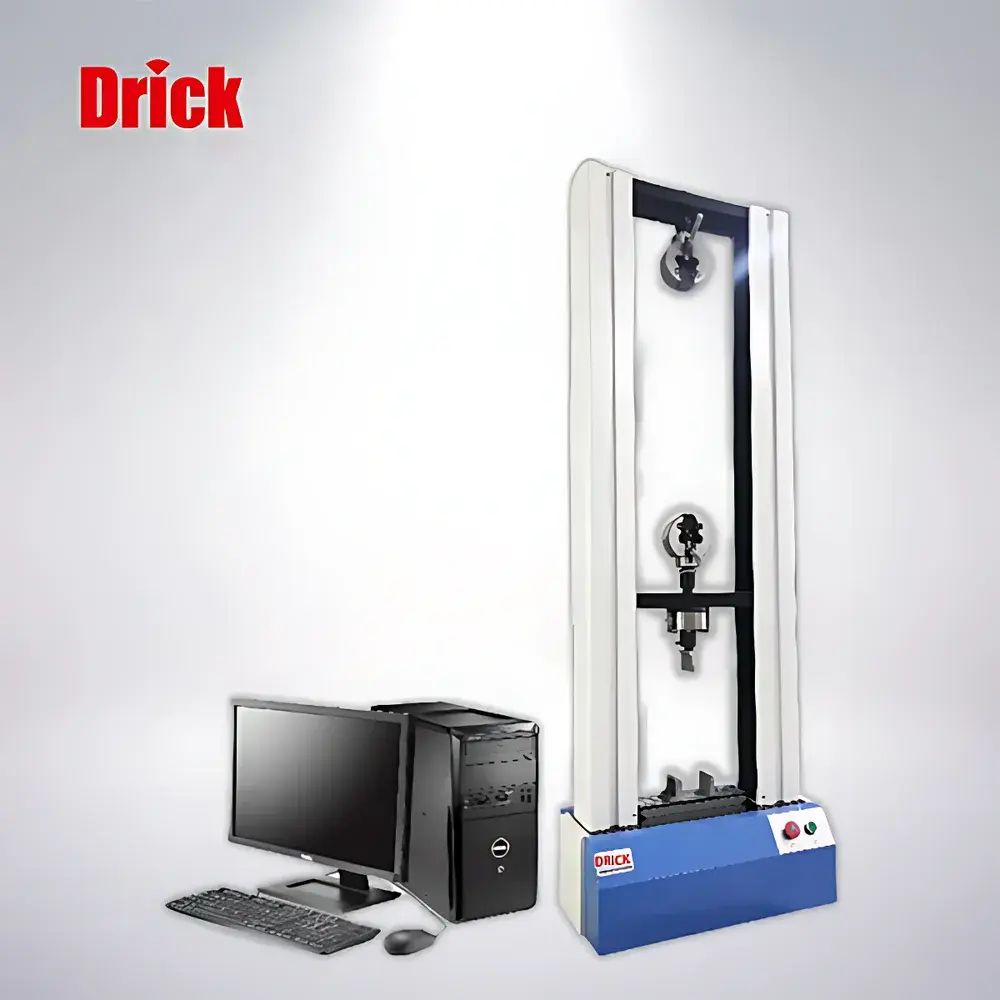
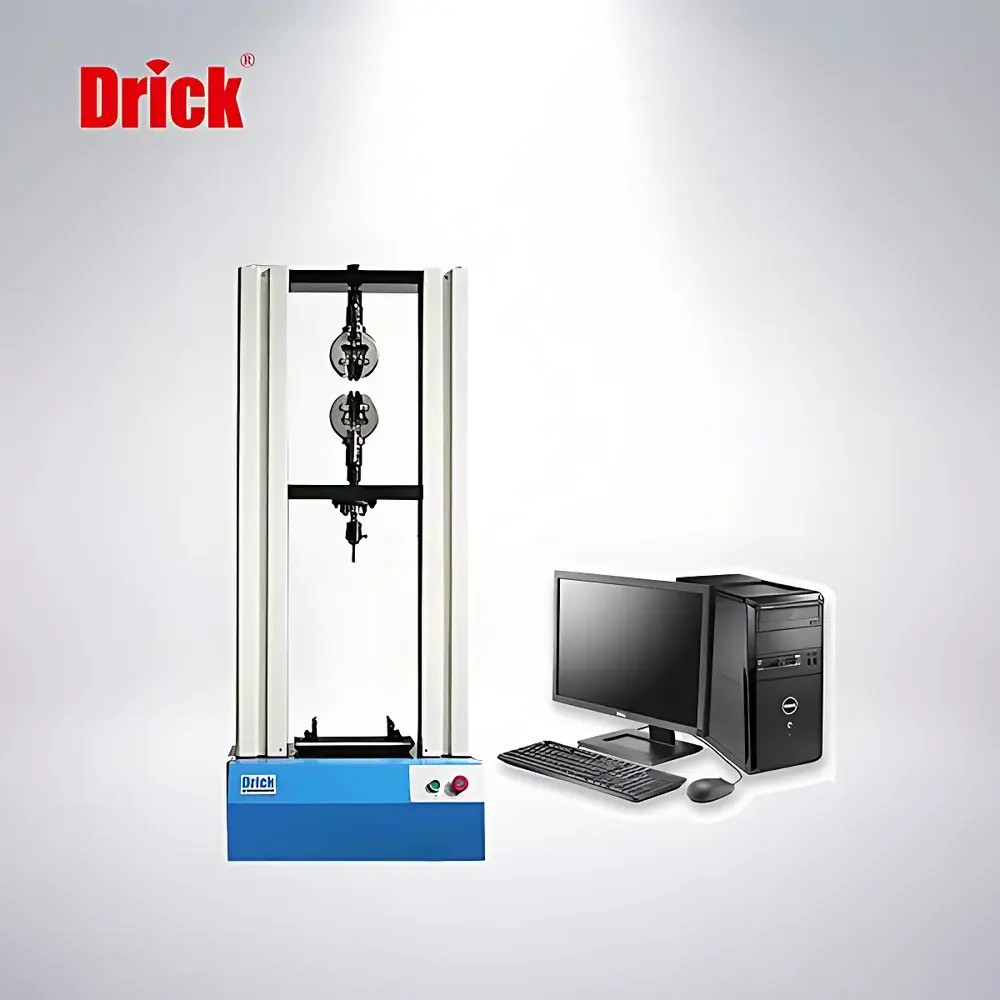
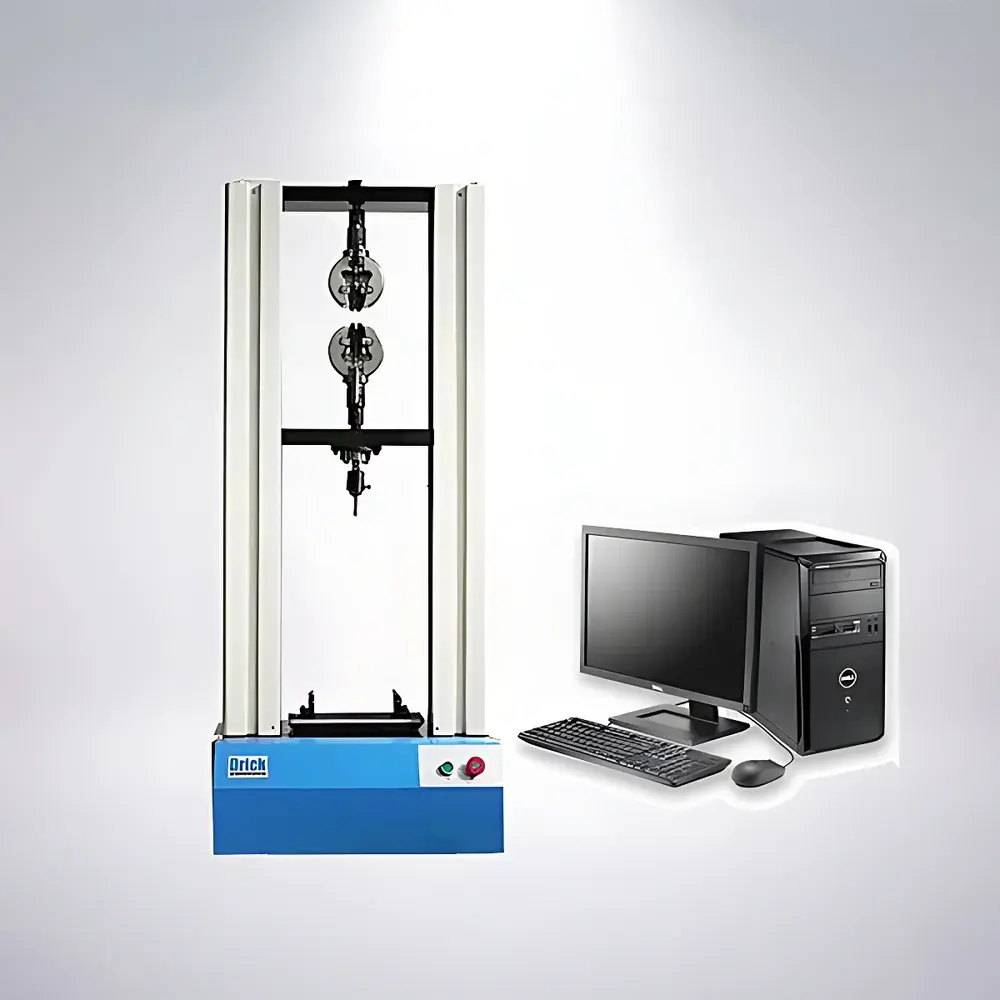
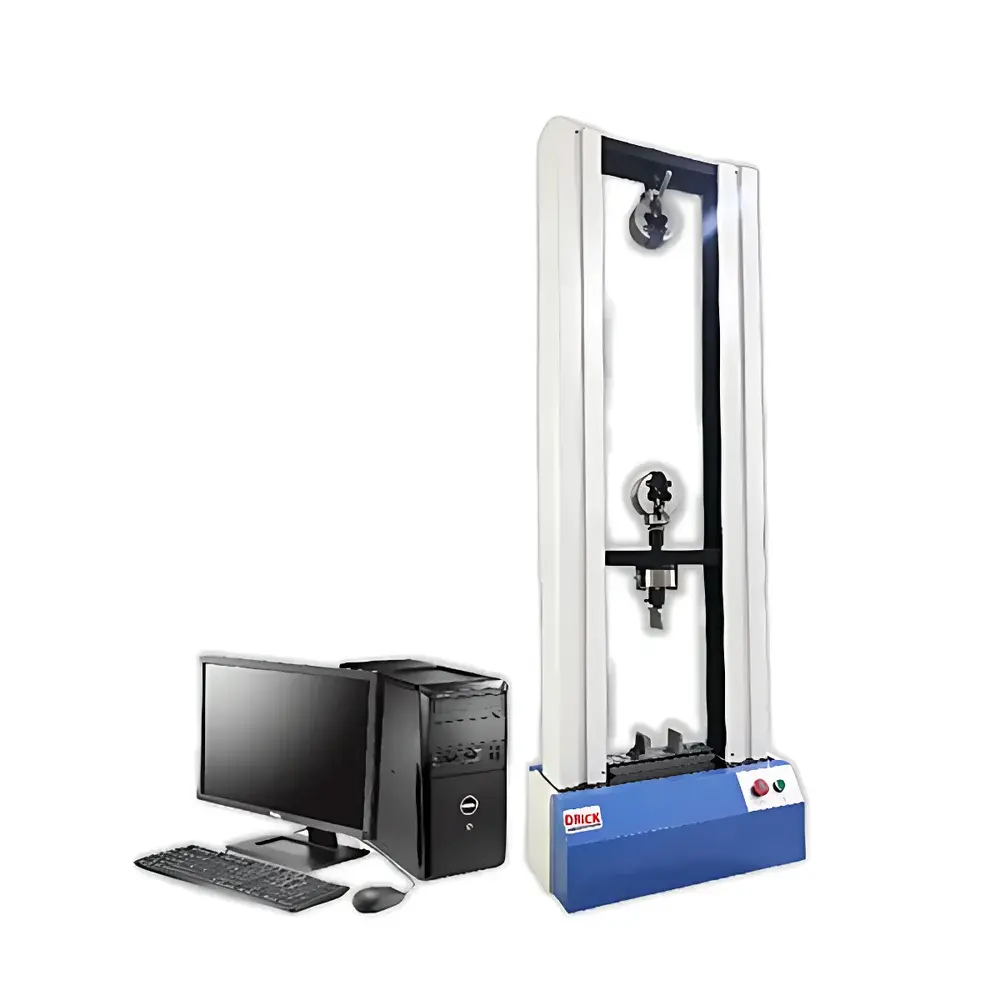
Drick DRK101 Microcomputer-Controlled Electronic Universal Testing Machine (≤20 kN)
| Brand | Drick |
|---|---|
| Origin | Shandong, China |
| Manufacturer Type | Direct Manufacturer |
| Country of Origin | China |
| Model | DRK101 |
| Instrument Type | Electromechanical Universal Testing Machine |
| Load Capacity | Up to 20 kN (selectable from 5 N–20 kN) |
| Force Accuracy | ±1.0% or ±0.5% of reading (customer-specified) |
| Test Speed Range | 0.1–500 mm/min |
| Effective Travel Distance | 600–900 mm (customizable) |
| Displacement Accuracy | ±0.5% of reading |
| Data Acquisition Rate | 50 Hz |
| Power Supply | AC 220 V, 50 Hz |
| Dimensions (W×D×H) | 1100 × 785 × 2090 mm |
| Weight | 750 kg |
| Compliance | ISO 178:2010 (Plastics — Determination of Flexural Properties) |
Overview
The Drick DRK101 Microcomputer-Controlled Electronic Universal Testing Machine is an electromechanical force-testing system engineered for precision mechanical property evaluation of metallic and non-metallic materials under tension, compression, bending, peel, tear, and shear loading conditions. Designed specifically for laboratories requiring reliable, repeatable, and standards-compliant mechanical testing up to 20 kN, the DRK101 integrates a high-rigidity structural frame, precision-ground ball-screw actuation, and closed-loop servo control to ensure minimal hysteresis, low friction loss, and consistent load application across its operational range. Its measurement principle relies on real-time transduction of axial force via calibrated load cells and displacement via high-resolution rotary encoders, with data acquisition synchronized at 50 Hz to capture dynamic material response accurately. The system supports full compliance with international test standards including ISO 178:2010 (flexural properties of plastics), ASTM D638/D790/D412, and GB/T 228.1–2021 (metal tensile testing), making it suitable for quality assurance, R&D validation, and regulatory submission workflows in industrial and academic environments.
Key Features
- Structural integrity: Galvanized and powder-coated steel frame ensures long-term corrosion resistance and dimensional stability under repeated loading cycles.
- Precision motion control: Preloaded recirculating ball screw assembly—superior to trapezoidal or Acme screws—delivers high positional repeatability, minimal backlash, and bidirectional accuracy essential for cyclic and creep testing protocols.
- High-fidelity sensing: Equipped with imported 24-bit analog-to-digital converters (1/100,000,000 resolution) and traceable load cells enabling force measurement accuracy of ±0.5% or ±1.0% of reading, depending on configuration.
- Intelligent servo drive: Industrial-grade servo motor provides smooth acceleration/deceleration, rapid speed response (<10 ms settling time), and precise position tracking across the full 0.1–500 mm/min speed range.
- Human-centered interface: Large backlit LCD display with intuitive Chinese-language menu navigation; real-time plotting of force–time, force–displacement, and force–strain curves during active testing.
- Integrated safety architecture: Dual hardware limit switches, software-defined overload protection, automatic return-to-start, and emergency stop circuitry compliant with IEC 61800-5-1 functional safety guidelines.
Sample Compatibility & Compliance
The DRK101 accommodates a broad spectrum of specimen geometries and material classes—including metallic wires, rods, strips, and sheets; polymeric films, cables, hoses, and composites; elastomeric cords, textiles, geotextiles, and laminated boards. Standard 30 mm jaw width is expandable to 50 mm or 100 mm upon request, and specialized fixtures (e.g., peel, bend, puncture, compression platens) are available for ISO/ASTM-mandated configurations. All test methods implemented via firmware adhere to documented procedures aligned with ISO 178:2010, ISO 527-1/-2, ISO 6892-1, ASTM D882, and GB/T 1040.1–2018. The system supports audit-ready operation under GLP and GMP frameworks through optional electronic signature and 21 CFR Part 11–compliant software modules (available as add-on license).
Software & Data Management
The DRK101 operates on Windows-based control software (XP/7/8/10 compatible) built using modular VB.NET architecture for extensibility and maintenance efficiency. It features automated parameter input (gauge length, crosshead speed, preload threshold), unit conversion (N, kN, lbf, MPa, psi), and direct output of standardized reports—including mean, standard deviation, coefficient of variation, modulus, yield point, ultimate tensile strength, elongation at break, and flexural modulus. Raw data export is supported in CSV, Excel (.xlsx), and XML formats. Optional report templates meet internal QA documentation requirements or external accreditation submissions (e.g., CNAS, A2LA). Thermal-printed output includes test ID, timestamp, operator name, environmental conditions (if logged), and graphical curve overlays—all traceable to instrument calibration records.
Applications
This testing machine serves as a primary mechanical characterization tool across multiple sectors: wire-and-cable manufacturers validating insulation tensile strength and jacket elongation; automotive suppliers verifying hose burst resistance and gasket compression set; construction material labs assessing gypsum board flexural rigidity and fiber-cement composite toughness; polymer compounders optimizing filler dispersion via stress–strain hysteresis analysis; and academic research groups conducting fundamental viscoelasticity studies on thermoplastic elastomers. Its adaptability to small-batch, multi-standard, and multi-material workflows makes it especially valuable in contract testing labs and university core facilities where throughput, method flexibility, and metrological traceability are equally critical.
FAQ
What is the maximum load capacity of the DRK101, and can it be calibrated for lower-range measurements?
The DRK101 is configurable for capacities from 5 N up to 20 kN. Load cell selection is matched to intended use; optional dual-range calibration allows high-resolution sub-newton testing while maintaining full-scale linearity.
Does the system support automated test sequence execution for batch samples?
Yes—the software enables programmable multi-step tests (e.g., preload → ramp → hold → unload) and batch mode with auto-indexing between specimens when integrated with optional sample stage accessories.
Is third-party calibration certification included with delivery?
Each unit ships with a factory calibration certificate traceable to NIM (National Institute of Metrology, China); ISO/IEC 17025-accredited calibration services are available upon request.
Can the DRK101 be integrated into a laboratory information management system (LIMS)?
Via TCP/IP or RS232 communication protocols and structured data export, the system supports seamless LIMS integration for automated result ingestion and metadata synchronization.
What maintenance intervals are recommended for long-term accuracy retention?
Annual verification of force and displacement transducers is advised; ball screw lubrication and encoder alignment checks are scheduled every 1,000 operating hours or biannually—whichever occurs first.



