
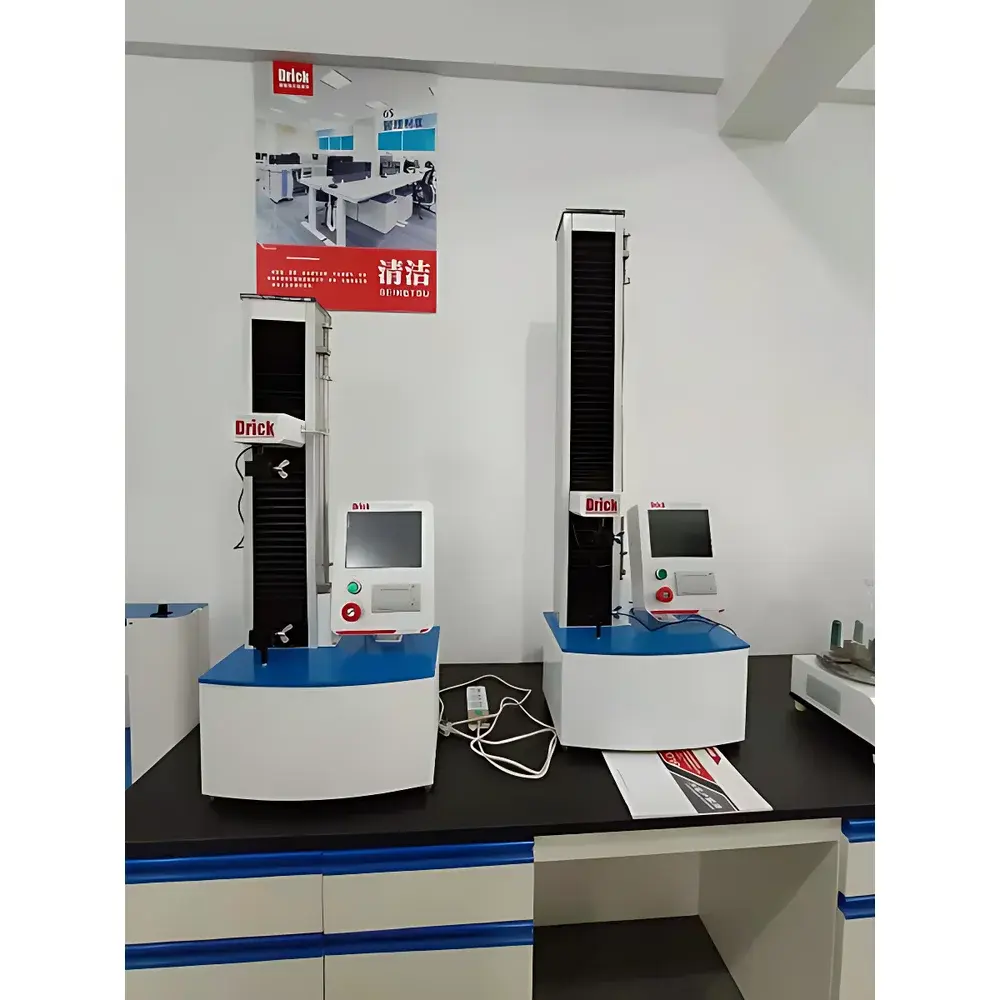
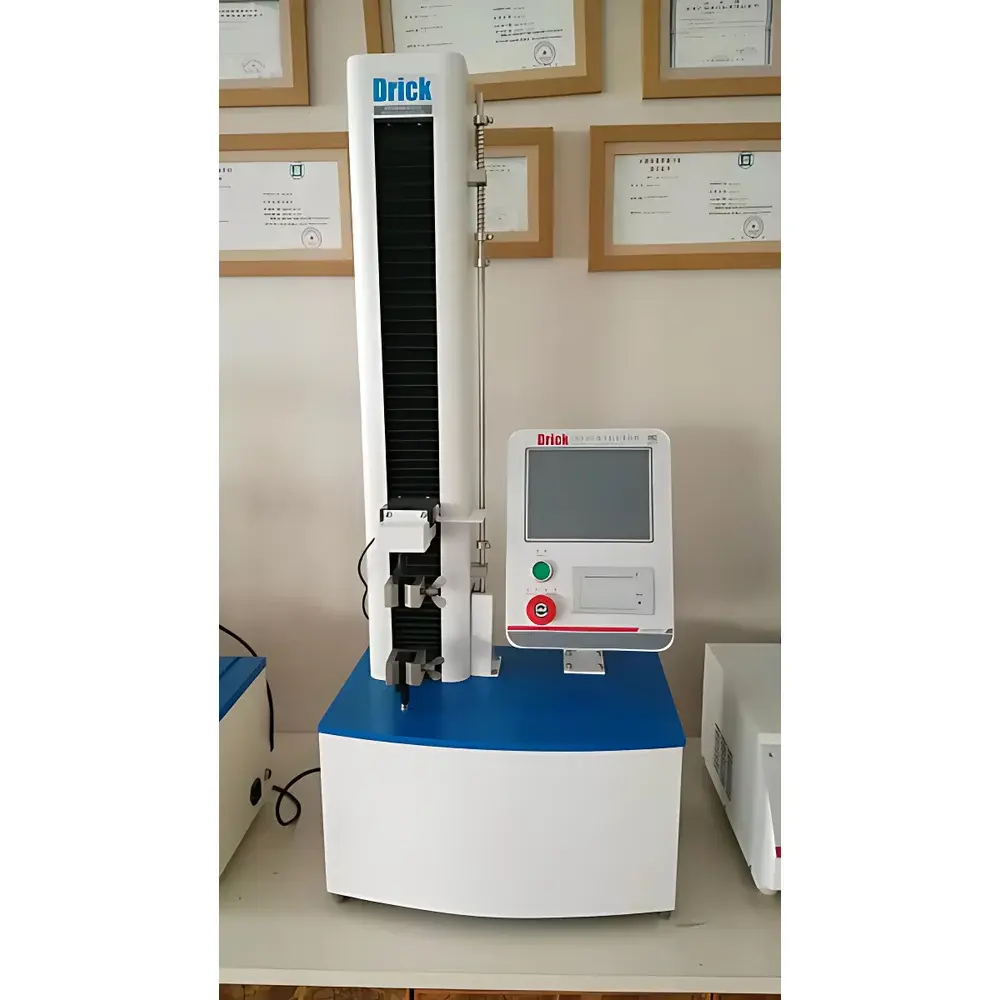
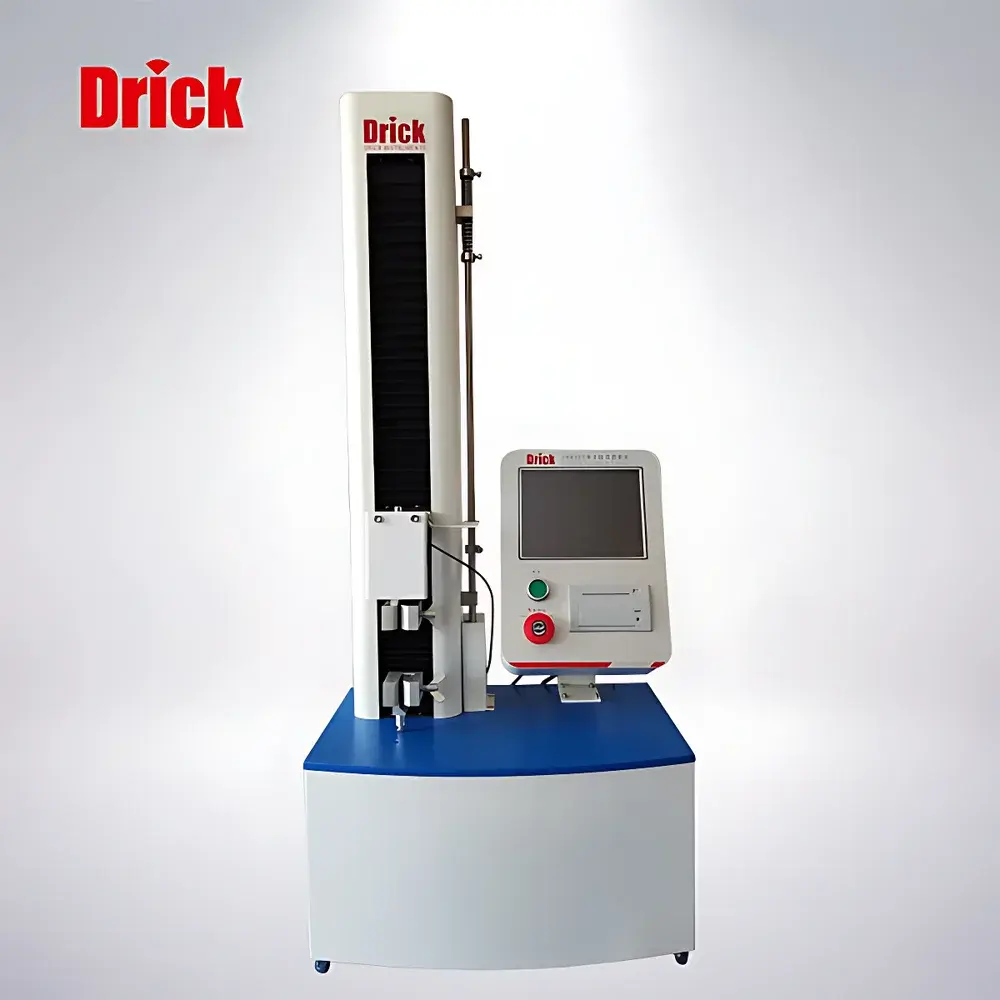
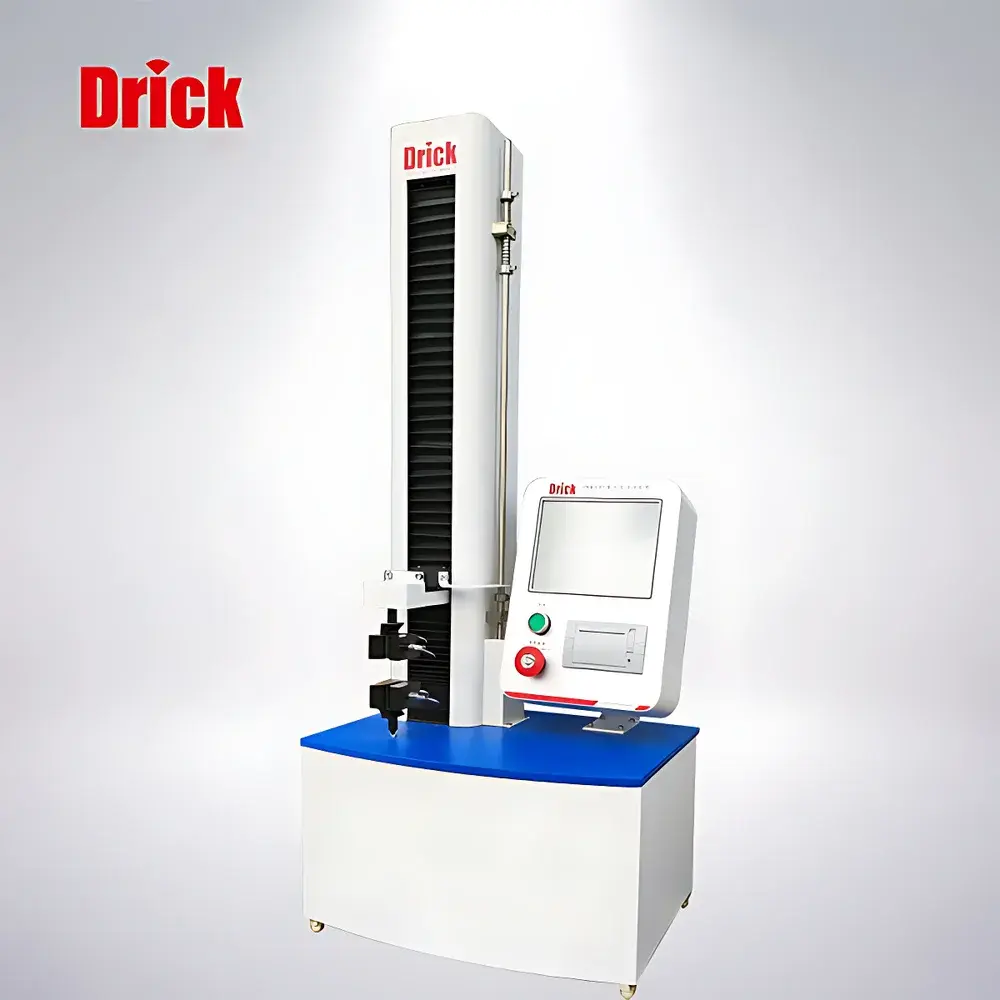
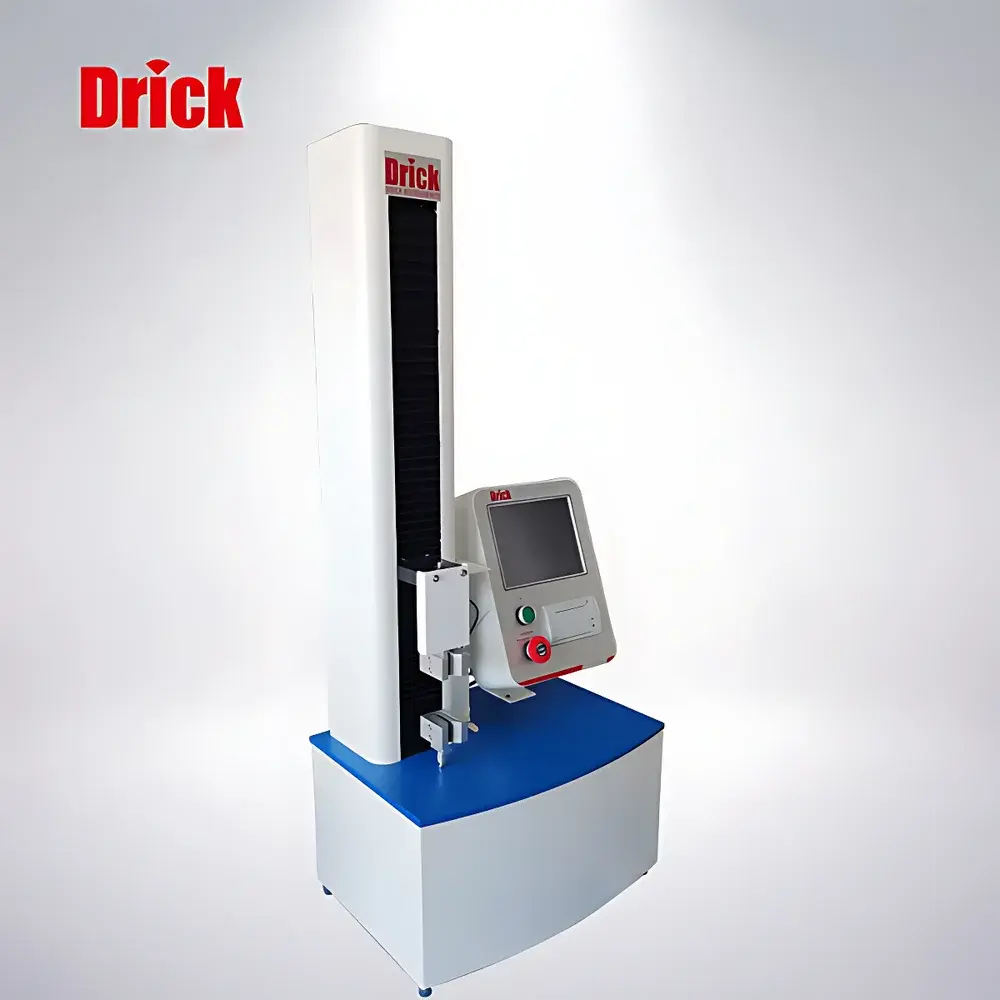
Drick DRK101A Universal Tensile Tester for Paper, Paperboard, and Flexible Packaging Materials
| Brand | Drick |
|---|---|
| Origin | Shandong, China |
| Manufacturer Type | Direct Manufacturer |
| Country of Origin | China |
| Model | DRK101A |
| Load Capacity Options | 100 N / 200 N / 500 N / 1000 N / 5000 N |
| Accuracy | Better than Class 0.5 |
| Deformation Resolution | 0.001 mm |
| Test Speed Range | 1–500 mm/min (infinitely variable) |
| Standard Specimen Width | 30 mm (50 mm optional) |
| Gauge Length | 400 mm (customizable) |
| Dimensions (L×W×H) | 500 × 300 × 1150 mm |
| Weight | 73 kg |
| Power Supply | AC 220 V, 50 Hz |
Overview
The Drick DRK101A Universal Tensile Tester is an electromechanical materials testing instrument engineered for precision mechanical characterization of fibrous, polymeric, and laminated sheet materials widely used in packaging, papermaking, converting, and hygiene product manufacturing. It operates on the principle of constant-rate extension (CRE), applying controlled uniaxial tensile force to standardized specimens while continuously recording load and displacement data. Designed in strict compliance with GB/T 12914–2008 — the Chinese national standard equivalent to ISO 1924-2 and ASTM D828 — the system delivers high reproducibility in measuring fundamental tensile properties including tensile strength, elongation at break, tensile energy absorption (TEA), tensile index, burst strength-related derived parameters (e.g., breaking length), and peel/heat-seal strength under defined geometries. Its modular load cell architecture supports five selectable capacity ranges (100 N to 5000 N), enabling traceable measurement across low-strength tissue papers and high-strength composite packaging substrates without hardware reconfiguration.
Key Features
- Microprocessor-controlled servo-motor drive with infinitely variable crosshead speed (1–500 mm/min), ensuring adherence to standardized strain rates across diverse material classes.
- High-resolution displacement sensing (0.001 mm resolution) coupled with Class 0.5 load accuracy per JJG 475–2018 (Chinese verification regulation for universal testing machines), supporting reliable quantification of subtle mechanical transitions — especially critical for wet-strength evaluation of sanitary tissue.
- Ergonomically optimized manual wedge-action grips with standardized 30 mm specimen width (50 mm optional), minimizing slippage and premature failure during testing of low-modulus films and nonwovens.
- Modular load cell design allowing field-swappable transducers — users select optimal capacity (100 N to 5000 N) based on typical specimen strength, preserving signal-to-noise ratio and measurement linearity.
- Robust structural frame (73 kg mass, 1150 mm height) with 400 mm standard travel distance — configurable for extended gauge lengths to accommodate ASTM D882-compliant film elongation protocols or custom packaging validation setups.
- Compliance-ready firmware architecture supporting audit trails, user access levels, and parameter locking — foundational for laboratories operating under GLP, GMP, or internal quality management systems aligned with ISO/IEC 17025 requirements.
Sample Compatibility & Compliance
The DRK101A accommodates a broad spectrum of planar flexible materials: paper and paperboard (including coated, recycled, and corrugated grades), plastic films (BOPP, PET, PE, CPP), laminates, aluminum foils, adhesive tapes (pressure-sensitive and hot-melt), nonwovens, hygiene product components (diaper leg cuffs, backsheet films, topsheet bonds), and textile filaments. It satisfies mechanical test requirements specified in GB/T 12914–2008 (tensile strength, elongation), GB/T 13022–91 (film tensile properties), GB/T 1040–2006 (plastics tensile testing), GB/T 2792–2014 (peel adhesion), GB/T 14344–2008 (synthetic filament tensile), and QB/T 2171–2014 (hygiene product seal integrity). While not certified to ISO/IEC 17025 out-of-box, its metrological traceability path (via factory calibration certificates referencing CNAS-accredited standards) enables integration into accredited lab workflows when paired with documented SOPs and periodic third-party verification.
Software & Data Management
The embedded control interface provides real-time load–displacement curve visualization, automatic peak detection, and calculation of standardized indices (e.g., tensile index = tensile strength / basis weight). Raw data export is supported in CSV format for post-processing in Excel or statistical analysis platforms. The system logs operator ID, test date/time, specimen ID, load cell serial number, and calibration validity status — fulfilling basic data integrity requirements per FDA 21 CFR Part 11 Annex A (electronic records) when deployed in regulated environments. Optional PC-based software extends functionality to multi-curve overlay, batch reporting, Weibull distribution analysis for strength variability, and customizable report templates compliant with internal QA documentation standards.
Applications
- Quality control of paper machine output: monitoring tensile strength and elongation consistency across reel widths and production shifts.
- Evaluation of wet tensile strength retention in facial tissues and towel products per GB/T 465.2, using optional humidity-conditioned specimen handling protocols.
- Validation of heat-seal integrity in flexible food packaging pouches (e.g., snack bags, coffee liners) per GB/T 2792–2014 peel methods.
- Characterization of delamination resistance in aluminum-plastic laminates used in pharmaceutical blister packaging.
- Testing of elastic recovery and permanent set in stretch-film formulations via cyclic loading-unloading sequences.
- Verification of bond strength in ultrasonically sealed nonwoven medical gowns and surgical drapes.
FAQ
What international standards does the DRK101A directly support?
It is designed to meet GB/T 12914–2008 (equivalent to ISO 1924-2), GB/T 1040–2006 (ISO 527), and GB/T 2792–2014 (ISO 8510-2), with mechanical performance validated against these references during factory acceptance testing.
Can the DRK101A perform cyclic or creep tests?
No — it is configured exclusively for monotonic tensile, peel, and seal strength tests per standard protocols. Cyclic loading requires dedicated dynamic testing systems with closed-loop strain control.
Is calibration traceable to national metrology institutes?
Yes — each unit ships with a factory calibration certificate referencing traceable standards maintained by provincial metrology institutes accredited under CNAS, with uncertainty budgets reported per ISO/IEC 17025 guidelines.
What maintenance is required to sustain measurement accuracy?
Annual verification of load cell linearity and displacement encoder accuracy is recommended; routine cleaning of guide rails and grip surfaces is required after every 200 test cycles to prevent particulate-induced friction errors.
Does the system support automated specimen feeding or multi-specimen staging?
No — it is a single-station manual-loading instrument. High-throughput labs typically integrate it with external robotic handlers or operate multiple units in parallel under centralized LIMS scheduling.





