
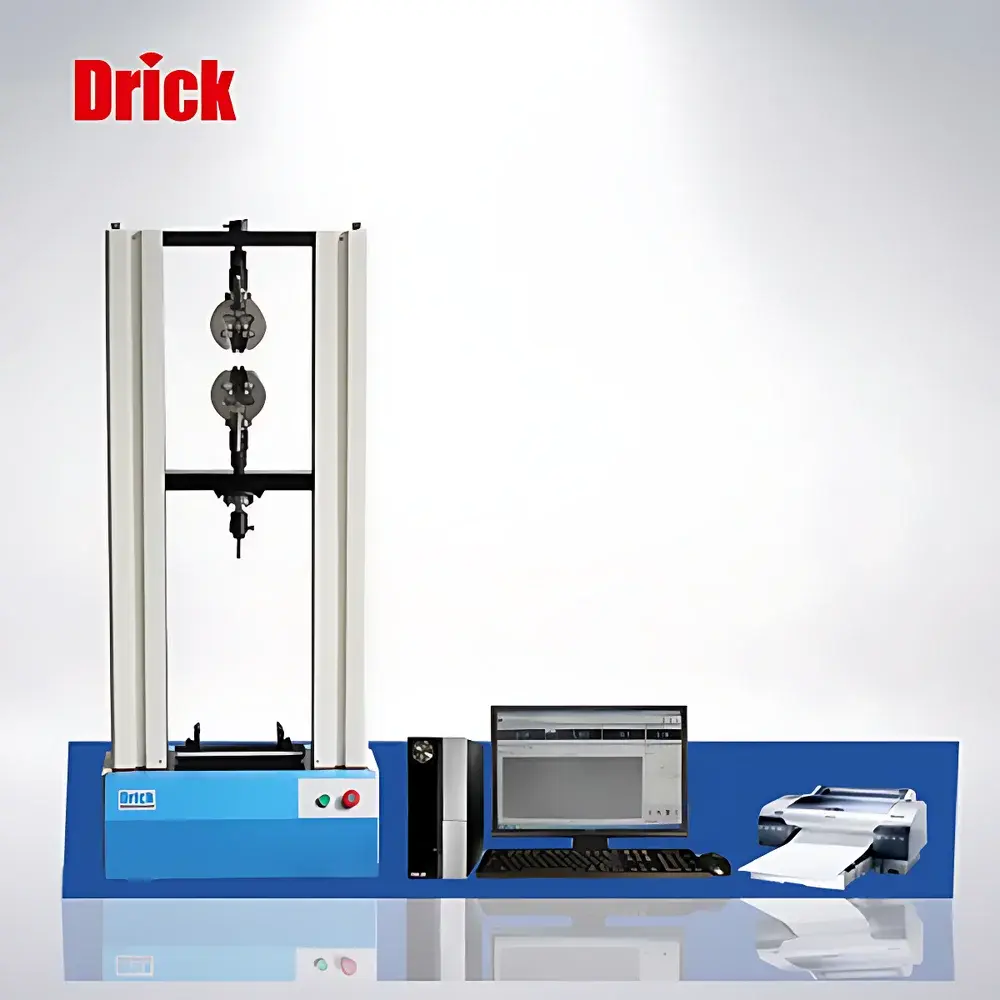
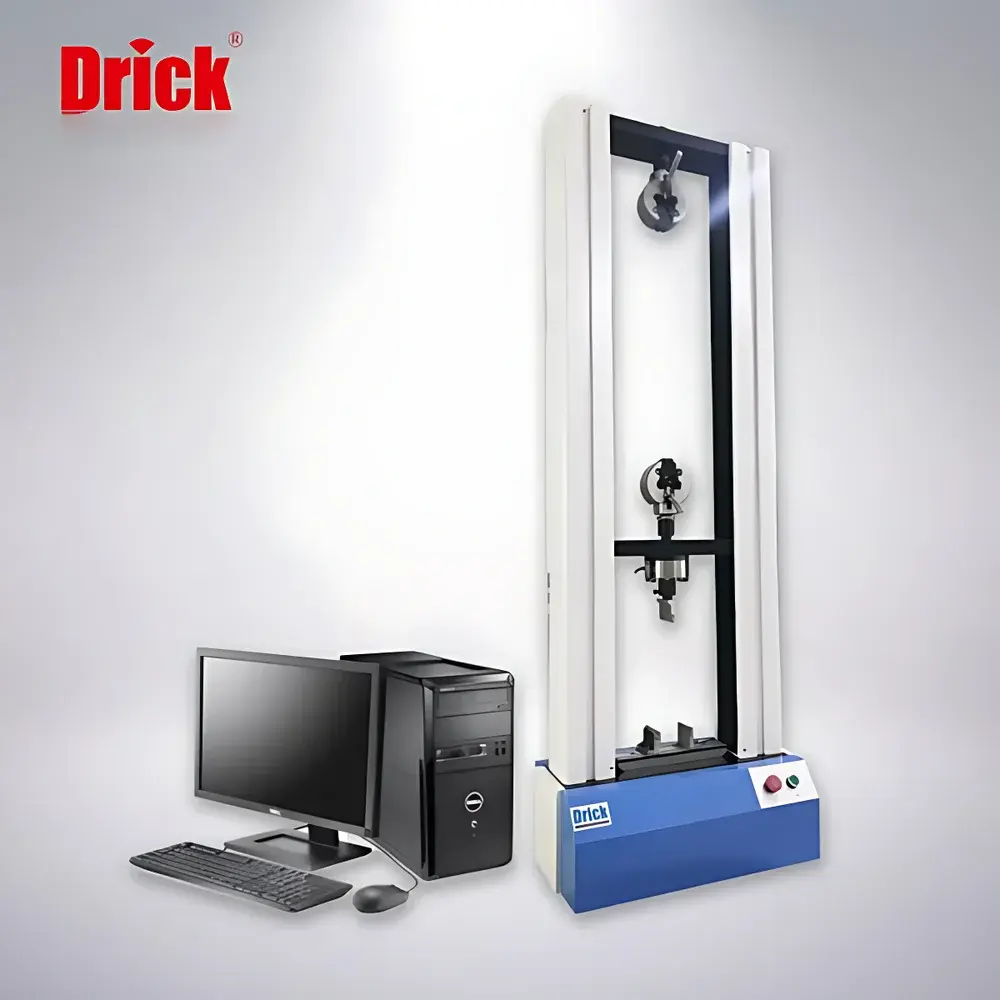
Drick DRK101DG Floor-Standing Universal Tensile Testing Machine Compliant with GB/T 1040.1–2006 and ISO 37
| Brand | Drick |
|---|---|
| Origin | Shandong, China |
| Manufacturer Type | Direct Manufacturer |
| Model | DRK101DG |
| Load Capacity Options | 100 N, 200 N, 500 N, 1 kN, 2 kN, 5 kN, 10 kN, 20 kN (user-selectable single capacity) |
| Force Accuracy | Better than Class 0.5 per GB/T 228.1 & ISO 7500-1 |
| Effective Force Range | 0.4%–100% FS (Class 0.5) |
| Displacement Resolution | ≤0.001 mm |
| Travel Range Options | 400 mm, 500 mm, 600 mm (customizable) |
| Crosshead Speed Range | 1–500 mm/min |
| Displacement Measurement Accuracy | ±0.2% of reading |
| Strain Measurement Accuracy | ±0.5% of reading |
| Test Width | 40 mm or 50 mm (expandable on request) |
| Power Supply | 220 V, 50 Hz, 0.75 kW (motor power scalable per load rating) |
| Dimensions (W×D×H) | 700 × 530 × 1900 mm |
| Net Weight | ~500 kg |
Overview
The Drick DRK101DG is a floor-standing, dual-column universal tensile testing machine engineered for high-reproducibility mechanical property evaluation of solid materials under uniaxial loading conditions. It operates on the principle of controlled crosshead displacement driven by a precision AC servo motor and high-accuracy ball-screw transmission system, enabling precise force–displacement–time data acquisition in accordance with standardized quasi-static mechanical testing protocols. Designed to meet the structural and metrological requirements of GB/T 1040.1–2006 (equivalent to ISO 527-1), ASTM D638, ISO 37, and other internationally harmonized standards, the DRK101DG delivers traceable, repeatable measurements of tensile strength, yield point, elongation at break, modulus of elasticity, and stress–strain behavior across diverse material classes.
Key Features
- Modular load cell architecture: Eight selectable nominal capacities (100 N to 20 kN), all calibrated to Class 0.5 accuracy per ISO 7500-1 and GB/T 228.1, ensuring optimal signal-to-noise ratio across test ranges.
- High-resolution motion control: Servo-driven crosshead with programmable speed range (1–500 mm/min) and real-time closed-loop feedback for consistent strain rate application.
- Integrated safety architecture: Dual-stage overload protection (110% FS auto-shutdown), electronic travel limit switches, and emergency stop circuitry compliant with IEC 60204-1.
- Ergonomic and robust frame design: Cold-rolled steel chassis with electrostatic powder coating; rigid dual-column structure minimizing deflection during high-load testing.
- Multi-functional test capability: Pre-configured routines for tensile, peel, tear, shear, and compression tests—supporting ISO 8510-2, ASTM D1876 (T-peel), ASTM D1938 (propagation tear), and ASTM D3330 (adhesive peel).
- Automatic return functionality: Programmable post-test rapid retraction to initial position, reducing operator intervention and cycle time.
Sample Compatibility & Compliance
The DRK101DG accommodates specimens ranging from thin polymer films (≥12 µm) to structural metal components (up to 20 kN ultimate load). Standard configurations include pneumatic or mechanical wedge-action grips for flat strips, cord-and-fiber fixtures, and specialized holders for foams, elastomers, and biomedical sutures. The system conforms to regulatory and quality assurance frameworks including ISO/IEC 17025 calibration traceability, GLP-compliant audit trails (via optional software module), and alignment with FDA 21 CFR Part 11 requirements for electronic records and signatures when paired with validated software deployment. All mechanical and electrical subsystems comply with CE marking directives (EMC Directive 2014/30/EU and Machinery Directive 2006/42/EC).
Software & Data Management
Bundled with Drick’s proprietary TESTMaster v5.2 control and analysis suite, the DRK101DG provides full PC-based operation via USB 2.0 or Ethernet interface. The software supports multi-curve overlay, automatic identification of yield point and breaking load, calculation of Young’s modulus (secant/tangent), Poisson’s ratio (with optional extensometer integration), and statistical reporting (mean, SD, CV%, min/max) across user-defined test groups. Raw data export is available in CSV, XML, and PDF formats, preserving metadata such as operator ID, environmental conditions (optional sensor input), calibration certificate ID, and timestamped audit logs. Optional modules enable GMP-compliant electronic signatures, role-based access control, and 21 CFR Part 11–compliant electronic record archiving.
Applications
- Plastics & Polymers: Tensile testing of extruded sheets, injection-molded parts, and thermoplastic films per ISO 527 and ASTM D638.
- Packaging Materials: Seal strength (ASTM F88), peel adhesion (ASTM D903), and puncture resistance (ASTM F1306) of laminates and flexible packaging.
- Textiles & Nonwovens: Breaking strength and elongation of woven fabrics, geotextiles, and medical gauze per ISO 9073 and ASTM D5035.
- Metals & Alloys: Mechanical characterization of wire, foil, and sheet metal per ISO 6892-1 and GB/T 228.1.
- Biomedical & Elastomeric Materials: Stress relaxation, cyclic loading, and creep behavior of silicone tubing, hydrogels, and suture materials (ISO 10993-12 compatible).
- Adhesives & Coatings: Lap-shear strength (ASTM D1002), T-peel (ASTM D1876), and 180° peel (ASTM D3330) for pressure-sensitive and structural adhesives.
FAQ
What international standards does the DRK101DG support out-of-the-box?
The system includes preloaded test methods aligned with ISO 37, ISO 527-1, ASTM D638, ASTM D882, ASTM D1938, GB/T 1040.1–2006, GB/T 228.1, and JIS P8113. Custom method creation is supported via script-based protocol editor.
Is extensometer integration available?
Yes—contact sensor (LVDT) and non-contact (video-based) extensometers are optional accessories, enabling high-accuracy strain measurement per ISO 9513 and ASTM E83 Class B-2 compliance.
Can the DRK101DG be integrated into an existing LIMS or MES environment?
Via TCP/IP API and configurable OPC UA server module (optional), the system supports bidirectional data exchange with laboratory information management systems and manufacturing execution platforms.
What is the calibration interval recommendation?
Annual verification against certified reference standards is recommended; internal self-calibration routines verify zero offset and linearity before each test session.
Does the machine support multi-step test profiles (e.g., hold, ramp, cyclic)?
Yes—TESTMaster v5.2 supports up to 100-step programmable test sequences, including dwell periods, load-controlled ramps, and displacement-controlled cycling with user-defined termination criteria.



