
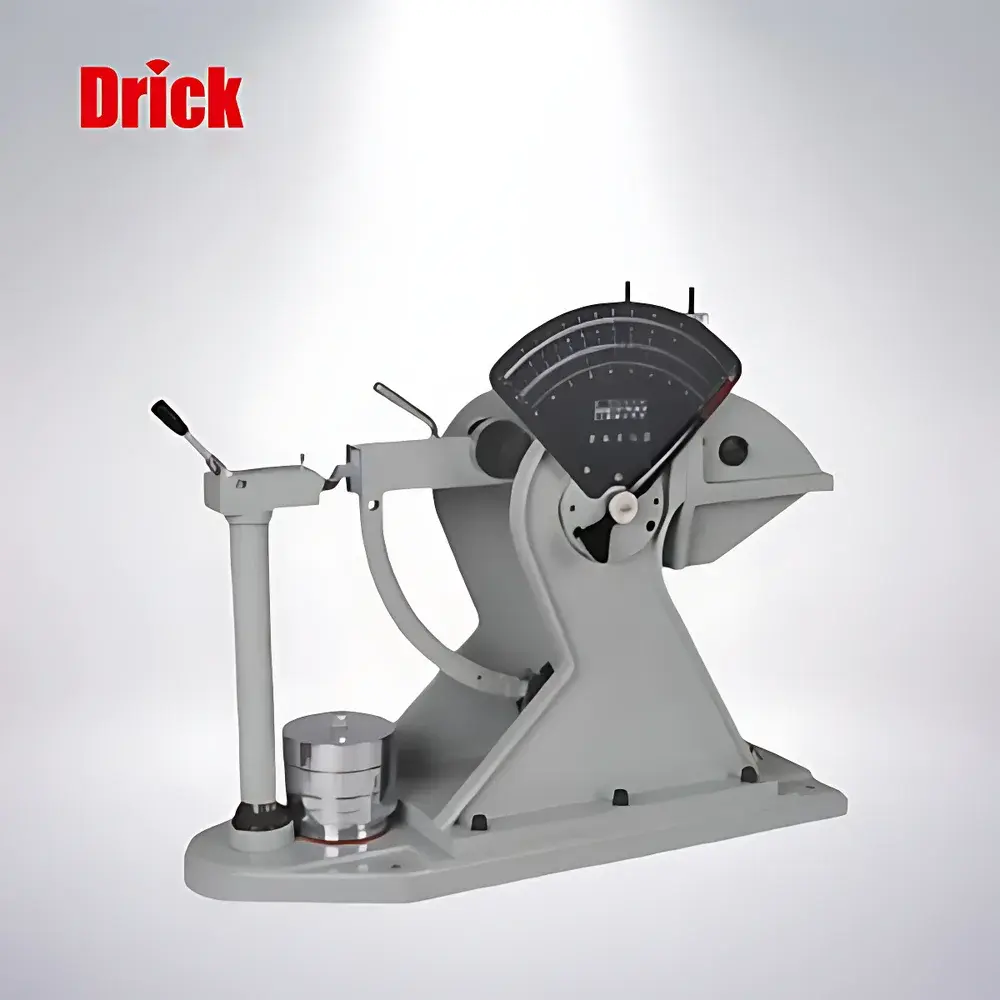
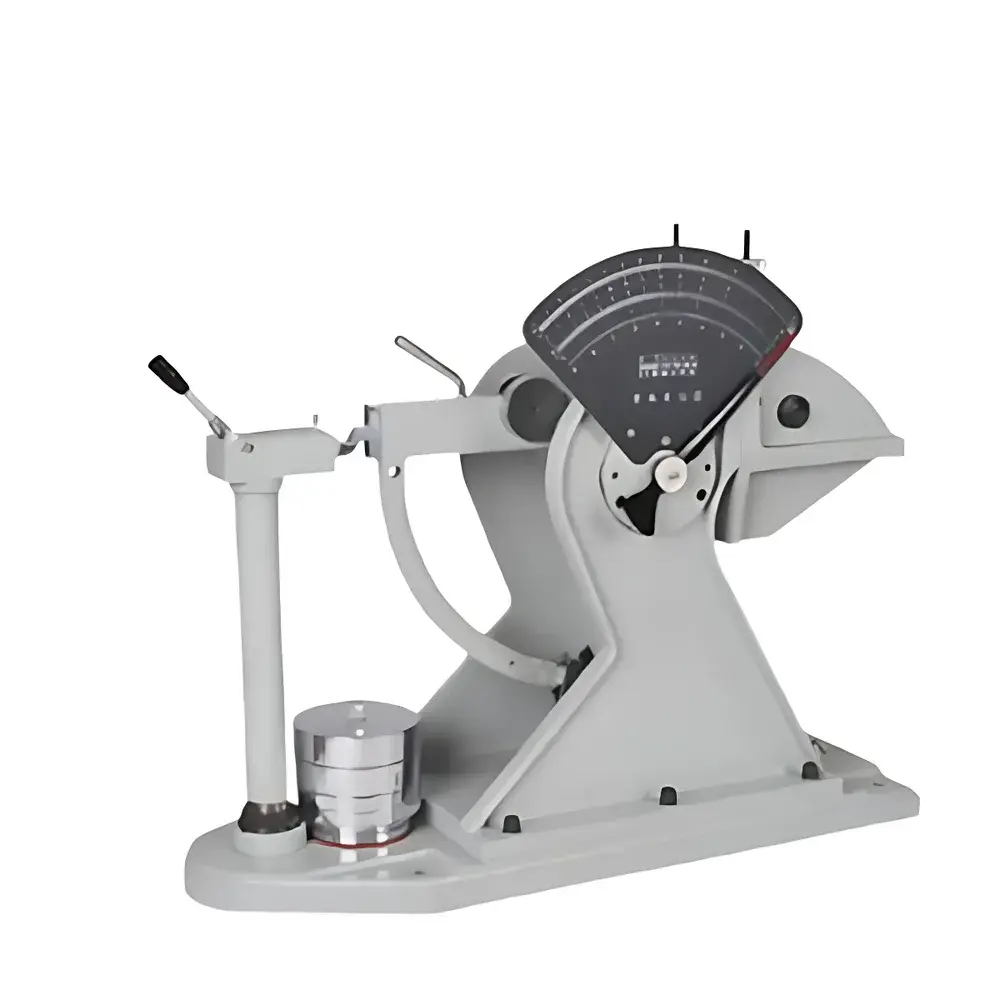
Drick DRK104A Puncture Strength Tester for Corrugated Board
| Brand | Drick |
|---|---|
| Origin | Shandong, China |
| Manufacturer Type | Direct Manufacturer |
| Country of Origin | China |
| Model | DRK104A |
| Price | USD 7,000 (FOB Qingdao) |
| Measurement Range | 0–48 J (4 ranges) |
| Accuracy | ±0.05 J to ±0.50 J per range |
| Friction Loss | ≤0.25 J |
| Pyramid Probe | Equilateral triangular base (60 mm × 60 mm × 60 mm), height (25 ± 0.7) mm, edge radius R (1.5 ± 0.1) mm |
| Dimensions (L×W×H) | 800 × 470 × 840 mm |
| Weight | 145 kg |
| Operating Environment | 5–35 °C, RH ≤85% |
| Standards Compliance | ISO 3036, GB/T 2679.7 |
Overview
The Drick DRK104A Puncture Strength Tester is a precision mechanical instrument engineered for the quantitative determination of puncture resistance in corrugated fiberboard and solid fiberboard according to standardized quasi-static penetration mechanics. It operates on the principle of energy absorption measurement: a calibrated pyramid-shaped probe—fabricated from hardened steel and geometrically defined per ISO 3036—is driven vertically into a horizontally clamped test specimen under controlled impact conditions. The kinetic energy required to fully penetrate the board is calculated from the angular displacement of a pendulum system, with mechanical damping minimized and friction losses rigorously compensated (≤0.25 J). Designed for deterministic, repeatable assessment of board integrity under localized dynamic loading, the DRK104A delivers traceable results essential for QC release testing, material specification validation, and packaging performance benchmarking in industrial environments.
Key Features
- Four-range calibrated pendulum system (0–6 J, 0–12 J, 0–24 J, 0–48 J) with range-specific accuracy guarantees (±0.05 J to ±0.50 J), validated across 20–80% of each full-scale value
- Integrated mechanical safety interlock and automatic handle reset mechanism to prevent operator error and ensure consistent drop-height repeatability
- Open-frame structural design with rigid cast-iron base and precision-machined guide columns, enabling rapid specimen loading and visual process monitoring
- Geometrically certified pyramid probe meeting ISO 3036 dimensional tolerances: equilateral triangular base (60 mm sides), height (25 ± 0.7) mm, and chamfered edges (R = 1.5 ± 0.1) mm
- Low-maintenance mechanical architecture with sealed bearings, hardened steel pivot shafts, and corrosion-resistant surface treatment for long-term stability in laboratory and production-floor settings
- Compact footprint (800 × 470 × 840 mm) and modular assembly facilitating integration into ISO/IEC 17025-accredited testing laboratories or inline QA stations
Sample Compatibility & Compliance
The DRK104A accommodates standard test specimens measuring 175 mm × 175 mm (per ISO 3036 and GB/T 2679.7), supporting single- and double-wall corrugated board, combined board, and solid bleached sulfate (SBS) substrates with basis weights ranging from 120 g/m² to 600 g/m². Specimen clamping employs dual pneumatic actuators (optional upgrade) or manual toggle levers, ensuring uniform compression without edge deformation. All test procedures conform strictly to ISO 3036:2021 “Paper and board — Determination of puncture resistance” and its national adoption GB/T 2679.7–2016. Instrument calibration protocols align with JJG (Light Industry) 78–2018 verification requirements for puncture testers. Traceability is maintained via factory-certified reference weights and documented pendulum moment-of-inertia verification.
Software & Data Management
While the DRK104A operates as a stand-alone mechanical tester, optional digital readout modules (DRK-DRO-104A) provide RS-232 or USB-C output of raw pendulum angle data, enabling direct import into LIMS or statistical process control (SPC) platforms. Calibration coefficients, range selection, and environmental metadata (temperature/humidity logs) are stored locally in non-volatile memory. Audit trails comply with GLP principles: all manual interventions—including range changes, zero adjustments, and probe cleaning—are timestamped and logged in human-readable format. For regulated environments (e.g., FDA-registered packaging suppliers), the optional DMS-Link software package supports 21 CFR Part 11-compliant electronic signatures, user-level access control, and encrypted data export in CSV or PDF/A-1b format.
Applications
- Quality conformance testing of incoming linerboard and medium for corrugated box manufacturing
- Process validation of starch adhesive cure profiles and hot-press dwell times in corrugator operations
- Comparative evaluation of recycled fiber content impact on board toughness and edge crush resistance correlation
- Developmental testing of high-performance barrier-coated boards used in pharmaceutical and electronics packaging
- Third-party certification testing for ISTA 3A/3E and ASTM D642-compliant shipping container qualification
- Academic research on fiber network failure mechanics under localized stress concentration
FAQ
What standards does the DRK104A explicitly support?
ISO 3036:2021 and GB/T 2679.7–2016 are fully implemented in both mechanical design and procedural documentation.
Is operator training required for ISO-compliant testing?
Yes—users must complete documented competency assessment covering specimen conditioning (23 °C / 50% RH per ISO 187), probe inspection protocol, and pendulum zeroing sequence.
Can the DRK104A be integrated into an automated test line?
With optional pneumatic clamping and digital interface module, it supports semi-automated batch processing; full robotic integration requires custom end-effector design.
How often must the pyramid probe be recalibrated or replaced?
Probe geometry verification is recommended every 500 tests or quarterly—whichever occurs first—using optical comparator or coordinate measuring machine (CMM) traceable to NIST standards.
Does the instrument include calibration certification?
Each unit ships with a factory calibration certificate (traceable to CNAS-accredited metrology lab) and a set of certified reference weights for daily verification.
Related Products





