
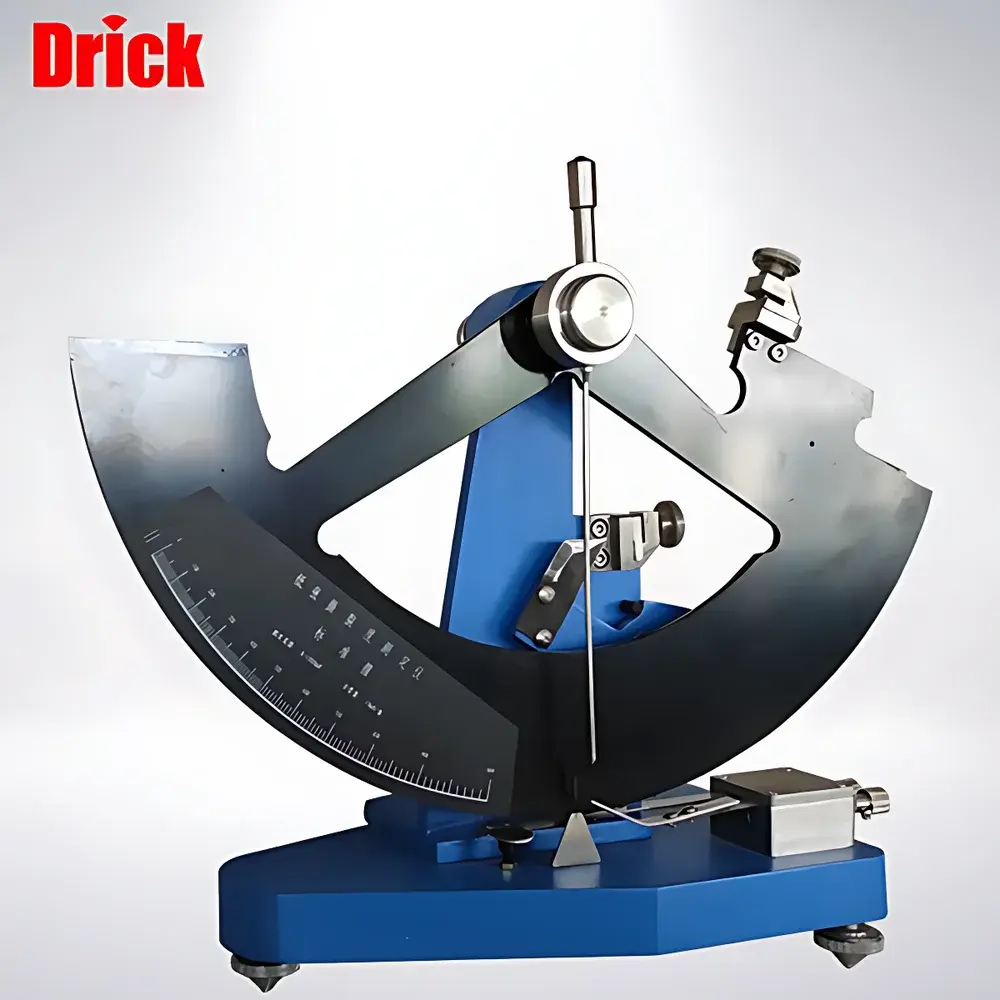
Drick DRK108A Elmendorf Tear Tester
| Brand | Drick |
|---|---|
| Origin | Shandong, China |
| Manufacturer Type | Direct Manufacturer |
| Country of Origin | China |
| Model | DRK108A |
| Price | USD 7,000 (FOB Qingdao) |
| Standard Compliance | ISO 1974, GB/T 455.1, GB/T 450–2002, GB/T 10739–2002 |
| Measuring Principle | Elmendorf pendulum tear method |
| Measurement Range (Standard Pendulum) | 10–1000 mN |
| Resolution | 10 mN (standard), 5 mN (light pendulum), 2 mN (ultra-light pendulum) |
| Accuracy | ±1% FS within 20–80% of full scale |
| Repeatability | <1% FS within 20–80% FS |
| Tear Arm Length | (104 ± 1) mm |
| Initial Tear Angle | 27.5° ± 0.5° |
| Tear Distance | (43 ± 0.5) mm |
| Clamp Face Dimensions | 25 × 15 mm |
| Clamp Spacing | (2.8 ± 0.3) mm |
| Specimen Size | (63 ± 0.5) mm × (50 ± 2) mm |
| Environmental Conditions | 23 °C ± 1 °C, 50% RH ± 5% |
| Dimensions (W × D × H) | 420 × 300 × 465 mm |
| Net Weight | 25 kg |
Overview
The Drick DRK108A Elmendorf Tear Tester is a precision mechanical instrument engineered for the quantitative determination of tear resistance in paper, board, and thin flexible sheet materials. It operates on the standardized Elmendorf pendulum principle—where a pre-notched specimen is clamped vertically, and a weighted pendulum with a fixed tear arm initiates and propagates a controlled tear across a defined distance. The energy absorbed during tearing is converted into a direct force reading (in millinewtons), enabling traceable, reproducible assessment of intrinsic material resistance to propagating fracture. Designed for laboratories requiring compliance with international standards—including ISO 1974, GB/T 455.1, and ASTM D1922 (via equivalent methodology)—the DRK108A delivers high mechanical stability and minimal operator dependency. Its robust cast-iron base, calibrated torsion-free pendulum assembly, and precision-machined clamping system ensure long-term metrological integrity under routine QC or R&D conditions.
Key Features
- Triple-pendulum configuration: standard (10–1000 mN), light (10–1000 mN, 5 mN resolution), and ultra-light (10–200 mN, 2 mN resolution) options enable broad dynamic range coverage—from lightweight tissue to medium-strength corrugated linerboard.
- Mechanically driven, zero-electronic-sensor architecture ensures immunity to electromagnetic interference and eliminates calibration drift associated with load cells or digital transducers.
- Precision-ground clamping surfaces (25 × 15 mm) with fixed inter-clamp spacing (2.8 ± 0.3 mm) guarantee uniform specimen alignment and consistent stress distribution at the tear initiation point.
- Fixed geometric parameters: tear arm length (104 ± 1 mm), initial tear angle (27.5° ± 0.5°), and tear propagation distance (43 ± 0.5 mm) strictly adhere to ISO 1974 dimensional tolerances.
- Compliance-ready mechanical design supports GLP documentation workflows: all critical dimensions are factory-certified and traceable to national metrology institutes; calibration certificates include uncertainty budgets per ISO/IEC 17025 requirements.
Sample Compatibility & Compliance
The DRK108A accommodates standard test specimens measuring (63 ± 0.5) mm × (50 ± 2) mm, prepared in accordance with GB/T 450–2002 (equivalent to ISO 186:1994) and conditioned at 23 °C ± 1 °C and 50% RH ± 5% per GB/T 10739–2002 (ISO 187:1990). While optimized for paper and paperboard, its mechanical design permits validated use on non-fibrous thin sheets—including polymer films (e.g., BOPP, PET), aluminum foil, nonwovens, and metallized laminates—provided specimen geometry and notch placement conform to ISO 1974 Annex B guidelines for alternative substrates. All test reports generated using this instrument satisfy audit requirements for ISO 9001, IATF 16949, and FDA-regulated packaging validation when paired with documented environmental monitoring and operator qualification records.
Software & Data Management
The DRK108A is a standalone mechanical tester with no embedded microprocessor or digital interface. Data recording follows manual entry protocols aligned with paper industry best practices: operators record raw pendulum deflection values directly from the engraved angular scale, apply standardized correction factors (per ISO 1974 Clause 8), and compute final tear resistance (mN) using the certified pendulum constant. For laboratories implementing electronic data capture, the instrument integrates seamlessly with LIMS or ELN platforms via external USB or RS-232-connected digital calipers (optional accessory) or barcode-scanned specimen IDs. All measurement procedures support 21 CFR Part 11-compliant audit trails when executed within validated SOPs that define calibration frequency (minimum semi-annual), verification checks (daily zero and reference standard), and technician competency assessments.
Applications
- Quality control of virgin and recycled paper grades across pulp & paper mills—monitoring consistency of fiber bonding, refining degree, and filler dispersion.
- Evaluation of packaging board tear performance for food, pharmaceutical, and e-commerce corrugated applications—correlating with real-world box opening resistance and edge-tear durability.
- R&D screening of coated papers, barrier laminates, and biodegradable films where tear initiation vs. propagation behavior informs coating adhesion and substrate toughness trade-offs.
- Regulatory submission testing for ISO 1974-compliant declarations in CE-marked medical device packaging and USP Class VI-certified primary packaging.
- Third-party certification testing per TAPPI T 414 and SCAN-P 23:2018, supporting FSC and PEFC chain-of-custody documentation.
FAQ
Does the DRK108A require electrical power or compressed air?
No. It is a fully mechanical pendulum instrument with no electronic components, motors, or pneumatic systems.
Can it be used for testing plastic films per ASTM D1922?
Yes—when configured with the ultra-light pendulum and validated per ASTM D1922 Annex A3 for alternative geometries; users must document specimen conditioning, notch geometry, and calculation methodology.
What calibration standards are supplied with the instrument?
A certified reference weight set (traceable to NIM, China) and a master reference specimen (with NIST-traceable tear value) are included for daily verification and periodic recalibration.
Is operator training included with purchase?
Yes—Drick provides on-site or remote ISO 1974-compliant operation training, including specimen preparation, environmental logging, data reduction, and uncertainty estimation per GUM (JCGM 100:2008).
How often must the pendulum bearing be serviced?
The hardened steel pivot bearing requires lubrication only once every 24 months under normal usage (≤20 tests/day); maintenance intervals are logged in the included calibration logbook.




