
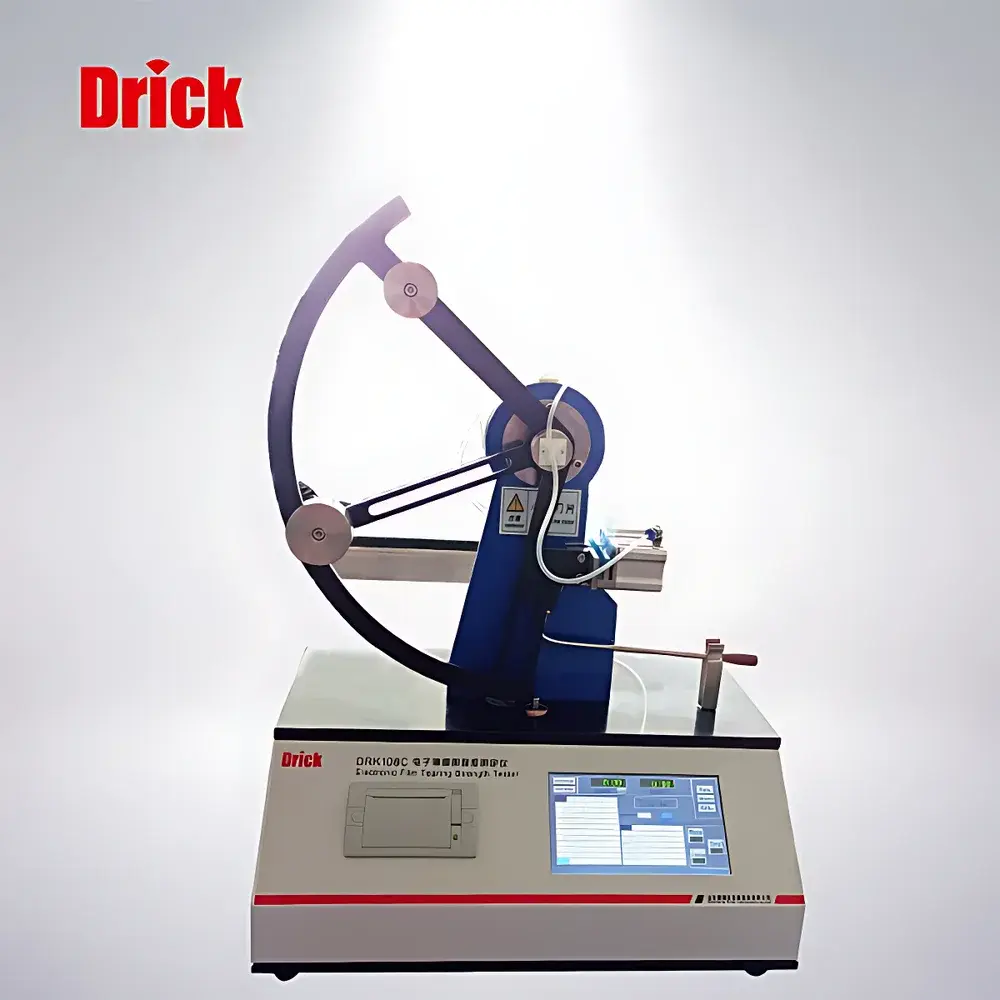
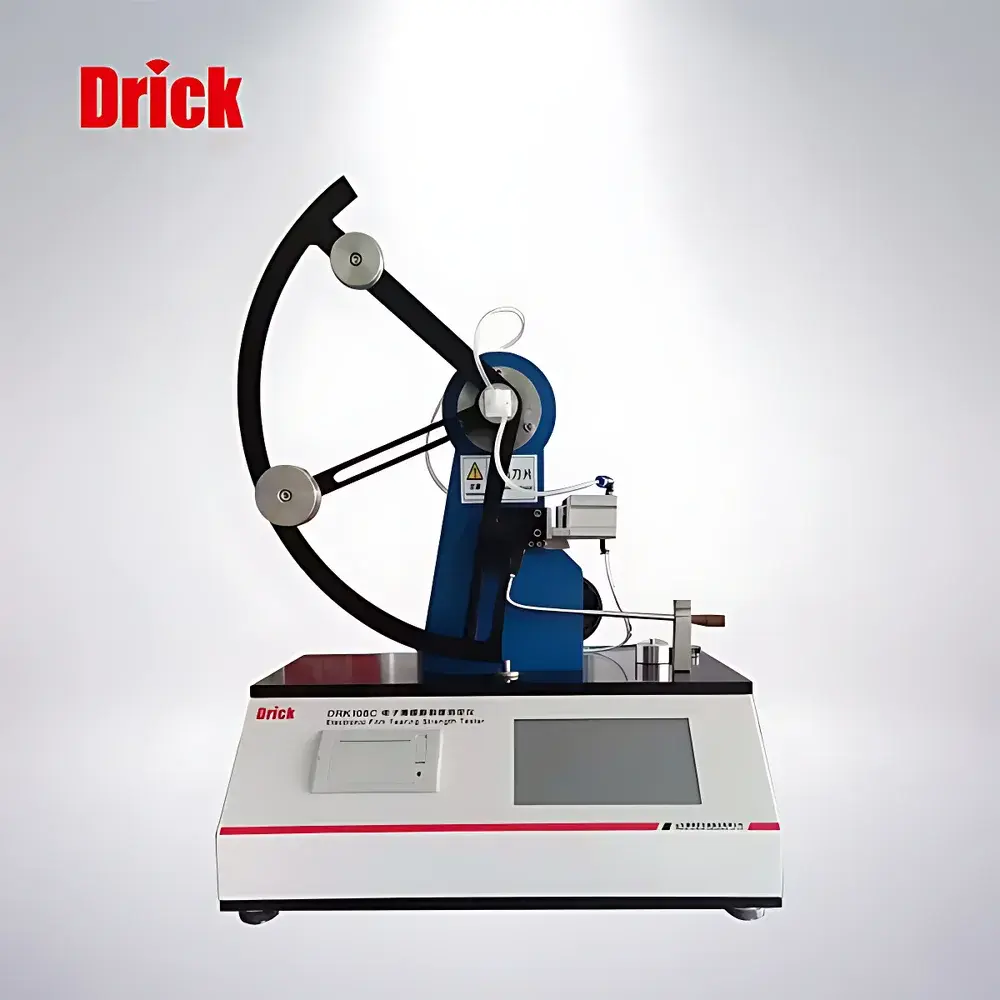
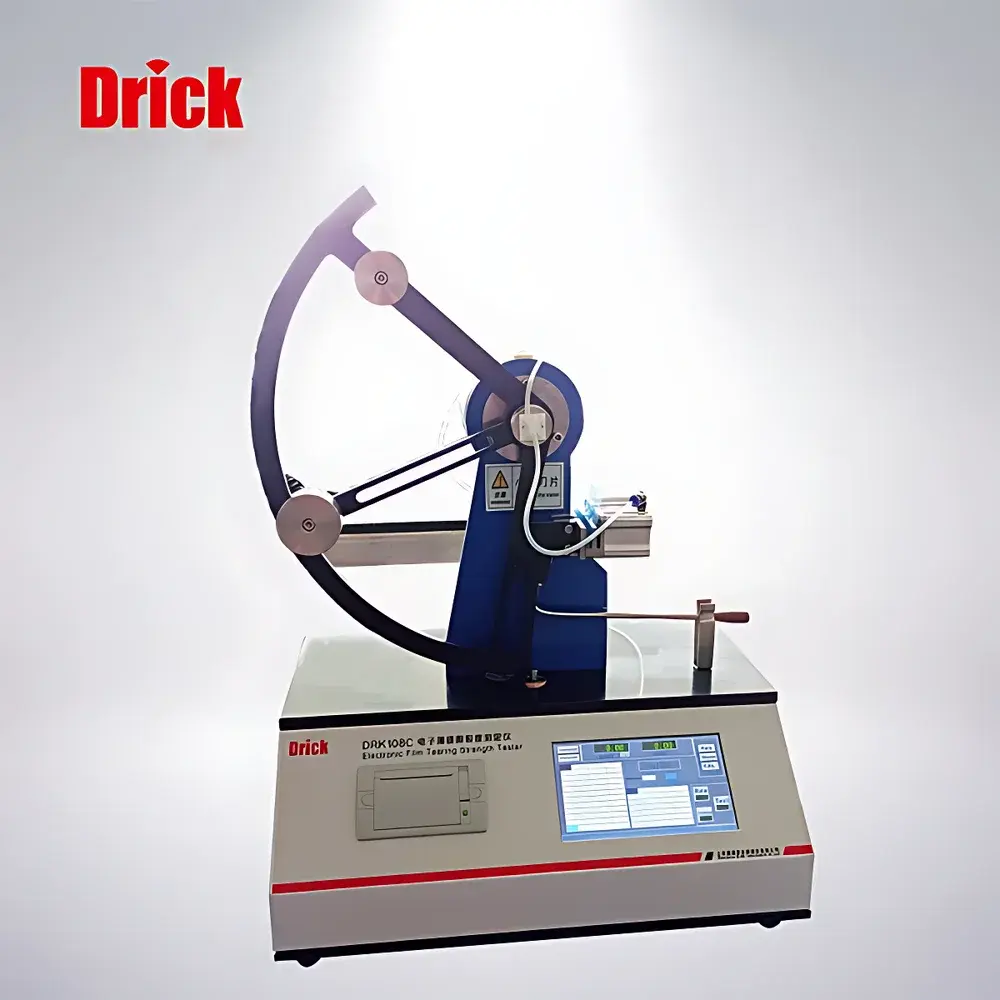
Drick DRK108C Elmendorf-Type Tear Resistance Tester for Films, Nonwovens, Textiles, and Waterproof Membranes
| Brand | Drick |
|---|---|
| Origin | Shandong, China |
| Manufacturer Type | Direct Manufacturer |
| Region of Manufacture | Domestic (China) |
| Model | DRK108C |
| Price | USD 6,050 (approx.) |
Overview
The Drick DRK108C Elmendorf-type Tear Resistance Tester is an electromechanical instrument engineered for precise, repeatable measurement of tear resistance in low-stiffness, flexible sheet materials. It operates on the fundamental principle of the Elmendorf pendulum method (as defined in ISO 6383-2 and GB/T 455), where a pre-notched specimen is torn by the kinetic energy of a calibrated falling pendulum. The instrument quantifies resistance as the energy required to propagate a tear across a defined distance—expressed in millinewton-meters (mN·m) or gram-force centimeters (gf·cm)—enabling direct comparison across material batches and production lots. Designed specifically for quality control laboratories in packaging, nonwoven manufacturing, textile R&D, and construction membrane testing, the DRK108C delivers traceable mechanical performance under controlled ambient conditions, with compliance assurance built into its calibration architecture and data handling workflow.
Key Features
- ARM-based embedded control system with real-time signal processing and deterministic response timing
- 7-inch full-color TFT-LCD touchscreen interface with intuitive icon-driven navigation and tactile feedback
- Integrated friction-angle compensation algorithm to correct for blade–specimen interface friction, reducing systematic bias per ISO 6383-2 Annex B
- High-resolution optical encoder (0.045° angular resolution) for precise pendulum displacement tracking and tear energy calculation
- On-device statistical engine supporting batch-level computation: mean, maximum, minimum, and standard deviation across up to 10 replicate tests per batch (511 batches stored internally)
- User-configurable test parameters including specimen thickness, layer count, and notch length—enabling adaptation to non-standard geometries per internal SOPs or customer-defined protocols
- Built-in theoretical weight calculator for verification of pendulum calibration masses against nominal values (e.g., 200 gf, 400 gf, 800 gf), supporting routine instrument qualification per ISO/IEC 17025 Section 6.5
Sample Compatibility & Compliance
The DRK108C accommodates specimens conforming to standardized dimensions specified in GB/T 455 (paper and board), GB/T 16578.2 (plastic films), and ISO 6383-2 (general elastomeric and fibrous sheets). Validated substrates include biaxially oriented polypropylene (BOPP), polyester (PET), polyethylene (PE), aluminum-plastic laminates, woven and nonwoven polyolefin fabrics, PVC-coated textiles, bituminous waterproofing membranes, and coated paperboard. All mechanical components—including pendulum arm, clamping jaws, and notching die—are manufactured to dimensional tolerances aligned with ISO 6383-2 Clause 5 requirements. The instrument supports audit-ready operation under GLP and GMP environments through timestamped test records, operator ID logging (via optional password-protected login), and immutable batch-level data retention.
Software & Data Management
Internal firmware stores 511 complete test batches, each containing up to 10 individual tear measurements with full metadata: date/time stamp, operator ID (if enabled), specimen ID, layer count, calculated tear resistance value (mN·m), and statistical summary. Data export is supported via USB 2.0 interface to CSV-formatted files compatible with LIMS platforms and statistical analysis software (e.g., Minitab, JMP). No proprietary software installation is required; raw files are human-readable and compliant with FDA 21 CFR Part 11 Annex A expectations for electronic record integrity when paired with organizational procedural controls. Firmware updates are delivered via signed USB image files, preserving cryptographic chain-of-custody for validation documentation.
Applications
- Quality release testing of flexible packaging films (e.g., snack pouches, pharmaceutical blister lidding)
- Process validation of spunbond/meltblown nonwovens used in medical gowns and filtration media
- Comparative tear propagation analysis of roofing membranes subjected to thermal cycling or UV exposure
- Routine QC of paperboard cartons and corrugated liners for e-commerce shipping durability
- Research-grade evaluation of textile reinforcement efficacy in geotextiles and agricultural mulch films
- Regulatory submission support for ASTM D1922 / ISO 6383-2-compliant tear data packages
FAQ
What standards does the DRK108C directly support?
It is configured and validated for GB/T 455, GB/T 16578.2, and ISO 6383-2. Optional firmware modules may extend coverage to ASTM D1922 upon request.
Can the instrument be integrated into a networked laboratory environment?
Yes—USB-host mode enables connection to Windows/Linux PCs for automated data archival; Ethernet or Wi-Fi integration requires external industrial gateway hardware.
Is calibration traceability provided with the instrument?
Each unit ships with a factory calibration certificate referencing national metrology institute–traceable reference masses and angular encoders, valid for 12 months under normal operating conditions.
How is operator error minimized during specimen preparation?
The integrated notching gauge and dual-jaw alignment guide ensure consistent 20 mm notch depth and parallel clamping per ISO 6383-2 Section 6.2; visual alignment aids are embedded in the UI.
Does the system meet requirements for regulated industries such as pharma or medical devices?
When deployed with documented SOPs, access controls, and periodic performance verification, it satisfies baseline data integrity expectations for ISO 13485 and ICH Q5E environments.




