
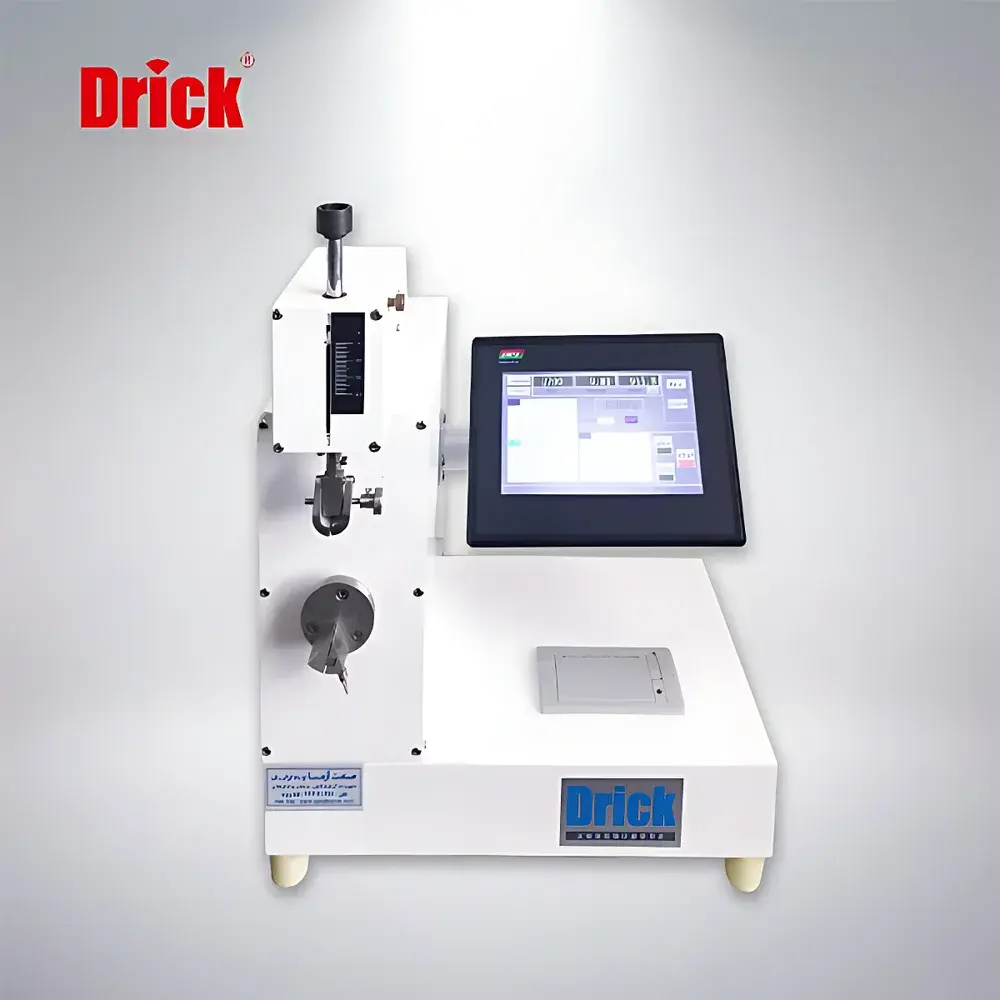
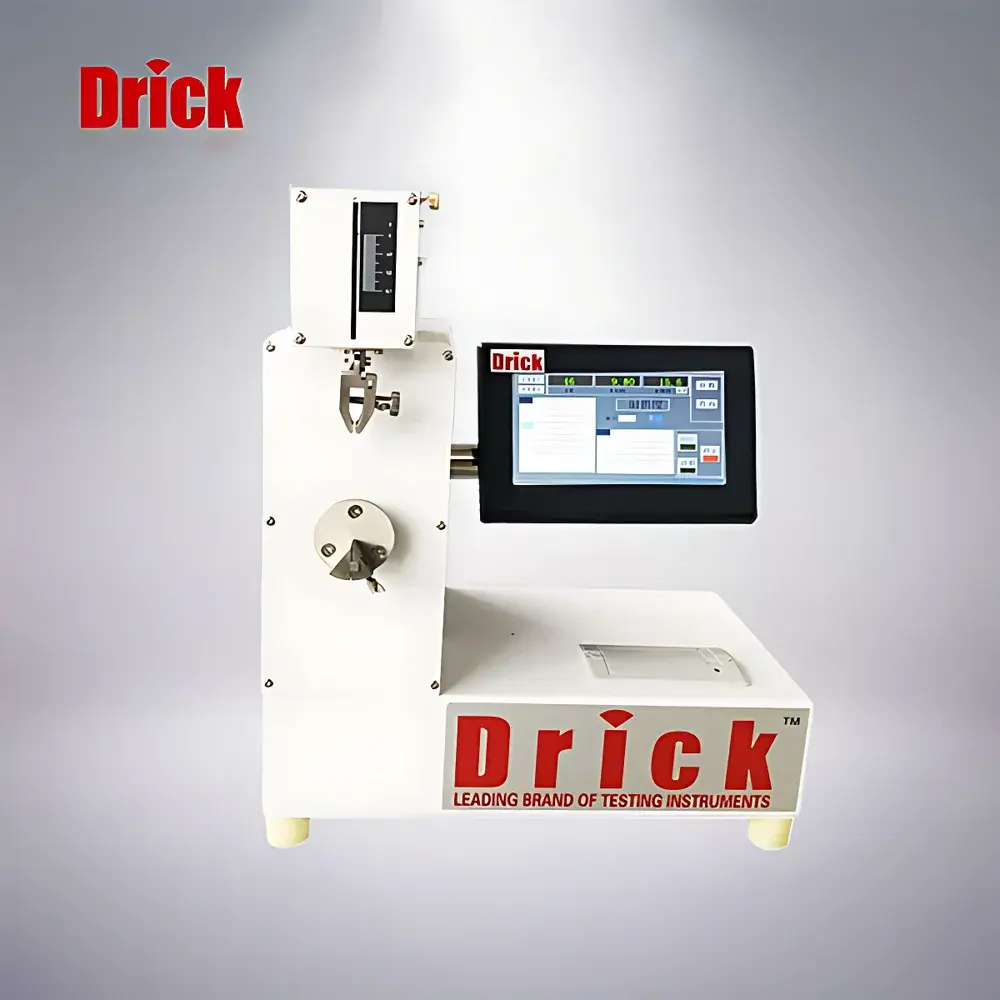
Drick DRK111 Touchscreen MIT Fold Endurance Tester
| Brand | Drick |
|---|---|
| Origin | Shandong, China |
| Manufacturer Type | Manufacturer |
| Country of Origin | China |
| Model | DRK 111 |
| Measurement Range | 1–9999 folds (extendable) |
| Folding Angle | 135° ± 2° |
| Folding Speed | 175 ± 10 folds/min |
| Tension Adjustment Range | 4.9–14.7 N |
| Folding Head Slot Widths | 0.25 mm, 0.50 mm, 0.75 mm, 1.00 mm |
| Folding Head Width | 19 ± 1 mm |
| Folding Mouth Fillet Radius | R0.38 mm ± 0.02 mm |
| Power Supply | AC 220 V ± 10%, 50 Hz |
| Operating Environment | 0–40 °C, RH ≤ 85% |
| Dimensions (L×W×H) | 390 × 305 × 440 mm |
| Net Weight | ≤ 21 kg |
| Compliance | ISO 5626, GB/T 2679.5, GB/T 457, QB/T 1049 |
Overview
The Drick DRK111 Touchscreen MIT Fold Endurance Tester is a precision-engineered instrument designed for the quantitative evaluation of fold endurance in thin sheet materials—primarily paper, paperboard, and other flexible planar substrates up to 1 mm in thickness. It operates on the fundamental principle of the MIT (Massachusetts Institute of Technology) folding method, wherein a standardized specimen is subjected to repeated 135° double-folding under controlled tension and angular displacement until failure occurs. The instrument employs a dual-pulse stepper motor drive system coupled with optical position feedback to ensure repeatable fold initiation, precise angular positioning, and consistent tension application across test cycles. Its microprocessor-based control architecture—integrated with a high-resolution capacitive touchscreen interface—enables real-time monitoring, parameter configuration, and deterministic execution of standardized test protocols per ISO 5626 and GB/T 2679.5. The mechanical design follows a monolithic opto-mechanical integration philosophy: all critical motion components—including folding arms, tension actuators, and specimen clamping assemblies—are rigidly mounted on a thermally stable baseplate to minimize hysteresis and mechanical drift during extended testing sequences.
Key Features
- Capacitive touchscreen HMI with intuitive Chinese/English bilingual graphical menu navigation—no physical buttons or external keyboard required
- Dual-pulse stepper motor control enabling sub-degree angular resolution and zero-backlash folding head positioning
- Automated post-test return-to-zero sequence with optical homing verification for inter-test repeatability
- Adjustable tension range (4.9–14.7 N) via calibrated spring-loaded loading mechanism, traceable to national force standards
- Interchangeable folding head inserts with four standardized slot widths (0.25, 0.50, 0.75, and 1.00 mm) for compliance with material-specific test requirements
- Integrated thermal-stabilized micro-printer for immediate hard-copy output of fold counts, statistical summaries, and timestamped test records
- Onboard data storage for up to 10 complete test sets (each comprising individual fold counts, logarithmic transforms, and arithmetic means), sorted ascending by fold count upon recall
- Real-time display of current fold count, cumulative cycles, tension deviation, and system status indicators
Sample Compatibility & Compliance
The DRK111 is validated for use with specimens meeting the dimensional and conditioning specifications outlined in ISO 5626 and GB/T 2679.5: rectangular strips measuring 15 mm × 100 mm, conditioned at 23 °C ± 1 °C and 50 % RH ± 2 % RH for a minimum of 4 hours prior to testing. It accommodates materials with grammage ranging from 40 g/m² to 400 g/m² and caliper up to 0.98 mm. The instrument’s folding geometry—including the 19 ± 1 mm folding head width, R0.38 mm ± 0.02 mm fillet radius, and ≤0.343 N tension variation due to rotational eccentricity—is rigorously aligned with metrological tolerances defined in QB/T 1049. All mechanical and electrical subsystems conform to IEC 61000-4 electromagnetic compatibility standards and GB/T 2828.1 sampling inspection protocols. Calibration certificates for force transducers and angular encoders are available upon request and support GLP-compliant laboratory documentation workflows.
Software & Data Management
While the DRK111 operates as a standalone embedded system without PC dependency, its firmware implements a deterministic real-time operating environment compliant with IEC 62443-3-3 security principles for industrial control devices. Test data—including raw fold counts, calculated log₁₀ values, group averages, and pass/fail flags based on user-defined thresholds—are stored in non-volatile flash memory with write-cycle protection. Each record contains embedded metadata: operator ID (manually entered), test date/time (RTC-synchronized), ambient temperature/humidity (via onboard sensors), and active configuration parameters (tension setting, slot width, folding angle). Data export is supported via USB-host interface for CSV-formatted reports compatible with LIMS platforms. Audit trails—including parameter changes, calibration events, and system resets—are time-stamped and immutable, satisfying foundational requirements for FDA 21 CFR Part 11–aligned environments where electronic records require attributable, legible, and contemporaneous documentation.
Applications
This tester serves quality assurance laboratories in pulp & paper mills, packaging converters, and regulatory testing centers where quantification of mechanical fatigue resistance is critical to product specification compliance. Typical applications include: comparative evaluation of fiber furnish blends (e.g., hardwood vs. softwood pulps), validation of sizing agent efficacy on folding endurance, assessment of coating adhesion integrity under cyclic flexure, shelf-life prediction of corrugated board crease lines, and incoming inspection of label stock for pharmaceutical cartons. In R&D settings, it supports DOE-based studies correlating refining energy, beating degree, and filler content with fold life distribution profiles. When used in conjunction with environmental chambers, it enables accelerated aging simulations—such as humidity-cycled folding tests—to model long-term performance degradation in tropical or high-humidity distribution channels.
FAQ
What standards does the DRK111 comply with?
ISO 5626, GB/T 2679.5, GB/T 457, and QB/T 1049.
Can the folding speed be adjusted outside the nominal 175 ± 10 folds/min range?
No—the drive firmware enforces strict adherence to the standard-specified speed to ensure inter-laboratory comparability.
Is third-party calibration certification included with shipment?
A factory calibration report is provided; ISO/IEC 17025-accredited calibration services are available as an optional add-on.
How is specimen alignment verified before initiating a test?
The instrument features a machined reference groove on the lower platen and illuminated alignment marks on the upper folding arm—both traceable to NIST-dimensioned master gauges.
Does the DRK111 support automated data transfer to enterprise QA systems?
Yes—via USB mass-storage mode or optional RS-232 serial interface with Modbus RTU protocol implementation.







