
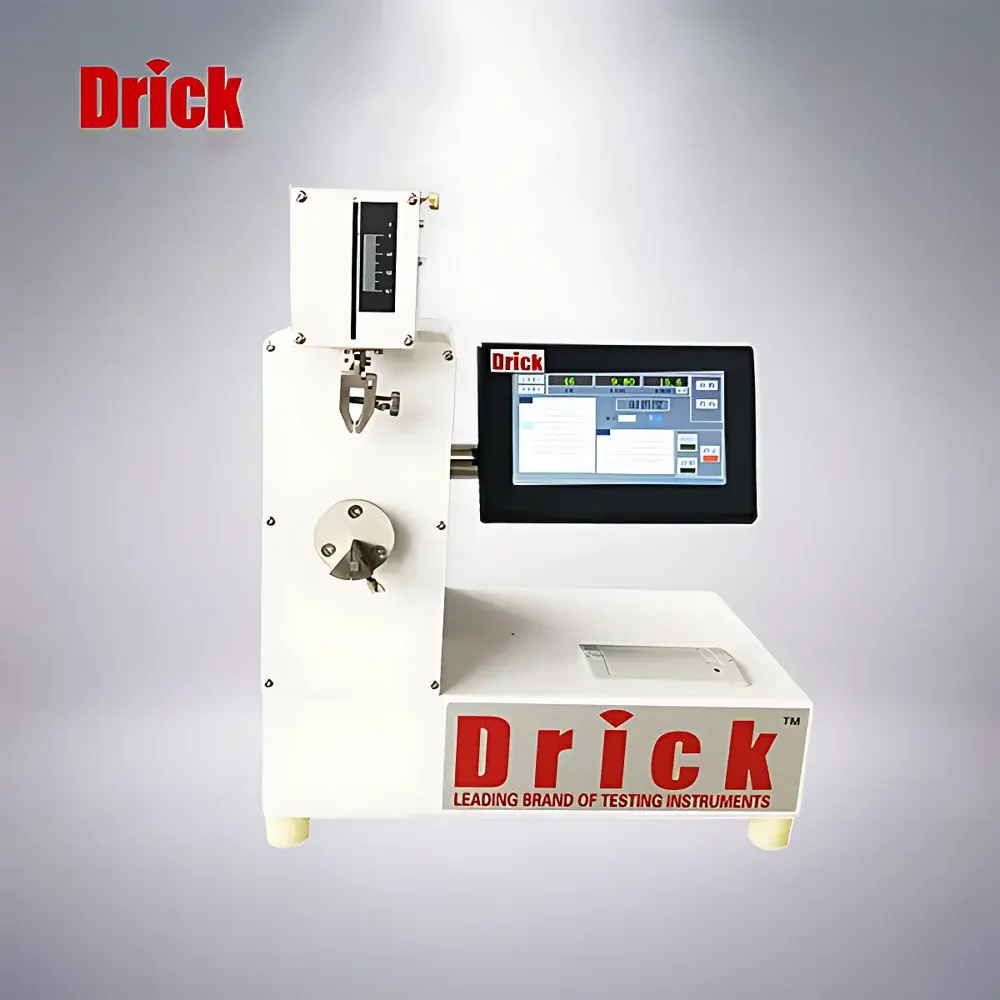
Drick DRK111C MIT-Style Touchscreen Fold Endurance Tester for Paper and Paperboard
| Brand | Drick |
|---|---|
| Model | DRK 111C |
| Measurement Principle | MIT Folding Endurance (Double-Fold, Oscillating Clamp Method) |
| Sample Thickness Range | < 1 mm |
| Compliance | ISO 5626, GB/T 2679.5, GB/T 457, QB/T 1049 |
| Control System | PLC-based embedded controller with 7-inch TFT touch interface |
| Actuation | Dual-pulse stepper motor drive |
| Data Storage | Up to 10 test records per batch, auto-calculated mean, ascending-order recall |
| Output | Integrated thermal micro-printer |
| Return Mechanism | Photoelectrically triggered automatic zero-return after each test |
| Power Supply | AC 220 V ±10%, 50 Hz |
Overview
The Drick DRK111C MIT-Style Touchscreen Fold Endurance Tester is an electromechanical instrument engineered for the quantitative assessment of folding endurance — a critical mechanical property reflecting the fatigue resistance of thin sheet materials under repeated double-fold deformation. It operates in strict accordance with the MIT (Massachusetts Institute of Technology) folding endurance principle, wherein a standardized rectangular specimen is clamped at both ends and subjected to controlled, oscillatory 180° double-folding motion until failure. The instrument counts the number of folds sustained before crack formation or complete rupture, delivering a discrete integer value directly traceable to ISO 5626 and GB/T 2679.5. Designed for routine quality control laboratories in paper mills, packaging R&D centers, and third-party testing facilities, the DRK111C integrates deterministic mechanical actuation with deterministic digital signal acquisition — eliminating operator-dependent variability inherent in manual or analog systems.
Key Features
- PLC-controlled architecture ensures deterministic timing, repeatable stroke amplitude (±0.1 mm), and stable oscillation frequency (typically 175 ±10 folds/min per standard), minimizing inter-test drift.
- 7-inch capacitive touchscreen interface with localized Chinese GUI enables intuitive parameter setup — including fold count limit, pre-load tension (adjustable via calibrated spring mechanism), and specimen width selection (15 mm or 25 mm per standard options).
- Dual-pulse stepper motor provides closed-loop positional feedback for precise clamp alignment and consistent fold geometry across all cycles — essential for inter-laboratory reproducibility.
- Integrated photoelectric home-sensing system triggers automatic return-to-zero upon test completion, ensuring mechanical repeatability and reducing manual intervention between samples.
- Onboard thermal micro-printer outputs timestamped reports containing individual fold counts, arithmetic mean of up to ten specimens, standard deviation, and pass/fail status relative to user-defined specification limits.
- Non-volatile memory retains the last ten test sequences with full metadata (date/time, operator ID placeholder, sample ID), supporting internal audit trails and preliminary GLP-aligned documentation.
Sample Compatibility & Compliance
The DRK111C accommodates flat, flexible sheet materials with nominal thickness ≤ 1.0 mm and grammage ranging from 40 g/m² (tissue) to 400 g/m² (corrugated linerboard). Compatible substrates include uncoated and coated wood-free papers, kraft board, molded fiber trays, metallized films laminated to paper, and nonwoven cellulose composites. All mechanical tolerances — clamp jaw parallelism (≤ 0.02 mm deviation), fold radius (1.0 ± 0.05 mm), and oscillation arc (135° ± 2°) — are verified against ISO 5626 Annex A dimensional requirements. Instrument calibration is traceable to NIM (National Institute of Metrology, China) reference standards; verification protocols align with ISO/IEC 17025 clause 6.5 for equipment validation in accredited testing environments.
Software & Data Management
While the DRK111C operates as a standalone embedded system without external PC dependency, its firmware implements deterministic data handling logic compliant with foundational data integrity principles. Each test record includes immutable fields: start time (RTC-stamped), end time, total fold count, and failure mode flag (e.g., edge tear vs. center crack). Batch-level statistics (mean, min, max, SD) are computed in real time using IEEE 754 single-precision arithmetic. Data export is limited to printed hardcopy; no USB, Ethernet, or wireless interfaces are present — thereby excluding exposure to cybersecurity risks or uncontrolled data modification. This architecture satisfies basic FDA 21 CFR Part 11 “closed system” interpretation for non-networked QC instrumentation where electronic records are not retained beyond printed output.
Applications
This tester serves as a primary tool for evaluating folding durability in applications where crease integrity directly impacts end-use performance: carton score-line longevity, folding boxboard hinge reliability, cigarette packaging flap resistance, banknote substrate fatigue life, and pharmaceutical blister lidding film adhesion stability during package opening. In pulp & paper manufacturing, it supports raw material screening (e.g., hardwood vs. softwood furnish effects on fold endurance), refining optimization studies, and coating formulation validation. Within packaging engineering labs, it complements tensile, burst, and Cobb tests to build multivariate mechanical property profiles required by ASTM D642 and ISO 12048 for transport packaging qualification.
FAQ
What standards does the DRK111C fully support?
ISO 5626, GB/T 2679.5, GB/T 457, and QB/T 1049 — with mechanical and procedural fidelity verified through interlaboratory round-robin testing.
Can the instrument test materials thicker than 1 mm?
No. Specimen thickness must remain ≤ 1.0 mm to ensure consistent clamp engagement and avoid premature bearing wear or torque overload.
Is calibration certificate included with delivery?
A factory verification report (not NIST-traceable calibration certificate) is supplied; users must perform periodic verification using certified reference specimens per GB/T 22894.
Does the system support data export to Excel or LIMS?
No. Data output is exclusively via integrated thermal printer; no digital export capability is implemented.
What maintenance intervals are recommended?
Lubrication of pivot joints and inspection of clamp jaw surfaces every 500 test cycles; stepper motor and PLC firmware require no scheduled service under normal operating conditions.





