
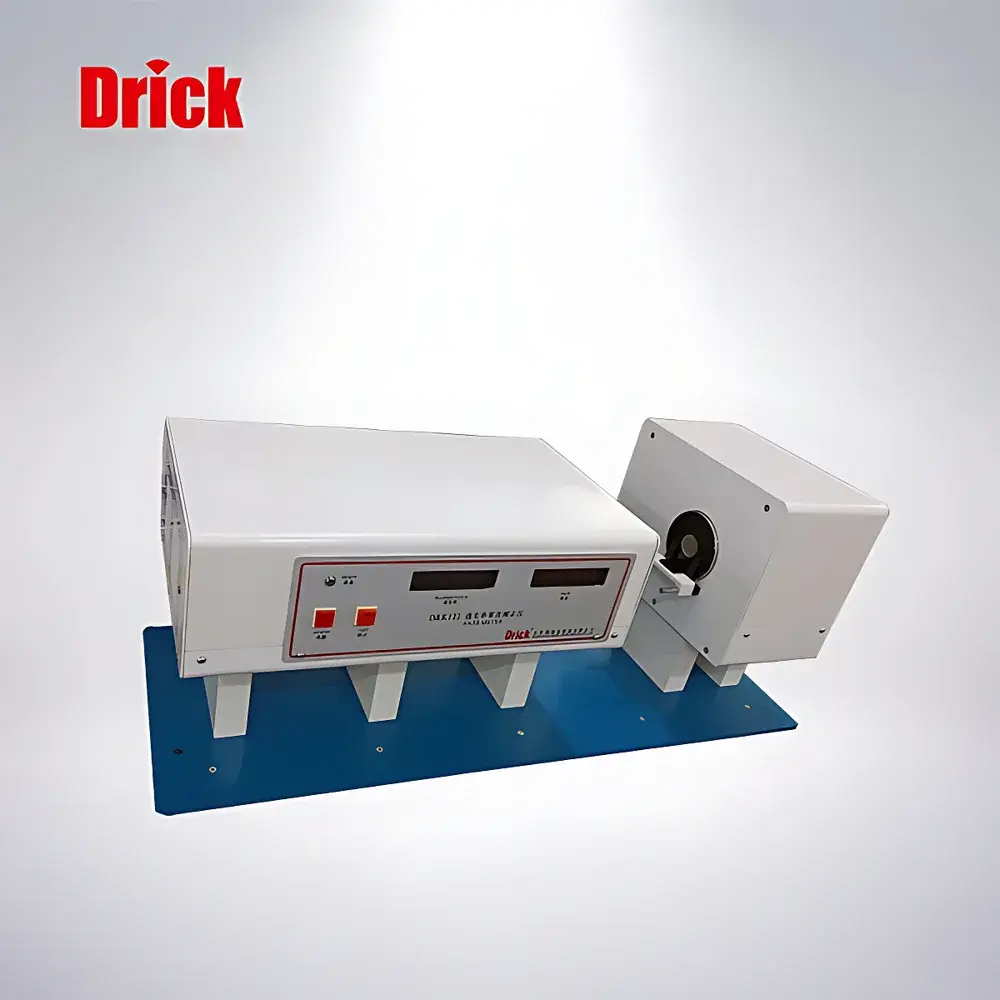
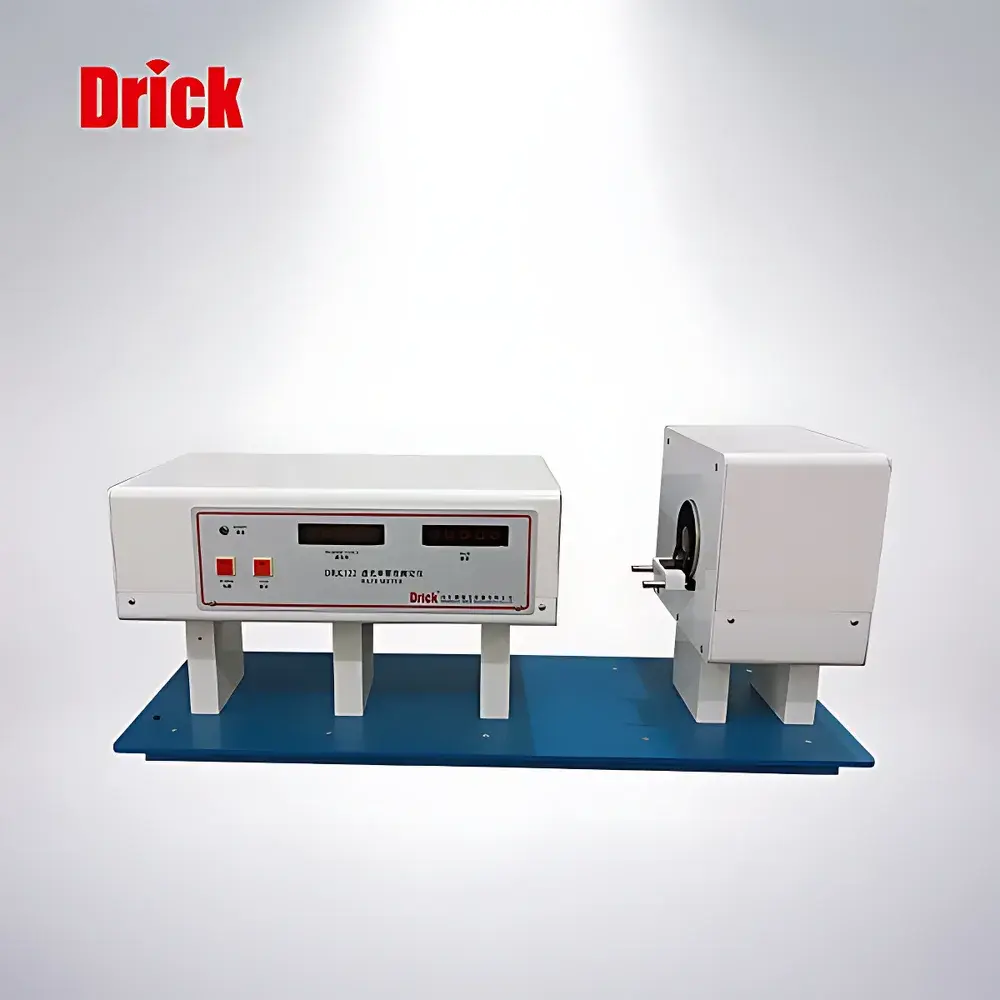
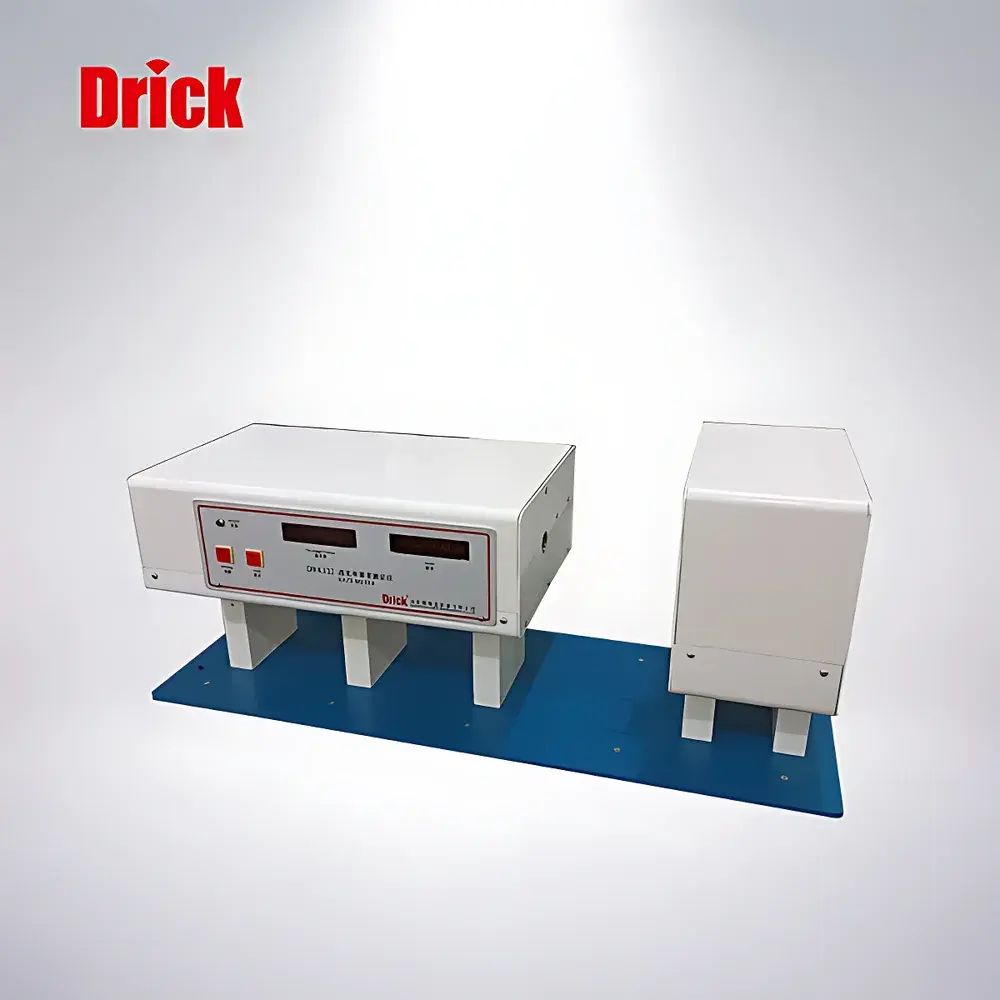
Drick DRK122B Luminous Transmittance and Haze Meter (C-Illuminant, Manual Operation)
| Brand | Drick |
|---|---|
| Origin | Shandong, China |
| Manufacturer Type | Direct Manufacturer |
| Country of Origin | China |
| Model | DRK122B |
| Product Type | Manual Operation |
| Transmittance Range | 0–100.0% |
| Haze Range | 0–30.00% |
| Transmittance Repeatability | ±0.1% |
| Haze Repeatability | ±0.01% |
| Sample Port Diameter | Input Φ25 mm / Output Φ21 mm |
| Light Source | C-illuminant (12 V DC, 50 W halogen lamp + color temperature correction filter) |
| Detector | Silicon photodiode with photopic luminosity function correction (compliant with CIE V(λ) spectral luminous efficiency function) |
| Measurement Accuracy | Transmittance ±0.1%, Haze ±0.01% |
| Sample Dimensions | 50 mm × 50 mm (solid), Liquid Cell: 50 × 50 × 10 mm |
| Instrument Dimensions | 740 × 270 × 300 mm |
| Net Weight | 21 kg |
| Power Supply | 220 V, 50 Hz |
| Operating Environment | 10–50 °C |
Overview
The Drick DRK122B Luminous Transmittance and Haze Meter is a manually operated optical measurement instrument engineered for precise quantification of luminous transmittance and haze in transparent and translucent planar materials. It operates on the principle of collimated parallel illumination combined with hemispherical diffuse collection via an integrating sphere geometry—fully compliant with ASTM D1003-61 (1997), GB/T 2410–2008, and JIS K 7105–1981. The system employs a standardized C-illuminant source (12 V DC, 50 W halogen lamp with chromaticity correction filter) to replicate daylight spectral power distribution (correlated color temperature ≈ 6774 K), ensuring metrological consistency across international laboratories. Photometric detection utilizes a silicon photodiode calibrated against the CIE photopic luminosity function V(λ), enabling traceable, spectrally weighted measurements of luminous transmittance (Tv) and total haze (Ht). Designed for routine QC environments where automation is not required but repeatability and regulatory alignment are critical, the DRK122B delivers high reproducibility without zero-point drift and functions reliably under ambient lighting—eliminating the need for darkroom installation.
Key Features
- Manual operation with fully microprocessor-controlled data acquisition and averaging algorithms—no analog dials or mechanical adjustments required
- Open-style sample port accommodates flat specimens up to 50 mm × 50 mm; optional magnetic film holder and liquid cell (50 × 50 × 10 mm) enable rapid switching between solid and liquid measurements
- Integrated C-illuminant source with stable thermal regulation and spectral fidelity verified per ISO/CIE standards
- Dual-display output: transmittance resolved to 0.1% and haze to 0.01%, with automatic calculation of mean values from up to 10 sequential readings
- Standard RS-232 interface supports direct connection to external printers or laboratory data loggers; includes built-in print-ready output port conforming to IEEE 1284 legacy protocols
- Self-diagnostic capability validated using supplied certified haze reference standard (certified traceability to NIM or equivalent national metrology institute)
- Robust mechanical architecture with vibration-damped base and EMI-shielded electronics—designed for continuous operation in industrial QA labs
Sample Compatibility & Compliance
The DRK122B accepts rigid flat samples (e.g., optical glass, PMMA sheets, automotive glazing), flexible films (PET, BOPP, PVC), and homogeneous liquids (aqueous solutions, pharmaceuticals, edible oils). Its geometry supports both transmission-mode haze (ASTM D1003 §7.2) and luminous transmittance (§6.1) determinations per ISO 13468-1 and ISO 14782. All measurements comply with GLP documentation requirements: each test record includes timestamp, operator ID (manually entered), sample ID, ambient temperature/humidity (user logged), and instrument serial number. While not FDA 21 CFR Part 11–validated out-of-the-box, the system’s deterministic firmware architecture and non-volatile result storage support audit-trail reconstruction during GMP inspections. Calibration verification follows NIST-traceable procedures using primary standards issued by CNAS-accredited calibration labs.
Software & Data Management
The DRK122B operates without proprietary PC software—measurement logic resides entirely in embedded firmware (ARM Cortex-M4 core, 1 MB flash). All processing—including V(λ)-weighted integration, haze ratio computation (H = Td/Tt × 100%), and statistical averaging—is performed onboard. Raw analog-to-digital conversion uses a 16-bit sigma-delta ADC with programmable gain, ensuring linearity over full dynamic range. Data export occurs via ASCII-formatted serial stream (9600 baud, 8N1), compatible with Excel, LabVIEW, or LIMS platforms. No cloud connectivity or remote access functionality is implemented—consistent with ISO/IEC 27001-aligned secure lab infrastructure policies. Firmware updates are performed via UART bootloader using manufacturer-supplied utility (Windows/Linux CLI).
Applications
This instrument serves as a primary metrology tool in quality control workflows for optical polymer manufacturing, packaging R&D, and medical device material validation. Typical use cases include: haze evaluation of anti-fog PET films per ASTM F1718; transmittance verification of ophthalmic lens substrates; turbidity screening of injectable drug solutions per USP ; clarity assessment of food-grade plastic containers; optical homogeneity testing of solar panel encapsulants; and performance monitoring of anti-reflective coatings on display cover glass. In academic settings, it supports teaching labs in optical physics and polymer science—particularly for correlating haze with crystallinity (via XRD), surface roughness (AFM), or phase separation morphology (TEM). Its C-illuminant configuration makes it especially suitable for applications where visual perception metrics (e.g., display readability, cockpit visibility) must align with human photopic response.
FAQ
Does the DRK122B meet ASTM D1003–2022 requirements?
Yes—the optical geometry, illuminant spectral profile, and detector spectral responsivity fully satisfy the current revision’s definitions for Method A (integrating sphere) measurements.
Can it measure samples thicker than 5 mm?
Yes—provided the specimen remains optically homogeneous and fits within the 50 × 50 mm aperture; thickness does not affect measurement validity unless internal scattering exceeds detector dynamic range.
Is calibration traceable to national standards?
Each unit ships with a factory-calibrated haze reference tile (certified value ±0.02% Haze, uncertainty budget documented); users may obtain NIST-traceable recalibration through Drick’s ISO/IEC 17025 accredited service center.
What maintenance is required?
Annual verification of lamp spectral output and detector responsivity is recommended; cleaning of integrating sphere interior with isopropyl alcohol and lint-free swabs every 6 months ensures long-term photometric stability.
Is there a version with automatic sample loading?
No—DRK122B is strictly manual-operation design; Drick offers the DRK122C model for automated throughput applications, featuring motorized stage and barcode sample identification.





