
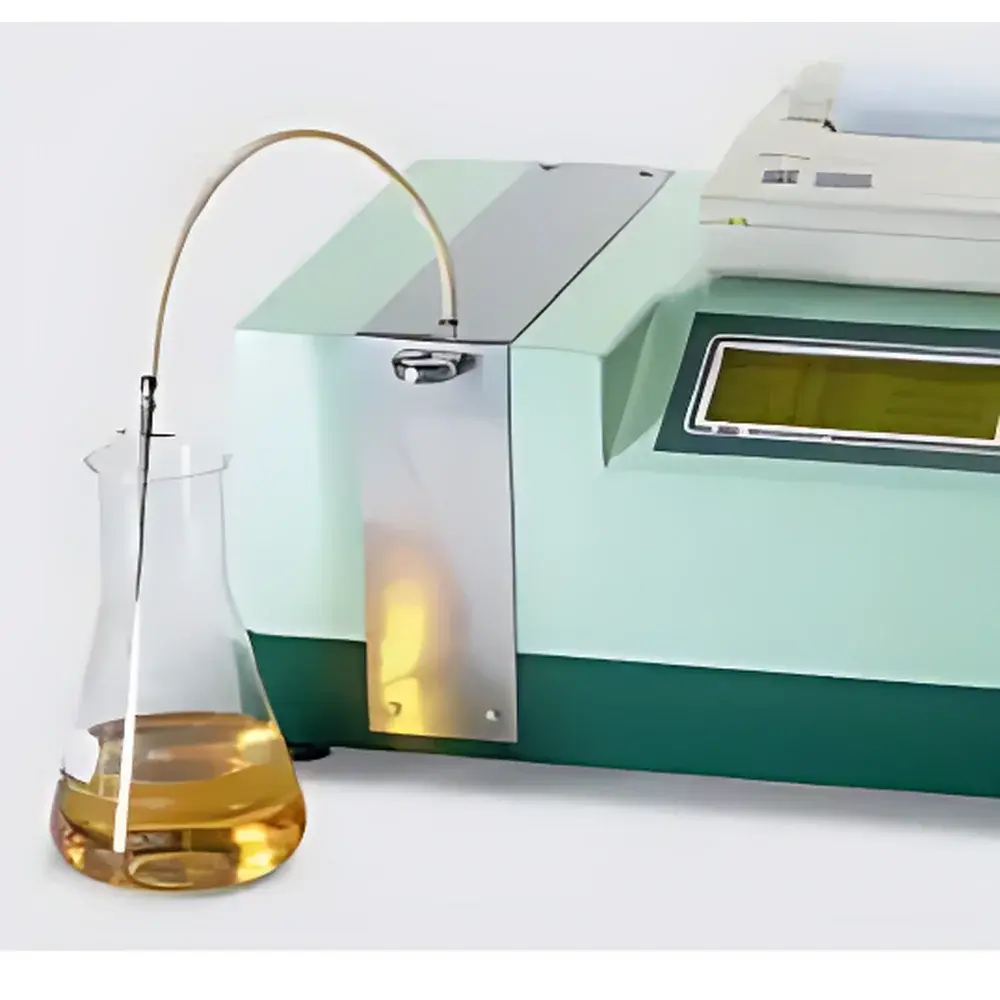
Funke Gerber FermentoFlash Beer Composition Analyzer
| Brand | Funke Gerber |
|---|---|
| Origin | Germany |
| Model | FermentoFlash |
| Instrument Type | Beer-Specific Analyzer |
| Alcohol Range | 0.00–15.00% (w/w or v/v, configurable), Repeatability: ±0.02% |
| Extract Range | 0.00–10.00% (w/w), Repeatability: ±0.04% |
| Apparent Extract Range | 0.00–10.00% (w/w), Repeatability: ±0.04% |
| Original Wort Gravity (Plato) | 0.00–20.00°P, Repeatability: ±0.02°P |
| Sample Volume | ~10 mL |
| Analysis Time | 60–120 s per sample |
| Calibration | Up to 20 reference beer profiles stored internally |
Overview
The Funke Gerber FermentoFlash Beer Composition Analyzer is a dedicated, benchtop analytical instrument engineered for rapid, standardized determination of key compositional parameters in beer and wort. It operates on the principle of thermodynamic differential analysis—leveraging precise, controlled heating cycles combined with real-time thermal response profiling to infer concentration-dependent physical behavior of major solutes. Unlike conventional enzymatic, densimetric, or distillation-based methods, the FermentoFlash utilizes a proprietary thermal signature algorithm calibrated against internationally recognized reference materials. This approach eliminates the need for reagents, consumable columns, or operator-dependent titration steps, delivering traceable, operator-independent results aligned with established brewing metrology frameworks including ISO 17285 (beer analysis), EBC Analytica Chapter 9 (alcohol and extract), and ASBC Methods of Analysis Section 5 (alcohol) and Section 7 (extract). Designed for routine QC laboratories in breweries, contract labs, and raw material suppliers, the FermentoFlash supports compliance-driven workflows where auditability, repeatability, and method equivalence are critical.
Key Features
- Single-step, fully automated analysis cycle requiring only ~10 mL of unfiltered, degassed beer or wort
- Thermally based measurement principle—no chemical reagents, enzymes, or hazardous solvents required
- Internal storage for up to 20 user-defined reference beer profiles (e.g., Pilsner, Weizen, Stout, Bock), enabling matrix-matched calibration across diverse beer styles
- Simultaneous quantification of alcohol content (% v/v or % w/w, user-selectable), original wort gravity (°P), true extract, apparent extract, and alcohol-free extract—all derived from one thermal scan
- Integrated thermal printer for immediate hard-copy reporting with timestamp, sample ID, calibration status, and operator code
- Rugged industrial-grade housing compliant with IP20 environmental rating; designed for continuous operation in production lab environments
- Self-diagnostic routines including temperature sensor validation, pump flow verification, and thermal ramp integrity checks
Sample Compatibility & Compliance
The FermentoFlash accepts standard beer matrices—including lagers, ales, sour beers, non-alcoholic brews, and high-gravity worts—without pre-dilution or filtration. Carbonation must be removed prior to analysis via gentle agitation or vacuum degassing to avoid bubble-induced thermal artifacts. The instrument meets essential regulatory and quality system requirements: data output conforms to GLP-compliant record-keeping standards; calibration history, measurement logs, and system checks are retained onboard for ≥3 months; firmware supports optional audit trail activation for FDA 21 CFR Part 11–aligned environments when paired with external LIMS integration. All performance specifications align with AOAC Official Method 992.10 (alcohol in beer) and EBC Method 9.2 (original extract), and traceability is maintained to NIST-traceable alcohol and sucrose reference standards.
Software & Data Management
The FermentoFlash operates via an embedded real-time OS with intuitive touchscreen interface. No PC dependency is required for routine operation; however, optional USB export enables CSV-formatted reports containing full thermal curve metadata, raw signal traces, and uncertainty estimates. Calibration profiles are managed through password-protected administrator mode, with version-stamped backup/restore capability. For enterprise deployment, the instrument supports RS-232 and Ethernet (TCP/IP) communication protocols compatible with common laboratory informatics systems. Audit trail functionality—when enabled—records user login/logout events, parameter changes, calibration actions, and result modifications with ISO 8601 timestamps and operator identifiers, satisfying GMP documentation requirements for brewing QA/QC departments.
Applications
- Routine batch release testing of finished beer for alcohol content and original wort concentration
- In-process monitoring during fermentation and maturation to track attenuation and extract depletion
- Raw material qualification of malt extracts, adjunct syrups, and wort concentrates
- Contract laboratory service delivery for third-party certification (e.g., organic, low-alcohol, or gluten-reduced claims)
- Method validation studies comparing thermal analysis against reference GC or hydrometric techniques
- Training and education in brewing science programs requiring rapid, hands-on compositional analysis
FAQ
What reference standards are required for initial calibration?
A minimum of one certified reference beer (e.g., NIST SRM 1849a or equivalent EBC-certified reference material) is required. Additional reference beers may be added to expand matrix coverage.
Can the FermentoFlash analyze non-alcoholic or dealcoholized beer?
Yes—provided carbonation is fully removed and samples fall within the specified extract and alcohol ranges; low-alcohol (<0.5% ABV) and alcohol-free formulations are supported.
Is periodic recalibration necessary?
Daily verification using a stored reference profile is recommended; full recalibration is required after firmware updates, sensor replacement, or if drift exceeds ±0.03% ABV over consecutive control checks.
Does the instrument comply with ISO/IEC 17025 requirements for accredited testing labs?
The FermentoFlash provides documented measurement uncertainty, traceable calibration, and full data retention—key inputs for method validation under ISO/IEC 17025:2017 Clause 7.7; final accreditation depends on lab-specific validation protocol execution.
How is maintenance performed?
Preventive maintenance includes quarterly thermal sensor verification, biannual pump tubing replacement, and annual full-system performance verification using certified reference materials—procedures detailed in the included service manual.



