
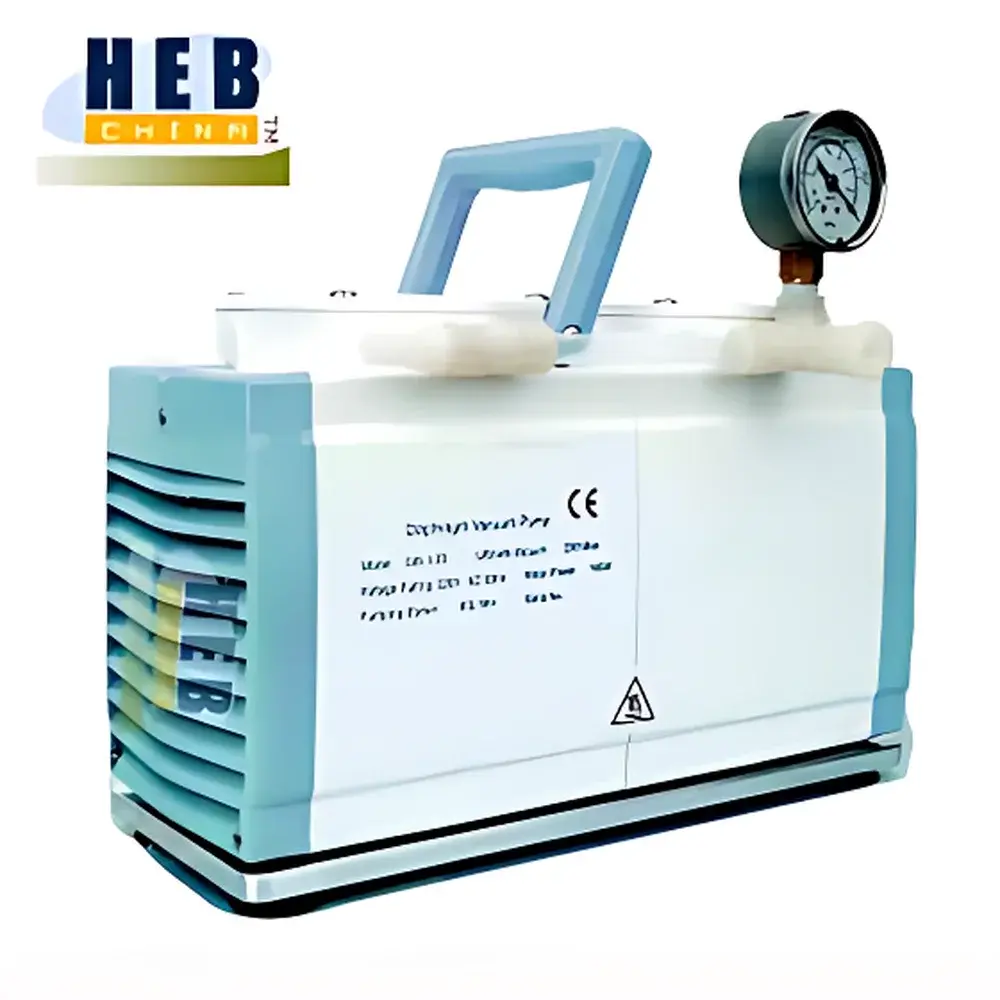
Jihepu GM-0.33A Diaphragm Vacuum Pump
| Brand | Jihepu |
|---|---|
| Origin | Shandong, China |
| Manufacturer Type | Authorized Distributor |
| Country of Origin | China |
| Model | GM-0.33A |
| Instrument Type | Diaphragm Vacuum Pump |
| Product Type | Oil-Free Vacuum Pump |
| Pumping Speed | 20 L/min |
| Ultimate Vacuum Pressure | ≤ −0.08 MPa (≤ 200 mbar) |
| External Dimensions | 235 × 120 × 215 mm |
| Net Weight | 7.5 kg |
| Motor Power | 160 W |
| Maximum Operating Temperature | < 60 °C |
| Ambient Operating Temperature Range | 7–40 °C |
| Inlet Port Diameter | Ø6 mm |
| Sound Pressure Level | < 55 dB(A) |
| Pump Housing Material | Aluminum Alloy with Corrosion-Resistant Coating |
| Vacuum Type | Negative Pressure (Suction Only) |
Overview
The Jihepu GM-0.33A Diaphragm Vacuum Pump is an oil-free, corrosion-resistant laboratory vacuum source engineered for precision and reliability in analytical instrumentation support. Based on positive displacement via elastomeric diaphragm oscillation, it generates stable negative pressure without lubricating oil—eliminating risk of hydrocarbon contamination, oil backstreaming, or maintenance-intensive oil changes. Its design meets the stringent vacuum stability requirements of gas chromatography (GC), high-performance liquid chromatography (HPLC) degassing, solid-phase extraction (SPE), vacuum filtration, and sample concentration workflows. Unlike rotary vane pumps, the GM-0.33A operates with zero oil vapor emission, making it suitable for cleanroom-adjacent environments and applications where sample integrity and instrument longevity are critical. The pump’s aluminum alloy housing—die-cast and finished with electrophoretic coating—ensures dimensional stability, thermal dissipation, and resistance to organic solvents and mild acids commonly encountered in pharmaceutical, forensic, and food safety laboratories.
Key Features
- Oil-free operation ensures contaminant-free vacuum for sensitive analytical systems including GC inlets, mass spectrometer interfaces, and autosampler purge lines.
- Robust diaphragm mechanism with reinforced EPDM/NBR composite membranes delivers >10,000 hours of service life under continuous duty at rated load.
- Integrated thermal protection circuit automatically deactivates the motor if internal temperature exceeds 60 °C, preventing coil degradation and ensuring long-term repeatability.
- Low-noise architecture (<55 dB[A] at 1 m) enables placement inside analytical labs without acoustic isolation enclosures.
- Compact footprint (235 × 120 × 215 mm) and lightweight design (7.5 kg) facilitate benchtop integration, mobile cart mounting, or shared-use facility deployment.
- Standard Ø6 mm inlet port compatible with ISO-KF 10, Swagelok® 1/4″ compression fittings, and common PTFE/viton tubing—no adapter required for most lab vacuum manifolds.
Sample Compatibility & Compliance
The GM-0.33A is validated for use with aqueous, polar organic, and moderately aggressive vapors typical in QC/QA labs—including methanol, acetonitrile, ethyl acetate, and dilute HCl or NaOH solutions. Its chemically inert wetted path (diaphragm, valves, and chamber surfaces) complies with ISO 8573-1:2010 Class 0 for oil-free air/vacuum purity. While not certified to UL/CSA or CE for medical device integration, the unit conforms to IEC 61000-6-3 (EMC emissions) and IEC 61000-6-2 (immunity). It supports GLP-compliant workflows when paired with audit-trail-capable controllers; however, standalone operation does not include 21 CFR Part 11 electronic signature functionality.
Software & Data Management
The GM-0.33A operates as a standalone analog device with no embedded firmware, touchscreen interface, or digital communication ports (e.g., RS-232, USB, or Ethernet). Vacuum output is manually regulated via upstream needle valve or system-level pressure transducer feedback loops. For automated integration, users may pair the pump with third-party PID controllers or PLC-based vacuum management systems using its 0–10 V analog control input (optional accessory). All operational parameters—including runtime, duty cycle, and ambient temperature—are logged externally via connected data acquisition hardware per ISO/IEC 17025 calibration traceability requirements.
Applications
- Gas chromatography carrier gas supply and detector vacuum support (e.g., ECD, NPD).
- HPLC mobile phase degassing and solvent reservoir evacuation prior to gradient elution.
- Vacuum-assisted filtration in microbiological testing and particulate analysis (e.g., ASTM D2986, ISO 16000-6).
- Concentration of volatile analytes in forensic toxicology (e.g., blood alcohol headspace prep) and environmental water testing (EPA Method 502.2).
- Evaporative light scattering detection (ELSD) and preparative chromatography solvent recovery systems.
- Lyophilizer primary condenser support in pilot-scale biopharmaceutical process development.
FAQ
Is the GM-0.33A suitable for vacuum oven applications?
Yes, provided the oven’s maximum operating temperature remains below 40 °C ambient and the total system volume does not exceed 15 L—achieving stable vacuum levels within 5–8 minutes.
Can this pump handle corrosive gases such as HCl or Cl₂?
No. While the diaphragm and housing resist mild acid mists, continuous exposure to halogenated or oxidizing gases will degrade elastomer integrity and void warranty.
Does the pump include a built-in vacuum gauge?
No. A separate analog or digital vacuum gauge (e.g., Pirani or capacitance manometer) must be installed downstream for accurate pressure monitoring.
What is the recommended maintenance interval?
Diaphragm and valve replacement is advised every 6,000 operating hours or annually—whichever occurs first—under standard lab conditions (25 °C, 40% RH, non-condensing vapors).
Is the motor thermally protected?
Yes. An embedded bimetallic thermal cutout interrupts power at ≥65 °C winding temperature and auto-resets upon cooling to <45 °C.



