
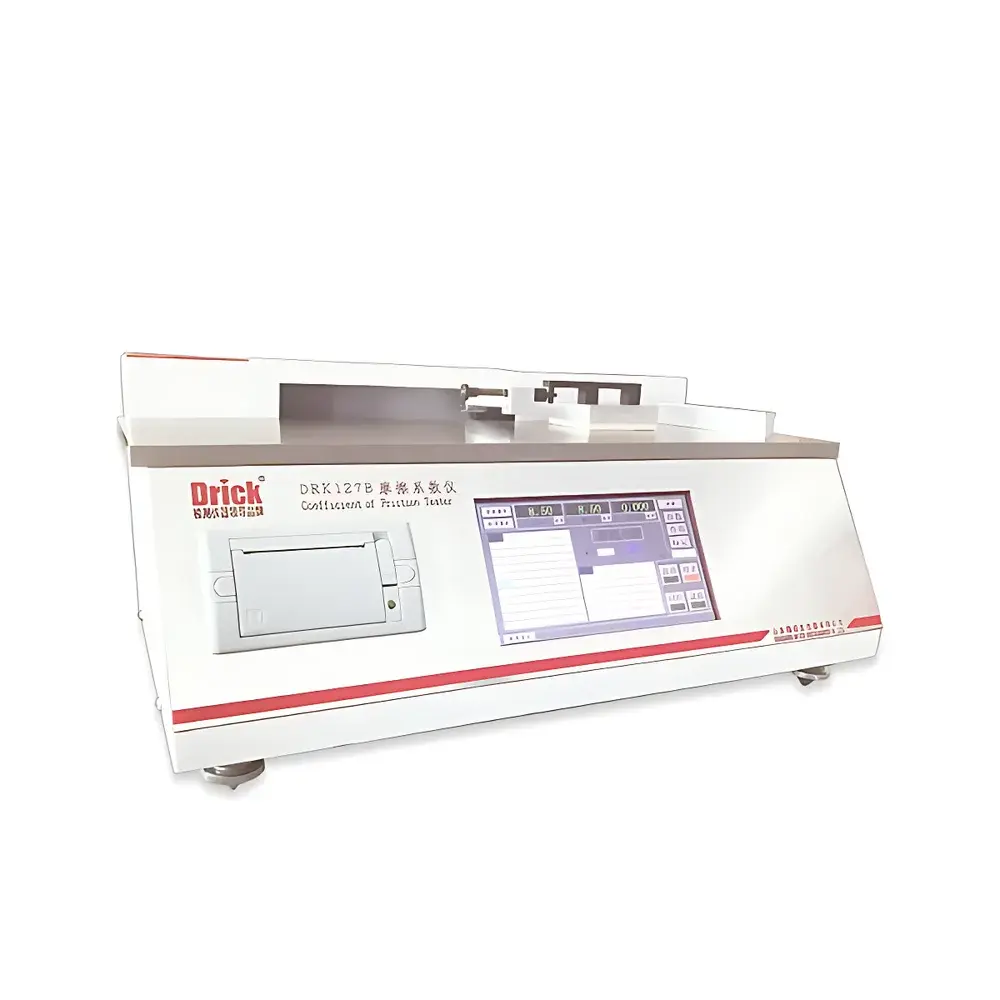
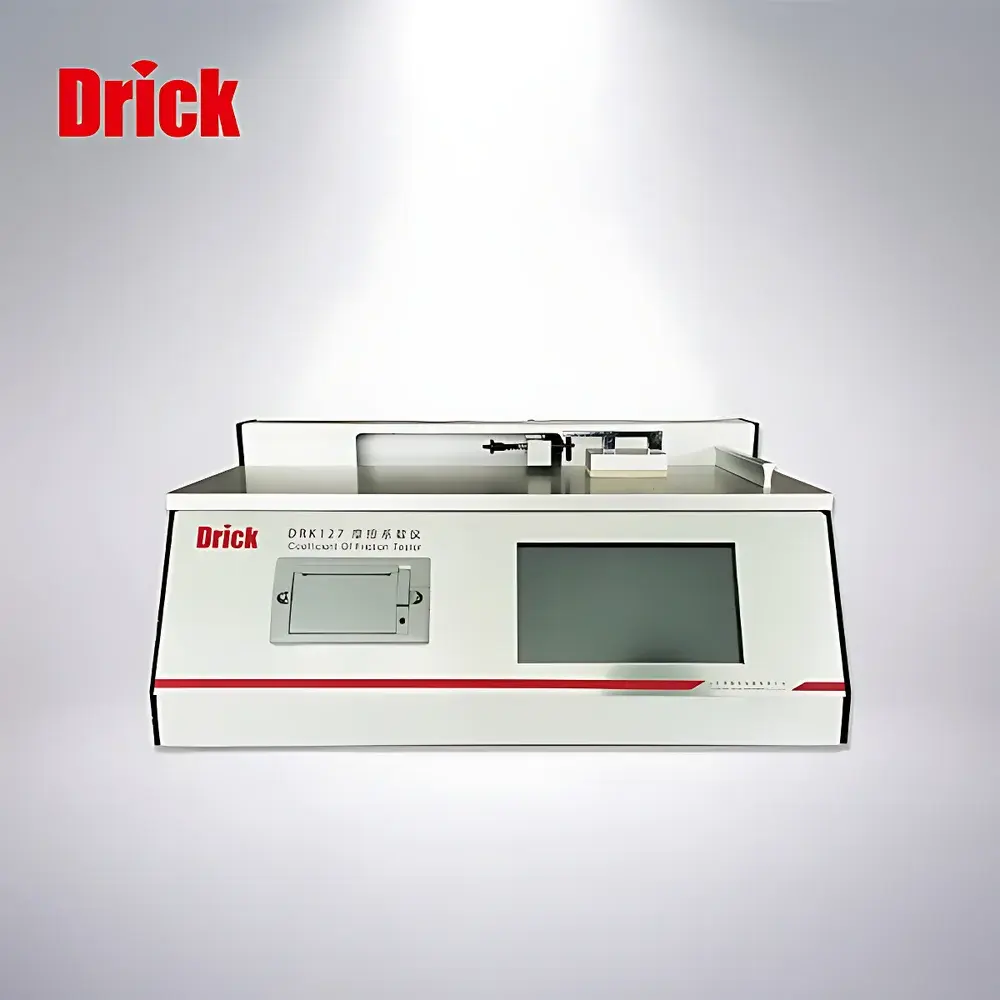
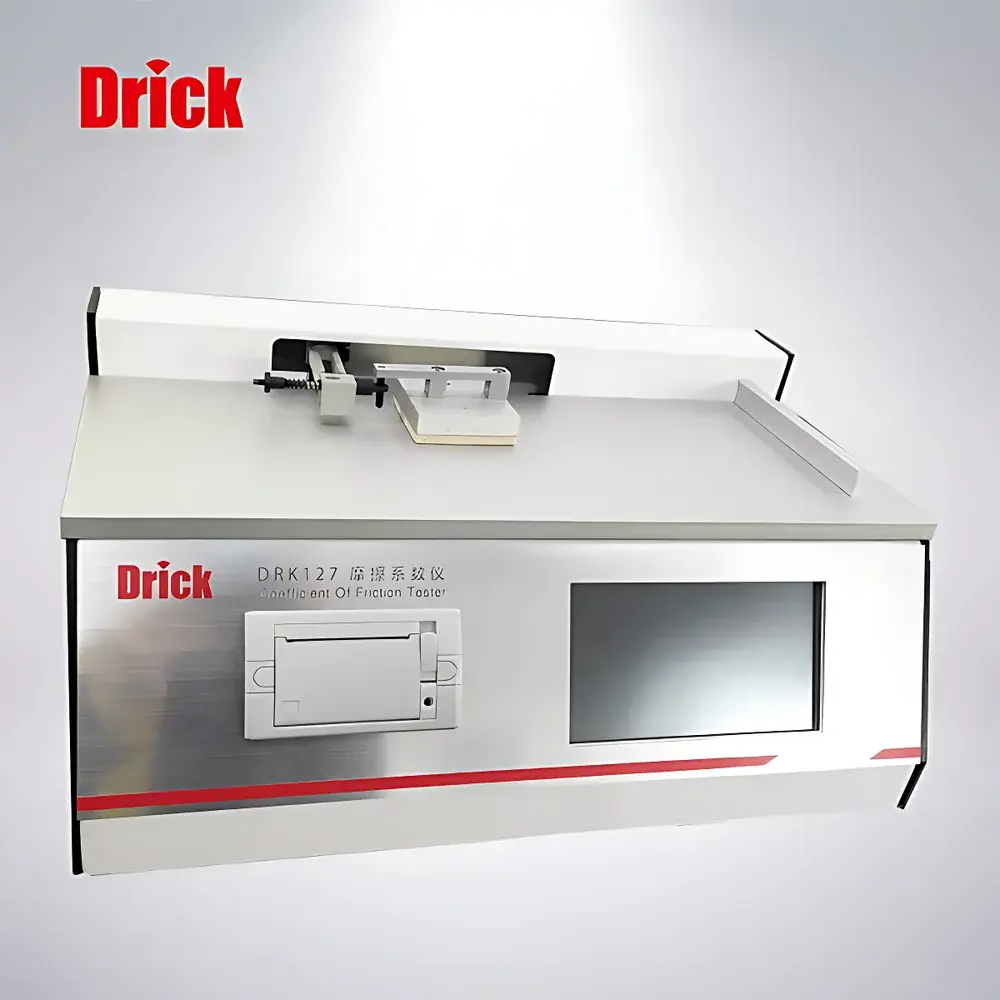
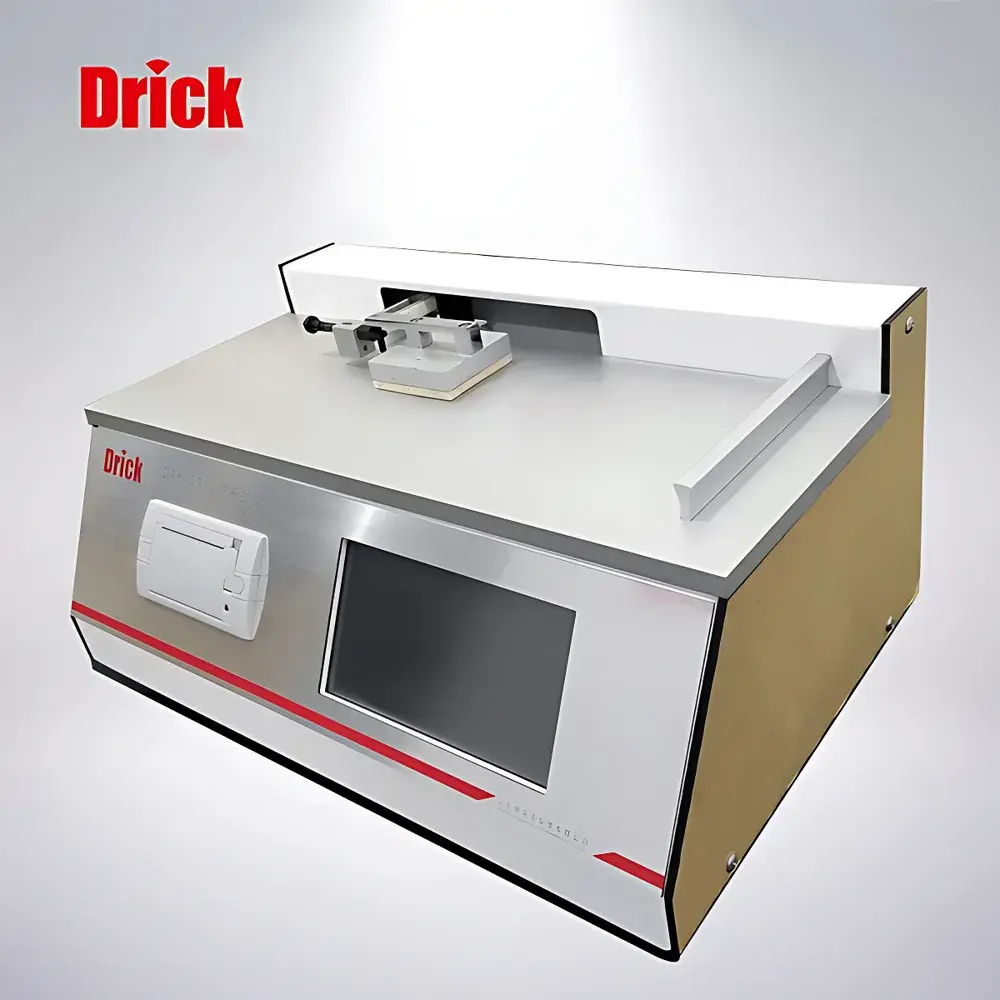
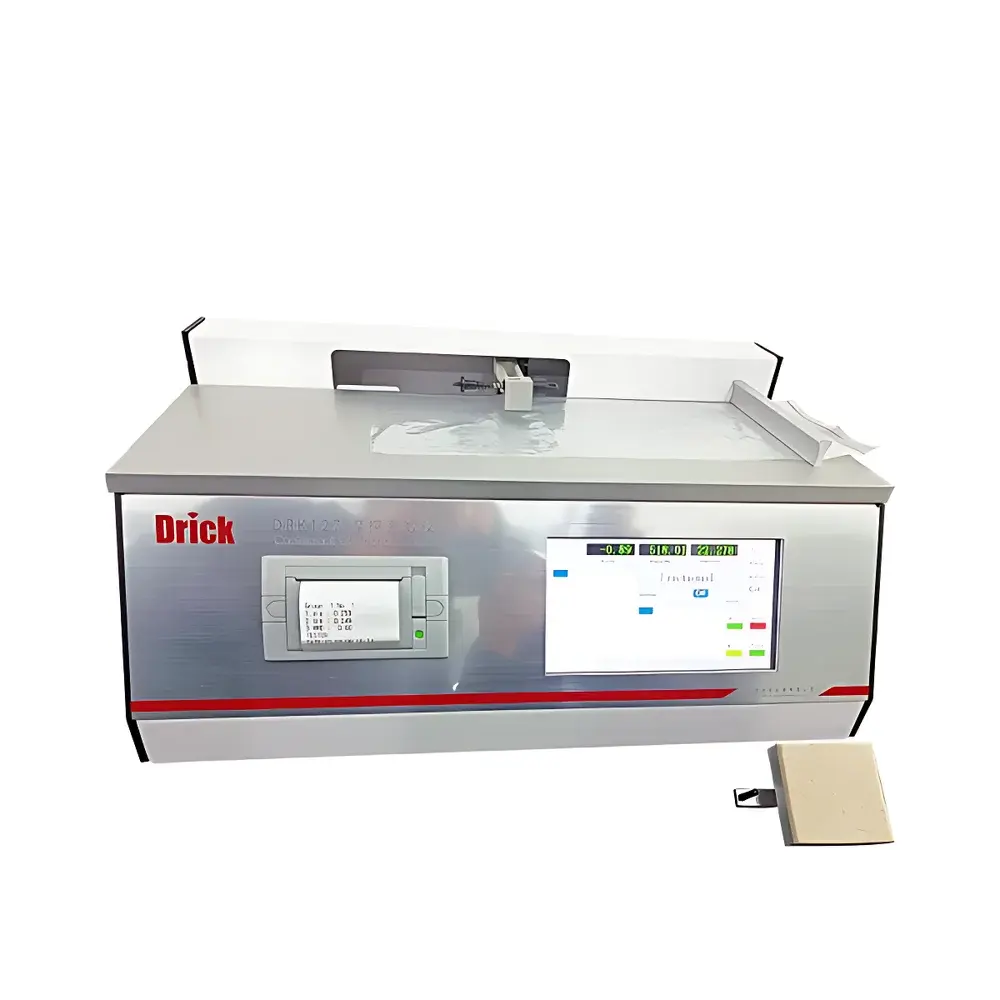
Drick DRK127 Coefficient of Friction Tester for Rubber, Paper, Paperboard, and Textiles
| Brand | Drick |
|---|---|
| Origin | Shandong, China |
| Manufacturer Type | Direct Manufacturer |
| Country of Origin | China |
| Model | DRK127 |
| Price | USD 7,000 (FOB Qingdao) |
Overview
The Drick DRK127 Coefficient of Friction (COF) Tester is a precision-engineered instrument designed to quantify static and kinetic coefficients of friction for flexible sheet materials under controlled normal load and sliding velocity conditions. It operates on the fundamental principle of horizontal pull testing—measuring the tangential force required to initiate (static COF) and maintain (kinetic COF) relative motion between two contacting surfaces in accordance with ASTM D1894, ISO 8295, GB/T 10006, and FZ/T 01054-2012. The system employs a high-stability load cell coupled with a microprocessor-controlled stepper motor drive, enabling repeatable, traceable, and GLP-compliant friction characterization across diverse material classes including elastomeric compounds, coated and uncoated papers, corrugated board substrates, nonwovens, woven fabrics, and polymer films.
Key Features
- ARM-based embedded control architecture with real-time data acquisition at 20 Hz sampling frequency
- 800 × 480 full-color TFT touchscreen interface replicating desktop-style operation—no external PC required for basic testing
- Simultaneous dual-parameter output: μs (static coefficient) and μk (kinetic coefficient) calculated per test cycle
- Adjustable normal force via calibrated sliding block masses (standard 200 g ± 0.1 g; optional weights available up to 2,000 g)
- Continuously variable test speed range: 0–500 mm/min, programmable in 1 mm/min increments
- Rapid return function with independent speed control—reducing cycle time by up to 40% compared to fixed-return systems
- On-device statistical processing: automatic calculation of mean, standard deviation, and coefficient of variation (CV%) across 10 replicate tests per batch
- High-resolution force measurement: 16-bit A/D conversion yielding 1/100,000 full-scale resolution and <0.1% linearity error
Sample Compatibility & Compliance
The DRK127 accommodates specimens up to 100 mm wide × 300 mm long, supporting standardized sample preparation per ISO 8295 Annex A and GB/T 10006 Section 5. Its modular sled design accepts interchangeable test blocks (e.g., stainless steel, rubber-coated, or custom-surface inserts) to simulate application-specific counterfaces. The instrument complies with regulatory frameworks governing packaging and textile quality assurance—including FDA-relevant material contact assessments and ISO 9001-certified manufacturing processes. All firmware and calibration routines are documented per ISO/IEC 17025 requirements, and raw test logs include timestamped metadata suitable for audit trails in GMP/GLP environments.
Software & Data Management
Data storage is managed internally on non-volatile flash memory capable of retaining 511 complete test batches (each batch comprising up to 10 individual trials). Each record includes force–time curve visualization, numerical COF values, environmental timestamps, operator ID (if enabled), and user-defined batch identifiers. Export options include CSV format via USB 2.0 port for integration into LIMS or statistical analysis platforms (e.g., JMP, Minitab). While no proprietary Windows software is bundled, the device supports manual data extraction without vendor lock-in—enabling full traceability and third-party validation per 21 CFR Part 11 when paired with institutional electronic signature protocols.
Applications
- Quality control of release liners and pressure-sensitive adhesive tapes in medical device packaging
- Evaluation of print surface slip resistance for folding cartons and labels subject to high-speed filling lines
- Development of low-friction coatings for food-grade plastic films (e.g., BOPP, PET, PE laminates)
- Textile finishing R&D—quantifying changes in fabric handle and seam slippage propensity after softening or resin treatments
- Validation of rubber compound formulations for conveyor belt linings and automotive interior trim components
- Academic research on tribological behavior of bio-based packaging substrates under variable humidity conditions
FAQ
Does the DRK127 support automated calibration verification?
Yes—the system includes built-in reference weight checks and zero-balance diagnostics accessible via service menu. Full calibration certificates traceable to NIM (China National Institute of Metrology) are provided with each unit.
Can test parameters be locked to prevent unauthorized modification?
Operator-level password protection is configurable to restrict access to critical settings such as speed limits, force thresholds, and data export functions.
Is the instrument compatible with ASTM D1894 test configurations?
Yes—by default, it implements the horizontal plane method using a 200 g sled and 150 mm/s test speed, fully aligned with ASTM D1894 Section 7.1. Alternative configurations (e.g., inclined plane mode) require mechanical adaptation not supplied with base model.
What maintenance intervals are recommended for long-term accuracy?
Annual verification of load cell linearity and slider rail lubrication is advised. No consumables beyond standard calibration weights are required under normal laboratory use conditions.
How is thermal drift compensated during extended testing sessions?
The integrated temperature-compensated strain gauge bridge and auto-zeroing algorithm at startup mitigate ambient-induced baseline drift, maintaining stability over 8-hour continuous operation cycles.





