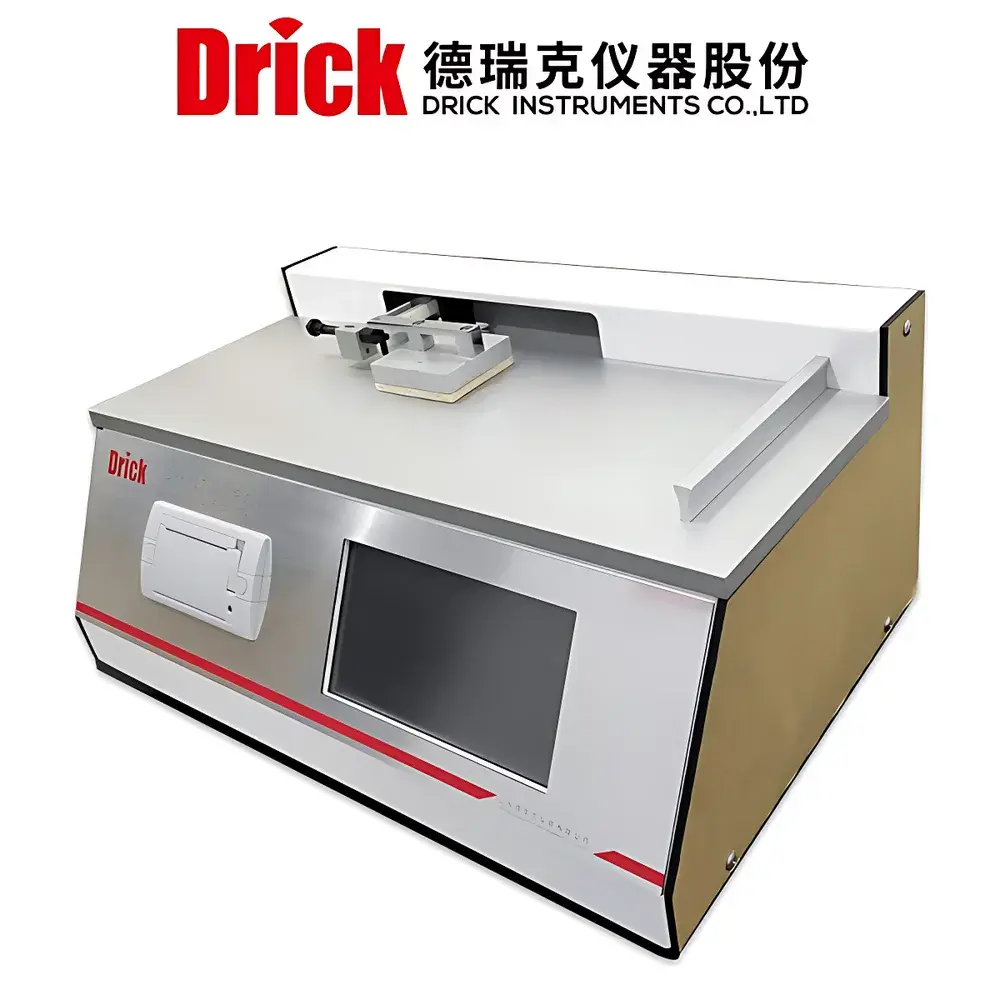
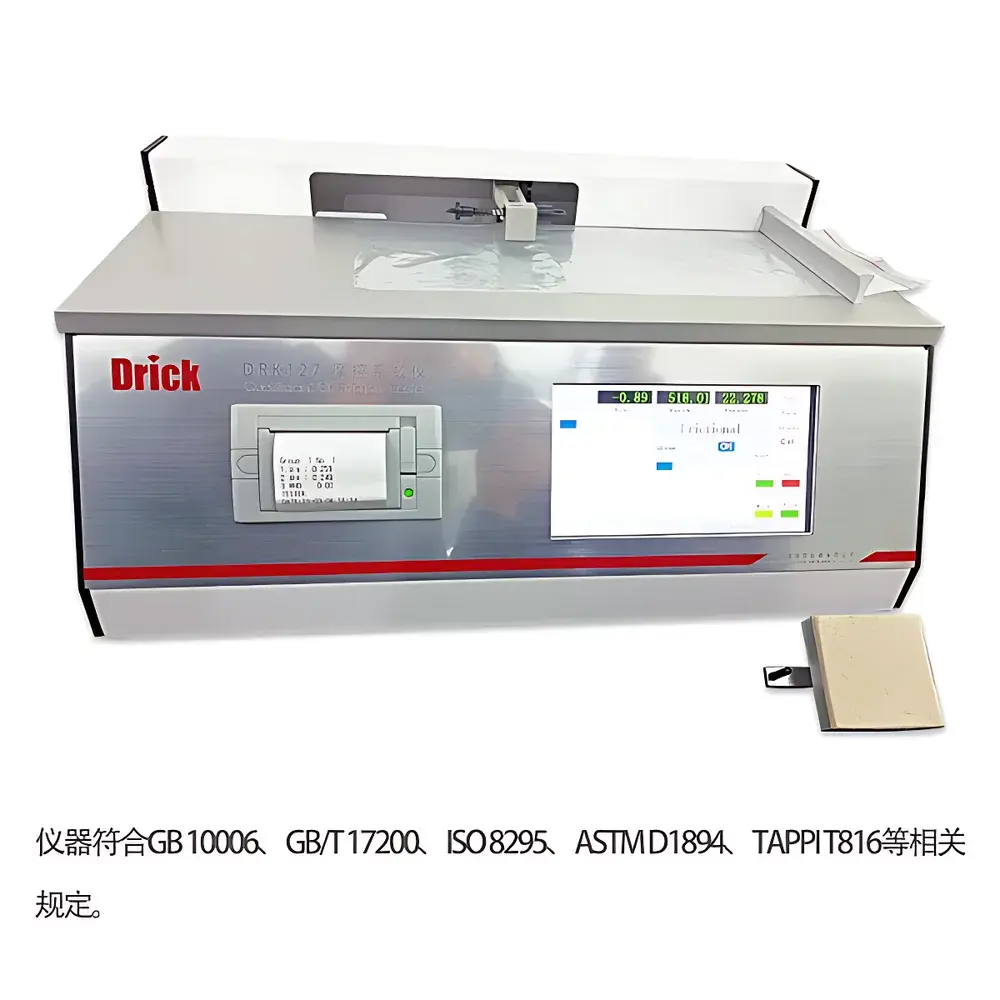
Drick DRK127 GB10006 Coefficient of Friction Tester for Plastic Films and Thin Sheets
| Brand | Drick |
|---|---|
| Origin | Shandong, China |
| Manufacturer Type | Direct Manufacturer |
| Country of Origin | China |
| Model | DRK127 |
| Load Range | 0–5 N |
| Accuracy Class | 0.5 |
| Travel Distance | 70 mm or 140 mm |
| Standard Slider Mass | 200 g |
| Test Speed | 150 mm/min |
| Operating Temperature | 15–30 °C |
| Relative Humidity | 20–80 % RH |
| Dimensions (L×W×H) | 470 × 300 × 190 mm |
| Net Weight | 20 kg |
| Compliance | GB 10006, GB/T 17200, ISO 8295, ASTM D1894, TAPPI T816 |
Overview
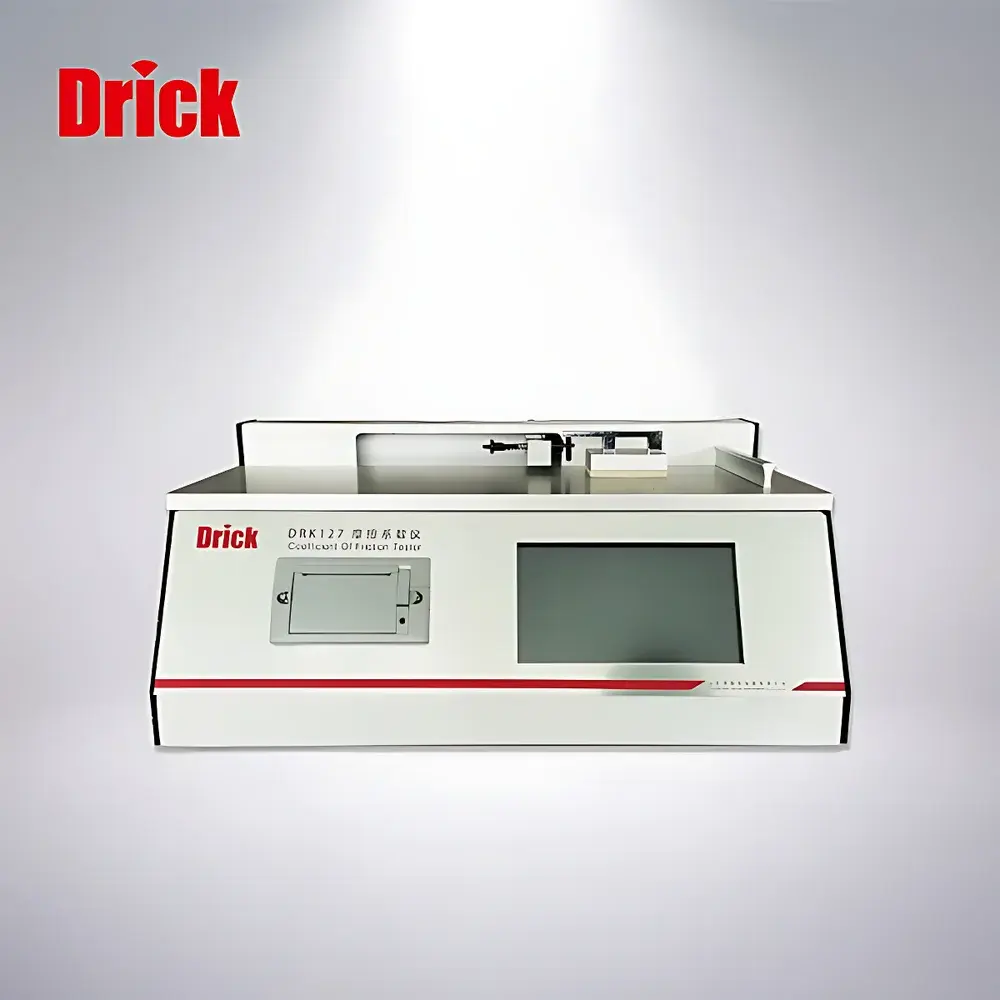
The Drick DRK127 GB10006 Coefficient of Friction Tester is a precision-engineered instrument designed for the quantitative determination of static and kinetic coefficients of friction (COF) in flexible packaging materials and thin-sheet substrates. It operates on the fundamental principle of horizontal pull testing, where a standardized slider is drawn across a stationary specimen under controlled normal load and constant velocity. The system measures tangential resistance force during both initial breakaway (static COF) and sustained sliding (kinetic COF), delivering traceable, repeatable data aligned with internationally recognized tribological test methodologies. Engineered for compliance-driven quality control laboratories in packaging, film manufacturing, and regulatory R&D environments, the DRK127 integrates mechanical stability with microprocessor-based signal acquisition to minimize thermal drift, electromagnetic interference, and operator-induced variability — critical factors affecting COF reproducibility per ISO/IEC 17025 requirements.
Key Features
- Simultaneous dual-mode measurement: automatic detection and independent reporting of both static (μs) and kinetic (μk) coefficients of friction
- Integrated timer-controlled dwell period: programmable static contact duration prior to motion initiation, ensuring consistent surface interaction per ASTM D1894 Section 7.3
- Zero-point auto-calibration: dynamic reset of force baseline immediately before each test cycle, eliminating residual offset from previous measurements
- Demagnetized test platform and slider assembly: certified residual magnetism <0.2 mT, reducing spurious magnetic adhesion effects that compromise low-force tribological accuracy
- Intuitive human-machine interface: backlit LCD display showing real-time force (N), elapsed time (s), and calculated COF values; PVC membrane keypad with tactile feedback
- Built-in thermal-stable load cell: 0–5 N range with 0.5-class accuracy (±0.5% of full scale), calibrated to national metrological standards
- Standardized 200 g slider (stainless steel, 63.5 mm × 63.5 mm contact area); optional 500 g slider available for high-friction or textured surfaces
- RS-232 serial port compliant with EIA/TIA-232-F specification for bidirectional communication with LIMS or custom data acquisition software
Sample Compatibility & Compliance
The DRK127 accommodates flat, non-porous, and dimensionally stable specimens up to 100 mm wide × 200 mm long, including biaxially oriented polypropylene (BOPP), polyester (PET), polyethylene (PE), aluminum foil laminates, coated paperboard, rubber sheets, textile composites, and polymer-coated metals. Its mechanical architecture conforms to the geometric and procedural constraints defined in GB 10006–1988 (Chinese national standard for plastic film COF), ISO 8295:1995 (Plastics — Film and sheeting — Determination of coefficient of friction), ASTM D1894–22 (Standard Test Method for Static and Kinetic Coefficients of Friction of Plastic Film and Sheeting), and TAPPI T816 om-18 (Coefficient of Friction of Paper and Paperboard). All force transduction, timing, and displacement subsystems are validated against JJG 475–2019 (Chinese verification regulation for universal material testing machines), supporting GLP-compliant documentation workflows.
Software & Data Management
While the DRK127 operates as a standalone instrument with embedded firmware, its RS-232 interface enables seamless integration into laboratory informatics ecosystems. Raw force/time datasets export in ASCII-delimited format (.csv), preserving timestamp, load channel, position encoder pulses, and user-defined metadata (batch ID, operator code, environmental log). When connected to validated PC software (e.g., Drick DataLink v3.x), the system supports audit-trail-enabled data logging compliant with FDA 21 CFR Part 11 requirements — including electronic signatures, immutable record retention, and change history tracking. Exported reports include statistical summaries (mean, SD, CV%), pass/fail status against pre-set specification limits, and graphical overlays of force vs. displacement curves.
Applications
This tester serves as a primary metrology tool for evaluating slip performance across multiple industrial domains: optimizing anti-block additive concentration in extruded films; validating surface treatment efficacy (e.g., corona, plasma, SiOx coating) on barrier webs; assessing lubricant migration in pharmaceutical blister packaging; characterizing haptic response of cosmetic tube interiors; verifying consistency of conveyor belt traction layers; and screening frictional behavior of medical device packaging seals. In R&D settings, it supports DOE-based formulation studies where COF is a critical response variable correlated with seal integrity, machinability, and end-user handling experience.
FAQ
What standards does the DRK127 explicitly support?
GB 10006, GB/T 17200, ISO 8295, ASTM D1894, and TAPPI T816.
Can the instrument measure both static and kinetic COF in a single test cycle?
Yes — the microcontroller triggers static measurement at first detectable force deviation, then transitions seamlessly to kinetic acquisition once steady-state sliding is confirmed.
Is calibration traceable to national metrology institutes?
Yes — the load cell is factory-calibrated using NIST-traceable deadweight standards; certificate of calibration includes uncertainty budget per ISO/IEC 17025 Annex A.
Does the system meet regulatory requirements for pharmaceutical packaging testing?
It satisfies mechanical and procedural prerequisites for USP , EP 3.2.9, and ICH Q5C when operated within validated environmental conditions and documented SOPs.
What maintenance is required to sustain measurement accuracy?
Monthly verification using certified reference sliders and annual recalibration by an accredited metrology lab; no consumables beyond thermal paper rolls for the integrated printer.