
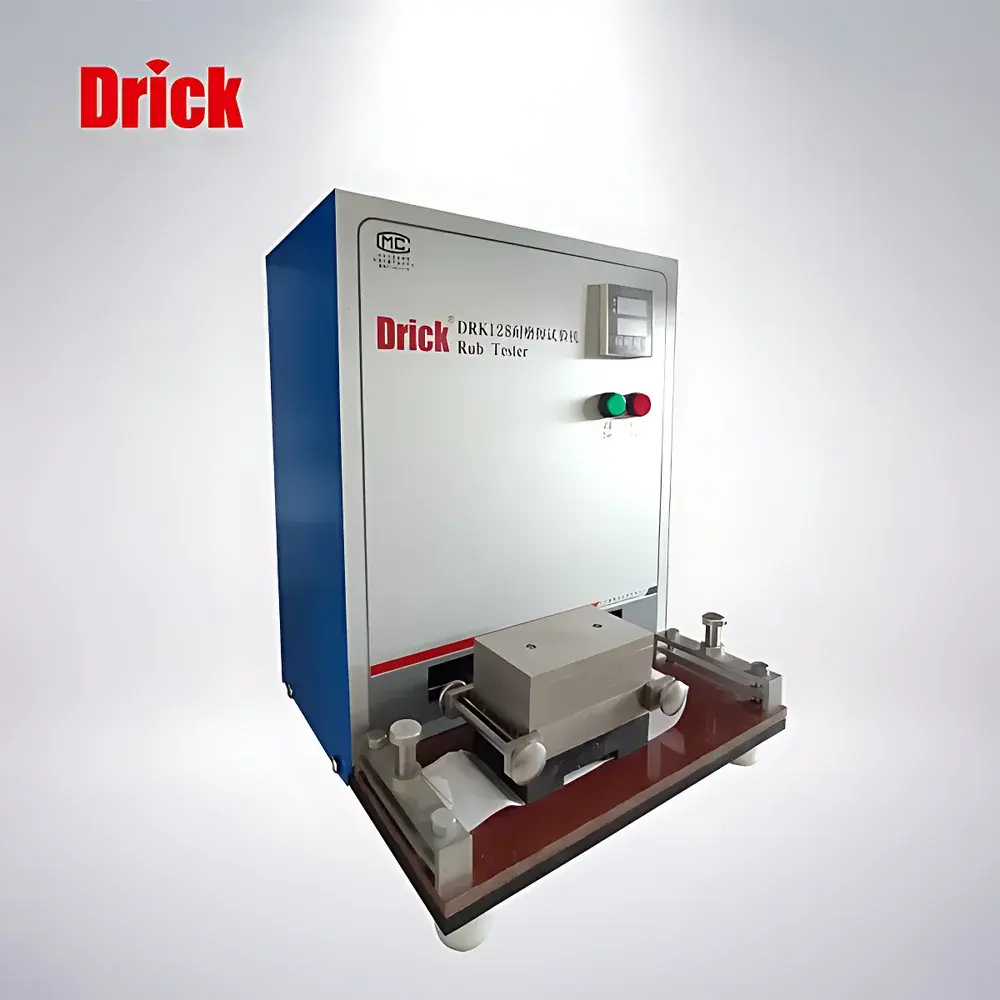
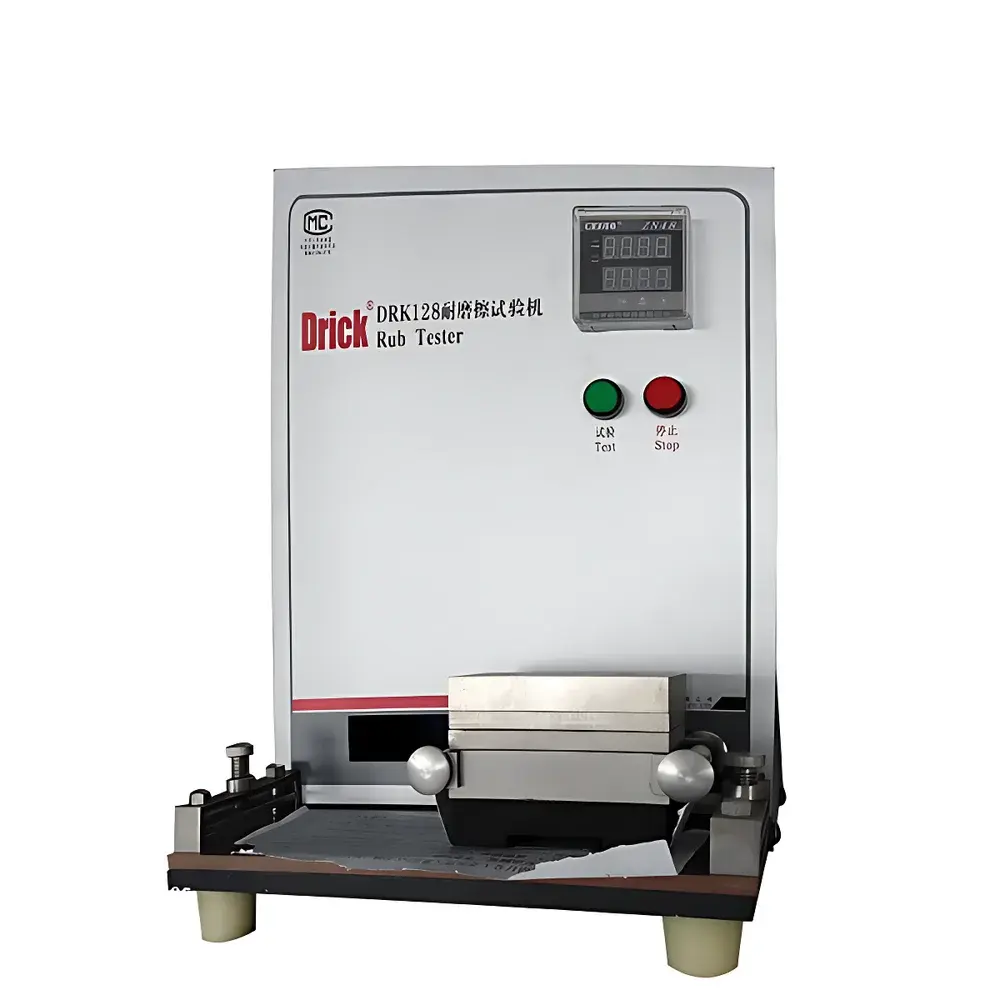

Drick DRK128 Dry Abrasion Tester for Printing and Packaging Applications
| Brand | Drick |
|---|---|
| Model | DRK128 |
| Origin | Shandong, China |
| Manufacturer | Yes |
| Country of Origin | China |
| Compliance | GB/T 7706, ASTM D5264, JIS K5701, TAPPI T476 |
| Applied Load | 20 ± 0.2 N |
| Oscillation Frequency | 43 cycles per minute (cpm) |
| Abrasion Area | 155 mm (L) × 50 mm (B) |
| Adjustable Cycles | 1–9999 |
| Specimen Size | 230 mm (L) × 50 mm (B) |
| Power Supply | AC 220 V, 50 Hz |
| Dimensions (W×D×H) | 260 × 245 × 340 mm |
| Net Weight | 17 kg |
Overview
The Drick DRK128 Dry Abrasion Tester is a precision-engineered instrument designed specifically for evaluating the surface durability of printed materials, photopolymer printing plates (PS plates), and coated packaging substrates under controlled mechanical stress. It operates on the principle of reciprocating linear abrasion—applying a defined normal load via a standardized weighted arm onto a specimen mounted on a horizontally oscillating friction table. The test simulates real-world handling, stacking, transport, and post-printing processing conditions where surface coatings, ink layers, or photosensitive emulsions are subjected to repeated dry rubbing contact. Unlike rotary or rotary-drum abrasion methods, the DRK128 employs a fixed-stroke, constant-pressure linear motion system aligned with ISO/IEC 17025 traceable calibration practices. Its design conforms strictly to GB/T 7706 (Chinese national standard for gravure printing ink abrasion resistance), ASTM D5264 (Standard Practice for Determining the Abrasion Resistance of Printed Materials), JIS K5701 (Japanese Industrial Standard for printing plate durability), and TAPPI T476 (Test Method for Rub Resistance of Printed Surfaces). This ensures methodological consistency across global quality control laboratories operating under GLP, GMP, or ISO 9001-certified environments.
Key Features
- Calibrated static load application of 20 ± 0.2 N—achieved through precision-machined counterweighted arm assembly with integrated load verification port for periodic metrological validation.
- Stable oscillation frequency of 43 cpm maintained by brushless DC motor and microprocessor-controlled timing circuitry, minimizing speed drift over extended test durations.
- Embedded friction table with hardened stainless-steel surface and precisely defined 155 mm × 50 mm active abrading zone, ensuring uniform pressure distribution and eliminating edge-effect artifacts.
- Zero-noise operation enabled by low-backlash gear train and vibration-damped base structure—critical for use in shared laboratory spaces or acoustic-sensitive QA environments.
- Non-volatile cycle memory retains programmed test parameters and accumulated count during unexpected power interruption, preserving data integrity without manual re-entry.
- Front-panel digital interface with LED display supports direct entry of target cycles (1–9999), real-time count monitoring, and immediate start/pause/resume functionality.
Sample Compatibility & Compliance
The DRK128 accommodates standard specimen dimensions of 230 mm × 50 mm, compatible with common press sheets, PS plate strips, laminated film samples, and corrugated board facestock coupons. It supports both dry-abrasion mode (standard configuration) and optional wet-abrasion testing when used with auxiliary fluid dispensing accessories (sold separately). All mechanical and electrical components comply with IEC 61010-1 safety requirements for laboratory equipment. Test reports generated using this instrument satisfy audit requirements under FDA 21 CFR Part 11 when paired with validated electronic record systems, and support traceability per ISO/IEC 17025 Clause 7.7 (uncertainty of measurement) when calibrated against NIST-traceable force and displacement standards.
Software & Data Management
While the DRK128 operates as a standalone benchtop instrument with embedded firmware, its digital output interface (RS-232 or optional USB-to-serial adapter) enables integration with third-party LIMS or QC data platforms. Cycle count, elapsed time, and pass/fail status can be logged externally for statistical process control (SPC) charting—particularly valuable for Six Sigma initiatives tracking coating adhesion stability across production batches. Firmware updates are available via secure download from Drick’s authorized technical portal, ensuring continued alignment with evolving ASTM and ISO revision cycles.
Applications
- Quantitative assessment of gravure and flexographic ink layer cohesion on paper, film, and foil substrates.
- Evaluation of PS plate photosensitive layer wear resistance under simulated press run conditions—directly correlating to predicted plate lifespan (i.e., “plate endurance” in commercial printing).
- Verification of UV-curable coating hardness and crosslink density prior to die-cutting or lamination.
- Comparative analysis of anti-scratch topcoats on pharmaceutical blister packaging and food-grade cartons.
- Root-cause investigation of print marring, scuff-induced color shift (ΔE > 2.0), and fiber lifting in recycled board grades.
FAQ
What standards does the DRK128 directly reference in its mechanical design?
GB/T 7706, ASTM D5264, JIS K5701, and TAPPI T476 define its stroke length, applied load tolerance, oscillation frequency, and specimen mounting geometry.
Can the DRK128 perform wet abrasion testing out of the box?
No—it is configured for dry abrasion by default; wet testing requires an optional liquid reservoir kit and modified abrasive medium (e.g., cotton swab saturated with ethanol or IPA).
Is calibration documentation provided with shipment?
Yes—a factory calibration certificate verifying load accuracy (±0.2 N) and cycle timing (±0.5 cpm) is included, along with traceability to CNAS-accredited reference standards.
How often should routine verification be performed?
Daily pre-test verification using certified load cell and stopwatch is recommended; full recalibration every 12 months or after 10,000 operational cycles.
Does the instrument support automated pass/fail logic based on user-defined thresholds?
Not natively—the DRK128 outputs raw cycle counts only; threshold-based decision logic must be implemented externally via connected software or PLC interface.




