
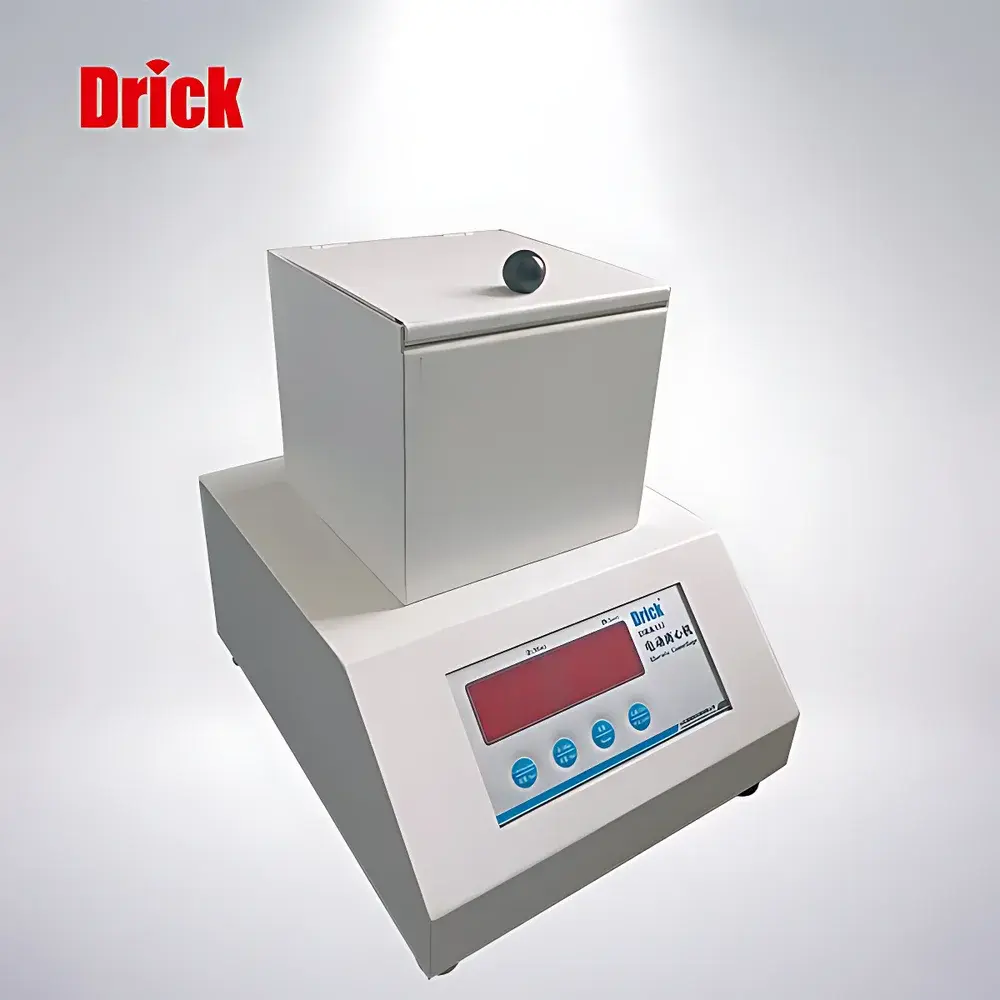
Drick DRK132 Benchtop Centrifuge (Dual-Speed: 1400 rpm / 2800 rpm, Customizable)
| Brand | Drick |
|---|---|
| Origin | Shandong, China |
| Manufacturer Type | OEM/ODM Manufacturer |
| Product Category | Domestic |
| Model | DRK132 |
| Instrument Type | Benchtop Centrifuge |
| Speed Configuration | Dual Fixed-Speed (1400 rpm and 2800 rpm, customizable upon order) |
| Rotor Type | Horizontal Swing-Out Rotor |
| Application Class | General-Purpose Laboratory Centrifuge |
| Dimensions | Ø300 mm × 340 mm (H) |
| Power Supply | AC 220 V, 50 Hz |
| Drum Specifications | Ø145 mm × 90 mm (H) |
Overview
The Drick DRK132 Benchtop Centrifuge is a purpose-engineered, dual-speed horizontal centrifuge designed for rapid dewatering and solid–liquid separation of fibrous suspensions—particularly pulp slurries—in laboratory environments. Operating on the principle of sedimentation under centrifugal force, the DRK132 generates consistent radial acceleration to accelerate phase separation without mechanical shearing or thermal degradation. Unlike high-speed or ultracentrifuges used for subcellular fractionation, this unit is optimized for robust, repeatable processing of coarse-to-medium particulate suspensions in quality control and process development workflows. Its fixed dual-speed architecture (1400 rpm and 2800 rpm) ensures operational simplicity and reproducibility across standardized test protocols—especially where regulatory traceability and method consistency are prioritized over variable speed ramping.
Key Features
- Horizontal swing-out rotor configuration with precision-machined aluminum drum (Ø145 mm × 90 mm H), enabling uniform sample distribution and minimal vibration at operational speeds.
- Dual-speed operation (1400 rpm and 2800 rpm) with factory-set, non-adjustable speed selection—eliminates user error and supports SOP-driven workflows compliant with GLP and internal QA documentation requirements.
- Compact benchtop footprint (Ø300 mm × 340 mm H) suitable for space-constrained laboratories including QC labs in paper mills, food testing facilities, and academic research spaces.
- Electromechanical braking system with controlled deceleration—ensures rapid yet safe stoppage without rotor coast-down delay, minimizing turnaround time between sequential samples.
- IP20-rated enclosure with reinforced polycarbonate lid interlock; meets IEC 61010-1 safety standards for laboratory electrical equipment.
- Low-noise motor drive (<65 dB(A) at 1 m distance) and vibration-damped base design support continuous operation in shared lab environments.
Sample Compatibility & Compliance
The DRK132 is validated for use with aqueous pulp suspensions, textile fiber dispersions, food slurry matrices (e.g., fruit puree, starch wash water), and environmental sediment samples. It accommodates standard 50–100 mL sample volumes per drum and is routinely deployed in accordance with TAPPI T227 (Consistency of Pulp Slurries), ISO 535 (Water Absorption of Paper and Board), and GB/T 24325–2009 (Testing Methods for Pulp Consistency). While not certified to ISO 13485 or FDA 21 CFR Part 11, its mechanical design and documentation package—including calibration certificate, conformity declaration, and traceable manufacturing records—support integration into GMP-aligned environments where centrifugation is a supporting step rather than a critical process parameter.
Software & Data Management
The DRK132 operates as a standalone electromechanical instrument with no embedded microprocessor or digital interface. All operational parameters are hardwired and non-programmable—enhancing long-term reliability and reducing firmware-related validation burden in regulated settings. Time-of-operation is tracked manually via external stopwatch or integrated lab timer systems. For audit readiness, users are advised to log run parameters (speed selected, duration, sample ID, operator name) in paper-based or LIMS-linked electronic notebooks. The absence of onboard memory or network connectivity eliminates cybersecurity risks and simplifies 21 CFR Part 11 compliance when paired with qualified electronic record systems.
Applications
- Paper & pulp laboratories: Standardized dewatering of beaten pulp for Canadian Standard Freeness (CSF) or Schopper–Riegler (SR) consistency measurement; preparation of representative samples prior to sheet formation or ash content analysis.
- Food science labs: Clarification of juice extracts, separation of insoluble solids from dairy wash water, and concentration of plant-based protein suspensions.
- Environmental testing: Rapid settling of suspended solids from wastewater influent/effluent samples for gravimetric TSS determination (EPA Method 160.2).
- Academic teaching: Demonstrating sedimentation kinetics, Stoke’s law validation, and centrifugal force–velocity relationships in undergraduate physical chemistry and materials science curricula.
- Agricultural research: Processing soil suspension samples for particle size distribution analysis via hydrometer or laser diffraction after centrifugal pre-concentration.
FAQ
Is the DRK132 compatible with ISO or ASTM standard test methods?
Yes—it is widely referenced in TAPPI and GB/T pulp testing standards and functionally aligns with ASTM D6303 (Standard Practice for Determining Pulp Consistency) when used with calibrated drum geometry and verified rotational speed.
Can the drum be autoclaved or sterilized?
No—the aluminum drum and polymer seals are not rated for autoclave cycles; chemical disinfection using 70% ethanol or isopropanol is recommended between runs.
What maintenance is required for long-term reliability?
Biannual inspection of rotor balance, bearing lubrication status, and lid interlock integrity is advised; no scheduled motor servicing is required within the first 5 years under normal usage (≤4 hrs/day, 5 days/week).
Does Drick provide calibration services or certificates?
Yes—each unit ships with a factory-issued speed verification certificate (traceable to national metrology institute standards) and optional annual recalibration service through authorized regional partners.
Is custom speed configuration available beyond 1400/2800 rpm?
Yes—OEM customization includes discrete speed options between 1000–4000 rpm (±10 rpm tolerance), subject to mechanical validation and extended lead time.



