
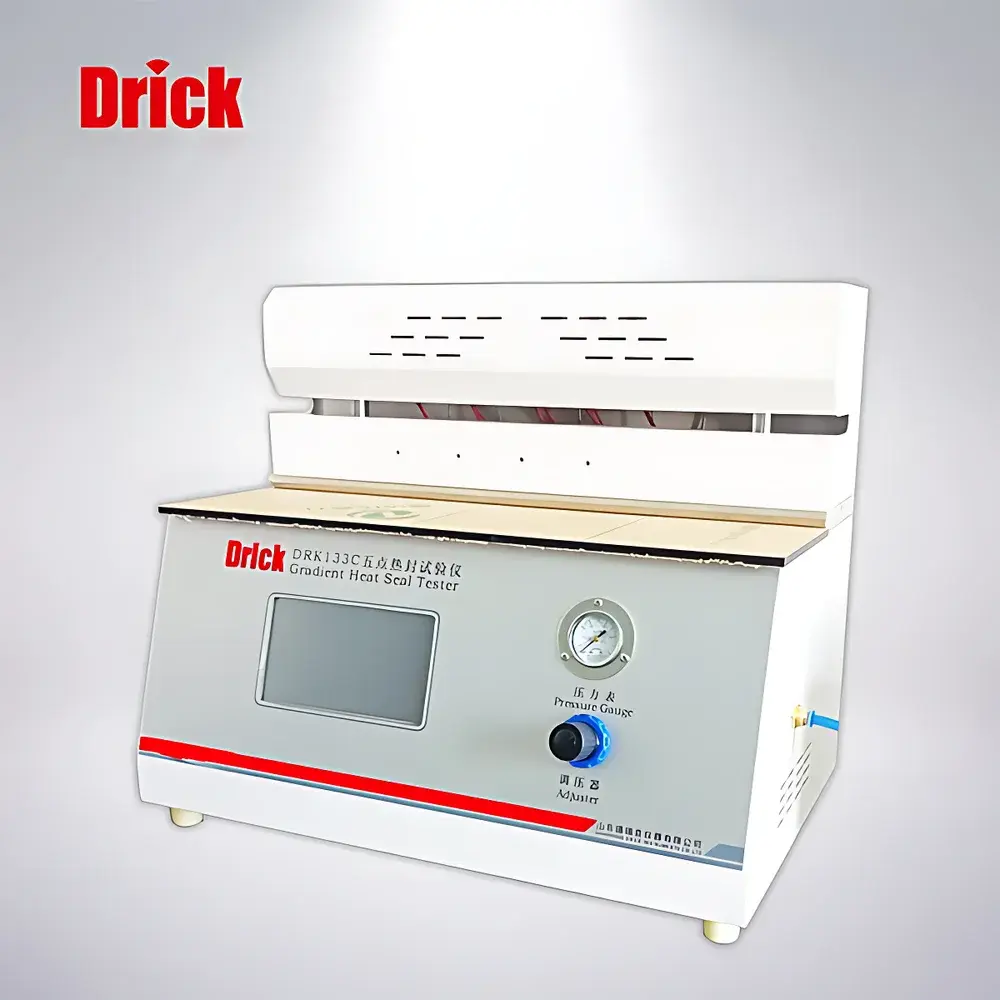
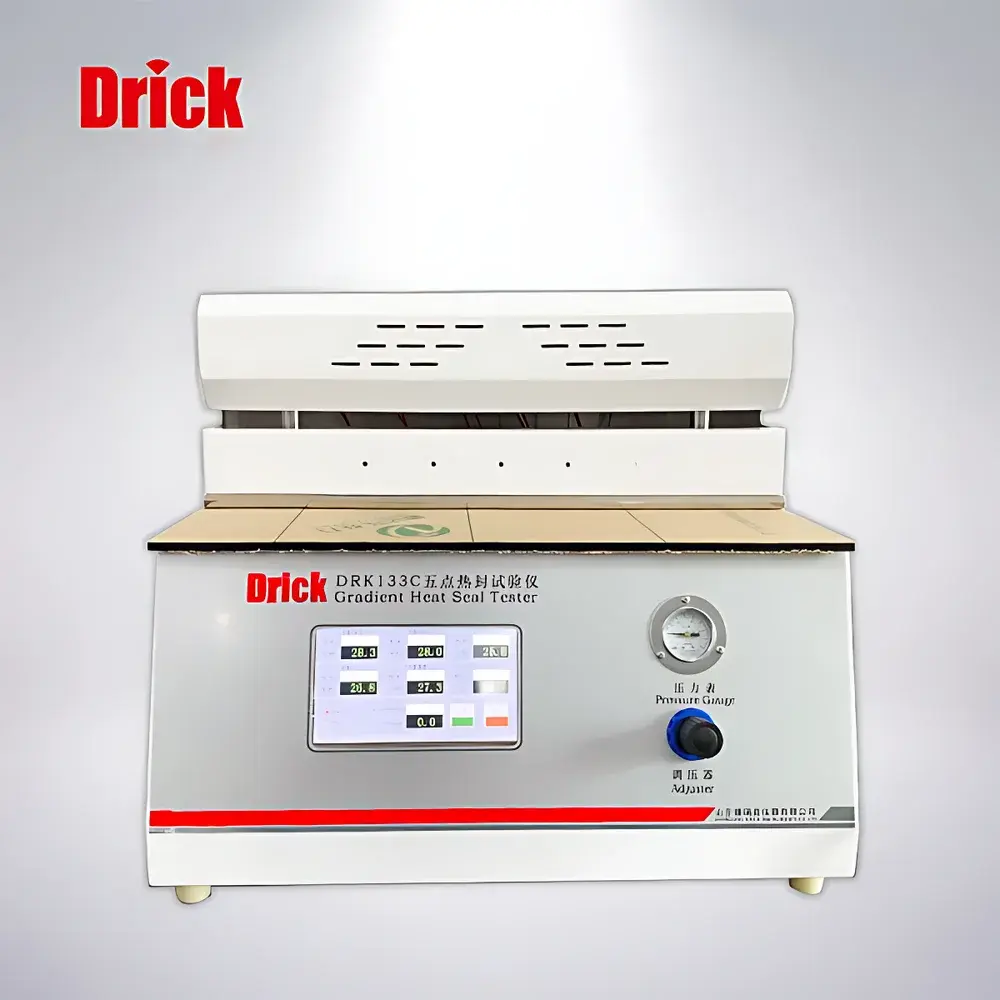
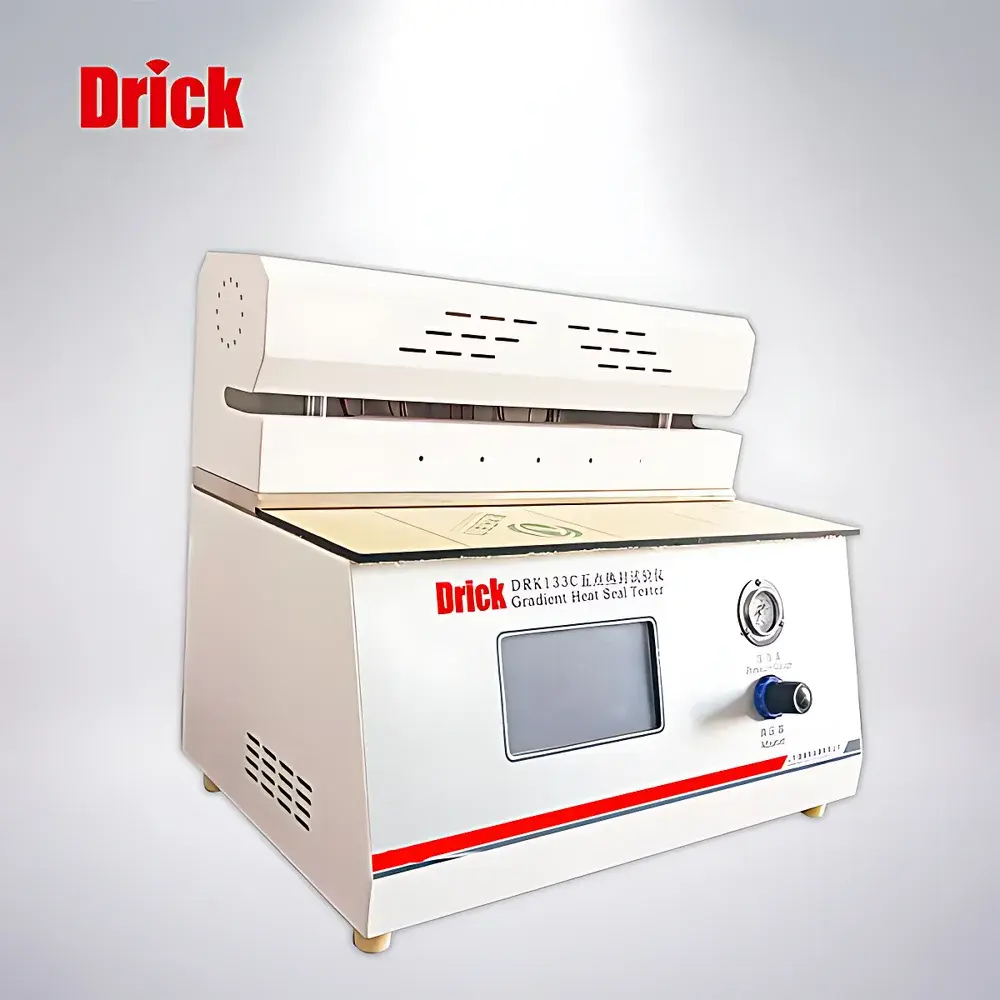
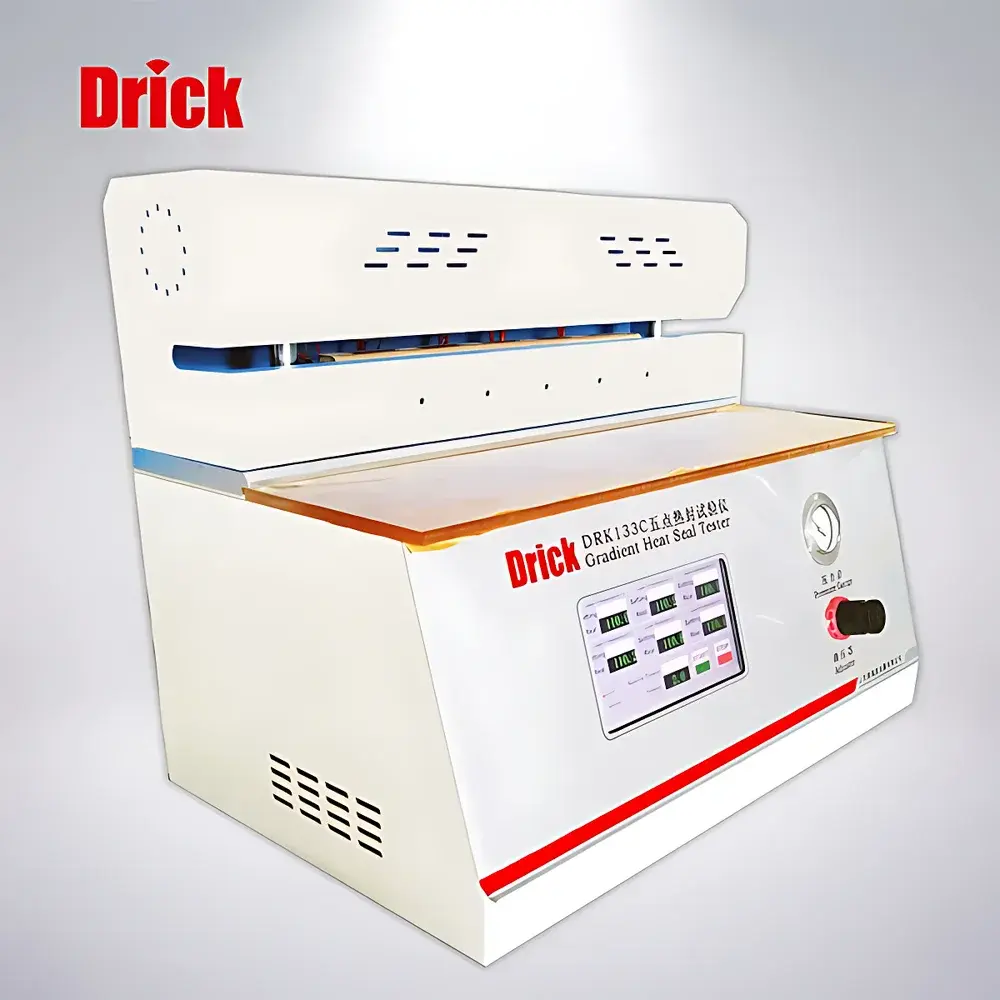
Drick DRK133 Five-Point Heat Seal Tester for Aluminum Foil and Plastic Composite Films
| Brand | Drick |
|---|---|
| Origin | Shandong, China |
| Manufacturer Type | Direct Manufacturer |
| Region of Origin | Domestic (China) |
| Model | DRK 133 |
| Price | USD 5,700 (FOB Qingdao) |
| Heat Seal Temperature Range | Ambient to 300 °C |
| Temperature Control Accuracy | ±0.5 °C |
| Seal Time Range | 0.1–999.9 s |
| Seal Pressure Range | 0.05–0.7 MPa |
| Seal Area | 40 mm × 10 mm (five-point configuration, customizable) |
| Heating Method | Dual-zone independent resistive heating with aluminum-filled uniform-heating tubes |
| Pneumatic Supply Requirement | 0.5–0.7 MPa (user-supplied air source) |
| Air Inlet Fitting | Ø8 mm polyurethane tubing |
| Dimensions (L×W×H) | 550 mm × 340 mm × 470 mm |
| Power Supply | AC 220 V, 50 Hz |
| Interface | RS232 serial port |
| Safety Features | Anti-scald thermal shielding, dual-mode activation (manual button + foot switch), synchronized pneumatic cylinder actuation |
Overview
The Drick DRK133 Five-Point Heat Seal Tester is a precision-engineered laboratory instrument designed for empirical determination and optimization of heat seal parameters in flexible packaging materials. It operates on the principle of controlled thermal compression—applying defined temperature, dwell time, and pressure to induce interfacial polymer chain diffusion and entanglement at the sealing interface. This thermomechanical process is governed by material-specific properties including melting point, melt viscosity, thermal stability, and thickness distribution. The DRK133 enables systematic evaluation of seal integrity across five discrete points under identical process conditions, facilitating statistical assessment of seal uniformity—a critical requirement for validating packaging line performance and ensuring compliance with sterile barrier or moisture-vapor transmission specifications.
Key Features
- Five-point parallel heat sealing configuration with independently controllable upper and lower sealing jaws—enabling simultaneous multi-location testing for repeatability analysis.
- Dual-zone digital PID temperature control system with ±0.5 °C accuracy across the full 25–300 °C operating range; aluminum-encapsulated heating elements ensure rapid thermal equilibration and spatial uniformity.
- Pneumatically actuated sealing mechanism featuring a bottom-mounted synchronized cylinder circuit, delivering consistent force application without mechanical hysteresis or drift.
- Intuitive 7-inch capacitive touchscreen HMI with menu-driven navigation, programmable test profiles, and real-time parameter monitoring.
- Configurable sealing geometry: standard 40 mm × 10 mm smooth-face sealing bar; optional custom jaw designs—including circular, annular, or stepped profiles—for specialized applications such as lidding (e.g., jelly cup seals) or tubular end-sealing.
- Integrated safety architecture: thermal insulation shrouds, automatic jaw retraction upon cycle completion, dual-initiation logic (manual push-button + foot pedal), and fail-safe pressure cutoff.
- RS232 serial interface for external data logging, instrument calibration traceability, and integration into lab information management systems (LIMS).
Sample Compatibility & Compliance
The DRK133 accommodates a broad spectrum of thermoplastic-based packaging substrates, including monolayer polyethylene (LDPE, LLDPE, HDPE), polypropylene (CPP, BOPP), polyester (PET), metallized films (VMPET, VMCPP), aluminum foil laminates, paper-plastic composites, coextruded structures, and peelable medical pouch films. Its standardized sealing protocol aligns with internationally recognized test methods: QB/T 2358–1998 (Chinese national standard for plastic film heat seal strength), ASTM F2029–22 (Standard Test Method for Measuring Heat Seal Strength of Thermoplastic Flexible Barrier Materials), and YBB 00122003–2015 (Chinese pharmaceutical packaging standard for heat-sealed blister and pouch integrity). When operated within documented calibration intervals and validated procedural controls, data generated on the DRK133 supports GLP-compliant documentation and satisfies pre-market validation requirements under ISO 11607-2 and FDA 21 CFR Part 11 for electronic records.
Software & Data Management
The embedded firmware supports up to 100 user-defined test protocols, each storing target temperature, pressure setpoint, dwell duration, cooling delay, and seal mode (single-cycle or repetitive). All executed tests are timestamped and logged locally with parameter snapshots. Through the RS232 interface, raw data—including actual measured temperature curves, pressure transducer feedback, and cycle timing—can be exported in CSV format for post-processing in statistical analysis packages (e.g., JMP, Minitab) or integrated into enterprise quality management systems (QMS). Audit trail functionality records operator ID, parameter changes, and calibration events—meeting traceability mandates for regulated environments.
Applications
Primary use cases include heat seal optimization for form-fill-seal (FFS) lines, validation of seal initiation temperature (SIT) and hot tack performance, comparative evaluation of alternative sealant layers (e.g., EVA vs. ionomer), and failure mode analysis of delamination or channeling defects. Extended configurations support functional testing of consumer-facing closures: jelly cup lidding via custom-diameter recessed lower jaw; end-sealing of squeeze tubes using narrow-profile sealing bars; and evaluation of peel strength anisotropy in asymmetric laminates. The five-point design also permits correlation of seal strength with local film thickness variation measured via non-contact laser micrometry.
FAQ
What standards does the DRK133 comply with?
It conforms to QB/T 2358, ASTM F2029, and YBB 00122003 for heat seal strength measurement.
Is compressed air supply included?
No—the instrument requires an external clean, dry air source delivering 0.5–0.7 MPa through an Ø8 mm polyurethane tube.
Can the sealing width be modified beyond the standard 40 mm?
Yes—custom sealing jaws (e.g., 20 mm, 60 mm, or patterned surfaces) are available upon request with engineering review.
Does the system support automated pass/fail判定 based on seal strength thresholds?
Not natively—the DRK133 outputs process parameters and seal geometry data; tensile strength must be measured separately using a dedicated seal strength tester (e.g., ASTM F88-compliant instrument).
What maintenance is required for long-term accuracy?
Annual verification of temperature sensors and pressure transducers against NIST-traceable references is recommended; cleaning of sealing surfaces with isopropyl alcohol after each use prevents residue buildup.





